Relative energy deficiency in sport
Also called REDs, RED-S
Harm to health and performance linked to too little energy from food for the training an athlete does. How consensus statements define it, who studies found it in, what trials found, and the debate over the model.
- Region
- Across the body
- Updated
- October 15, 2026
- Reviewed
- October 15, 2026 · how entries are checked
What it is
Where the term came from
A 2014 IOC consensus statement introduced the term Relative Energy Deficiency in Sport, shortened to RED-S7. It was meant to replace the term “Female Athlete Triad”, and the panel said the broader name reflects that male athletes are affected too7. The statement argued the condition is not a triad of three parts but a syndrome touching many aspects of body function, health and performance7. It listed impaired bone health, immunity, menstrual function, metabolic rate, protein building and heart health7.
The 2014 statement traced the cause to too little food energy for what health, daily living, growth and sport need7.
How the 2023 statement defines it
A 2023 IOC consensus statement describes REDs as harmful health and performance outcomes in athletes of both sexes who are exposed to low energy availability1. Its full definition names “problematic” exposure, prolonged or severe, as the cause1. The outcomes it lists include lower energy metabolism, reproductive function, musculoskeletal health, immunity and glycogen (stored carbohydrate) building1. It adds heart and blood health, and says these can lead to poorer well-being, more injury risk and lower performance1.
The 2023 statement defines energy availability as energy eaten minus energy spent in exercise, divided by fat-free mass (body weight that isn’t fat)1. It is given in kilocalories per kilogram of fat-free mass per day1. A 2007 American College of Sports Medicine position stand used the same core idea of intake minus exercise expenditure8.
The 2023 statement describes a continuum, starting from “adaptable” exposure with mild effects that reverse quickly1. At the other end is “problematic” exposure, with greater and possibly lasting disruption of body systems1.
The triad models beside it
The 2007 position stand defined the Female Athlete Triad through three linked factors8. These are bone mineral density (how much mineral is packed into bone), menstrual function and energy availability8. It named low energy availability as the factor that appears to harm reproductive and bone health8.
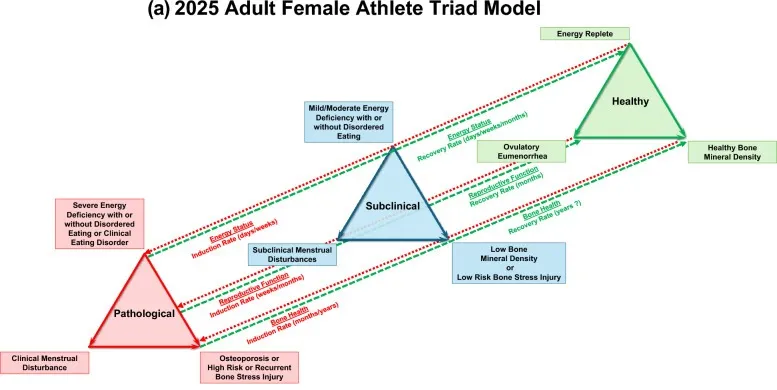
The Female Athlete Triad Coalition’s 2025 update now uses “energy deficiency” in place of “low energy availability”5. Low energy availability becomes one of several signs, beside low body weight, weight loss and low body mass index, among others5. The update’s reason is that energy availability is hard to estimate reliably and can swing widely from day to day5. Its model shows energy and menstrual outcomes recovering at different rates, and notes a lack of data on whether bone health recovers fully5.
A 2021 Coalition statement defines a Male Athlete Triad of three linked conditions9:
- energy deficiency or low energy availability, which may or may not come with disordered eating9;
- functional hypothalamic hypogonadism (low reproductive hormones)9;
- osteoporosis (thin, weak bones) or low bone density, with or without bone stress injury9.
Is there a threshold?
The 2007 position stand said most effects appear below 30 kilocalories per kilogram of fat-free mass per day8. The 2023 IOC statement says this figure came from short-term laboratory studies of a small group of sedentary women1. It adds that later work found large differences between individuals, the sexes and body systems1. The 2025 Coalition update cites studies of untrained women on a 3-month exercise programme with reduced food intake5. These do not support a fixed threshold for preventing period problems, and the level that disturbed periods varied between people5.
Who it affects
How common it is
Reported figures vary widely with the group and the method1,10:
| What was counted | In whom | Reported figure |
|---|---|---|
| Low energy availability or REDs signs | Female athletes across sports (IOC 2023) | 23% to 79.5%1 |
| Low energy availability or REDs signs | Male athletes across sports (IOC 2023) | 15% to 70%1 |
| Classed as low energy availability | 6118 athletes in 46 studies (2025 meta-analysis) | 44.7%: 44.2% of women, 49.4% of men2 |
| Classed as at risk of REDs | 730 athletes in 8 studies (same meta-analysis) | 63.0%2 |
| REDs or low energy availability, six methods | 265 elite adult team ball sport athletes (2026 review) | 0% to 80%10 |
The IOC statement links the spread partly to the lack of one definitive way to identify REDs, and to inconsistent research methods1. The 2025 Coalition update says a new study of how common the triad’s parts are is critically needed5.
Which sports and ages
The 2025 meta-analysis introduces REDs as affecting many athletes, particularly in endurance, aesthetic and weight-class sports2. The 2007 position stand singled out restrictive eating by girls and women in sports that stress leanness8. The 2025 Coalition update grades a statement on adolescent athletes in aesthetic, weight-class, endurance, lean-body or non-weight-bearing sports as Level A5. They face more risk of late first periods, absent periods and low bone density5.
Male and para athletes
The 2021 Coalition statement says the Male Athlete Triad is seen most often in teenage and young adult men in endurance and weight-class sports9. The 2023 IOC statement reports that 20% of original studies from 2018 to 2022 included male athletes1. The level at which males show symptoms is less understood, it says, but appears lower than in females1. It gives about 9 to 25 kilocalories per kilogram of fat-free mass per day1. The 2021 Coalition statement agrees in direction: data suggest men need a more severe deficiency to affect reproductive and bone health9.
The 2023 IOC statement says how common REDs is in para athletes is unknown1. It notes concern that their risk of problematic low energy availability may be higher still than in other athletes1.
What studies found
Bone health and bone stress injuries
A 2022 review, cited on the stress fracture page, names low energy availability as a major risk for bone stress injuries in women and men11. Two studies of distance athletes and runners report these links12,13:
- Elite distance athletes. In a cross-sectional study (a group looked at once), bone injuries were about 4.5 times as common in two groups as in the others12. These were 13 women with absent periods and 10 men with low testosterone12.
- Male college runners. Of 156 runners, 27% had a bone stress injury over an average of 1.9 years13. Each one-point rise in a risk score that included low energy availability was linked with 37% higher risk13.
The 2025 Coalition update grades as Level A that athletes with functional hypothalamic oligo-amenorrhoea (infrequent or absent periods) have lower bone density5. They also show poorer bone shape, structure and estimated strength than athletes with regular periods and non-athletes, mainly at non-weight-bearing sites5.
The update’s Level A statement: energy deficiency and low nutrient intake can cause low density and low peak bone mass in adolescent female athletes5. At Level C, it says low bone density in these athletes may not reverse in the short term5. Some may catch up once weight and periods have returned for long enough, it adds5.
Performance and training
The 2025 meta-analysis reported that athletes with low energy availability had lower endurance and running performance than athletes with normal energy availability2. They also had poorer training response, coordination, concentration, judgement, explosive power and agility, and missed more training through illness2.
Other reviews found less consistent effects14,15. A 2025 scoping review of six studies in 103 male athletes found strength, endurance and speed improved, worsened or did not change14. A 2026 systematic review covered 21 studies with 536 participants15. In people with low energy availability, 10 studies reported impaired lean mass responses to training (−1% to −5%) and 10 found no real change15. Differing definitions, training and follow-up stopped its authors from pooling the results15.
The 2023 IOC statement says REDs and overtraining syndrome share symptoms in a complex way, and neither has one validated measurable sign in the body1. A 2022 meta-analysis found that overreaching (a short-term dip in performance from hard training) is also seen without markers of low energy availability16.
Trials of raising energy intake
The REFUEL trial assigned 76 exercising women with menstrual disturbances, from two universities, to one of two groups for 12 months3. One group raised energy intake 20–40% above baseline needs (40 women); the other kept intake the same (36 women)3. The higher-intake group was more likely to have periods during the trial3. In a subgroup analysis that left out 22 women, 64% of that group improved menstrual function, against 19% of controls3.
In the REFUEL trial, 12 months of higher energy intake did not improve bone density compared with the control group4. Weight, body fat and period frequency rose with higher intake4. Femoral neck density fell in both groups4. The drop-out or early-stop rate was 57%, and 33 women stayed for the full 12 months3. The 2023 IOC statement describes the same trial and agrees: some outcomes improved, but not bone loss1.
Trials and reviews of hormones and other approaches
A randomised trial assigned 121 athletes aged 14 to 25 with infrequent or absent periods to three arms, and 73 completed it17. These were an oestrogen skin patch with cyclic progesterone, a contraceptive pill, or no hormones17. After 12 months, the patch raised spine and femoral neck (top of the thighbone) bone density scores more than either17. Its registry record lists no masking, so it was open-label: athletes and researchers knew the groups18. US National Institutes of Health grants funded it, and one author reported Novo Nordisk and Sanofi ties17.
The 2007 position stand said no drug adequately restored bone loss in athletes with functional hypothalamic amenorrhoea (absent periods)8. Two 2025 reviews report on drug and other approaches19,20:
- A meta-analysis of 19 studies in 759 females, four of them testing drugs, found some positive bone density results from drugs19. A lack of well-powered studies limits this19. The same meta-analysis found non-drug approaches helped menstrual recovery and energy availability, on low to moderate certainty evidence19.
- A systematic review of 11 studies found hormonal approaches had limited effects on bone density20. In the same review, raised energy intake was followed by returning periods but no significant gain in bone density20.
On bone, the first review’s drug results differ from the 2007 stand; the second review’s are closer to it8,19,20.
The 2025 Coalition update grades as Level A that the return of periods may not mean full reproductive recovery5. At the same grade, it says recovery may take longer in women whose periods were disturbed for longer5.
A debate over the model
Researchers disagree over how far the REDs model holds up6,21. A 2022 critical review says the triad model rests on decades of experiments but may seem narrow21. In its view, RED-S proposes wider health effects, many of which need stronger scientific support21.
The 2025 Coalition update notes that the 2023 IOC statement no longer mentions either the female or the male triad5. It raises the concern that REDs includes gut and immune outcomes with no randomised trials showing a causal link to low energy availability5. It also says the model is applied to men without data on causal links in men5. In its view, eating disorders, reproductive problems and low bone density remain the most common outcomes, with the strongest causal evidence5.
A 2024 critical review examines the evidence behind the REDs model6. It argues that low energy availability is very hard to separate from other causes of the same symptoms6. It also says the model assumes one cause rather than several adding up6. The same review says observational and cross-sectional studies mostly lasted under 7 days, and very few studies can show cause and effect6. It concludes this makes the model somewhat immune to being proved wrong6.
The IOC statement keeps the wider definition, with outcomes across many body systems1. On measurement, the sides point the same way5,6. The 2024 review reports the IOC view that energy availability is too hard to measure accurately in the field6. The Coalition grades as Level B that measuring it outside the laboratory is problematic5.
Connections
REDs links to several other library entries1,5,11:
- Stress fracture: a 2022 review names low energy availability as a major risk for injuries of this kind11.
- Bone: a 2025 consensus statement describes the Female Athlete Triad’s parts as energy status, reproductive function and bone health5.
- Overtraining: the 2023 IOC statement says REDs and overtraining syndrome share overlapping symptoms1.
Relative energy deficiency in sport is linked in studies with
Relative energy deficiency in sport has been studied for its effects on
Relative energy deficiency in sport overlaps in symptoms with
Sources
- Mountjoy M, Ackerman KE, Bailey DM, Burke LM, Constantini N, Hackney AC, Heikura IA, Melin A, Pensgaard AM, Stellingwerff T, Sundgot-Borgen JK, Torstveit MK, Jacobsen AU, Verhagen E, Budgett R, Engebretsen L, Erdener U (2023). 2023 International Olympic Committee's (IOC) consensus statement on Relative Energy Deficiency in Sport (REDs).. British journal of sports medicine. doi:10.1136/bjsports-2023-106994 PMID 37752011
- Gallant TL, Ong LF, Wong L, Sparks M, Wilson E, Puglisi JL, Gerriets VA (2025). Low Energy Availability and Relative Energy Deficiency in Sport: A Systematic Review and Meta-analysis.. Sports medicine (Auckland, N.Z.). doi:10.1007/s40279-024-02130-0 PMID 39485653
- De Souza MJ, Mallinson RJ, Strock NCA, Koltun KJ, Olmsted MP, Ricker EA, Scheid JL, Allaway HC, Mallinson DJ, Kuruppumullage Don P, Williams NI (2021). Randomised controlled trial of the effects of increased energy intake on menstrual recovery in exercising women with menstrual disturbances: the 'REFUEL' study.. Human reproduction (Oxford, England). doi:10.1093/humrep/deab149 PMID 34164675
- De Souza MJ, Ricker EA, Mallinson RJ, Allaway HCM, Koltun KJ, Strock NCA, Gibbs JC, Kuruppumullage Don P, Williams NI (2022). Bone mineral density in response to increased energy intake in exercising women with oligomenorrhea/amenorrhea: the REFUEL randomized controlled trial.. The American journal of clinical nutrition. doi:10.1093/ajcn/nqac044 PMID 35170727
- De Souza MJ, Williams NI, Misra M, Nattiv A, Joy E, Barrack M, Ricker EA, Gorrell S, Koltun KJ, O'Donnell E, Mallinson RJ, Salamunes ACC, Woodruff K, Fredericson M, Plessow F (2026). 2025 Update to the Female Athlete Triad Coalition Consensus Statement Part 1: State of the Science and Introduction of a New Adolescent Model.. Sports medicine. doi:10.1007/s40279-025-02333-z PMID 41474493
- Jeukendrup AE, Areta JL, Van Genechten L, Langan-Evans C, Pedlar CR, Rodas G, Sale C, Walsh NP (2024). Does Relative Energy Deficiency in Sport (REDs) Syndrome Exist?. Sports medicine (Auckland, N.Z.). doi:10.1007/s40279-024-02108-y PMID 39287777
- Mountjoy M, Sundgot-Borgen J, Burke L, Carter S, Constantini N, Lebrun C, Meyer N, Sherman R, Steffen K, Budgett R, Ljungqvist A (2014). The IOC consensus statement: beyond the Female Athlete Triad--Relative Energy Deficiency in Sport (RED-S).. British journal of sports medicine. doi:10.1136/bjsports-2014-093502 PMID 24620037
- Nattiv A, Loucks AB, Manore MM, Sanborn CF, Sundgot-Borgen J, Warren MP (2007). The Female Athlete Triad. Medicine and science in sports and exercise. doi:10.1249/mss.0b013e318149f111 PMID 17909417
- Nattiv A, De Souza MJ, Koltun KJ, Misra M, Kussman A, Williams NI, Barrack MT, Kraus E, Joy E, Fredericson M (2021). The Male Athlete Triad-A Consensus Statement From the Female and Male Athlete Triad Coalition Part 1: Definition and Scientific Basis.. Clinical journal of sport medicine. PMID 34091537
- Billingham T, Comyns TM, Norton C, Warrington G, Sweeney G, Purtill H, Kenny IC (2026). Relative energy deficiency in sport (REDs) in elite adult team ball sport athletes: a systematic review.. Journal of science and medicine in sport. doi:10.1016/j.jsams.2025.10.011 PMID 41177746
- Hoenig T, Ackerman KE, Beck BR, Bouxsein ML, Burr DB, Hollander K, Popp KL, Rolvien T, Tenforde AS, Warden SJ (2022). Bone stress injuries. Nature reviews. Disease primers. doi:10.1038/s41572-022-00352-y PMID 35484131
- Heikura IA, Uusitalo ALT, Stellingwerff T, Bergland D, Mero AA, Burke LM (2018). Low Energy Availability Is Difficult to Assess but Outcomes Have Large Impact on Bone Injury Rates in Elite Distance Athletes.. International journal of sport nutrition and exercise metabolism. doi:10.1123/ijsnem.2017-0313 PMID 29252050
- Kraus E, Tenforde AS, Nattiv A, Sainani KL, Kussman A, Deakins-Roche M, Singh S, Kim BY, Barrack MT, Fredericson M (2019). Bone stress injuries in male distance runners: higher modified Female Athlete Triad Cumulative Risk Assessment scores predict increased rates of injury.. British journal of sports medicine. doi:10.1136/bjsports-2018-099861 PMID 30580252
- Hänisch T, Nieß AM, Carlsohn A (2025). Effects of low energy availability on performance in male athletes: A scoping review.. Journal of science and medicine in sport. doi:10.1016/j.jsams.2024.10.008 PMID 39547891
- DeJong Lempke AF, Smulligan KL, Desai GA, Hagan KE, Oldham JR, Islam LZ, Whitney KE (2026). Impaired neuromusculoskeletal response to training stimuli associated with low energy availability: a systematic review.. British journal of sports medicine. doi:10.1136/bjsports-2025-110096 PMID 41087038
- Kuikman MA, Coates AM, Burr JF (2022). Markers of Low Energy Availability in Overreached Athletes: A Systematic Review and Meta-analysis.. Sports medicine (Auckland, N.Z.). doi:10.1007/s40279-022-01723-x PMID 35819582
- Ackerman KE, Singhal V, Baskaran C, Slattery M, Campoverde Reyes KJ, Toth A, Eddy KT, Bouxsein ML, Lee H, Klibanski A, Misra M (2019). Oestrogen replacement improves bone mineral density in oligo-amenorrhoeic athletes: a randomised clinical trial.. British journal of sports medicine. doi:10.1136/bjsports-2018-099723 PMID 30301734
- Massachusetts General Hospital (sponsor) (2009). Fat Mediated Modulation of Reproductive and Endocrine Function in Young Athletes (ClinicalTrials.gov NCT00946192). ClinicalTrials.gov. Link
- Wood AN, Soundy A (2025). Pharmacological vs. Non-Pharmacological Treatment in the Management of Relative Energy Deficiency in Sport (REDs): A Systematic Review and Meta-Analysis.. Sports (Basel, Switzerland). doi:10.3390/sports13120453 PMID 41441437
- Rudin R, Harris L, White H, Hammond L (2025). Exploring different interventions for Relative Energy Deficiency in Sport (REDs): A systematic review.. JSAMS plus. doi:10.1016/j.jsampl.2024.100085 PMID 41878388
- De Souza MJ, Strock NCA, Ricker EA, Koltun KJ, Barrack M, Joy E, Nattiv A, Hutchinson M, Misra M, Williams NI (2022). The Path Towards Progress: A Critical Review to Advance the Science of the Female and Male Athlete Triad and Relative Energy Deficiency in Sport.. Sports medicine (Auckland, N.Z.). doi:10.1007/s40279-021-01568-w PMID 34665451
Changes
- First published.