Stress fracture
Also called stress fractures, bone stress injury, bone stress injuries, stress reaction
An overuse injury to bone, from a stress reaction to a crack. How reviews define it, which athletes and recruits were studied, how long return to sport took by site, and what trials found.
- Region
- Lower leg
- Updated
- October 6, 2026
- Reviewed
- October 6, 2026 · how entries are checked
What it is
How reviews define it
A 2022 review defines a bone stress injury as an overuse injury to generally normal bone, brought on by repeated loads1. A review of these injuries in athletes describes them as a continuum6. Built-up small-scale damage begins as a stress reaction, can progress to a stress fracture, and then to a complete fracture6.
The 2022 review separates two kinds1:
- Fatigue fractures come from loading above a person’s habitual levels1.
- Insufficiency fractures happen where altered bone biology, such as osteoporosis (thin, weak bones), lets normal loads cause a similar injury1.
A 2025 expert-panel study noted that international consensus on definitions, risk factors and management was lacking7.
Which bones
A 2001 review states that almost any bone can develop a stress fracture8. Weight-bearing leg and foot bones are affected most often, especially the tibia (shinbone), tarsals and metatarsals (the long bones in the middle of the foot)8.
The sites recorded differ between two groups of athletes9,10:
- 320 athletes in a 1987 series. Tibia 49.1%, tarsals 25.3%, metatarsals 8.8%, femur (thigh bone) 7.2%, fibula 6.6% and pelvis 1.6%9.
- 671 stress fractures in US college athletes. Metatarsals 37.9%, tibia 21.9%, and the lower back, lumbar spine or pelvis 12.1%10.
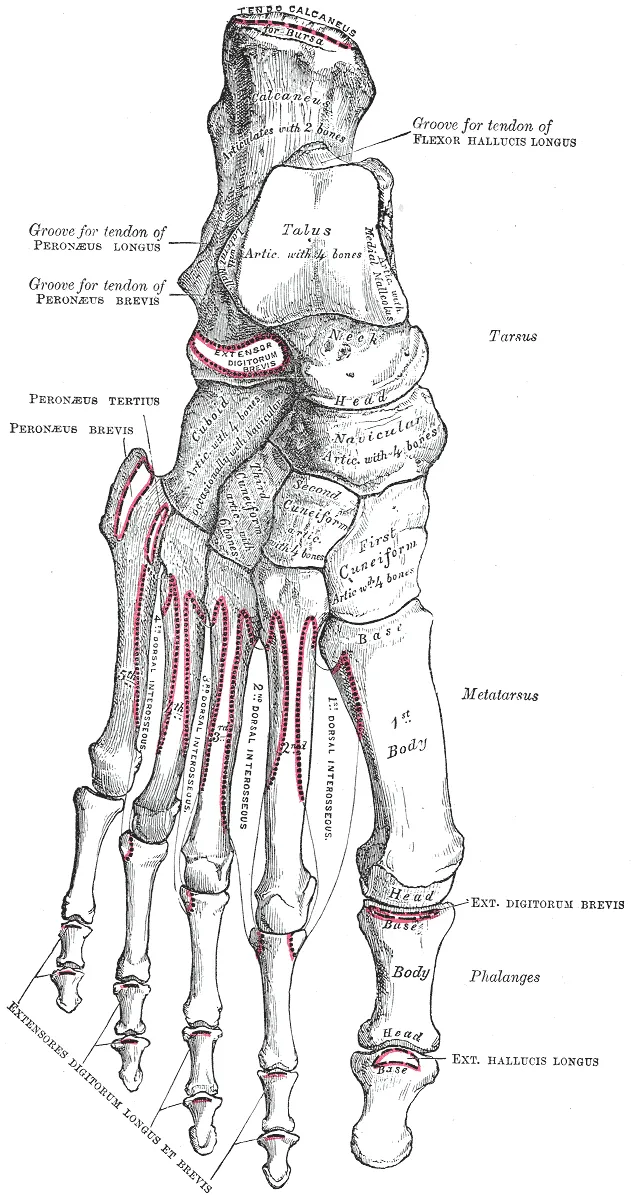
Low-risk and high-risk sites
A 2017 review defines low-risk stress fractures as those with a low probability of spreading, healing late or failing to unite11. High-risk ones have higher rates of each, and of displacement, where the bone ends move out of line11.
| Class | Sites the review names |
|---|---|
| Low-risk, in a 2022 review | Second and third metatarsal shafts, posteromedial (back and inner) tibia, fibula, shaft of the humerus (upper arm bone) and ribs1 |
| High-risk, in a 2000 review | Tension side of the femoral neck, patella (kneecap), front of the tibia, medial malleolus (inner ankle bump) and talus (ankle bone)12. Also the tarsal navicular, fifth metatarsal and great toe sesamoids12 |
The femoral neck is the angled part of the thigh bone just below the ball of the hip. The 2000 review attributes poor healing at high-risk sites to tensile (pulling) forces and relatively poor blood supply12. A 2023 systematic review (a study that sums up the research on a question) called sorting by location standard practice, but not sufficiently validated4.
What scans show
A 2022 review describes plain X-rays as insensitive for these injuries, and MRI as the imaging method of choice1. MRI is a scan that shows soft tissue in detail.
Who it affects
How often it was recorded
A review notes that recent data on bone stress injuries are limited6. Two of the figures below use the athlete-exposure, which is one athlete taking part in one practice or game10,13.
| Group studied | What was recorded |
|---|---|
| US college athletes, 33 sports, 2016 to 2022 | Average annual risk of 4%2 |
| US college athletes, 2004 to 2014 | 5.70 per 100,000 athlete-exposures10 |
| US high school athletes, 2005 to 2013 | 1.54 per 100,000 athlete-exposures13 |
| 221 US college distance runners, seven years | 32 per 100 athlete-years14 |
| 748 competitive high school runners, mean 2.3 seasons | 5.4% of girls and 4.0% of boys15 |
| New US military recruits, as reported by a 2022 review | Up to 5–10% in the first two to three months of basic training1 |
Women and men
- US college sports played by both sexes. Women had about twice the rate of men, 9.13 against 4.44 per 100,000 athlete-exposures10.
- Runners. A meta-analysis (a study that pools earlier studies) of prospective studies found bone stress injury more frequent in female runners16. It found no difference in overall injury rate16.
- Military recruits. A 2022 review reports these injuries 3.1 to 3.6 times as often in female as in male recruits1.
- Track and field. In a 12-month study of 111 competitive athletes, 21.1% had a stress fracture, with no difference between men and women17.
What goes with it
A 2022 review names unaccustomed physical activity as the most important risk factor in athletes and military recruits1. It calls a previous bone stress injury the most universal one1. In a meta-analysis of runners, the pooled odds were 4.99 times higher with a previous stress fracture and 2.31 times higher in women3.
Studies also report on energy and menstrual factors1,18:
- The 2022 review calls low energy availability a major risk factor that affects bone health in women and men1. The term means too little energy from food left for the body’s needs after training.
- In a prospective study of 259 exercising girls and women, 10.8% had a bone stress injury18. Risk was about 15–20% with one significant risk factor18. It was 30–50% with combined factors related to the Female Athlete Triad18. The Triad is low energy availability, menstrual problems and low bone density occurring together.
- In a survey of 183 competitive female distance runners, the 12-month rate was 2.25 times greater in those with fewer than nine periods19.
Another review describes these injuries as arising from many interacting factors6. The review adds that single risk factors predict these injuries poorly6.
What studies found
How it goes over time
A 2022 review states that these injuries bring pain and lost function, and may go on to become a complete fracture1. It adds that they frequently recur, often at a different location1. The same review states that most people recover completely when the injury is found and managed early1.
Of 671 stress fractures in US college athletes, 21.5% were recurrent and 20.7% ended a season10.
Return to sport by site
A systematic review and meta-analysis pooled 76 studies of athletes, covering 2,974 bone stress injuries4. More than 90% of athletes returned to sport, and the time taken depended on the site4.
| Site | Pooled days to return to sport |
|---|---|
| Posteromedial tibial shaft | 444 |
| Fibula | 564 |
| Femoral neck | 1074 |
| Tarsal navicular | 1274 |
Complication rates were highest for the femoral neck, tarsal navicular, front of the tibial shaft and fifth metatarsal4. They were lowest in the fibula, pubic bone and back inner tibial shaft4.
MRI grade and return time
Studies have disagreed on whether a higher MRI grade goes with a longer return20. The authors of a 2022 meta-analysis noted that some earlier studies found no significant relationship20. Across 16 studies and 560 injuries, they found higher grade correlated with a longer return20. Mean time rose from 41.7 days at grade 1 to 98.5 days at grade 420.
Trials of insoles and orthoses
Reviews of shock-absorbing insoles and foot orthoses (shaped shoe inserts) disagree21,22:
- 2005 Cochrane review. Its 13 prevention trials were in military recruits21. Four compared shock-absorbing boot inserts with a control, and each reported fewer bone stress injuries with inserts21. The one trial with a significant result lacked important design details21. The authors concluded that inserts probably reduce the incidence (new cases over a set time) in military personnel21.
- 2017 meta-analysis. Foot orthoses lowered the risk of stress fractures, with a risk ratio (how many times as often it happened) of 0.5922. Shock-absorbing insoles did not, with a risk ratio of 1.1522. Trial quality varied greatly22.
- 2023 meta-analysis of 11 randomised trials. The risk ratio with foot orthoses was 0.47, on evidence rated low quality23. The authors concluded that orthoses could potentially help in the military setting23.
The 2023 review also concluded that the effect of footwear and training-related strategies on risk is still unknown23.
Trials of stretching, supplements and a medicine
| What was tested | Who was studied | What was found |
|---|---|---|
| Leg stretching in warm-up | Military recruits, two cluster-randomised trials | No significant effect on lower-limb stress fractures and stress reactions21 |
| Calcium supplement alone | 1,398 healthy male military recruits, 247 of them allocated the supplement | Weekly incidence of stress fractures and tibial stress syndrome over nine weeks was similar with and without it; usual dietary calcium already averaged above 800 mg a day24 |
| Calcium with vitamin D | 5,201 female Navy recruits | 5.3% against 6.6% on placebo over eight weeks of basic training5 |
| Risedronate, a bisphosphonate | 324 new infantry recruits | No statistically significant difference in stress fracture incidence25 |
| Nutrition education on energy availability | Female distance runners at two US colleges | Overall rate not reduced: 0.43 against 0.52 events per person-year before26 |
In the nutrition study, the rate fell at one college and did not fall at the other26. The authors suggest the effect may depend on a team’s culture, environment and resources26.
Trials in people with a stress fracture
Trials of an air-filled leg brace for tibial stress fractures disagree27,28:
- In a randomised trial of 18 athletes, the brace group returned to full activity in 21 days27. The group managed with rest and a gradual return took 77 days27.
- In a randomised trial of 31 soldiers (20 finished), the brace made no difference to the trial’s two timed outcomes28.
- A Cochrane review pooled three small trials and found a shorter time to full activity, with highly inconsistent results21.
Two devices were tested against placebo devices29,30:
- Pulsed ultrasound. In a double-blind trial of 26 midshipmen, it did not significantly shorten healing time29. A 2023 systematic review found five studies with mixed results31.
- Electric field stimulation. In a randomised trial of 44 people with posteromedial tibial stress fractures, it made no difference to healing time30.
A systematic review of 18 studies compared surgery with non-surgical care at three high-risk sites32. It drew no strong conclusion, on low-certainty evidence32.
Connections
The bones
Each bone’s own page covers its stress fractures in more detail4,33:
- Tibia. Front-of-shaft injuries had among the highest complication rates in a meta-analysis, and posteromedial ones among the lowest4.
- Fibula. In a systematic review of 45 fibular stress fractures, each healed without surgery34.
- Metatarsals. A review states that shaft stress fractures develop most often in the second metatarsal11.
- Navicular. This midfoot bone is given as an example of a high-risk site33.
- Calcaneus (heel bone). Its stress fractures are classed as low-risk35.
- Femur. A review describes femoral neck stress fractures as relatively rare, most common in military recruits and endurance athletes36.
Shin splints and running
Medial tibial stress syndrome, or shin splints, is pain along the inner edge of the shinbone that comes with exercise. In an MRI study of 22 athletes with leg pain, the eight with stress fractures showed a wide bright signal in one area of marrow37. It was absent in those with shin splints37.
A review reports that bone stress injuries make up 15–20% of musculoskeletal injuries in several sports, including recreational running6.
Stress fracture involves
Stress fracture is one kind of injury to
Stress fracture is compared with
Stress fracture has been counted in studies of
Sources
- Hoenig T, Ackerman KE, Beck BR, Bouxsein ML, Burr DB, Hollander K, Popp KL, Rolvien T, Tenforde AS, Warden SJ (2022). Bone stress injuries. Nature reviews. Disease primers. doi:10.1038/s41572-022-00352-y PMID 35484131
- Wainwright KF, Whelan BM, Fahy KE, Harmon KG (2026). Epidemiology of bone stress injury in Division I National Collegiate Athletic Association Athletes from 2016 to 2022. British journal of sports medicine. doi:10.1136/bjsports-2025-110888 PMID 41951345
- Wright AA, Taylor JB, Ford KR, Siska L, Smoliga JM (2015). Risk factors associated with lower extremity stress fractures in runners: a systematic review with meta-analysis. British journal of sports medicine. doi:10.1136/bjsports-2015-094828 PMID 26582192
- Hoenig T, Eissele J, Strahl A, Popp KL, Stürznickel J, Ackerman KE, Hollander K, Warden SJ, Frosch KH, Tenforde AS, Rolvien T (2023). Return to sport following low-risk and high-risk bone stress injuries: a systematic review and meta-analysis. British journal of sports medicine. doi:10.1136/bjsports-2022-106328 PMID 36720584
- Lappe J, Cullen D, Haynatzki G, Recker R, Ahlf R, Thompson K (2008). Calcium and vitamin d supplementation decreases incidence of stress fractures in female navy recruits. Journal of bone and mineral research : the official journal of the American Society for Bone and Mineral Research. doi:10.1359/jbmr.080102 PMID 18433305
- Crunkhorn ML, Etxebarria N, Toohey LA, Charlton P, Watson K, Drew M (2025). The Natural History of Bone Stress Injuries in Athletes: From Inception to Resolution.. Sports medicine. doi:10.1007/s40279-025-02280-9 PMID 40721688
- Hoenig T, Hollander K, Popp KL, Fredericson M, Kraus EA, Warden SJ, Tenforde AS, Bone Stress Injury Authorship Group (2025). International Delphi consensus on bone stress injuries in athletes. British journal of sports medicine. doi:10.1136/bjsports-2024-108616 PMID 39638438
- Boden BP, Osbahr DC, Jimenez C (2001). Low-risk stress fractures. The American journal of sports medicine. doi:10.1177/03635465010290010201 PMID 11206247
- Matheson GO, Clement DB, McKenzie DC, Taunton JE, Lloyd-Smith DR, MacIntyre JG (1987). Stress fractures in athletes. The American journal of sports medicine. doi:10.1177/036354658701500107 PMID 3812860
- Rizzone KH, Ackerman KE, Roos KG, Dompier TP, Kerr ZY (2017). The Epidemiology of Stress Fractures in Collegiate Student-Athletes, 2004-2005 Through 2013-2014 Academic Years. Journal of athletic training. doi:10.4085/1062-6050-52.8.01 PMID 28937802
- Robertson GA, Wood AM (2017). Lower limb stress fractures in sport: Optimising their management and outcome. World journal of orthopedics. doi:10.5312/wjo.v8.i3.242 PMID 28361017
- Boden BP, Osbahr DC (2000). High-risk stress fractures: evaluation and treatment. The Journal of the American Academy of Orthopaedic Surgeons. doi:10.5435/00124635-200011000-00002 PMID 11104398
- Changstrom BG, Brou L, Khodaee M, Braund C, Comstock RD (2015). Epidemiology of stress fracture injuries among US high school athletes, 2005-2006 through 2012-2013. The American journal of sports medicine. doi:10.1177/0363546514562739 PMID 25480834
- Wolff A, Kurina LM, Sainani KL, Tenforde AS, Nattiv A, Fredericson M (2025). A Descriptive Analysis of the Seasonal Patterns of Bone Stress Injury Incidence in Division I Collegiate Distance Runners. The American journal of sports medicine. doi:10.1177/03635465241307231 PMID 39836388
- Tenforde AS, Sayres LC, McCurdy ML, Sainani KL, Fredericson M (2013). Identifying sex-specific risk factors for stress fractures in adolescent runners. Medicine and science in sports and exercise. doi:10.1249/MSS.0b013e3182963d75 PMID 23584402
- Hollander K, Rahlf AL, Wilke J, Edler C, Steib S, Junge A, Zech A (2021). Sex-Specific Differences in Running Injuries: A Systematic Review with Meta-Analysis and Meta-Regression. Sports medicine (Auckland, N.Z.). doi:10.1007/s40279-020-01412-7 PMID 33433864
- Bennell KL, Malcolm SA, Thomas SA, Wark JD, Brukner PD (1996). The incidence and distribution of stress fractures in competitive track and field athletes. The American journal of sports medicine. doi:10.1177/036354659602400217 PMID 8775123
- Barrack MT, Gibbs JC, De Souza MJ, Williams NI, Nichols JF, Rauh MJ, Nattiv A (2014). Higher incidence of bone stress injuries with increasing female athlete triad-related risk factors. The American journal of sports medicine. doi:10.1177/0363546513520295 PMID 24567250
- Hutson MJ, O'Donnell E, Petherick E, Brooke-Wavell K, Blagrove RC (2021). Incidence of bone stress injury is greater in competitive female distance runners with menstrual disturbances independent of participation in plyometric training. Journal of sports sciences. doi:10.1080/02640414.2021.1945184 PMID 34269142
- Hoenig T, Tenforde AS, Strahl A, Rolvien T, Hollander K (2022). Does Magnetic Resonance Imaging Grading Correlate With Return to Sports After Bone Stress Injuries? A Systematic Review and Meta-analysis.. The American journal of sports medicine. doi:10.1177/0363546521993807 PMID 33720786
- Rome K, Handoll HH, Ashford R (2005). Interventions for preventing and treating stress fractures and stress reactions of bone of the lower limbs in young adults. The Cochrane database of systematic reviews. doi:10.1002/14651858.CD000450.pub2 PMID 15846606
- Bonanno DR, Landorf KB, Munteanu SE, Murley GS, Menz HB (2017). Effectiveness of foot orthoses and shock-absorbing insoles for the prevention of injury: a systematic review and meta-analysis. British journal of sports medicine. doi:10.1136/bjsports-2016-096671 PMID 27919918
- Lavigne A, Chicoine D, Esculier JF, Desmeules F, Frémont P, Dubois B (2023). The Role of Footwear, Foot Orthosis, and Training-Related Strategies in the Prevention of Bone Stress Injuries: A Systematic Review and Meta-Analysis. International journal of exercise science. doi:10.70252/ZNRS2138 PMID 37649463
- Schwellnus MP, Jordaan G (1992). Does calcium supplementation prevent bone stress injuries? A clinical trial. International journal of sport nutrition. doi:10.1123/ijsn.2.2.165 PMID 1299491
- Milgrom C, Finestone A, Novack V, Pereg D, Goldich Y, Kreiss Y, Zimlichman E, Kaufman S, Liebergall M, Burr D (2004). The effect of prophylactic treatment with risedronate on stress fracture incidence among infantry recruits. Bone. doi:10.1016/j.bone.2004.04.016 PMID 15268892
- Fredericson M, Roche M, Barrack MT, Tenforde A, Sainani K, Kraus E, Kussman A, Miller Olson E, Kim BY, Fahy K, Miller E, Diamond E, Meraz S, Singh S, Nattiv A (2023). Healthy Runner Project: a 7-year, multisite nutrition education intervention to reduce bone stress injury incidence in collegiate distance runners. BMJ open sport & exercise medicine. doi:10.1136/bmjsem-2023-001545 PMID 37180969
- Swenson EJ Jr, DeHaven KE, Sebastianelli WJ, Hanks G, Kalenak A, Lynch JM (1997). The effect of a pneumatic leg brace on return to play in athletes with tibial stress fractures. The American journal of sports medicine. doi:10.1177/036354659702500309 PMID 9167811
- Allen CS, Flynn TW, Kardouni JR, Hemphill MH, Schneider CA, Pritchard AE, Duplessis DH, Evans-Christopher G (2004). The use of a pneumatic leg brace in soldiers with tibial stress fractures--a randomized clinical trial. Military medicine. doi:10.7205/milmed.169.11.880 PMID 15605935
- Rue JP, Armstrong DW 3rd, Frassica FJ, Deafenbaugh M, Wilckens JH (2004). The effect of pulsed ultrasound in the treatment of tibial stress fractures. Orthopedics. doi:10.3928/0147-7447-20041101-18 PMID 15566133
- Beck BR, Matheson GO, Bergman G, Norling T, Fredericson M, Hoffman AR, Marcus R (2008). Do capacitively coupled electric fields accelerate tibial stress fracture healing?. The American journal of sports medicine. doi:10.1177/0363546507310076 PMID 18055921
- McDaniel M, Eltman NR, Pan J, Swanson RL 2nd (2023). Evaluation of Low-Intensity Pulsed Ultrasound on Stress Fractures to Reduce the Time to Return to Sport or Activity in the Physically Active Population: A Systematic Review. Cureus. doi:10.7759/cureus.49129 PMID 38024090
- Mallee WH, Weel H, van Dijk CN, van Tulder MW, Kerkhoffs GM, Lin CW (2015). Surgical versus conservative treatment for high-risk stress fractures of the lower leg (anterior tibial cortex, navicular and fifth metatarsal base): a systematic review. British journal of sports medicine. doi:10.1136/bjsports-2013-093246 PMID 25138980
- Shakked RJ, Walters EE, O'Malley MJ (2017). Tarsal navicular stress fractures. Current reviews in musculoskeletal medicine. doi:10.1007/s12178-017-9392-9 PMID 28110392
- Encinas R, Sharpe J, Bakaes Y, Mazoue C, Jackson B, Gonzalez T (2023). Fibula Stress Fractures: A Systematic Review.. Foot & ankle specialist. doi:10.1177/19386400231184124 PMID 37491891
- Paavana T, Rammohan R, Hariharan K (2024). Stress fractures of the foot - current evidence on management. Journal of clinical orthopaedics and trauma. doi:10.1016/j.jcot.2024.102381 PMID 38435398
- Bernstein EM, Kelsey TJ, Cochran GK, Deafenbaugh BK, Kuhn KM (2022). Femoral Neck Stress Fractures: An Updated Review.. Journal of the American Academy of Orthopaedic Surgeons. doi:10.5435/JAAOS-D-21-00398 PMID 35077440
- Aoki Y, Yasuda K, Tohyama H, Ito H, Minami A (2004). Magnetic resonance imaging in stress fractures and shin splints. Clinical orthopaedics and related research. doi:10.1097/01.blo.0000126333.13806.87 PMID 15123957
Changes
- Re-reviewed after a published correction to a cited source was read and recorded; no change to the page.
- First published.