Ribs
Also called rib, rib cage, first rib, floating ribs, thoracic cage
The twelve pairs of curved bones that, with the breastbone and spine, make the rib cage. How they move for breathing, how muscle pull cracks them in rowing, golf and throwing, and how long studies found they took to settle.
- Region
- Trunk
- Muscles
- serratus anterior, external oblique, internal oblique, scalenes
- Updated
- October 28, 2026
- Reviewed
- October 28, 2026 · how entries are checked
Function
Twelve pairs in a closed ring
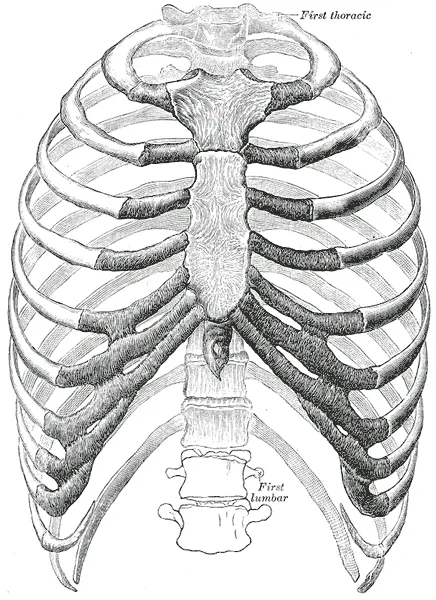
The rib cage is made of 12 pairs of ribs, their costal cartilages and the sternum1. At the back, the ribs are anchored to the 12 thoracic vertebrae, the chest part of the spine1. The cage protects the heart and lungs1. A review of rowing injuries describes each rib as part of a closed ring, finished by the sternum in front and the vertebrae behind6. Because the ribs share the breastbone, the rib cage takes load as a whole unit rather than one rib at a time6.
Each rib’s bony part stops short of the sternum and ends in a costal cartilage made of hyaline cartilage, a smooth, glassy kind1. The ribs fall into three groups by how they reach the front1:
| Group | Ribs | How the front end attaches |
|---|---|---|
| True ribs | 1 to 7 | Each costal cartilage joins the sternum directly1 |
| False ribs | 8 to 12 | No direct link to the sternum; the cartilages of 8 to 10 join the cartilage above1 |
| Floating ribs | 11, 12 | Short, with no sternal link; small cartilages end in the side wall of the abdomen1 |
The parts of a rib and its joints
A typical rib has a head at its back end, a narrow neck, a small bump called the tubercle, and a long shaft1. Just past the tubercle is the angle, where the rib bends most sharply1. The angles form the rearmost part of the cage and line up with the inner edge of the scapula (shoulder blade)1.
The head of a typical rib meets mainly the vertebra of the same number and partly the one above1. Its tubercle meets the transverse process (side spur) of the same vertebra1. At the front, each rib joins its cartilage at a synchondrosis, a cartilage joint that does not turn to bone with age1. The first rib’s cartilage anchors to the manubrium (the upper breastbone) the same way1. Ribs 2 to 7 meet the sternum at synovial joints, joints with a fluid-filled space1.
The first rib
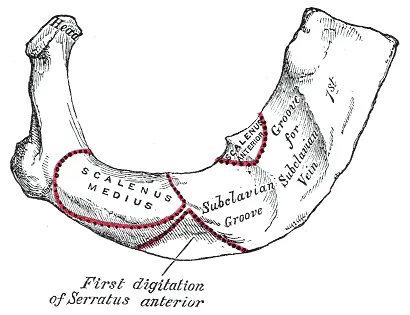
The first rib joins only the first thoracic vertebra, while each other rib joins two7. It may also join the clavicle (collarbone), at the costoclavicular joint7.
A review of pitching injuries describes the first rib as thinner than the rest2. It has a groove for the subclavian artery and one for the subclavian vein, and it thins further at each2. A scalene tubercle (bump) between them takes the anterior scalene2. The anterior and middle scalenes, muscles at the side of the neck, lift the first rib and resist its being pulled down2. A 2022 consensus describes the brachial plexus and subclavian artery passing between those two muscles and the first rib8.
Moving the ribs to breathe
In a quiet breath in, the diaphragm moves down and the external intercostal muscles lift the ribs up and out1. Three sets of intercostal muscles fill each gap between ribs, and the internal set draws the ribs together for breathing out1. Normal breathing out is passive1. In a forced breath out, the obliques push the belly organs up against the diaphragm, and the internal intercostals help squeeze the cage1.
A CT study named two parts of rib motion10. Pump-handle movement mainly changes the cage’s depth from front to back, and bucket-handle movement mainly changes its width10. In six healthy people, pump-handle movement was on average four times larger than bucket-handle movement, from a relaxed breath out to a full breath in10.
Breakdown
Muscle pull, not impact
A review contrasts the two: lower-limb stress fractures often follow repeated impact, while rib stress fractures are thought to come from repeated trunk muscle pulls2. A narrative review reports rib bone stress injuries most often in athletes who repeat upper-body movements11. One review of upper-limb stress fractures names three common sites5:
- the front and side of the first rib5;
- the back and side of ribs 5 to 95;
- near the spine on ribs 2 to 75.
Rowing
Reviews give these figures for rib stress fractures in rowers3,12:
| Group | Rib stress fractures |
|---|---|
| Elite rowers | 8.1% to 16.4%3 |
| University rowers | 2%3 |
| Junior elite rowers | 1%3 |
| Share of injuries, college and Canadian national | About 10% of injuries12 |
In 151 Australian national team rowers followed from 2012 to 2016, 19 rib stress injuries were recorded13. Yearly prevalence ranged from 4% to 15.4%, with rib 6 the most common site13. Prevalence did not differ significantly by sex, sweep versus scull rowing or weight class, but incidence rose significantly in the pre-Olympic year13.
Reports describe the loading behind them12,14:
- A review reports that fractures tend to occur in hard training at a low stroke rate and a high load per stroke12.
- From 14 fractures in 10 elite rowers, the authors suggested repeated bending by the serratus anterior and external oblique as the cause. They noted similarities to rib fractures from coughing14.
- A review reports that biomechanical analysis puts the bending in the middle third of the rib, on its back-and-side segment12.
Two studies each compared seven national team rowers who had a past rib stress fracture with seven matched controls15,16. One found significantly lower lumbar (lower-back) spine bone mineral density in the injured rowers15. The other found more serratus anterior and trapezius co-contraction (both working at once) in them16. In 133 elite rowers, bone density, diet restriction, menstrual function and weight class were associated with past rib injury17. Against this, a review of 17 studies found insufficient or conflicting evidence for training changes, technique, female sex, low bone density, equipment and training type18.
Golf
In 19 golfers with rib stress fractures, average age 39, ribs 4 to 6 were most often affected, and 18 were beginners19. A structured review of 44 golf stress fractures found the ribs the most reported site20. Of the 44, 80% were on the golfer’s lead side20.
Throwing and the first rib
A review notes that case reports in baseball pitchers point to the first rib as possibly the most common site2. It describes the hypothesis that repeated opposing pulls cause most first-rib stress fractures in pitchers2. The serratus anterior pulls down and the scalenes pull up2. The same review notes the rib is thinnest and weakest at the subclavian artery groove2. In 24 first-rib stress fractures in 23 overhead throwing athletes, mean age was 16.8 years, and 19 fractures were on the throwing side21.
Lower down, a review reports that pitchers’ injuries to ribs 7 to 9 have been put down to opposing external oblique and serratus anterior pulls2. Among 121 rib fractures in Major League Baseball from 2011 to 2022, pitchers more often had stress fractures and outfielders traumatic ones22.
Blows and sudden pulls
A review of rib fractures in athletes calls them the most common serious chest injury, mostly in the middle and lower ribs23. It describes first-rib and floating-rib fractures as avulsions, breaks from a sudden strong muscle pull23. In a case series of 13 athletes under 18 with first-rib fractures, 8 were traumatic and 5 were stress fractures24. A single case report describes a weightlifter whose collarbone and second rib broke suddenly during dips25.
Recovery
How bone repairs overuse damage
Rib healing is described here through one review’s account of remodelling and through time away from sport. In that account, overuse of the trunk starts remodelling, with osteoclasts (cells that remove bone) breaking down bone for two to three weeks2. Osteoblasts (cells that build bone) then refill the gaps, which can take months2.
Time away, by sport
A 2022 review lists the ribs among low-risk sites, which usually heal without major complication26. Reported times differ by sport and measure:
| Group studied | Time reported |
|---|---|
| Rowers, a database-search review | 4 to 6 weeks of lost training in nine studies; range 1 to 16 weeks18 |
| Rowers, review of rowing injuries | Usually healed in 6 to 8 weeks when found early12 |
| Australian national team rowers | Median 69 days for a fracture, 57 for a stress reaction13 |
| Major League pitchers, review | 8 to 10 weeks, against an average of 5 for intercostal and abdominal oblique strains2 |
| Professional baseball players | About 14 weeks after stress fractures (17.6 for pitchers), 7 after traumatic ones22 |
| Two NFL players, cartilage injuries | 2 to 4 weeks27 |
The first rib heals less reliably
One review reports that most rib bone stress injuries heal after 4 to 6 weeks of a gradual return to throwing2. First-rib and complete fractures carry more risk of not healing and may need up to 6 to 12 months to heal2. Another review gives first-rib fractures a 29% non-healing rate, with return after an average of 3.4 months once free of symptoms5. In 24 first-rib stress fractures in throwers, 71% had healed and 29% had not at a mean of 7.5 months after non-surgical care began21.
A review notes that complications of rib fractures include a collapsed lung and thoracic outlet syndrome2. It adds that non-healing or excess callus, the new tissue that bridges a break, can lead to the syndrome2.
Connections
Muscles on the ribs
A pitching review lists many muscles attaching to the rib cage2. They include the serratus anterior, latissimus dorsi, rectus abdominis, pectoralis major and minor, intercostals, obliques and scalenes2. Several attach at these places1,2,28,29,30:
| Muscle | Where it meets the ribs |
|---|---|
| Serratus anterior | The sides of the first nine ribs28 |
| External oblique | The lower eight ribs29 |
| Internal oblique | The lower ribs30 |
| Diaphragm | The lower six ribs and their cartilages, and the 12th ribs1 |
| Scalenes | The upper surface of the first rib (anterior and middle)2 |
Joints, neighbours and related pages
In the thoracic spine, the attached rib cage greatly limits bending forward, back and to the side1.
The first rib may join the clavicle, and the brachial plexus passes between the scalenes and the first rib7,8. A 2022 consensus names three spaces where narrowing can cause thoracic outlet syndrome8. They are the gap between the scalenes, the costoclavicular space and the space beneath the pectoralis minor, the subject of pectoralis minor syndrome8.
The stress fracture page covers bone stress injuries across the body, where ribs count as a low-risk site26. Related exercise pages: a case report links dips with a second rib fracture25.
Ribs is attached to by
Ribs forms a joint with
Ribs lies next to
Ribs forms part of
Ribs can involve
Ribs is injured in
Ribs is loaded by
Sources
- Betts JG, Young KA, Wise JA, Johnson E, Poe B, Kruse DH, Korol O, Johnson JE, Womble M, DeSaix P (2022). Anatomy and Physiology 2e. OpenStax. Link
- Schowalter S, Le B, Creps J, McInnis KC (2022). Rib Fractures in Professional Baseball Pitchers: Mechanics, Epidemiology, and Management. Open access journal of sports medicine. doi:10.2147/OAJSM.S288882 PMID 36248020
- McDonnell LK, Hume PA, Nolte V (2011). Rib Stress Fractures Among Rowers. Sports Medicine. doi:10.2165/11593170-000000000-00000 PMID 21985212
- Gregory PL, Biswas AC, Batt ME (2002). Musculoskeletal problems of the chest wall in athletes. Sports medicine (Auckland, N.Z.). doi:10.2165/00007256-200232040-00003 PMID 11929353
- Koslosky EJ, Heath DM, Atkison CL, Dutta A, Brady CI (2024). Upper Extremity Stress Fractures.. Sports Medicine - Open. doi:10.1186/s40798-024-00769-7 PMID 39327396
- Warden SJ, Gutschlag FR, Wajswelner H, Crossley KM (2002). Aetiology of rib stress fractures in rowers. Sports medicine (Auckland, N.Z.). doi:10.2165/00007256-200232130-00002 PMID 12392443
- Safarini OA, Bordoni B (2026). Anatomy, Thorax, Ribs. StatPearls. PMID 30855912
- Dengler NF, Ferraresi S, Rochkind S, Denisova N, Garozzo D, Heinen C, Alimehmeti R, Capone C, Barone DG, Zdunczyk A, Pedro MT, Antoniadis G, Kaiser R, Dubuisson A, Kretschmer T, Rasulic L (2022). Thoracic Outlet Syndrome Part I: Systematic Review of the Literature and Consensus on Anatomy, Diagnosis, and Classification of Thoracic Outlet Syndrome by the European Association of Neurosurgical Societies' Section of Peripheral Nerve Surgery.. Neurosurgery. doi:10.1227/neu.0000000000001908 PMID 35319532
- Henry BM, Vikse J, Sanna B, Taterra D, Gomulska M, Pękala PA, Tubbs RS, Tomaszewski KA (2018). Cervical Rib Prevalence and its Association with Thoracic Outlet Syndrome: A Meta-Analysis of 141 Studies with Surgical Considerations. World neurosurgery. doi:10.1016/j.wneu.2017.11.148 PMID 29203316
- Luu BL, McDonald RJ, Bolsterlee B, Héroux ME, Butler JE, Hudson AL (2021). Movement of the ribs in supine humans for small and large changes in lung volume. Journal of applied physiology (Bethesda, Md. : 1985). doi:10.1152/japplphysiol.01046.2020 PMID 34013751
- Schwanz KL, Karnovsky SC, Malafronte J, Borg-Stein J, Tenforde AS, McInnis KC (2025). Rib Bone Stress Injuries: A Narrative Review with Protocol for Rehabilitation and Prevention. Current sports medicine reports. doi:10.1249/JSR.0000000000001256 PMID 40472154
- Hosea TM, Hannafin JA (2012). Rowing injuries.. Sports Health. doi:10.1177/1941738112442484 PMID 23016093
- Harris R, Trease L, Wilkie K, Drew M (2020). Rib stress injuries in the 2012-2016 (Rio) Olympiad: a cohort study of 151 Australian Rowing Team athletes for 88 773 athlete days. British journal of sports medicine. doi:10.1136/bjsports-2019-101584 PMID 31959675
- Karlson KA (1998). Rib Stress Fractures in Elite Rowers. The American journal of sports medicine. doi:10.1177/03635465980260040701 PMID 9689370
- Vinther A, Kanstrup IL, Christiansen E, Alkjaer T, Larsson B, Magnusson SP, Aagaard P (2005). Exercise-induced rib stress fractures: influence of reduced bone mineral density. Scandinavian journal of medicine & science in sports. doi:10.1111/j.1600-0838.2004.00400.x PMID 15773863
- Vinther A, Kanstrup IL, Christiansen E, Alkjaer T, Larsson B, Magnusson SP, Ekdahl C, Aagaard P (2006). Exercise-induced rib stress fractures: potential risk factors related to thoracic muscle co-contraction and movement pattern. Scandinavian journal of medicine & science in sports. doi:10.1111/j.1600-0838.2005.00473.x PMID 16643197
- Lundy B, Suni V, Drew M, Trease L, Burke LM (2022). Nutrition factors associated with rib stress injury history in elite rowers. Journal of science and medicine in sport. doi:10.1016/j.jsams.2022.08.017 PMID 36137920
- D'Ailly PN, Sluiter JK, Kuijer PP (2016). Rib stress fractures among rowers: a systematic review on return to sports, risk factors and prevention. The Journal of sports medicine and physical fitness. PMID 26173790
- Lord MJ, Ha KI, Song KS (1996). Stress fractures of the ribs in golfers. The American journal of sports medicine. doi:10.1177/036354659602400121 PMID 8638744
- Lee AD (2009). Golf-related stress fractures: a structured review of the literature. The Journal of the Canadian Chiropractic Association. PMID 20037694
- Funakoshi T, Furushima K, Kusano H, Itoh Y, Miyamoto A, Horiuchi Y, Sugawara M, Itoh Y (2019). First-Rib Stress Fracture in Overhead Throwing Athletes. The Journal of bone and joint surgery. American volume. doi:10.2106/JBJS.18.01375 PMID 31094981
- Gopalkrishnan S, Hernandez KL, Lambert B, Goble HM, Lintner DM, Jack RA 2nd (2026). Epidemiology, Performance, and Return to Sport After Rib Fracture in Professional Baseball Players. Orthopaedic journal of sports medicine. doi:10.1177/23259671251409187 PMID 41625508
- Miles JW, Barrett GR (1991). Rib fractures in athletes. Sports medicine (Auckland, N.Z.). doi:10.2165/00007256-199112010-00005 PMID 1925189
- Walls HR, Shields C, Ellington MD, Edmonds EW (2026). Isolated First Rib Fractures in Adolescent Athletes: An Epidemiologic Review. Journal of pediatric orthopedics. doi:10.1097/BPO.0000000000003383 PMID 42318849
- Malavolta EA, Assunção JH, Gracitelli ME, Lobo FL, Ferreira Neto AA (2016). Fracture of the clavicle and second rib: an indirect injury from tricep dips. The Journal of Sports Medicine and Physical Fitness. PMID 27377364
- Hoenig T, Ackerman KE, Beck BR, Bouxsein ML, Burr DB, Hollander K, Popp KL, Rolvien T, Tenforde AS, Warden SJ (2022). Bone stress injuries. Nature reviews. Disease primers. doi:10.1038/s41572-022-00352-y PMID 35484131
- McAdams TR, Deimel JF, Ferguson J, Beamer BS, Beaulieu CF (2016). Chondral Rib Fractures in Professional American Football: Two Cases and Current Practice Patterns Among NFL Team Physicians. Orthopaedic journal of sports medicine. doi:10.1177/2325967115627623 PMID 26925425
- Neumann DA, Camargo PR (2019). Kinesiologic considerations for targeting activation of scapulothoracic muscles - part 1: serratus anterior.. Brazilian Journal of Physical Therapy. doi:10.1016/j.bjpt.2019.01.008 PMID 30737019
- Mehta CP, Daftary A, Lawande M (2021). Side Strain and Impact Injuries at the Iliac Crest Attachment of Lateral Abdominal Wall Musculature in Cricketers: An Uncommon Injury Pattern.. Indian Journal of Radiology and Imaging. doi:10.1055/s-0041-1734345 PMID 34556921
- Komatsu S, Kaneko H, Nagashima M (2022). Characteristics of internal oblique muscle strain in professional baseball players: a case series.. BMC Sports Science, Medicine and Rehabilitation. doi:10.1186/s13102-022-00510-5 PMID 35752868
Changes
- First published.