Thoracic outlet syndrome
Also called TOS
How surgeons' groups define the squeezing of nerves or blood vessels between the base of the neck and the armpit, where they disagree, who it is reported in, and what trials and series found.
- Region
- Neck
- Muscles
- pectoralis minor
- Updated
- October 22, 2026
- Reviewed
- October 22, 2026 · how entries are checked
What it is
How sources define it
Reporting standards from the Society for Vascular Surgery in 2016 call the syndrome a group of disorders sharing compression at the thoracic outlet1. A 2022 consensus of European nerve surgeons, built on a systematic search of the literature, adds the cause2. In its account, bone, muscle or fibrous tissue presses on the bundle of nerves and blood vessels there2. Both name three structures at risk1,2:
- the brachial plexus, the network of nerves, starting at the neck, that serves the arm2;
- the subclavian artery, the large artery that runs beneath the collarbone2;
- the subclavian vein, the large vein that runs beneath the collarbone2.
The 2016 standards name a neurogenic (nerve), a venous and an arterial form after these, and say the forms can coexist1.
Three places the squeeze can happen
The 2022 consensus names three spaces where narrowing can cause the syndrome2:
- the interscalene triangle, bounded by the anterior and middle scalene muscles at the side of the neck and by the first rib2;
- the costoclavicular space, the gap between the collarbone and the first rib2;
- the space beneath the pectoralis minor, a smaller chest muscle beneath the pectoralis major2.
According to the consensus, the brachial plexus and the subclavian artery run through the triangle between the scalenes2. The subclavian vein runs in front of the anterior scalene instead2.
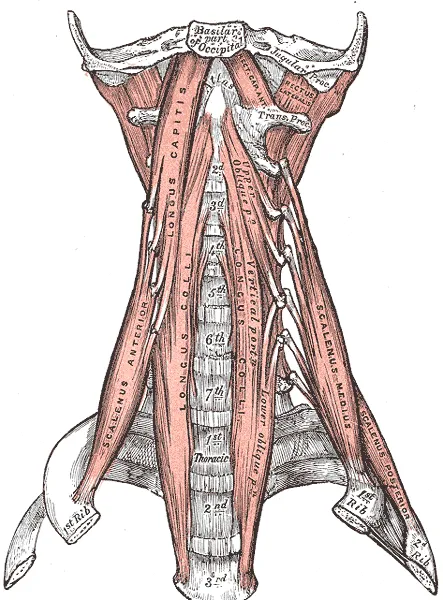
Squeezing beneath the pectoralis minor has its own page, pectoralis minor syndrome. A 2022 review calls it the dominant cause of the neurogenic form5. A 2017 review describes squeezing above and below the collarbone as two conditions that often occur together6.
The three forms
| Form | How sources describe it | Share of cases |
|---|---|---|
| Neurogenic | The most frequent type, in a 2022 consensus2 | 39% to 95% in the literature2 |
| Venous | Can lead to clots in arm veins in 10% to 20% of cases, in a 2022 review of sport7 | About 5% to 10%7 |
| Arterial | An artery squeezed by an anatomical abnormality, usually in younger people, in a 2024 review8 | Rare, 1% to 19%, mostly with cervical ribs2 |
The 2022 review of sport names the venous form’s sudden complication Paget-Schroetter syndrome7. A clot in the arm veins can sometimes lead to a pulmonary embolism, a clot that blocks an artery in the lungs7. A 2020 review calls Paget-Schroetter syndrome a rare clot in the vein of the armpit and below the collarbone9.
Where definitions disagree
Sources do not agree on how to define or classify the syndrome, especially its neurogenic form2,3.
- 2016 standards. The neurogenic form counts as present when three of four criteria are met, including a positive response to a scalene test injection1.
- “Disputed” cases. Vascular surgery standards advise against the term, the 2022 consensus reports, but most neurologists still split the neurogenic form into true and disputed types2.
- A new split. The 2022 consensus proposes one neurogenic type with weakness or wasting of arm muscles, and others with mainly pain or sensory symptoms2.
- Adapted criteria. A 2024 Delphi study of 21 hand surgeons, which polled them in rounds to work toward agreement, recommends an adapted version of the 2016 criteria10.
A 2014 Cochrane review, a systematic review done to the Cochrane Collaboration’s published standards, called for an agreed definition3.
Why it is hard to pin down
The 2022 consensus reports that tests holding the arm in set positions have a sensitivity of 72% and a specificity of 53%2. That is, they picked up 72% of cases but correctly cleared 53% of people without the syndrome2. The consensus calls identifying and classifying it a challenge2.
In a records review of 41 people with artery compression at the outlet, two-thirds had long-standing symptoms hard to tell from nerve compression11. Of 23 whose symptoms suggested nerve compression alone, 13 had a significant artery abnormality11.
Who it affects
How common it is
Estimates vary widely2,7. Prevalence is the share of people who have a condition at a given time; incidence is how many new cases appear over a set time.
| Who was studied | What was found |
|---|---|
| People generally, in the 2022 consensus | Prevalence estimated at 10 per 100,000 people, perhaps much higher in athletes2 |
| The general population, in a 2022 review of sport | Incidence hard to judge, probably about 3 to 80 cases per 100,000 people7 |
| 526 people referred to one centre | Neurogenic form estimated at 2 to 3 new cases per 100,000 people a year, much lower than earlier estimates12 |
| The same 526 people | Venous form estimated at 0.5 to 1 case per 100,000 people a year; arterial form sporadic12 |
Sex, age and extra ribs
- Sex. The 2022 consensus reports the syndrome as four times more common in women than in men2.
- Age. A 2022 review of sport gives mean ages in the general population, not in athletes7. These are 20 to 30 for the vascular forms and 30 to 40 for the neurogenic form7.
- Children. A 2024 meta-analysis, which pools several earlier studies, covered six studies (216 patients)13. It found the syndrome more common in girls, and the neurogenic form a smaller share than in adults13.
- Cervical ribs. These ribs of the neck occur in 0.5% to 2% of people, and 5% to 10% of those with them develop the syndrome2.
Athletes
The 2022 review of sport reports that sports with repeated overhead arm motion and arm strength seem to be the most described7. Most of its case reports were of swimmers and baseball pitchers7. Citing case reports, the review states that strength training seems to be a risk factor in itself, while stressing that the syndrome is rare7. Quoting a 2010 source, it reports that 60% to 80% of people with Paget-Schroetter syndrome described intense upper-arm training in the days before the clot7. A 2020 review of 123 published cases of Paget-Schroetter syndrome in athletes found baseball (26.8%) and weightlifting (19%) the sports most often reported9.
What studies found
Surgery or non-surgical care for the nerve form
The authors of the STOPNTOS trial state that solid evidence for surgery on the neurogenic form was lacking before their trial4. Their trial, at one centre and not blinded, took 50 people who had not responded to non-surgical care4. It compared decompression through the armpit, surgery that takes pressure off a nerve, with continued non-surgical care4.
At three months, mean disability scores were 45 after surgery and 65 without4. The scores came from the DASH, a questionnaire that scores disability of the arm, shoulder and hand4. Every person in the non-surgical group then applied for surgery, after which the groups no longer differed4.
A prospective study follows people forward in time. In one such study of 150 people with the neurogenic form, all began with a six-week course of non-surgical care15. Afterwards, 27% improved enough to continue with that care alone, 60% had surgery and 13% declined further care or follow-up15. QuickDASH scores, from a shorter version of the DASH, fell by a mean 29.5% with that care alone and 47.9% with surgery15. No factors clearly predicted who would do well with that care alone15.
Comparing operations for the nerve form
Reviews and one recent trial compared operations with each other3,16.
| Study | What it found |
|---|---|
| One trial of 55 people with the “disputed” type, in the 2014 Cochrane review | Removing the first rib through the armpit eased pain more than a nerve operation above the collarbone; the evidence was very low quality3 |
| A 2019 meta-analysis | Pooled success of 76% and 77% for two first rib removals, one adding scalene removal, and 85% for an operation leaving the rib17 |
| A 2023 meta-analysis of 22 articles | Larger DASH gains and fewer complications after scalene surgery that left the rib than after first rib removal18 |
| A 2025 meta-analysis of 18 studies | Excellent or good results in 71% after scalene surgery that left the rib; most studies used unvalidated measures19 |
| A 2025 randomised trial of 48 women | Pain and numbness fell after two first rib operations, called resection and avulsion, with no significant difference between them16 |
The 2014 Cochrane review found no randomised evidence that either operation in its trial was better than no operation3. In the 2024 Delphi study, there was no agreement on routinely removing the first rib; 13 of 21 surgeons did not10.
Botulinum toxin injections
Botulinum toxin is a drug that weakens or relaxes a muscle it is injected into. The Cochrane review’s one trial of it, Finlayson 2011, randomised 38 people with the syndrome to injections into the scalene muscles3. The trial’s report found no clinically or statistically significant gain over a placebo, a dummy injection of saline, in pain, tingling or function20. The Cochrane review’s own calculation found a significant fall in tingling at six months, but not in pain3.
Allergan Inc gave the trial a grant and the study drug, the review states3. It had also paid the authors about 10,000 Canadian dollars for training doctors in the toxin’s use3. The review states that Allergan had no role in the trial’s design or reporting3.
A 2023 systematic review, a set, checkable search and summary of the research, covered 10 studies (555 patients)21. For the neurogenic form, it found no evidence for the toxin as a validated option21. The pectoralis minor syndrome page sets out the trial’s figures and further reviews22.
The venous and arterial forms
Reviews of Paget-Schroetter syndrome found no randomised trials and no agreed best approach23,24. A 2021 meta-analysis of 25 studies, none of them randomised, made one comparison in a subgroup of 20 studies23. There, first rib removal was linked with better symptom resolution than clot-dissolving drugs alone23. A 2023 meta-analysis of 60 reports rated the certainty of its evidence very low24. In it, symptoms persisted in 46% given blood thinners alone, and in 4% given clot-dissolving drugs then first rib removal24.
For the arterial form, a 2024 review states that people usually need an operation that includes at least first rib removal8. It describes outcomes as typically excellent, although people whose clots have travelled to the hand may need a finger amputated8.
Return to sport
Several series followed athletes after surgery for the syndrome25,26,27:
| Who was studied | What was reported |
|---|---|
| 26 Major League Baseball pitchers who had a rib removed, found through public injury reports25 | 81% returned to play after a mean 10 months25 |
| 79 overhead athletes after first rib removal | 97% returned to play and 81% to the same level26 |
| 60 athletes aged 13 to 19 | 94.4% of the venous and 73.9% of the neurogenic group returned, not a statistically significant difference27 |
In a US college database, 96% of 76 athletes with the syndrome were managed without surgery28. Of these, 80.6% returned to full competition, as did 89.9% of those operated on28. The 2022 review of sport found no long-term study of athletes after surgery7.
Connections
The pectoralis minor syndrome page covers squeezing below the collarbone, beneath the chest muscle6. A 2022 review there says nerve symptoms were once put down to squeezing between the scalenes, or between the clavicle (collarbone) and first rib5.
The axillary nerve is one of the five end branches of the brachial plexus29. A stinger is a short-lived nerve injury of the brachial plexus or of neck nerve roots, in one study’s description30. The seven cervical vertebrae are the bones of the neck31.
A 2026 scoping review, which maps the research on a topic, found stretching common in non-surgical programmes for the neurogenic form32. The scalene and chest muscles were the main targets32. The doorway pec stretch page reports studies of chest stretching, including one of eight weeks in 81 active people33.
Thoracic outlet syndrome includes the space beneath the chest muscle described in
Thoracic outlet syndrome can involve the space beneath
Thoracic outlet syndrome involves the nerve network that gives rise to
Thoracic outlet syndrome is described by spaces near
Thoracic outlet syndrome involves the same nerve network as
Thoracic outlet syndrome is related to
Thoracic outlet syndrome has non-surgical programmes that stretch the muscles of
Sources
- Illig KA, Donahue D, Duncan A, Freischlag J, Gelabert H, Johansen K, Jordan S, Sanders R, Thompson R (2016). Reporting standards of the Society for Vascular Surgery for thoracic outlet syndrome.. Journal of Vascular Surgery. doi:10.1016/j.jvs.2016.04.039 PMID 27565607
- Dengler NF, Ferraresi S, Rochkind S, Denisova N, Garozzo D, Heinen C, Alimehmeti R, Capone C, Barone DG, Zdunczyk A, Pedro MT, Antoniadis G, Kaiser R, Dubuisson A, Kretschmer T, Rasulic L (2022). Thoracic Outlet Syndrome Part I: Systematic Review of the Literature and Consensus on Anatomy, Diagnosis, and Classification of Thoracic Outlet Syndrome by the European Association of Neurosurgical Societies' Section of Peripheral Nerve Surgery.. Neurosurgery. doi:10.1227/neu.0000000000001908 PMID 35319532
- Povlsen B, Hansson T, Povlsen SD (2014). Treatment for thoracic outlet syndrome.. Cochrane Database of Systematic Reviews. doi:10.1002/14651858.CD007218.pub3 PMID 25427003
- Goeteyn J, Pesser N, Houterman S, van Sambeek MRHM, van Nuenen BFL, Teijink JAW (2022). Surgery Versus Continued Conservative Treatment for Neurogenic Thoracic Outlet Syndrome: the First Randomised Clinical Trial (STOPNTOS Trial).. European Journal of Vascular and Endovascular Surgery. doi:10.1016/j.ejvs.2022.05.003 PMID 35537641
- Ahmed AS, Graf AR, Karzon AL, Graulich BL, Egger AC, Taub SM, Gottschalk MB, Bowers RL, Wagner ER (2022). Pectoralis minor syndrome - review of pathoanatomy, diagnosis, and management of the primary cause of neurogenic thoracic outlet syndrome.. JSES reviews, reports, and techniques. doi:10.1016/j.xrrt.2022.05.008 PMID 37588453
- Sanders RJ, Annest SJ (2017). Pectoralis Minor Syndrome: Subclavicular Brachial Plexus Compression.. Diagnostics (Basel). doi:10.3390/diagnostics7030046 PMID 28788065
- Garraud T, Pomares G, Daley P, Menu P, Dauty M, Fouasson-Chailloux A (2022). Thoracic Outlet Syndrome in Sport: A Systematic Review.. Frontiers in Physiology. doi:10.3389/fphys.2022.838014 PMID 35755427
- Potluri VK, Li RD, Crisostomo P, Bechara CF (2024). A review of arterial thoracic outlet syndrome.. Seminars in Vascular Surgery. doi:10.1053/j.semvascsurg.2024.02.001 PMID 38704178
- Keller RE, Croswell DP, Medina GIS, Cheng TTW, Oh LS (2020). Paget-Schroetter syndrome in athletes: a comprehensive and systematic review.. Journal of Shoulder and Elbow Surgery. doi:10.1016/j.jse.2020.05.015 PMID 32868012
- Chim H, Hagan RR (2024). Consensus Recommendations for Neurogenic Thoracic Outlet Syndrome from the INTOS Workgroup.. Plastic and Reconstructive Surgery Global Open. doi:10.1097/GOX.0000000000006107 PMID 39206209
- Criado E, Berguer R, Greenfield L (2010). The spectrum of arterial compression at the thoracic outlet.. Journal of Vascular Surgery. doi:10.1016/j.jvs.2010.03.009 PMID 20541346
- Illig KA, Rodriguez-Zoppi E, Bland T, Muftah M, Jospitre E (2021). The Incidence of Thoracic Outlet Syndrome.. Annals of Vascular Surgery. doi:10.1016/j.avsg.2020.07.029 PMID 32771464
- Price A, Fredricks N, Truong N, North RY (2024). Pediatric thoracic outlet syndrome: a systematic review and meta-analysis.. Journal of Neurosurgery: Pediatrics. doi:10.3171/2024.2.PEDS23511 PMID 38428008
- Rochkind S, Ferraresi S, Denisova N, Garozzo D, Heinen C, Alimehmeti R, Capone C, Barone DG, Zdunczyk A, Pedro MT, Antoniadis G, Kaiser R, Dubuisson A, Pondaag W, Kretschmer T, Rasulic L, Dengler NF (2023). Thoracic Outlet Syndrome Part II: Consensus on the Management of Neurogenic Thoracic Outlet Syndrome by the European Association of Neurosurgical Societies' Section of Peripheral Nerve Surgery.. Neurosurgery. doi:10.1227/neu.0000000000002232 PMID 36542350
- Balderman J, Abuirqeba AA, Eichaker L, Pate C, Earley JA, Bottros MM, Jayarajan SN, Thompson RW (2019). Physical therapy management, surgical treatment, and patient-reported outcomes measures in a prospective observational cohort of patients with neurogenic thoracic outlet syndrome.. Journal of Vascular Surgery. doi:10.1016/j.jvs.2018.12.027 PMID 30852035
- Kakamad FH (2025). To resect or avulse first rib in management of neurogenic thoracic outlet syndrome: a randomized controlled trial.. Updates in Surgery. doi:10.1007/s13304-025-02125-0 PMID 39910027
- Yin ZG, Gong KT, Zhang JB (2019). Outcomes of Surgical Management of Neurogenic Thoracic Outlet Syndrome: A Systematic Review and Bayesian Perspective.. Journal of Hand Surgery (American Volume). doi:10.1016/j.jhsa.2018.06.120 PMID 30122304
- Blondin M, Garner GL, Hones KM, Nichols DS, Cox EA, Chim H (2023). Considerations for Surgical Treatment of Neurogenic Thoracic Outlet Syndrome: A Meta-Analysis of Patient-Reported Outcomes.. Journal of Hand Surgery (American Volume). doi:10.1016/j.jhsa.2023.03.005 PMID 37055338
- Ruopsa N, Vastamäki H, Vahlberg T, Vastamäki M, Ristolainen L (2025). Rib-sparing scalenotomy in thoracic outlet syndrome treatment: A systematic review and meta-analysis.. Scandinavian Journal of Surgery. doi:10.1177/14574969251332910 PMID 40264363
- Finlayson HC, O'Connor RJ, Brasher PMA, Travlos A (2011). Botulinum toxin injection for management of thoracic outlet syndrome: a double-blind, randomized, controlled trial.. Pain. doi:10.1016/j.pain.2011.04.027 PMID 21628084
- Fouasson-Chailloux A, Jager T, Daley P, Falcone A, Duysens C, Estoppey D, Merle M, Pomares G (2023). Possible role of the botulinum toxin in the management of neurogenic thoracic outlet syndrome: a systematic review.. European Journal of Physical and Rehabilitation Medicine. doi:10.23736/S1973-9087.23.07815-2 PMID 37737048
- Kök M, Schropp L, van der Schaaf IC, Vonken EJ, van Hattum ES, de Borst GJ, Petri BJ (2023). Systematic Review on Botulinum Toxin Injections as Diagnostic or Therapeutic Tool in Thoracic Outlet Syndrome.. Annals of Vascular Surgery. doi:10.1016/j.avsg.2023.05.009 PMID 37236533
- Karaolanis G, Antonopoulos CN, Koutsias SG, Giosdekos A, Metaxas EK, Tzimas P, de Borst GJ, Geroulakos G (2021). A systematic review and meta-analysis for the management of Paget-Schroetter syndrome.. Journal of Vascular Surgery: Venous and Lymphatic Disorders. doi:10.1016/j.jvsv.2021.01.011 PMID 33540134
- Hoexum F, Hoebink M, Coveliers HME, Wisselink W, Jongkind V, Yeung KK (2023). Management of Paget-Schroetter Syndrome: a Systematic Review and Meta-Analysis.. European Journal of Vascular and Endovascular Surgery. doi:10.1016/j.ejvs.2023.08.065 PMID 37678659
- Arnold MT, Hart CM, Greig DE, Trikha R, Gelabert HA, Jones KJ (2022). Thoracic Outlet Syndrome in Major League Baseball Pitchers: Return to Sport and Performance Metrics After Rib Resection.. Orthopaedic Journal of Sports Medicine. doi:10.1177/23259671221079835 PMID 35494495
- Funakoshi T, Furushima K, Miyamoto A, Kusano H, Takahashi T, Inoue A, Shimokobe H (2024). Thoracic outlet syndrome in overhead athletes.. JSES International. doi:10.1016/j.jseint.2023.12.004 PMID 38707577
- Talutis SD, Ulloa JG, Gelabert HA (2023). Adolescent athletes can get back in the game after surgery for thoracic outlet syndrome.. Journal of Vascular Surgery. doi:10.1016/j.jvs.2022.10.002 PMID 36243264
- Talutis SD, Ulloa JG, Hame SL, Gelabert HA (2025). Occurrence, management, and outcome of thoracic outlet syndrome in a National Collegiate Athletic Association Division I conference.. Journal of Vascular Surgery. doi:10.1016/j.jvs.2025.01.236 PMID 40132734
- Okwumabua E, Thompson JH (2023). Anatomy, Shoulder and Upper Limb, Axillary Nerve.. StatPearls. PMID 29630264
- Lamplot JD, Petit C, Lee R, Mack CD, Herzog MM, Solomon GS, et al. (2024). Epidemiology of Stingers in the National Football League, 2015-2019.. Sports health. doi:10.1177/19417381231223413 PMID 38229225
- Raveendranath V, Kavitha T, Umamageswari A (2019). Morphometry of the Uncinate Process, Vertebral Body, and Lamina of the C3-7 Vertebrae Relevant to Cervical Spine Surgery.. Neurospine. doi:10.14245/ns.1836272.136 PMID 31284340
- O'Sullivan J, Rushton C, Bateman M, Miller C, Stapleton C, Hill J (2026). Physical assessment and rehabilitation for neurogenic thoracic outlet syndrome (NTOS): A scoping review.. Hand Therapy. doi:10.1177/17589983251411877 PMID 41657761
- Wohlann T, Warneke K, Kalder V, Behm DG, Schmidt T, Schiemann S (2024). Influence of 8-weeks of supervised static stretching or resistance training of pectoral major muscles on maximal strength, muscle thickness and range of motion.. Eur J Appl Physiol. doi:10.1007/s00421-023-05413-y PMID 38240811
Changes
- First published.