Axillary nerve
The nerve that wraps under the shoulder joint to the deltoid and teres minor. Where it runs, what it supplies, how a dislocation, a blow or a tight gap injures it, and what studies report about recovery.
- Region
- Shoulder
- Updated
- October 8, 2026
- Reviewed
- October 8, 2026 · how entries are checked
Function
Where it starts and where it runs
The axillary nerve is one of the five end branches of the brachial plexus, the nerve network of the arm1. Two reviews give the fifth and sixth neck nerve roots, C5 and C6, as its source5,6. A nerve root is the part of a nerve where it leaves the spinal cord.
A review describes the nerve running along the lower outer border of the subscapularis, a muscle on the front of the shoulder blade6. It then passes very close to the lower inner surface of the joint capsule, the sleeve of tough tissue that encloses a joint6. Another review describes it passing beneath the glenohumeral joint, the main shoulder joint5. That review calls this the place where trauma is most likely to injure it5.
The nerve passes from the front to the back of the shoulder through the quadrilateral space2. The posterior circumflex humeral blood vessels pass through with it2. Here it lies against the lower joint capsule and the surgical neck of the humerus, the upper arm bone2. The surgical neck is the narrow part of that bone just below its rounded top. The teres minor forms the upper border of the space6.
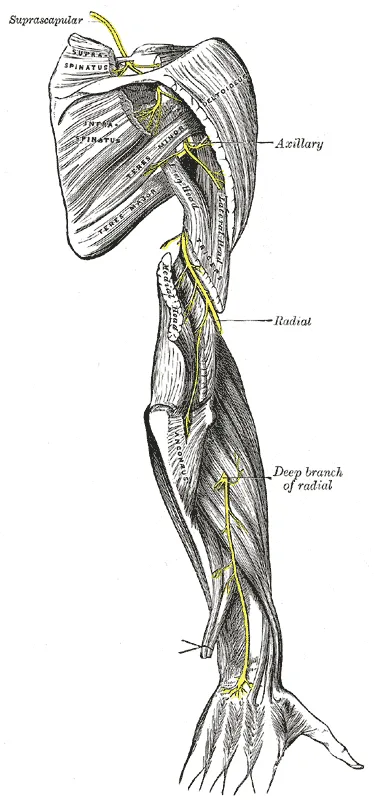
One dissection covered 30 sides from 15 cadavers (bodies donated for study)7. It found bands of fascia, a tough connective tissue, in the space in 27 of the 30 sides7.
Where it divides and what it supplies
The nerve splits into a front (anterior) and a back (posterior) branch8. Two cadaver studies give different figures for where it divides7,8.
| Cadavers dissected | What was counted | Inside the quadrilateral space | Elsewhere |
|---|---|---|---|
| 15, giving 30 sides | Division into its muscle branches | 33% of sides | 66%, behind the space7 |
| 50, giving 100 nerves | Split into anterior and posterior branches | 65% of cases | 35%, within the deltoid8 |
A review describes the anterior branch passing deep to the deltoid, around the neck of the humerus2. In that account it supplies the front and middle of the deltoid, and almost always part of the back2.
The posterior branch supplies the back of the deltoid and the teres minor2. It also gives rise to a skin nerve, which supplies the skin of the upper outer arm2. In 30 shoulders from 15 cadavers, the posterior branch alone supplied the back of the deltoid in 70% of cases9. Both branches supplied it in 26.7%, and the anterior branch did in 3.3%9. A review states that the nerve also sends sensory branches, which carry feeling, to the shoulder joint6.
Breakdown
How it gets hurt
A review names injury to this nerve as the most common isolated peripheral nerve injury around the shoulder in adults6. The causes it lists include direct blows, dislocations, fractures, traction (a pull along the length), penetrating wounds, quadrilateral space syndrome and surgery6. Another review places the most common zone of injury just before the quadrilateral space4.
Neuropathy means damage to a nerve, or a disorder of one. A review of sports nerve injuries describes axillary neuropathy as disturbed feeling over the outer shoulder, an area called the regimental patch5. With it comes weakness in raising the arm sideways and turning it outward5. The review notes that pain and weakness from a dislocation or fracture can hide it at first5.
With a shoulder dislocation
A dislocation is when a bone is forced fully out of its normal place at a joint. A review attributes the nerve’s vulnerability to how it is fixed in place2. It is held between the neck of the humerus and the quadrilateral space, and its many branches tether it further along2. So it is pulled when the head of the humerus dislocates2.
One review reports isolated axillary nerve injury in 3.3% to 40% of shoulder dislocations2.
Single studies counted different things in different groups10,11,12.
| Who was studied | What was counted | Share |
|---|---|---|
| 240 patients with a traumatic anterior (forward) dislocation | Axillary nerve injury on its own, and combined with other injuries | 3.33% and 12.5%10 |
| 108 patients aged 60 or more with an anterior dislocation | Axillary nerve injury | 9.3%11 |
| 77 patients with an anterior dislocation after low-velocity trauma | Axillary nerve involved, in a clinical and EMG study | 42%12 |
A literature review relays one study, of 77 patients, in which the probability of a nerve injury with dislocation rose by a factor of 1.3 with each added 10 years of age13. A literature review found complete disruption of a nerve after dislocation to be rare13. It was seen only in the axillary nerve, in 2.4% and 2.7% of patients in two studies13. The shoulder dislocation page covers the dislocation itself.
In sport and under a load
A review states that axillary nerve injuries are among the most common peripheral nerve injuries in contact-sport athletes14. One series followed 11 contact athletes with an isolated axillary nerve injury and no known dislocation15. Nine were hurt tackling in football and two in hockey collisions15. Seven took a direct blow to the front outer deltoid, and in four the neck was bent away while the shoulder was pushed down15.
A retrospective review, one that looks back at past records, covered 152,095 military conscripts16. Nerve compression after carrying a load on the shoulders affected the axillary nerve in 13 patients16. It affected the long thoracic nerve, a nerve on the side of the chest, in 1916.
Squeezing in the quadrilateral space
Quadrilateral space syndrome is a rare condition in which the nerve, or the artery beside it, is trapped in the quadrilateral space17. A 2025 review calls compression of the nerve there extremely rare, with fewer than 50 cases reported5. Another review names fibrous bands as the leading cause6. It says studies have shown the bands tighten when the arm is raised sideways and rotated, which makes the space smaller6.
A third review states that reported cases typically involve otherwise healthy people under forty18. They can have a history of repeated overhead activity, such as volleyball, baseball or swimming18. A 2025 review states that the exact way the isolated syndrome develops is still not clearly understood6. It adds that most of the evidence on compression of this nerve comes from case series, reports on groups of patients with no comparison group6.
Recovery
Without an operation
Two reviews state that most axillary nerve injuries recover without an operation4,5. One says the majority of traumatic injuries in athletes are conduction blocks, also called neurapraxia4,5. Neurapraxia is the mildest grade of nerve injury, in which signals are blocked but the nerve fibres stay whole.
A review describes the injury that comes with a dislocation as often low-grade, going on to full recovery without intervention2. A small number of patients have a higher-grade injury that is less likely to recover useful function without surgery2. The same review states that a conduction block should recover fully by three months2.
What follow-up studies found
- 108 patients aged 60 or more with an anterior dislocation. The 9.3% with an axillary nerve injury recovered completely in 3 to 12 months11.
- 77 patients with an anterior dislocation. On EMG and strength testing, recovery was almost complete12. Shoulder function was significantly impaired in those with axillary and suprascapular nerve lesions12.
- 11 contact athletes followed for 31 to 276 months. No athlete recovered full nerve function, and three had no deltoid improvement15. Ten of the 11 returned to their previous level of sport15.
Reviews of nerve injuries after dislocation report a mixed picture3,13. A systematic review found the literature inconsistent: some studies reported a favourable course, and others raised concerns about lost function3. A literature review reports that some studies described recovery without intervention in 75% to 100% of patients13. It adds that the capacity to regenerate falls with age, with lasting loss of limb movement in up to 60% of patients13.
After surgery
A review states that results of axillary nerve repair have been good compared with other peripheral nerves4. It attributes this to the nerve being a single bundle, and to the short distance from the usual injury zone to the muscle4.
Studies compare two operations, nerve grafts and nerve transfers19. A graft is a piece of tissue moved from one place to replace or rebuild a damaged part. A nerve transfer reroutes a working nerve to a muscle that has lost its own nerve supply.
| Group studied | What was reported |
|---|---|
| A 2017 systematic review of 10 retrospective studies, with 20 nerve grafts and 46 transfers | Useful strength for raising the arm sideways in 100% of graft patients and 87% of transfer patients; the difference was not statistically significant19 |
| 44 patients, counted in a 2025 review, described as having surgical release for quadrilateral space syndrome | 13 reported excellent or full recovery, 24 good or partial recovery, and 5 no improvement, paralysis or progressing symptoms5 |
One review reports a trend towards better results when surgery is done less than 4 to 6 months after injury2,4. It reports stronger evidence of significantly poorer results after 9 to 12 months2,4. An earlier review put the best results at 3 to 6 months2,4. A review also reports that results of grafting and transfer worsen after age 30, with the possibility of no recovery after age 502.
Connections
The muscles it supplies
The anterior branch supplies the anterior deltoid, and the posterior branch supplies the posterior deltoid and the teres minor6. The middle deltoid receives both6. In long-standing compression of the nerve, wasting of the deltoid and teres minor may be seen6.
The shoulder joint and its injuries
In a dissection of 15 cadaver specimens, the axillary nerve supplied the two lower parts of the shoulder joint in each specimen20. In twelve fresh cadaver shoulders, the nerve lay close to the socket with the arm in neutral, extended or turned inward21. With the arm raised sideways and turned outward under traction, the capsule tightened and the nerve moved away from the socket21.
A review notes that axillary nerve injury may occur together with a shoulder dislocation and a tear of the rotator cuff22. The combination is called the “unhappy triad” of the shoulder22. The rotator cuff is a group of four muscles that cross the shoulder joint and help hold it steady.
Axillary nerve supplies
Axillary nerve runs along the lower outer border of
Axillary nerve sends sensory branches to
Axillary nerve lies against the surgical neck of
Axillary nerve is injured in
Axillary nerve can be injured together with a tear of
Axillary nerve was compressed under carried shoulder loads, in one study of conscripts, alongside
Sources
- Okwumabua E, Thompson JH (2023). Anatomy, Shoulder and Upper Limb, Axillary Nerve.. StatPearls. PMID 29630264
- Avis D, Power D (2018). Axillary nerve injury associated with glenohumeral dislocation: A review and algorithm for management.. EFORT open reviews. doi:10.1302/2058-5241.3.170003 PMID 29657847
- Lorente A, Mariscal G, Barrios C, Lorente R (2023). Nerve Injuries after Glenohumeral Dislocation, a Systematic Review of Incidence and Risk Factors.. Journal of Clinical Medicine. doi:10.3390/jcm12134546 PMID 37445581
- Steinmann SP, Moran EA (2001). Axillary nerve injury: diagnosis and treatment.. The Journal of the American Academy of Orthopaedic Surgeons. doi:10.5435/00124635-200109000-00006 PMID 11575912
- Farag JI, McDougall AN, Catapano M (2025). Common sports-related nerve injuries seen by the electrodiagnostic medical consultant.. Muscle & nerve. doi:10.1002/mus.28298 PMID 39535438
- Ayik G, Kolac UC, Kaymakoglu M, McFarland E, Huri G (2025). Dark side of the shoulder: suprascapular and axillary nerve compressions.. International Orthopaedics. doi:10.1007/s00264-025-06465-9 PMID 40082300
- Tubbs RS, Tyler-Kabara EC, Aikens AC, Martin JP, Weed LL, Salter EG, Oakes WJ (2005). Surgical anatomy of the axillary nerve within the quadrangular space.. Journal of neurosurgery. doi:10.3171/jns.2005.102.5.0912 PMID 15926719
- Loukas M, Grabska J, Tubbs RS, Apaydin N, Jordan R (2009). Mapping the axillary nerve within the deltoid muscle.. Surgical and radiologic anatomy : SRA. doi:10.1007/s00276-008-0409-3 PMID 18766295
- Uz A, Apaydin N, Bozkurt M, Elhan A (2007). The anatomic branch pattern of the axillary nerve.. Journal of shoulder and elbow surgery. doi:10.1016/j.jse.2006.05.003 PMID 17097311
- Atef A, El-Tantawy A, Gad H, Hefeda M (2016). Prevalence of associated injuries after anterior shoulder dislocation: a prospective study.. International orthopaedics. doi:10.1007/s00264-015-2862-z PMID 26133290
- Gumina S, Postacchini F (1997). Anterior dislocation of the shoulder in elderly patients.. The Journal of bone and joint surgery. British volume. doi:10.1302/0301-620x.79b4.7497 PMID 9250734
- Visser CP, Coene LN, Brand R, Tavy DL (1999). The incidence of nerve injury in anterior dislocation of the shoulder and its influence on functional recovery. The Journal of bone and joint surgery. British volume. doi:10.1302/0301-620x.81b4.9005 PMID 10463745
- Gutkowska O, Martynkiewicz J, Urban M, Gosk J (2018). Brachial plexus injury after shoulder dislocation: a literature review.. Neurosurgical review. doi:10.1007/s10143-018-1001-x PMID 29961154
- Perlmutter GS, Apruzzese W (1998). Axillary Nerve Injuries in Contact Sports. Sports medicine (Auckland, N.Z.). doi:10.2165/00007256-199826050-00005 PMID 9858397
- Perlmutter GS, Leffert RD, Zarins B (1997). Direct injury to the axillary nerve in athletes playing contact sports.. The American journal of sports medicine. doi:10.1177/036354659702500112 PMID 9006694
- Mäkelä JP, Ramstad R, Mattila V, Pihlajamäki H (2006). Brachial plexus lesions after backpack carriage in young adults.. Clinical orthopaedics and related research. doi:10.1097/01.blo.0000229338.29277.29 PMID 16906084
- Charmode S, Sharma S, Kushwaha S, Mehra S, Philip S, Janagal R, Amrutiya P (2023). Quadrangular Space Syndrome: a systematic review of surgical and medical therapeutic advances.. Journal of Public Health in Africa. doi:10.4081/jphia.2023.2239 PMID 36798848
- Hangge PT, Breen I, Albadawi H, Knuttinen MG, Naidu SG, Oklu R (2018). Quadrilateral Space Syndrome: Diagnosis and Clinical Management.. Journal of clinical medicine. doi:10.3390/jcm7040086 PMID 29690525
- Koshy JC, Agrawal NA, Seruya M (2017). Nerve Transfer versus Interpositional Nerve Graft Reconstruction for Posttraumatic, Isolated Axillary Nerve Injuries: A Systematic Review.. Plastic and reconstructive surgery. doi:10.1097/prs.0000000000003749 PMID 29068931
- Tran J, Peng PWH, Agur AMR (2019). Anatomical study of the innervation of glenohumeral and acromioclavicular joint capsules: implications for image-guided intervention.. Regional anesthesia and pain medicine. doi:10.1136/rapm-2018-100152 PMID 30635516
- Uno A, Bain GI, Mehta JA (1999). Arthroscopic relationship of the axillary nerve to the shoulder joint capsule: an anatomic study.. Journal of shoulder and elbow surgery. doi:10.1016/s1058-2746(99)90133-7 PMID 10389077
- Apaydin N, Tubbs RS, Loukas M, Duparc F (2010). Review of the surgical anatomy of the axillary nerve and the anatomic basis of its iatrogenic and traumatic injury.. Surgical and radiologic anatomy : SRA. doi:10.1007/s00276-009-0594-8 PMID 19916067
Changes
- Revised to report sources added after their published corrections were read