Shoulder dislocation
Also called dislocated shoulder, shoulder instability, anterior shoulder dislocation, anterior shoulder instability
The upper arm bone forced out of the shoulder socket, most often forward. How a care pathway and reviews define it, who it affects, how often it recurs, and what trials of slings, exercise and surgery found.
- Region
- Shoulder
- Updated
- October 8, 2026
- Reviewed
- October 8, 2026 · how entries are checked
What it is
How a care pathway and reviews define it
A 2015 care pathway from two British orthopaedic societies defines traumatic anterior (forward) shoulder instability7. It is excessive forward movement of the head of the humerus (upper arm bone) on the socket, caused primarily by a traumatic event7. The pathway says its symptoms include pain, discomfort, subluxation or dislocation7. A subluxation is a partial slip of a joint out of its usual place. A dislocation is when a bone is forced fully out of its normal place at a joint.
A 2019 Cochrane review describes acute anterior dislocation as the most common type of shoulder dislocation, usually the result of an injury1. Afterwards, the review says, the shoulder is less stable and more prone to dislocating again, especially in active young adults1. The 2015 pathway states that 96% of shoulder dislocations have historically been put down to a traumatic episode7. Anterior dislocations account for 97% of those, it adds7.
The joint involved is the shoulder joint, which moves through a larger range than any other joint in the body8. That freedom comes from a lack of structural support, so the gain in movement is offset by a loss of stability8.
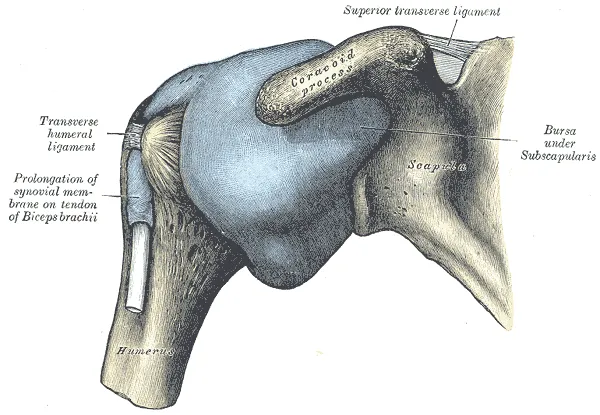
How instability is classified
The FEDS system classifies instability of the glenohumeral joint (the main shoulder joint, the ball and socket) by four features9. They are frequency, cause, main direction and severity9. Cause is traumatic or atraumatic (without an injury), and direction is anterior, posterior (backward) or inferior (downward)9. Severity is subluxation or dislocation9.
In a review of 120 posterior dislocations, 67% followed a traumatic accident and most of the rest followed seizures10. A 2026 Cochrane review characterises multidirectional instability as subluxation or dislocation, with symptoms, in two or more directions11.
What is injured along with it
A Bankart lesion is a detachment of the front of the labrum along with the joint capsule12. The labrum is a rim of tough tissue around the edge of a joint socket, and the capsule is the sleeve enclosing the joint. A systematic review searches for all the research on a question in a set, checkable way. One of 22 studies (1,920 shoulders) found a Bankart lesion in 59% after a first forward dislocation from injury13. Its authors urge caution because results differed substantially between studies, and the shoulder labrum page covers these tears13.
Among 3,633 consecutive patients with a traumatic anterior dislocation, 33.4% had a torn rotator cuff or a fracture of the greater tuberosity14. The rotator cuff is a group of four muscles that cross the shoulder joint and help hold it steady. The greater tuberosity is a bump at the top of the upper arm bone. In 3,633 such patients, 13.5% had a neurological deficit (a loss of nerve function) after the joint was put back14. The rotator cuff tendons page covers cuff tears, and the axillary nerve page covers nerve injury with dislocation14.
Who it affects
How common it is
Studies have counted dislocations in a province, in primary care records and in the military15,16,17. Person-years are a count of people multiplied by the years each was followed.
| Group studied | What was found |
|---|---|
| Ontario, Canada: people aged 16 to 70, 2002 to 2010 | 20,719 had a first anterior dislocation put back by a physician, 23.1 per 100,000 person-years; 98.3 among young males15 |
| UK primary care records, ages 16 to 70, 1995 to 2015 | 40.4 per 100,000 person-years in men and 15.5 in women16 |
| US military personnel, 1998 to 2006 | 1.69 per 1,000 person-years17 |
Age, sex and activity
In the Ontario count the median age was 35, and 74.3% were male15. Among 8,940 dislocations seen in US emergency departments, 71.8% were in males, and the rate peaked at ages 20 to 2918. Of those 8,940, 58.8% resulted from a fall and 48.3% occurred during sports or recreation18. In the UK records the rate in women rose with age, to 28.6 per 100,000 person-years at ages 61 to 7016.
What studies found
How often it happens again
A Swedish multicentre study followed 255 patients after a first anterior dislocation2. Among Swedish patients aged 12 to 40 managed without surgery, 43% of 229 shoulders had not dislocated again after 25 years2. A further 7% had dislocated once more, 14.4% had recurred and then become stable, and 7.9% were still recurring2. Another 27% had had surgery for recurrent instability2.
Shorter studies report a wide range15,19:
| Group studied | What was found |
|---|---|
| 20,719 people in Ontario after a first anterior dislocation was put back | 19% needed another shoulder reduction (the joint put back), after a median of 0.9 years15 |
| 252 patients aged 15 to 35, given a sling and then an exercise programme | Instability in 55.7% of shoulders within two years and 66.8% by the fifth year20 |
| 15 studies of first anterior dislocations managed without surgery | Recurrence from 19% to 88%; a pooled rate of 21% overall and 47% in the highest-level studies19 |
A systematic review of first anterior dislocations found the odds of recurrence 12.76 times higher under age 20 than over it19. In males the odds were 2.68 times higher19. It rated the evidence as moderate for age and low for sex19. In a 25-year follow-up of first anterior dislocations, by contrast, neither sex nor athletic activity appeared to affect the rate of dislocating again2.
Joint wear in later years
In a Swedish study, people aged 12 to 40 at a first anterior dislocation had X-rays 25 years later21. Of 223 shoulders, 44% had a normal joint, 29% mild joint degeneration, 9% moderate and 17% severe21. In a 25-year follow-up of first-time anterior dislocations, 18% of shoulders that had not dislocated again still had moderate or severe degeneration21. The figure was 39% for shoulders that recurred without surgery21.
A meta-analysis of 36 articles (1,832 patients) with at least five years of follow-up looked at osteoarthritis, wear of joint cartilage22. A meta-analysis pools the results of several earlier studies. It found similar proportions after surgical and non-surgical management of anterior instability22. Only one of the 36 articles reported on non-surgical management22.
Arm position in a sling
The 2019 Cochrane review says most anterior dislocations are managed with a few weeks in a sling or brace, then exercises1. Its seven trials each compared holding the arm in external rotation, turned outward, with internal rotation, turned inward1. The review was uncertain whether external rotation changes the risk of dislocating again at 12 months or later1. A meta-analysis of 17 studies, searched to December 2025, found no significant difference between the two positions in recurrence rate23.
Early surgery against a sling
Bankart repair is an operation that fixes the torn labrum back onto the rim of the shoulder socket. Arthroscopic means keyhole surgery inside a joint, using a small camera. Several reviews have pooled trials of surgery after a first dislocation3,4,24:
- A 2004 Cochrane review of five trials (239 young, active, mainly male people) found later instability significantly less often in the surgical groups24. It found no evidence for other groups of patients24.
- A meta-analysis of five randomised trials (mean ages about 23) found recurrent instability in 6.3% of surgical patients and 46.6% of sling patients3.
- A 2024 network meta-analysis, which compares many options at once, pooled 15 randomised trials4. Arthroscopic Bankart repair likely gave a large reduction in redislocation compared with immobilisation (keeping the arm still) in internal rotation4. The four approaches it compared may differ little or not at all in instability-specific quality of life4.
Exercise programmes
A UK randomised trial enrolled 482 adults (mean age 45) with a first traumatic anterior dislocation managed without surgery25. One group had one session of advice, and the other had that advice plus supervised sessions25. Shoulder function at six months did not differ significantly between them25. For multidirectional instability, a 2026 Cochrane review found no completed randomised trial comparing exercise with placebo, no intervention, a waiting list or usual care11.
One operation against another
A systematic review of eight comparative studies (795 shoulders) covered surgery for recurrent traumatic anterior instability5. It found a significantly lower risk of recurrence and redislocation after the Latarjet procedure than after Bankart repair5. The Latarjet procedure is an operation that fixes a block of bone to the front of the shoulder socket. The review found no significant difference in complications needing another operation5. Its authors note the studies were retrospective (looking back at past records) and of limited quality5.
A 2021 meta-analysis pooled 7 cohort studies, which follow groups of people over time, of arthroscopic Bankart repair and the Latarjet procedure6. A risk ratio is how many times more often something happens in one group than in another. The review found:
- Recurrence: a higher risk after Bankart repair, with a risk ratio of 2.87, and of 2.74 for redislocation6.
- Six to ten years on: a pronounced advantage for Latarjet in recurrence (risk ratio 3.00) and redislocation (2.85)6.
- Infection: a lower risk after Bankart repair (risk ratio 0.16)6.
- Other measures: the pooled effect favoured neither operation for the Rowe score (a shoulder score), revision (a repeat operation) or haematoma6. A haematoma is a pocket of blood that collects in tissue.
Two more systematic reviews took studies with at least 10 years of follow-up, and each covered one operation26,27.
| Review | Recurrent instability | Recurrent dislocation | Revision |
|---|---|---|---|
| Arthroscopic Bankart repair: 9 studies, 822 shoulders | 31.2%26 | 16.0%26 | 17.0%26 |
| Open Latarjet procedure: 13 studies, 845 shoulders | 8.5%27 | 3.2%27 | 3.7%27 |
The Bankart review found signs of joint degeneration in 59.4%26. The Latarjet review found arthritic changes in 38.2% and residual shoulder pain in 35.7%27.
Going back to sport
A systematic review of 22 studies followed 1,310 athletes after a first anterior dislocation managed without surgery28. It found 76.5% returned to play, 51.5% at their pre-injury level, with a pooled recurrence rate of 54.7%28. A 2022 statement from 65 shoulder surgeons in 14 countries says the minimum time before athletes go back to play is unknown29.
Connections
The condition centres on the shoulder joint, whose socket is roughly a third the size of the ball it holds8. One review puts injury of the axillary nerve at up to 40% of anterior dislocations30.
Related exercise pages: pull-up and push-up31,32. One case report describes a 44-year-old woman in whom both shoulders dislocated forwards at the same time during chin-ups31. A review of posterior instability in contact athletes states that these athletes will often report pain with push-ups and the bench press32.
Shoulder dislocation involves
Shoulder dislocation often comes with injury to
Shoulder dislocation can come with injury to
Shoulder dislocation has a case report during
Shoulder dislocation has a review that mentions
Sources
- Braun C, McRobert CJ (2019). Conservative management following closed reduction of traumatic anterior dislocation of the shoulder.. The Cochrane database of systematic reviews. doi:10.1002/14651858.CD004962.pub4 PMID 31074847
- Hovelius L, Olofsson A, Sandström B, Augustini BG, Krantz L, Fredin H, Tillander B, Skoglund U, Salomonsson B, Nowak J, Sennerby U (2008). Nonoperative treatment of primary anterior shoulder dislocation in patients forty years of age and younger. The Journal of bone and joint surgery. American volume. doi:10.2106/JBJS.G.00070 PMID 18451384
- Belk JW, Wharton BR, Houck DA, Bravman JT, Kraeutler MJ, Mayer B, Noonan TJ, Seidl AJ, Frank RM, McCarty EC (2023). Shoulder Stabilization Versus Immobilization for First-Time Anterior Shoulder Dislocation: A Systematic Review and Meta-analysis of Level 1 Randomized Controlled Trials.. The American journal of sports medicine. doi:10.1177/03635465211065403 PMID 35148222
- Karasuyama M, Tsuruta T, Yamamoto S, Ariie T, Kawakami J, Minamikawa T, Ohzono H, Moriyama H, Gotoh M (2024). Comparative efficacy of treatments for a first-time traumatic anterior shoulder dislocation: a systematic review and network meta-analysis.. Journal of shoulder and elbow surgery. doi:10.1016/j.jse.2024.05.036 PMID 39025357
- An VV, Sivakumar BS, Phan K, Trantalis J (2016). A systematic review and meta-analysis of clinical and patient-reported outcomes following two procedures for recurrent traumatic anterior instability of the shoulder: Latarjet procedure vs. Bankart repair.. Journal of shoulder and elbow surgery. doi:10.1016/j.jse.2015.11.001 PMID 26809355
- Imam MA, Shehata MSA, Martin A, Attia H, Sinokrot M, Bahbah EI, Gwilym S, Jacob J, Narvani AA, Meyer DC (2021). Bankart Repair Versus Latarjet Procedure for Recurrent Anterior Shoulder Instability: A Systematic Review and Meta-analysis of 3275 Shoulders.. The American journal of sports medicine. doi:10.1177/0363546520962082 PMID 33264030
- Brownson P, Donaldson O, Fox M, Rees JL, Rangan A, Jaggi A, Tytherleigh-Strong G, McBernie J, Thomas M, Kulkarni R (2015). BESS/BOA Patient Care Pathways. Shoulder & elbow. doi:10.1177/1758573215585656 PMID 27582981
- Betts JG, Young KA, Wise JA, Johnson E, Poe B, Kruse DH, Korol O, Johnson JE, Womble M, DeSaix P (2022). Anatomy and Physiology 2e. OpenStax. Link
- Kuhn JE, Helmer TT, Dunn WR, Throckmorton V TW (2011). Development and reliability testing of the frequency, etiology, direction, and severity (FEDS) system for classifying glenohumeral instability.. Journal of shoulder and elbow surgery. doi:10.1016/j.jse.2010.10.027 PMID 21277809
- Robinson CM, Seah M, Akhtar MA (2011). The epidemiology, risk of recurrence, and functional outcome after an acute traumatic posterior dislocation of the shoulder.. The Journal of bone and joint surgery. American volume. doi:10.2106/JBJS.J.00973 PMID 21915575
- Karasuyama M, Imai T, Gotoh M, Kawakami J, Ariie T, Yamamoto S (2026). Exercise for multidirectional instability of the shoulder.. The Cochrane database of systematic reviews. doi:10.1002/14651858.CD015450.pub2 PMID 41705637
- Almajed YA, Hall AC, Gillingwater TH, Alashkham A (2022). Anatomical, functional and biomechanical review of the glenoid labrum.. J Anat. doi:10.1111/joa.13582 PMID 34725812
- Rutgers C, Verweij LPE, Priester-Vink S, van Deurzen DFP, Maas M, van den Bekerom MPJ (2022). Recurrence in traumatic anterior shoulder dislocations increases the prevalence of Hill-Sachs and Bankart lesions: a systematic review and meta-analysis.. Knee Surg Sports Traumatol Arthrosc. doi:10.1007/s00167-021-06847-7 PMID 34988633
- Robinson CM, Shur N, Sharpe T, Ray A, Murray IR (2012). Injuries associated with traumatic anterior glenohumeral dislocations.. The Journal of bone and joint surgery. American volume. doi:10.2106/jbjs.j.01795 PMID 22218378
- Leroux T, Wasserstein D, Veillette C, Khoshbin A, Henry P, Chahal J, Austin P, Mahomed N, Ogilvie-Harris D (2014). Epidemiology of primary anterior shoulder dislocation requiring closed reduction in Ontario, Canada.. The American journal of sports medicine. doi:10.1177/0363546513510391 PMID 24275862
- Shah A, Judge A, Delmestri A, Edwards K, Arden NK, Prieto-Alhambra D, Holt TA, Pinedo-Villanueva RA, Hopewell S, Lamb SE, Rangan A, Carr AJ, Collins GS, Rees JL (2017). Incidence of shoulder dislocations in the UK, 1995-2015: a population-based cohort study.. BMJ open. doi:10.1136/bmjopen-2017-016112 PMID 29138197
- Owens BD, Dawson L, Burks R, Cameron KL (2009). Incidence of shoulder dislocation in the United States military: demographic considerations from a high-risk population.. The Journal of bone and joint surgery. American volume. doi:10.2106/JBJS.H.00514 PMID 19339562
- Zacchilli MA, Owens BD (2010). Epidemiology of shoulder dislocations presenting to emergency departments in the United States.. The Journal of bone and joint surgery. American volume. doi:10.2106/JBJS.I.00450 PMID 20194311
- Wasserstein DN, Sheth U, Colbenson K, Henry PD, Chahal J, Dwyer T, Kuhn JE (2016). The True Recurrence Rate and Factors Predicting Recurrent Instability After Nonsurgical Management of Traumatic Primary Anterior Shoulder Dislocation: A Systematic Review.. Arthroscopy : the journal of arthroscopic & related surgery : official publication of the Arthroscopy Association of North America and the International Arthroscopy Association. doi:10.1016/j.arthro.2016.05.039 PMID 27487737
- Robinson CM, Howes J, Murdoch H, Will E, Graham C (2006). Functional outcome and risk of recurrent instability after primary traumatic anterior shoulder dislocation in young patients.. The Journal of bone and joint surgery. American volume. doi:10.2106/JBJS.E.01327 PMID 17079387
- Hovelius L, Saeboe M (2009). Neer Award 2008: Arthropathy after primary anterior shoulder dislocation--223 shoulders prospectively followed up for twenty-five years.. Journal of shoulder and elbow surgery. doi:10.1016/j.jse.2008.11.004 PMID 19254851
- Verweij LPE, Pruijssen EC, Kerkhoffs GMMJ, Blankevoort L, Sierevelt IN, van Deurzen DFP, van den Bekerom MPJ (2021). Treatment type may influence degree of post-dislocation shoulder osteoarthritis: a systematic review and meta-analysis.. Knee surgery, sports traumatology, arthroscopy : official journal of the ESSKA. doi:10.1007/s00167-020-06263-3 PMID 32936334
- Boutros M, Awad G, Adio A, Lawand J, Smadi Z, Khan AZ, Hill BW, Horneff JG, Abboud JA (2026). Comparing external vs. internal rotation immobilization following primary anterior shoulder dislocation: a meta-analysis.. The Physician and sportsmedicine. doi:10.1080/00913847.2026.2647715 PMID 41843404
- Handoll HH, Almaiyah MA, Rangan A (2004). Surgical versus non-surgical treatment for acute anterior shoulder dislocation.. The Cochrane database of systematic reviews. doi:10.1002/14651858.CD004325.pub2 PMID 14974064
- Kearney RS, Ellard DR, Parsons H, Haque A, Mason J, Nwankwo H, Bradley H, Drew S, Modi C, Bush H, Torgerson D, Underwood M, The ARTISAN collaborators, ARTISAN collaborators (2024). Acute rehabilitation following traumatic anterior shoulder dislocation (ARTISAN): pragmatic, multicentre, randomised controlled trial.. BMJ (Clinical research ed.). doi:10.1136/bmj-2023-076925 PMID 38233068
- Murphy AI, Hurley ET, Hurley DJ, Pauzenberger L, Mullett H (2019). Long-term outcomes of the arthroscopic Bankart repair: a systematic review of studies at 10-year follow-up.. Journal of shoulder and elbow surgery. doi:10.1016/j.jse.2019.04.057 PMID 31311748
- Hurley ET, Jamal MS, Ali ZS, Montgomery C, Pauzenberger L, Mullett H (2019). Long-term outcomes of the Latarjet procedure for anterior shoulder instability: a systematic review of studies at 10-year follow-up.. Journal of shoulder and elbow surgery. doi:10.1016/j.jse.2018.08.028 PMID 30545784
- Hurley ET, Colasanti CA, Haskel JD, Strauss EJ, Alaia MJ, Jazrawi LM, Matache BA (2023). Return to Play After Non-Operative Management of Primary Anterior Shoulder Instability A Systematic Review.. Bulletin of the Hospital for Joint Disease (2013). PMID 37200329
- Matache BA, Hurley ET, Wong I, Itoi E, Strauss EJ, Delaney RA, Neyton L, Athwal GS, Pauzenberger L, Mullett H, Jazrawi LM, Anterior Shoulder Instability International Consensus Group (2022). Anterior Shoulder Instability Part III-Revision Surgery, Rehabilitation and Return to Play, and Clinical Follow-Up-An International Consensus Statement.. Arthroscopy : the journal of arthroscopic & related surgery : official publication of the Arthroscopy Association of North America and the International Arthroscopy Association. doi:10.1016/j.arthro.2021.07.019 PMID 34332051
- Farag JI, McDougall AN, Catapano M (2025). Common sports-related nerve injuries seen by the electrodiagnostic medical consultant.. Muscle & nerve. doi:10.1002/mus.28298 PMID 39535438
- Felderman H, Shih R, Maroun V (2009). Chin-up-induced bilateral anterior shoulder dislocation: a case report.. The Journal of emergency medicine. doi:10.1016/j.jemermed.2008.06.001 PMID 19062229
- DeFoor MT, McDermott ER, DePhillipo NN, Dekker TJ (2025). Posterior shoulder instability in the contact athlete: a review of the diagnosis, management and outcomes.. Annals of joint. doi:10.21037/aoj-25-26 PMID 41221335
Changes
- Revised to report sources added after their published corrections were read