Rotator cuff tendons
Also called rotator cuff
The four tendons that wrap the top of the upper arm bone and hold it in the shoulder socket. How they steady the joint, how often they tear with age, and what is known about how they change.
- Region
- Shoulder
- Muscles
- supraspinatus, infraspinatus, subscapularis, teres minor
- Updated
- September 29, 2026
- Reviewed
- September 29, 2026 · how entries are checked
Function
How four tendons make one cuff
The rotator cuff is a ring of tendons around the shoulder joint1. It is made of the tendons of four muscles1. Two are the subscapularis (a rotator cuff muscle on the front of the shoulder blade) and the supraspinatus1. The other two are the infraspinatus and teres minor (a small rotator cuff muscle on the back of the shoulder blade)1. Each tendon links the scapula (shoulder blade) to the humerus (upper arm bone)1.
As they cross the joint, the tendons wrap around the head of the humerus1. There they fuse with the front, top and back walls of the joint capsule, the sleeve of tough tissue around the joint1.
In a study of 32 intact cuffs from 30 cadavers (donated bodies), the tendons fanned out and wove together6. They formed one unbroken attachment on the humerus6.
The tendon along the top
The supraspinatus is a cuff muscle that sits above the ridge, or spine, of the shoulder blade7. Its tendon runs outward beneath the acromion, the bony point at the top of the shoulder7. It then passes over the head of the humerus and blends with the joint capsule7. It attaches to the top face of the greater tuberosity, a bump at the top of the upper arm bone7.
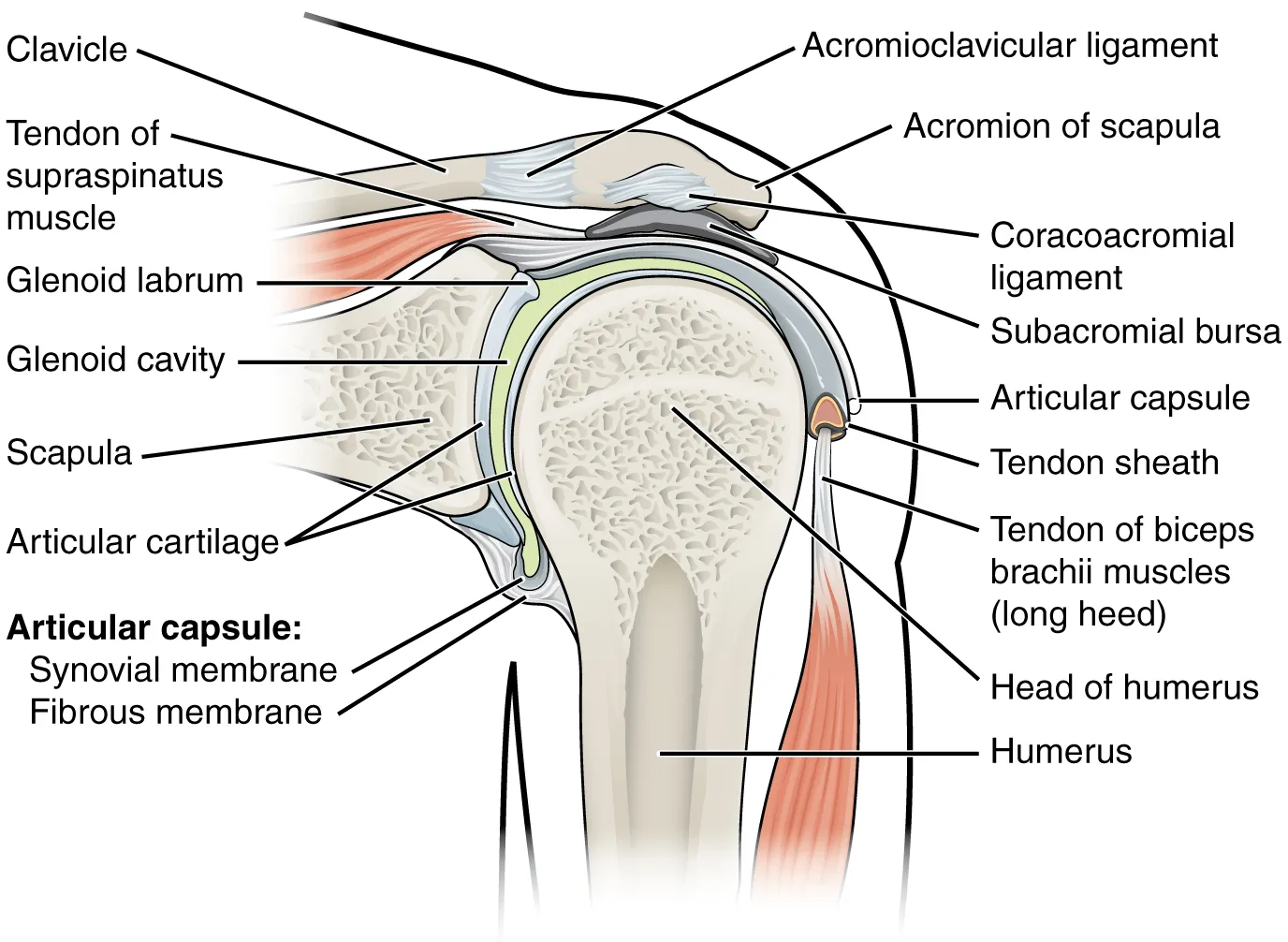
Two bursae, small fluid-filled cushions, reduce friction where the cuff tendons cross the joint1. They lie between the tendons and the shoulder blade1.
How the cuff holds the joint steady
The shoulder gets its main support from the muscles that cross it, especially the four cuff muscles1. Besides moving the arm, these muscles keep adjusting how hard they pull, acting as active ligaments1. The cuff presses the ball of the humerus into the socket, which is called concavity compression2. With nearby muscles, it keeps the unstable joint centred and stops the humerus riding upward2. When this balance is lost, the ball can shift or partly slip out of place2.
A review sorts the shoulder’s supports into two kinds8. Fixed supports include the joint capsule and ligaments8. The cuff muscles are active supports8. So is the long head of the biceps (the two-headed muscle on the front of the upper arm)8.
What the cuff muscles do
The supraspinatus helps steady the joint and lifts the arm out to the side, called abduction7. It may also help weakly with external rotation, turning the arm outward7. The infraspinatus is a thick, triangular muscle filling much of the infraspinous fossa, the hollow on the back of the shoulder blade below its ridge9. It mainly helps turn the arm outward and raise it in the plane of the shoulder blade, called scaption9.
A review reports estimated forces for the deltoid (the rounded muscle that caps the shoulder) and three cuff muscles in sideways lifting10:
| Muscle | Estimated force during abduction |
|---|---|
| Middle deltoid | 434 newtons10 |
| Subscapularis | 283 newtons10 |
| Infraspinatus | 205 newtons10 |
| Supraspinatus | 117 newtons10 |
In scaption, the same review says, the infraspinatus and subscapularis produce two to three times the supraspinatus’s force10. Yet the supraspinatus lifts the arm more effectively, because it has a better moment arm (leverage)10. The cuff muscles lift the arm best at low angles, and the deltoid at higher ones10.
Breakdown
Tendinopathy and pain under the acromion
A Dutch guideline defines subacromial pain syndrome as shoulder pain that hurts most when the arm is raised11. The pain does not come from an injury or a rheumatic disease11. The guideline counts degenerative supraspinatus tears among the conditions it covers11.
One review describes two groups of causes for cuff tendinopathy, local pain in a tendon that comes with activities that load it12:
- Outside causes, such as acromion shape, posture or altered movement, crowd the space under the acromion and help squeeze the tendons’ bursa-facing side12.
- Inside causes are changes in the tendon’s biology, mechanics, shape and blood supply that weaken it under pulling or shearing overload12.
The review concludes that cuff tendinopathy is not one uniform condition12.
In overhead throwing athletes, internal impingement describes symptoms with the arm raised and turned out13. The greater tuberosity and the cuff’s joint-facing surface press against the back-top edge of the socket13. In internal impingement, partial tears on the joint side are a common imaging finding13.
How common tears are
A 2026 meta-analysis, a study pooling earlier studies, combined 17 imaging studies of 5,988 people14. Across those studies, it estimated that 38.6% of people had a cuff tear14. The share was 23.6% in people without symptoms and 55.5% in symptomatic, trauma or outpatient groups14. For full-thickness tears, the pooled figure was 21.0%, against 43.8% when any tear counted14.
Ultrasound (a scan made with sound waves) screening of 664 residents of one village found full-thickness tears in 22.1%4:
| Age group | Residents with a full-thickness tear |
|---|---|
| 20s to 40s | 0%4 |
| 50s | 10.7%4 |
| 60s | 15.2%4 |
| 70s | 26.5%4 |
| 80s | 36.6%4 |
A systematic review of 30 studies concluded that cuff wear is common enough in people without symptoms to count as a normal part of ageing3. That makes it hard to tell when a change on a scan is causing symptoms3. The supraspinatus is generally believed to be the tendon most often torn15. Even so, wasting of the infraspinatus muscle is often seen with small to medium tears15.
Who tears, and whether it hurts
A meta-analysis of 6,653 people looked at factors linked to tears16:
- At age 60 or over, the odds of a tear were 5.07 times those under 6016.
- The odds were 2.30 times higher in the dominant arm than the other arm16.
- Sex showed no significant link with tears16.
The village screening, by contrast, found a sex difference in some age groups4. There, full-thickness tears were significantly more common in men than women in their 50s and 60s, but not in their 70s and 80s4.
In one village screening of 664 residents, about two-thirds of the full-thickness tears found caused no symptoms4. Another study scanned 588 people for pain in one shoulder17. In those with tears in both shoulders, the painful tear was on average 30% larger than the painless one17.
Load in sport and lifting
A 2026 European consensus graded as presumptive the higher rate of joint-side partial tears in overhead and contact athletes18.
In 35 elite teenage tennis players without symptoms, MRI (magnetic resonance imaging) scans showed infraspinatus tendinosis, or tendon wear, more often in the playing arm19. In 24 competitive powerlifters in the bench press position, women had a smaller gap under the acromion than men20. The supraspinatus tendon also filled a larger share of that gap in the women20. Rotator cuff injury is among the injuries the literature links to the bench press, though high-quality data are lacking21.
Blood supply near the attachment
Studies disagree about a poorly supplied zone near the supraspinatus attachment22,23. In a study that injected the vessels of 22 adult shoulders, a “critical zone” with no visible vessels lay on the tendon, larger with age22. Its outer edge sat on average 7.8 mm from the bone22. In 18 specimens, another study found few vessels near the attachment on the joint side, and a good supply on the bursa side24. Measuring blood flow during keyhole surgery in 56 patients, however, researchers could not show such a zone in normal cuffs23.
Recovery
What short-term studies show
The two studies here of how these tendons respond to load measured thickness around one session, not change over months of training25,26. In 8 state- and national-level swimmers, supraspinatus tendon thickness rose right after both a long and a hard session25. After the hard session, it was still thicker at 6 hours but not at 24 hours25.
The other study followed 50 competitive swimmers aged 14 to 2226. The authors report data suggesting that larger rises in thickness after practice go with a higher chance of significant shoulder pain26. That pain was tracked over the following 6 months26.
What happens to tears over time
A systematic review of 21 studies, covering 1,831 tears, looked at tear growth27. Partial-thickness tears, which go through part of the tendon, progressed in 26.7% over about 2.2 years27. Full-thickness tears progressed in 54.9% over about 3 years27. The studies defined progression in several different ways27. The European consensus judged the course of joint-side tears in overhead and contact athletes unpredictable18.
A prospective study, one that follows people forward in time, tracked 229 people aged 65 or under with a painless tear from wear28. Over a median (middle value) of 7.1 years, 60% of the tears grew28. In the same group, 57% of shoulders became painful, and pain went with tear growth28. For full-thickness tears in that study, the share not yet grown fell over time28:
| Years of follow-up | Full-thickness tears still not grown |
|---|---|
| 2 | 74%28 |
| 5 | 42%28 |
| 8 | 20%28 |
Two cohort studies, which follow a group of people over time, tracked painful tears first managed without surgery29,30. One followed 452 people with full-thickness tears not caused by an injury, after a standard 6- to 12-week programme without surgery29. Over 10 years, 115 people, about a quarter, had surgery at some point, and scores in those who did not have surgery did not decline29. The other followed 82 people with a painful supraspinatus tear after 12 weeks of exercise30. Within 2 years, 30.5% of tears had grown, and current or past smokers had 5.4 times the odds of growth30.
Blood flow at the edges of tears
In the 56 patients measured during keyhole surgery, blood flow was lower in cuffs with impingement, or pinching under the acromion, than in normal cuffs23. It was higher at the edges of tears23. The authors suggest this might reflect an attempt at repair23.
What trials of surgery found
A trial randomly assigned 313 people with subacromial pain and intact cuff tendons to three groups31. One had subacromial decompression surgery, one had arthroscopy (keyhole surgery inside a joint) only, and one had no intervention31. At 6 months, shoulder scores did not differ between the two surgery groups31. Both did slightly better than no intervention, but by less than a clinically important amount31.
A Cochrane systematic review looked at adults with rotator cuff disease but no full-thickness tear5. It found high-certainty evidence that decompression gave no clinically important benefit over placebo surgery up to one year5. That held for pain, function and quality of life5.
Trials of surgical repair in full-thickness tears report different results at different time points32,33:
- At one year: a Cochrane review pooled trials in adults with full-thickness tears, mostly small, wear-related supraspinatus tears. They compared repair with exercise-based care without surgery. Surgery probably gave little or no extra improvement in pain32.
- At 15 years: a trial assigned 103 people with tears up to 3 cm to repair, or to physiotherapy with repair later if needed. The repair group scored 11.8 points higher on the Constant score, a score of shoulder pain, daily activity, movement and strength33. Its pain was 1.8 cm lower on a 10-cm scale33.
In the 26 people in that trial never operated on, tears grew on average from 16.2 to 31.6 mm front to back33. A meta-analysis of 31 studies of repaired full-thickness tears found that 15% to 21% had torn again on scans, depending on follow-up time34. Age, larger tears and fatty infiltration, or fat building up in the muscle, influenced how well repairs healed34.
What trials of exercise found
A 2026 network meta-analysis (one that compares many options at once) pooled 89 randomised trials (studies that assign people to groups by chance)35. Together they included 5,532 adults with cuff tendinopathy35. Shoulder-muscle exercises may have reduced pain and improved function compared with no intervention35. Most other interventions may not have done better than shoulder exercises alone35. The evidence for both findings was very uncertain35.
Other studies found no clear differences between groups, or conflicting results36,37,38:
- A Cochrane review found one high-quality trial of manual therapy (hands-on methods such as massage) plus exercise against placebo. It studied 120 people with long-standing cuff disease. It found no clinically important differences36.
- In a randomised trial of 200 people with long-standing subacromial impingement, usual care was compared with usual care plus a large dose of shoulder strengthening. That was built mainly on external rotation exercises, and pain and disability scores at 4 months were no better37.
- A systematic review found three randomised trials, with 283 people, comparing higher and lower exercise doses in cuff tendinopathy. Their results conflicted, with low to very low certainty38.
Connections
The deltoid and the biceps
The deltoid works with the cuff to lift the arm to the side39. When it contracts, it tends to slide the ball of the humerus upward40. The subscapularis, infraspinatus and teres minor pull down against this40. In people with cuff disease, the deltoid also makes up for weak neighbouring muscles39. A systematic review found large full-thickness cuff tears to be a significant risk factor for the deltoid rupturing41.
The long head of the biceps is one of the shoulder’s active supports, alongside the cuff muscles8.
Exercises that work the cuff
Related exercise pages: band external rotation. A 2009 review lists turning the arm out and in, at the side or raised 90 degrees, among exercises with high to very high activity10. That activity was in the cuff, deltoids and shoulder-blade muscles10. In studies of healthy people, cuff muscle activity changed with the setup42:
- In 10 healthy people, side-lying external rotation with the arm at the side drew the most infraspinatus and teres minor activity of seven exercises43.
- In 13 healthy men, supraspinatus activity during standing band external rotation was higher with the arm raised 45 or 90 degrees than at the side42.
- In those 13 men, a moderate band drew more supraspinatus and infraspinatus activity than a light band42.
In 15 volunteers doing the bench press, infraspinatus activity was significantly higher than subscapularis activity44. The authors read the cuff’s activity as steadying the shoulder against front-to-back shifting forces44.
Rotator cuff tendons is loaded by
Rotator cuff tendons works with to lift the arm
Rotator cuff tendons steadies the shoulder with
Rotator cuff tendons is active in
Sources
- Betts JG, Young KA, Wise JA, Johnson E, Poe B, Kruse DH, Korol O, Johnson JE, Womble M, DeSaix P (2022). Anatomy and Physiology 2e. OpenStax. Link
- Akhtar A, Richards J, Monga P (2021). The biomechanics of the rotator cuff in health and disease - A narrative review.. Journal of Clinical Orthopaedics and Trauma. doi:10.1016/j.jcot.2021.04.019 PMID 34012769
- Teunis T, Lubberts B, Reilly BT, Ring D (2014). A systematic review and pooled analysis of the prevalence of rotator cuff disease with increasing age.. Journal of Shoulder and Elbow Surgery. doi:10.1016/j.jse.2014.08.001 PMID 25441568
- Minagawa H, Yamamoto N, Abe H, Fukuda M, Seki N, Kikuchi K, Kijima H, Itoi E (2013). Prevalence of symptomatic and asymptomatic rotator cuff tears in the general population: From mass-screening in one village.. Journal of Orthopaedics. doi:10.1016/j.jor.2013.01.008 PMID 24403741
- Karjalainen TV, Jain NB, Page CM, Lähdeoja TA, Johnston RV, Salamh P, Kavaja L, Ardern CL, Agarwal A, Vandvik PO, Buchbinder R (2019). Subacromial decompression surgery for rotator cuff disease.. Cochrane Database of Systematic Reviews. doi:10.1002/14651858.CD005619.pub3 PMID 30707445
- Clark JM, Harryman DT 2nd (1992). Tendons, ligaments, and capsule of the rotator cuff. Gross and microscopic anatomy.. Journal of Bone and Joint Surgery (American Volume). PMID 1624486
- Jeno SH, Munjal A, Schindler GS (2023). Anatomy, Shoulder and Upper Limb, Arm Supraspinatus Muscle.. StatPearls. PMID 30725887
- La Rose J, Madrazo-Ibarra A, Varacallo MA (2026). Anatomy, Rotator Cuff.. StatPearls. PMID 28722874
- Williams JM, Sinkler MA, Obremskey W (2023). Anatomy, Shoulder and Upper Limb, Infraspinatus Muscle.. StatPearls. PMID 30020627
- Escamilla RF, Yamashiro K, Paulos L, Andrews JR (2009). Shoulder muscle activity and function in common shoulder rehabilitation exercises.. Sports Medicine. doi:10.2165/00007256-200939080-00004 PMID 19769415
- Lambers Heerspink FO, Veen EJD, Dorrestijn O, Visser CPJ, Leijs MJC, Van Poppel D, Stroomberg PA, Ottenheijm RPG, Kallewaard JW, De Ruiter TJW, Martens HA, Janssen FM, Geltink T, Ruiter MS, Van Raaij JJAM (2026). Update of guideline for diagnosis and treatment of subacromial pain syndrome: a multidisciplinary review by the Dutch Orthopedic Association Part 1: preventive measures, diagnostics, and non-surgical treatment of subacromial pain syndrome.. Acta Orthopaedica. doi:10.2340/17453674.2026.45365 PMID 41718640
- Seitz AL, McClure PW, Finucane S, Boardman ND 3rd, Michener LA (2011). Mechanisms of rotator cuff tendinopathy: intrinsic, extrinsic, or both?. Clinical Biomechanics. doi:10.1016/j.clinbiomech.2010.08.001 PMID 20846766
- Corpus KT, Camp CL, Dines DM, Altchek DW, Dines JS (2016). Evaluation and treatment of internal impingement of the shoulder in overhead athletes.. World Journal of Orthopedics. doi:10.5312/wjo.v7.i12.776 PMID 28032029
- Yang Y, Fu X, Meng S, Zhong M (2026). Prevalence of rotator cuff tears: a systematic review and meta-analysis of observational studies.. Frontiers in Physiology. doi:10.3389/fphys.2026.1876217 PMID 42755726
- Mochizuki T, Sugaya H, Uomizu M, Maeda K, Matsuki K, Sekiya I, Muneta T, Akita K (2008). Humeral insertion of the supraspinatus and infraspinatus. Journal of Bone and Joint Surgery (American Volume). doi:10.2106/JBJS.G.00427 PMID 18451386
- Sayampanathan AA, Andrew TH (2017). Systematic review on risk factors of rotator cuff tears.. Journal of Orthopaedic Surgery (Hong Kong). doi:10.1177/2309499016684318 PMID 28211286
- Yamaguchi K, Ditsios K, Middleton WD, Hildebolt CF, Galatz LM, Teefey SA (2006). The demographic and morphological features of rotator cuff disease. Journal of Bone and Joint Surgery (American Volume). doi:10.2106/JBJS.E.00835 PMID 16882890
- Kany J, Iban MAR, Rosso C, Peach C, Métais P, Dias CM, Calvo E, Saccomanno MF, Bøe B, Brilakis E, Bilsel K, Kovacic L, Raebroeckx AV, Gomes N, Martetschläger F, Beaufils P, Dyrna FGE (2026). The 2026 ESSKA-ESA formal consensus on partial-thickness posterosuperior rotator cuff tears (Part 1): Definitions, classifications, etiologies, natural history and diagnosis.. Knee Surgery, Sports Traumatology, Arthroscopy. doi:10.1002/ksa.70587 PMID 42704696
- Johansson FR, Skillgate E, Adolfsson A, Jenner G, DeBri E, Swärdh L, Cools AM (2015). Asymptomatic Elite Adolescent Tennis Players' Signs of Tendinosis in Their Dominant Shoulder Compared With Their Nondominant Shoulder.. Journal of Athletic Training. doi:10.4085/1062-6050-51.1.07 PMID 26651279
- Motlagh JG, Lipps DB (2026). Impact of muscular fatigue and sex on supraspinatus occupation ratio during bench press in competitive powerlifters.. Journal of Sports Sciences. doi:10.1080/02640414.2026.2639894 PMID 41804856
- Noteboom L, Belli I, Hoozemans MJM, Seth A, Veeger HEJ, Van Der Helm FCT (2024). Effects of bench press technique variations on musculoskeletal shoulder loads and potential injury risk.. Frontiers in Physiology. doi:10.3389/fphys.2024.1393235 PMID 38974522
- Ling SC, Chen CF, Wan RX (1990). A study on the vascular supply of the supraspinatus tendon.. Surgical and Radiologic Anatomy. doi:10.1007/BF01624517 PMID 1705053
- Levy O, Relwani J, Zaman T, Even T, Venkateswaran B, Copeland S (2008). Measurement of blood flow in the rotator cuff using laser Doppler flowmetry.. Journal of Bone and Joint Surgery (British Volume). doi:10.1302/0301-620X.90B7.19918 PMID 18591599
- Lohr JF, Uhthoff HK (1990). The microvascular pattern of the supraspinatus tendon.. Clinical Orthopaedics and Related Research. PMID 2323147
- Porter KN, Talpey S, Pascoe D, Blanch PD, Walker HM, Shield AJ (2021). The effect of swimming volume and intensity on changes in supraspinatus tendon thickness.. Physical Therapy in Sport. doi:10.1016/j.ptsp.2020.12.002 PMID 33310584
- Porter K, Shield A, Pascoe D, Harvey J, Talpey S (2024). Does an Increase in Supraspinatus Tendon Thickness After Swimming Increase the Likelihood of Future Shoulder Pain?. Sports Health. doi:10.1177/19417381231208715 PMID 37946512
- Garcia MJ, Caro D, Hammerle MV, Villarreal JB, DeAngelis JP, Ramappa AJ, Nazarian A (2024). Disparities in Rotator Cuff Tear Progression Definitions and Rates. JBJS Open Access. doi:10.2106/JBJS.OA.24.00097 PMID 39440278
- Torchia MT, Sefko JA, Steger-May K, Teefey SA, Middleton WD, Keener JD (2023). Evaluation of survivorship of asymptomatic degenerative rotator cuff tears in patients 65 years and younger: a prospective analysis with long-term follow-up.. Journal of Shoulder and Elbow Surgery. doi:10.1016/j.jse.2023.03.008 PMID 37024038
- Kuhn JE, Dunn WR, Sanders R, Baumgarten KM, Bishop JY, Brophy RH, Carey JL, Holloway BG, Jones GL, Ma CB, Marx RG, McCarty EC, Poddar SK, Smith MV, Spencer EE, Vidal AF, Wolf BR, Wright RW (2024). The Predictors of Surgery for Symptomatic, Atraumatic Full-Thickness Rotator Cuff Tears Change Over Time. Journal of Bone and Joint Surgery (American Volume). doi:10.2106/JBJS.23.00978 PMID 38980920
- Inoue J, Mattar LT, Takaba K, Takeuchi S, Popchak AJ, Smith CN, Musahl V, Debski RE, Irrgang JJ (2026). Factors associated with progression of symptomatic isolated supraspinatus tears 2 years after exercise therapy.. Journal of Shoulder and Elbow Surgery. doi:10.1016/j.jse.2026.04.049 PMID 42128285
- Beard DJ, Rees JL, Cook JA, Rombach I, Cooper C, Merritt N, Shirkey BA, Donovan JL, Gwilym S, Savulescu J, Moser J, Gray A, Jepson M, Tracey I, Judge A, Wartolowska K, Carr AJ (2018). Arthroscopic subacromial decompression for subacromial shoulder pain (CSAW): a multicentre, pragmatic, parallel group, placebo-controlled, three-group, randomised surgical trial.. The Lancet. doi:10.1016/S0140-6736(17)32457-1 PMID 29169668
- Karjalainen TV, Jain NB, Heikkinen J, Johnston RV, Page CM, Buchbinder R (2019). Surgery for rotator cuff tears.. Cochrane Database of Systematic Reviews. doi:10.1002/14651858.CD013502 PMID 31813166
- Moosmayer S, Lund G, Seljom US, Haldorsen B, Svege IC, Hennig T, Pripp AH, Smith HJ (2024). Fifteen-Year Results of a Comparative Analysis of Tendon Repair Versus Physiotherapy for Small-to-Medium-Sized Rotator Cuff Tears: A Concise Follow-up of Previous Reports.. Journal of Bone and Joint Surgery (American Volume). doi:10.2106/JBJS.24.00065 PMID 39197154
- Longo UG, Carnevale A, Piergentili I, Berton A, Candela V, Schena E, Denaro V (2021). Retear rates after rotator cuff surgery: a systematic review and meta-analysis.. BMC Musculoskeletal Disorders. doi:10.1186/s12891-021-04634-6 PMID 34465332
- Lazzarini SG, Bettariga F, Mosconi B, Maestroni L, Cordani C, Bandini E, Dal Farra F, Lopez P, Arienti C (2026). Comparative effectiveness of physical therapy interventions in adults with rotator cuff tendinopathy: a systematic review and network meta-analysis.. British Journal of Sports Medicine. doi:10.1136/bjsports-2025-110024 PMID 42135016
- Page MJ, Green S, McBain B, Surace SJ, Deitch J, Lyttle N, Mrocki MA, Buchbinder R (2016). Manual therapy and exercise for rotator cuff disease.. Cochrane Database of Systematic Reviews. doi:10.1002/14651858.CD012224 PMID 27283590
- Clausen MB, Hölmich P, Rathleff M, Bandholm T, Christensen KB, Zebis MK, Thorborg K (2021). Effectiveness of Adding a Large Dose of Shoulder Strengthening to Current Nonoperative Care for Subacromial Impingement: A Pragmatic, Double-Blind Randomized Controlled Trial (SExSI Trial).. American Journal of Sports Medicine. doi:10.1177/03635465211016008 PMID 34048281
- Malliaras P, Johnston R, Street G, Littlewood C, Bennell K, Haines T, Buchbinder R (2020). The Efficacy of Higher Versus Lower Dose Exercise in Rotator Cuff Tendinopathy: A Systematic Review of Randomized Controlled Trials.. Archives of Physical Medicine and Rehabilitation. doi:10.1016/j.apmr.2020.06.013 PMID 32682937
- Stokey PJ, Kaur S, Lee A, Behrens K, Ebraheim N (2024). Anatomy and Deficiency of the Deltoid Muscle: A Review of Literature.. Orthopedic Reviews. doi:10.52965/001c.115352 PMID 38562147
- Elder A, Powers CM (2025). Scapular Stabilization for Shoulder Pain: Putting the Cart Before the Horse?. International Journal of Sports Physical Therapy. doi:10.26603/001c.128049 PMID 39906061
- Min KS, Chung BH, Sy JW, Kelly SP (2024). Systematic review on the incidence, operative treatments, and outcomes of deltoid ruptures.. JSES Reviews, Reports, and Techniques. doi:10.1016/j.xrrt.2024.04.006 PMID 39157250
- Sung JH, Kim GT, Shin H, Lee D, Wang J (2026). The effects of shoulder abduction angle and elastic band resistance on shoulder muscle activity during external rotation exercises.. Scientific Reports. doi:10.1038/s41598-025-34767-w PMID 41559205
- Reinold MM, Wilk KE, Fleisig GS, Zheng N, Barrentine SW, Chmielewski T, Cody RC, Jameson GG, Andrews JR (2004). Electromyographic analysis of the rotator cuff and deltoid musculature during common shoulder external rotation exercises.. Journal of Orthopaedic and Sports Physical Therapy. doi:10.2519/jospt.2004.34.7.385 PMID 15296366
- Wattanaprakornkul D, Halaki M, Cathers I, Ginn KA (2011). Direction-specific recruitment of rotator cuff muscles during bench press and row.. Journal of Electromyography and Kinesiology. doi:10.1016/j.jelekin.2011.09.002 PMID 21978788
Changes
- Tidy pass: minor review findings fixed, glosses aligned with the reviewed glossary.
- First published.