Biceps brachii
Also called biceps
The two-headed muscle on the front of the upper arm. How it bends the elbow and turns the palm up, how it tires and tears, how it grows with training, and what it works with.
- Region
- Upper arm
- Starts on (short head)
- the coracoid process, a hooked bony point on the shoulder blade2,6
- Starts on (long head)
- the supraglenoid tubercle at the top of the shoulder socket, and the upper labrum, the socket's tough rim (Scapula) (Long head of biceps tendon)6,7
- Ends on
- the radial tuberosity, a bump on the radius near the elbow, and the fascia of the forearm (Distal biceps tendon)1,6,7
- Tendons
- Long head of biceps tendon, Distal biceps tendon
- Updated
- October 22, 2026
- Reviewed
- October 22, 2026 · how entries are checked
Function
Its shape and where it starts
On the front of the upper arm lies the biceps brachii, a large, thick muscle1. It is fusiform: its big central belly tapers toward each end, like a spindle1,2. The belly is the large middle section that shows when the muscle is flexed2. The prefix bi- means two, so the name tells how many origins the muscle has2.
The two starting points are on the scapula (shoulder blade)6. The short head starts at the coracoid process, a hooked bony point at the front of the shoulder blade6. The long head starts at the supraglenoid tubercle, a small bump at the top of the shoulder socket, and the upper labrum6. The labrum is a rim of tough tissue around the edge of the socket.
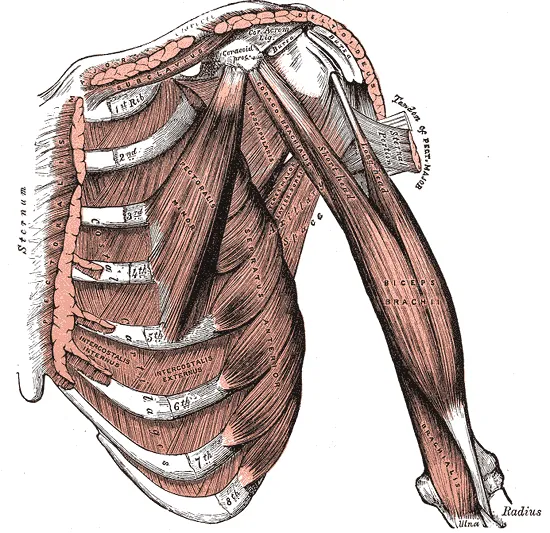
How the two heads become one muscle
The long head’s tendon joins the short head in the middle third of the upper arm, where both turn into muscle7. The muscle then crosses the elbow to attach to the radial tuberosity, a bump on the radius near the elbow7. The radius is the forearm bone on the thumb side. At its lower end the muscle also carries on as the bicipital aponeurosis, a flat sheet of tendon over the forearm1.
In 15 arms from body donors, the muscle and its tendons twisted 90 degrees outward from top to bottom8. The long head’s tendon attached to the upper part of the bump, and the short head’s tendon to the lower part8.
What it moves
The biceps crosses both the shoulder and the elbow2. It bends the elbow, helps turn the palm up, and helps raise the arm forward at the shoulder2. When a cup is lifted, the biceps is the prime mover, the main muscle making the movement2. The brachialis, a muscle under the biceps, helps as a synergist, a muscle that aids the same movement2. The brachioradialis, a forearm muscle, also aids elbow bending2.
One study suggests the two heads favour different jobs9. In 17 elbows from body donors, the short head attached further down, placed to be the stronger elbow bender9. The long head attached further from the forearm’s turning axis, placed to be the stronger supinator9.
In two anatomical specimens and a computer model, the biceps’ leverage for bending peaked with the elbow more straightened10. That peak was larger with the palm turned up10. In 36 healthy men holding 1 kg still, the biceps appeared more active palm up, and the brachioradialis palm down11.
Long fibre bundles
Fascicles are bundles of muscle fibres lying side by side. In 11 healthy people scanned by ultrasound, long-head fascicles measured 8.26 to 15.51 cm across three elbow positions12. Their length differed in a steady pattern between elbow positions, in line with what the muscle does12.
Nerve and blood supply
The musculocutaneous nerve drives the biceps13. It is an end branch of the brachial plexus, the network of nerves from the neck that serves the arm13. It carries fibres from the fifth to seventh spinal nerves of the neck13. It runs down between the biceps and brachialis and supplies both13. Past the biceps tendon it takes a new name and carries feeling from the outer forearm13.
The branches that reach the muscle vary between people14:
- In 46 dissected arms, 60.5% had one branch to the biceps, and the rest had two14.
- The branches left the nerve about 45% of the way from the acromion (bony top of the shoulder) to the outer elbow14.
The biceps gets its blood from the brachial artery, the main artery of the upper arm, and that artery’s branches15.
Size and strength in men and women
In a study of 8 men and 8 women, the women’s biceps had a 45% smaller cross-sectional area, meaning a slice across it16. The men had larger fibres, but fibre number did not differ significantly between the sexes16. Strength rose with muscle size, and strength per unit of size for elbow bending did not differ between the sexes16.
Breakdown
How lowering work tires it
Each row below is one study of eccentric exercise4,17,18:
| Who was studied | What was found |
|---|---|
| 192 people (98 men, 94 women) | Maximal force in the exercised muscle fell 57% straight after eccentric exercise, with no significant difference between the sexes17 |
| 12 young men | Maximal eccentric elbow bending caused soreness, but concentric (shortening) work did not18. A measure on MRI scans, called T2, rose 9 to 29% over 1 to 5 days18 |
| 16 people | Stiffness of the elbow benders rose 46% one hour after maximal eccentric work, and no longer differed significantly from before by 48 hours4 |
| 15 inactive men, nine muscle groups | Strength loss was greater for the elbow benders, elbow straighteners and chest muscle than for the other muscles19 |
In the 16-person study, the MRI measure rose 15% at 48 hours4.
Tears through the muscle belly
A 2019 case report says closed tears of the upper biceps muscle, where the skin is not broken, are rarely reported3. It links them mainly to military static line parachute jumps, where a wrongly routed line strikes the arm3.
When its nerve is hurt
A handbook chapter describes damage to the musculocutaneous nerve alone as rare21. It is most often caused by injury, and less often by squeezing of the nerve, tumours or immune disorders21. A report of three cases describes the usual picture as painless weakness of the biceps and brachialis after recent hard resistance exercise of the arm22. In all three it was the dominant arm22.
Recovery
Force after eccentric exercise
In the study of 192 people, force in the exercised muscle had recovered by 67% at 132 hours after eccentric exercise17. About one in five, 21%, recovered force more slowly17. In the slowest group of nine, force took 33 to 47 days to recover17.
The repeated bout effect is the smaller damage and soreness seen when the same unaccustomed exercise is done a second time. In 15 inactive men who repeated the same eccentric exercises two weeks later, every damage measure changed less the second time19. The protection was similar across the muscles tested, including the elbow benders19.
How it grows with training
In one large study, growth varied widely from person to person5. After 12 weeks of training one arm, the change in biceps size in 585 adults ranged from a 2% loss to a 59% gain5. In the same study, men gained 2.5% more size than women, while women made larger relative strength gains5.
A meta-analysis pools the results of several earlier studies to get one combined answer. One meta-analysis of 29 studies in healthy adults found relative gains in muscle size similar between the sexes23. Gains in absolute size slightly favoured men23. That held for the upper body but not for the lower body23.
In one study, each person’s response repeated24. Untrained adults did two identical 10-week training periods, 10 weeks apart24. Each person’s gain in biceps size in the first period tracked their gain in the second24.
What happens during a break
In untrained adults, biceps size fell during a 10-week break from training25. During the first 5 weeks back, it grew faster than in a group that trained without a break25. Both groups ended with similar gains25. In untrained adults doing repeated 10-week training periods, those with bigger gains at first tended to lose more in the next 10 weeks without training24.
After a tear through the belly
A review of 28 paratroopers with a closed cut through the belly that was not repaired found significant lasting weakness and deformity26. Late repair attempts brought only a small gain26. In another study, 9 repaired paratroopers had greater turning strength for palm-up movement than 3 managed without surgery27. The repaired group was followed for about 2 years, the other group for about 1127. The repaired group also had better appearance and higher satisfaction27.
Connections
The tendons at each end
The distal biceps tendon attaches to the radial tuberosity6. On MRI of 106 elbows, most of these tendons left the belly as two separate tendons, and most of those then joined before attaching28.
The long head of biceps tendon starts at the top of the shoulder socket7. A tendon of the biceps runs in a groove in the humerus (upper arm bone)2. Studies disagree about long-head activity in healthy shoulders29. A scoping review found six studies showing its activity as the arm is raised, and four finding no significant activity29.
The other elbow benders
The muscles that bend the elbow include the biceps, brachialis and brachioradialis2. The brachialis lies under the biceps and adds power to elbow bending2. In 15 young healthy men bending the elbow as hard as they could, all three were very active whatever the forearm position30.
Studies disagree on whether hand position changes how hard the biceps works31,32. In 16 healthy people, biceps activity did not change significantly with hand position31. In ten competitive bodybuilders doing cable curls, biceps activity was greater with the palms up than with the palms down or a neutral grip32.
The triceps
The biceps sits in the front section of the arm, and the triceps brachii in the back section2. They work as a pair: the biceps bends the elbow and the triceps straightens it2. The brachial artery and its branches supply both muscles15.
The biceps’ long head has longer fascicles than the triceps’ outer (lateral) head, and it works over a wider range than the triceps’ long head12,33. In 11 healthy people, the longest average fascicle in the triceps’ outer head, at 7.53 cm, was shorter than the shortest biceps fascicles12. In 10 arm specimens, the biceps’ long head changed length by 56% of its best length across elbow motion33. The triceps’ long head changed by 28%, because of its smaller leverage33.
The median nerve
The median nerve, a main nerve of the forearm and hand, runs down the inner side of the upper arm34. It travels with the brachial artery, between the biceps and brachialis34.
Exercises that load it
Related exercise pages: biceps curl, bench press and dead hang32,35,36. Studies of these exercises found these results:
| Exercise | What studies found |
|---|---|
| Biceps curl | In 32 young adults new to weight training, five weeks of curls near a straight elbow increased muscle thickness more than curls with it bent37 |
| Biceps curl | A review of six studies found research on range of motion and growth in the arms limited and conflicting38 |
| Bench press | A systematic review of bench press studies describes the biceps as a stabiliser and a muscle working against the movement35 |
| Dead hang | In 11 male climbers hanging until failure, the authors classed the biceps as a posture-holding muscle36 |
| Dead hang | In 17 recreational climbers, biceps activity was lower with the arms fully straight than with the elbows bent39 |
Biceps brachii pulls through
Biceps brachii works against
Biceps brachii runs beside
Biceps brachii is loaded by
Sources
- Tiwana MS, Charlick M, Varacallo MA (2024). Anatomy, Shoulder and Upper Limb, Biceps Muscle.. StatPearls. PMID 30137823
- Betts JG, Young KA, Wise JA, Johnson E, Poe B, Kruse DH, Korol O, Johnson JE, Womble M, DeSaix P (2022). Anatomy and Physiology 2e. OpenStax. Link
- Kalinterakis G, Antonogiannakis E, Rampakakis I, Tsialogiannis E, Syllaios A, Ziogas M (2019). Traumatic Closed Proximal Muscle Rupture of the Biceps Brachii in Military Paratrooper.. Case reports in orthopedics. doi:10.1155/2019/3472729 PMID 31559099
- Lacourpaille L, Nordez A, Hug F, Couturier A, Dibie C, Guilhem G (2014). Time-course effect of exercise-induced muscle damage on localized muscle mechanical properties assessed using elastography.. Acta physiologica (Oxford, England). doi:10.1111/apha.12272 PMID 24602146
- Hubal MJ, Gordish-Dressman H, Thompson PD, Price TB, Hoffman EP, Angelopoulos TJ, Gordon PM, Moyna NM, Pescatello LS, Visich PS, Zoeller RF, Seip RL, Clarkson PM (2005). Variability in muscle size and strength gain after unilateral resistance training.. Medicine and science in sports and exercise. PMID 15947721
- Hsu D, Anand P, Mabrouk A, Chang KV (2023). Biceps Tendon Rupture.. StatPearls. PMID 30020607
- Varacallo MA, Mair SD (2023). Proximal Biceps Tendinitis and Tendinopathy.. StatPearls. PMID 30422594
- Athwal GS, Steinmann SP, Rispoli DM (2007). The distal biceps tendon: footprint and relevant clinical anatomy.. Journal of Hand Surgery (American Volume). doi:10.1016/j.jhsa.2007.05.027 PMID 17923307
- Eames MH, Bain GI, Fogg QA, van Riet RP (2007). Distal Biceps Tendon Anatomy. Journal of Bone and Joint Surgery (American Volume). doi:10.2106/JBJS.D.02992 PMID 17473142
- Murray WM, Delp SL, Buchanan TS (1995). Variation of muscle moment arms with elbow and forearm position.. Journal of Biomechanics. doi:10.1016/0021-9290(94)00114-j PMID 7775488
- Chen Y, Huang S, Shen P, Li Y, He Y, Dong G, Huang S, Zou M, Zhang Z, Liu C (2025). Forearm rotation and elbow angle differentially modulate biceps brachii and brachioradialis muscle stiffness and EMG activity during low-load isometric contractions: a cross-sectional study in healthy individuals.. BMC sports science, medicine & rehabilitation. doi:10.1186/s13102-025-01226-y PMID 40604986
- Nelson CM, Dewald JPA, Murray WM (2016). In vivo measurements of biceps brachii and triceps brachii fascicle lengths using extended field-of-view ultrasound.. Journal of biomechanics. doi:10.1016/j.jbiomech.2016.03.040 PMID 27083062
- Desai SS, Arbor TC, Varacallo MA (2023). Anatomy, Shoulder and Upper Limb, Musculocutaneous Nerve.. StatPearls. PMID 30480938
- Pacha Vicente D, Forcada Calvet P, Carrera Burgaya A, Llusá Pérez M (2005). Innervation of biceps brachii and brachialis: Anatomical and surgical approach.. Clinical anatomy (New York, N.Y.). doi:10.1002/ca.20057 PMID 15768419
- Epperson TN, Varacallo MA (2023). Anatomy, Shoulder and Upper Limb, Brachial Artery.. StatPearls. PMID 30725830
- Miller AE, MacDougall JD, Tarnopolsky MA, Sale DG (1993). Gender differences in strength and muscle fiber characteristics.. European journal of applied physiology and occupational physiology. doi:10.1007/BF00235103 PMID 8477683
- Sayers SP, Clarkson PM (2001). Force recovery after eccentric exercise in males and females.. European journal of applied physiology. doi:10.1007/s004210000346 PMID 11394240
- Ochi E, Tsuchiya Y, Nosaka K (2016). Differences in post-exercise T2 relaxation time changes between eccentric and concentric contractions of the elbow flexors.. European journal of applied physiology. doi:10.1007/s00421-016-3462-3 PMID 27632383
- Chen TC, Yang TJ, Huang MJ, Wang HS, Tseng KW, Chen HL, Nosaka K (2019). Damage and the repeated bout effect of arm, leg, and trunk muscles induced by eccentric resistance exercises.. Scandinavian Journal of Medicine & Science in Sports. doi:10.1111/sms.13388 PMID 30663816
- McKay BD, Yeo NM, Jenkins NDM, Miramonti AA, Cramer JT (2017). Exertional Rhabdomyolysis in a 21-Year-Old Healthy Woman: A Case Report.. Journal of Strength and Conditioning Research. doi:10.1519/JSC.0000000000001824 PMID 28146033
- Beecher G, Dyck PJB, Zochodne DW (2024). Axillary and musculocutaneous neuropathies.. Handbook of clinical neurology. doi:10.1016/B978-0-323-90108-6.00004-1 PMID 38697736
- Braddom RL, Wolfe C (1978). Musculocutaneous nerve injury after heavy exercise.. Archives of physical medicine and rehabilitation. PMID 666561
- Refalo MC, Nuckols G, Galpin AJ, Gallagher IJ, Hamilton DL, Fyfe JJ (2025). Sex differences in absolute and relative changes in muscle size following resistance training in healthy adults: a systematic review with Bayesian meta-analysis.. PeerJ. doi:10.7717/peerj.19042 PMID 40028215
- Räntilä A, Halonen EJ, Tiainen EJ, Kaasinen SO, Hulmi JJ, Ahtiainen JP (2025). Repeated Resistance Training Reveals the Reproducibility of Muscle Strength and Size Responses Within Individuals.. European journal of sport science. doi:10.1002/ejsc.70095 PMID 41307987
- Halonen EJ, Gabriel I, Kelahaara MM, Ahtiainen JP, Hulmi JJ (2024). Does Taking a Break Matter-Adaptations in Muscle Strength and Size Between Continuous and Periodic Resistance Training.. Scandinavian journal of medicine & science in sports. doi:10.1111/sms.14739 PMID 39364857
- Heckman JD, Levine MI (1978). Traumatic closed transection of the biceps brachii in the military parachutist.. The Journal of bone and joint surgery. American volume. PMID 649641
- Kragh JF Jr, Basamania CJ (2002). Surgical repair of acute traumatic closed transection of the biceps brachii.. The Journal of bone and joint surgery. American volume. doi:10.2106/00004623-200206000-00014 PMID 12063334
- Boyle AB, Uri Ke J, Ragg A, MacLean SBM (2022). Anatomy of the distal biceps tendon: an in vivo 3-T magnetic resonance imaging study.. Journal of Shoulder and Elbow Surgery. doi:10.1016/j.jse.2021.11.015 PMID 34973425
- Diplock B, Hing W, Marks D (2023). The long head of biceps at the shoulder: a scoping review.. BMC Musculoskeletal Disorders. doi:10.1186/s12891-023-06346-5 PMID 36978047
- Caufriez B, Dugailly PM, Brassinne E, Schuind F (2018). The Role of the Muscle Brachioradialis in Elbow Flexion: An Electromyographic Study.. Journal of Hand Surgery Asian-Pacific Volume. doi:10.1142/S2424835518500145 PMID 29409427
- Kleiber T, Kunz L, Disselhorst-Klug C (2015). Muscular coordination of biceps brachii and brachioradialis in elbow flexion with respect to hand position.. Frontiers in Physiology. doi:10.3389/fphys.2015.00215 PMID 26300781
- Coratella G, Tornatore G, Longo S, Toninelli N, Padovan R, Esposito F, Cè E (2023). Biceps Brachii and Brachioradialis Excitation in Biceps Curl Exercise: Different Handgrips, Different Synergy.. Sports (Basel). doi:10.3390/sports11030064 PMID 36976950
- Murray WM, Buchanan TS, Delp SL (2000). The isometric functional capacity of muscles that cross the elbow.. Journal of Biomechanics. doi:10.1016/s0021-9290(00)00051-8 PMID 10828324
- Löppönen P, Hulkkonen S, Ryhänen J (2022). Proximal Median Nerve Compression in the Differential Diagnosis of Carpal Tunnel Syndrome.. Journal of Clinical Medicine. doi:10.3390/jcm11143988 PMID 35887752
- Stastny P, Gołaś A, Blazek D, Maszczyk A, Wilk M, Pietraszewski P, Petr M, Uhlir P, Zając A (2017). A systematic review of surface electromyography analyses of the bench press movement task.. PLoS One. doi:10.1371/journal.pone.0171632 PMID 28170449
- Exel J, Kaufmann P, Froschauer O, Baca A, Kainz H, Mochizuki L (2026). Upper-Body Neuromechanical Coordination Strategies During Fatiguing Sustained Dead Hangs in Climbers.. European Journal of Sport Science. doi:10.1002/ejsc.70197 PMID 42168114
- Sato S, Yoshida R, Kiyono R, Yahata K, Yasaka K, Nunes JP, Nosaka K, Nakamura M (2021). Elbow Joint Angles in Elbow Flexor Unilateral Resistance Exercise Training Determine Its Effects on Muscle Strength and Thickness of Trained and Non-trained Arms.. Frontiers in Physiology. doi:10.3389/fphys.2021.734509 PMID 34616309
- Schoenfeld BJ, Grgic J (2020). Effects of range of motion on muscle development during resistance training interventions: A systematic review.. SAGE Open Medicine. doi:10.1177/2050312120901559 PMID 32030125
- Exel J, Deimel D, Koller W, Werle C, Baca A, Maffiodo D, Sesana R, Colombo A, Kainz H (2023). Neuromechanics of finger hangs with arm lock-offs: analyzing joint moments and muscle activations to improve practice guidelines for climbing.. Frontiers in Sports and Active Living. doi:10.3389/fspor.2023.1251089 PMID 37927449
Changes
- Links to the new brachialis page
- First published.