Triceps brachii
Also called triceps
The three-headed muscle on the back of the upper arm that straightens the elbow. How its heads are built and supplied, how it tears, how it grows with training, and what it works with.
- Region
- Upper arm
- Starts on (long head)
- the infraglenoid tubercle, a small bump just below the shoulder socket on the shoulder blade1,3,22
- Starts on (lateral head)
- the outer side of the upper arm bone1,3
- Starts on (medial head)
- the back and inner side of the upper arm bone1,3
- Ends on
- the upper olecranon, the bony point of the elbow on the ulna, through one tendon shared by all three heads (Distal triceps tendon)1,24
- Tendons
- Distal triceps tendon
- Updated
- October 8, 2026
- Reviewed
- October 8, 2026 · how entries are checked
Function
Three heads, one tendon
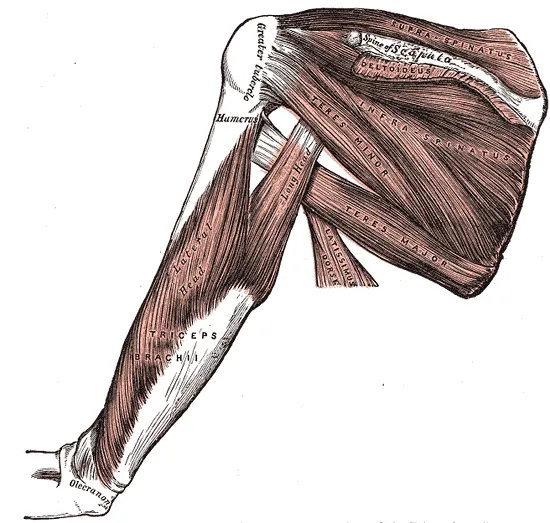
The triceps brachii is a big, thick muscle at the back of the upper arm, often shaped like a horseshoe1. No other muscle runs along the back of the humerus (upper arm bone)3. It has three heads: a long head, a lateral (outer) head and a medial (inner) head1. Together they form a spindle-shaped muscle that crosses both the shoulder and the elbow3.
The heads start in different places3:
- The long head starts on the infraglenoid tubercle, a small bump on the scapula (shoulder blade) just below the shoulder socket1.
- The lateral head starts on the outer side of the humerus3.
- The medial head starts on the back and inner side of the humerus3.
One dissection study used 64 specimens from 36 cadavers (bodies donated for study)7. In it, the long head was fused with the joint capsule and attached directly to the labrum7. The joint capsule is the sleeve of tough tissue that encloses a joint. The labrum is a rim of tough tissue around the edge of a joint socket.
The three heads join in one tendon on the upper olecranon, the bony point of the elbow on the ulna (one of the two forearm bones)1. The medial head has its own tendon, which lies deeper than the tendon of the other two heads and is separate at first3. The distal triceps tendon page covers this attachment in detail.
What it moves
The triceps’ main job is to extend (straighten) the elbow1. The anconeus, a small muscle at the back of the elbow, adds a little to this work3. One review describes the medial head as working in every kind of elbow straightening3. By that account, the long and lateral heads join in mainly when the elbow straightens against resistance3.
Of the three heads, only the long head crosses two joints2. Through it, the triceps helps with shoulder extension, moving the arm backward3. So do the latissimus dorsi (a broad back muscle), the back of the deltoid (the rounded muscle that caps the shoulder), and teres major (a thick shoulder muscle)3. The triceps also plays a part in adduction, bringing the arm toward the body, though other muscles matter more for it3. When the arm is raised to the side, the long head helps hold the top of the humerus from slipping downward3.
In 18 people whose triceps was electrically stimulated, its pull backward at the shoulder rose significantly as the arm was raised from 0° to 80°8. A review by the same authors adds that it fell slightly beyond 80°3.
Size, fibres and leverage
In 10 arm specimens, the triceps had the largest physiological cross-sectional area of the major elbow muscles, at 14.9 cm²9. That is a measure of size taken straight across all of a muscle’s fibres. The triceps is made mostly of type 2 fibres, which contract fast10.
A muscle’s moment arm is its leverage: how far its line of pull sits from the joint it turns. In MRI scans (which show soft tissue in detail) of 18 people, the triceps’ moment arm grew as the elbow straightened11. It went from 1.74 cm with the elbow bent to 110° to 2.39 cm at 30°11. A review reports that in 10 cadaver arms, the front-to-back depth of the ulna explained over 60% of the spread in peak moment arm3.
Its nerves and blood supply
The triceps is supplied mainly by the radial nerve, which comes from the brachial plexus (the network of nerves that serves the arm)12. In 30 arms dissected from 15 cadavers, the radial nerve always gave at least four branches to the triceps13. One went to the long head, one to the lateral head and two to the medial head13.
A narrative review (a summary written without a set search method) pooled 15 studies of 336 specimens12. In 55, the axillary nerve (the nerve that makes the deltoid contract) supplied the long head12. The radial nerve was still the main source12. Across 11 studies of 318 specimens, the medial head got ulnar nerve branches in 6412. The ulnar nerve runs past the inner side of the elbow to the little-finger side of the hand.
Blood reaches the triceps through the profunda brachii artery (deep artery of the arm)14. It runs between the lateral and medial heads with the radial nerve, and gives branches to the muscles and the humerus14.
Breakdown
Where the triceps can tear
One case report lists triceps tears and avulsions at the bone, in the tendon, where muscle meets tendon, and in the muscle belly4. An avulsion is a tear in which a tendon pulls away from the bone it attaches to. It calls these injuries uncommon4.
It says tears inside the muscle belly are rarer than tendon tears4. Its literature review found only 9 earlier reported cases4. The authors describe these tears as usually seen in young, active people who play sports; 7 of the 9 were male4. Most followed a direct blow while the muscle was contracting during sport; only 2 involved indirect force4.
The distal triceps tendon page covers tendon tears in detail. A systematic review gathers all the research on a question. In pooled results from one, men outnumbered women 11 to 1 among tendon tears15. Among athletes with repaired tears in another review, weightlifting was the most common activity, followed by American football16. In resistance training, a review reports these tears mainly while lowering the bar in bench or overhead pressing, as the triceps lengthens16.
Snapping triceps
In snapping triceps syndrome, part of the lower triceps slides over the medial epicondyle (the inner bony bump of the elbow) as the elbow bends18. It makes a snap that may or may not hurt18. A literature review of 24 studies describes it as rare but often misdiagnosed18. Of 64 patients pooled in that review, 90.6% also had an unstable ulnar nerve, and 64.1% had ulnar nerve symptoms18.
The long head and the shoulder
The long head has been seen affected when the axillary nerve is injured12. The authors of the dissection study above proposed that the long head could be indirectly linked to posterior (backward) shoulder instability7. They based this on its ties to the capsule and labrum7.
Recovery
How it grows with training
In eleven men who trained the triceps for 12 weeks, its largest cross-sectional area (the size of a slice across the muscle) rose 33.6%19. Its moment arm rose 5.5%, less than muscle size alone predicted, and the depth of the olecranon did not change19. In 18 people imaged with MRI, a larger triceps went with a longer moment arm at every elbow angle measured11.
After 12 weeks of elbow extensor training, the lower region grew significantly less than the middle and upper regions20. This matched lower activity in the lower region during a single session20. In twelve young men training with a multijoint exercise for 12 weeks, the middle regions grew significantly more than the uppermost region21. That matched where the muscle was most active in the first session21.
Arm overhead or at the side
The long head is stretched further with the arm overhead than with the arm at the side5. In one study, 21 adults trained one arm with overhead cable elbow extensions and the other with the arm at the side, for 12 weeks5. MRI measured the growth in muscle volume5:
| Part of the triceps | Overhead arm | Arm at the side |
|---|---|---|
| Long head | +28.5%5 | +19.6%5 |
| Lateral and medial heads | +14.6%5 | +10.5%5 |
| Whole triceps | +19.9%5 | +13.9%5 |
The overhead arm always lifted 34–39% less weight, yet strength rose by a similar amount in both arms5. A review calls the extra growth in the lateral and medial heads unexpected, because those heads cross only the elbow6. It suggests factors other than muscle length may be involved6.
The evidence does not all agree6. A second study making the same comparison found no difference in long head growth6. That review suggests the gap may come from how muscle was measured, study length (12 against 6 weeks), or how the exercise was set up6.
After a tear in the muscle
A case report notes that earlier reports described good or excellent overall results for triceps muscle-belly tears managed without surgery4. Some reports noted a slight loss of straightening power and endurance4. The case itself was a 22-year-old college water polo player with tears in the long and lateral heads4. Managed without surgery, he returned to competition 7 months after the injury4.
Connections
The biceps brachii
The biceps brachii, at the front of the arm, and the triceps, at the back, work as an opposing pair22. The biceps bends the forearm and the triceps straightens it22. In 10 arm specimens, the triceps’ long head changed length by 28% of its best working length across elbow motion9. The biceps’ long head changed by 56%, because its moment arm was larger (4.7 cm against 2.3 cm)9.
Fascicles are bundles of muscle fibres lying side by side. In an ultrasound (sound-wave scan) study of 11 healthy people, the triceps’ lateral head had much shorter fascicles than the biceps’ long head23.
The shoulder muscles
At the shoulder, the long head helps move the arm back alongside the latissimus dorsi and the back of the deltoid3. At the elbow, one anatomy study notes the three heads have long been described as joining in a single attachment on the olecranon24. The distal triceps tendon page covers it.
Exercises that load it
Studies that record muscle activity with EMG describe how common exercises use the triceps2,25,26. Related exercise pages: triceps extension, bench press and overhead press5,25,27.
| Exercise | What studies found |
|---|---|
| Triceps extension | In 10 healthy people, the long head made most modelled force with the arm down; the medial head did with it raised 90° or more2 |
| Triceps extension | In 25 people doing pushdowns to failure, EMG suggested the three heads did not act together as one28 |
| Bench press | A systematic review of 14 EMG studies found triceps and pectoralis major (the large chest muscle) activity similar, and both above the front deltoid25 |
| Bench press | In 28 men lifting their 6-repetition maximum (heaviest load for six lifts), triceps activity was lower with a wide grip than medium or narrow29 |
| Overhead press | In 15 healthy men pressing standing, triceps activity was about 39% greater with a barbell than with dumbbells26 |
| Push-up | In 20 young men, triceps activity was significantly higher than pectoralis major activity in standard, diamond and wide push-ups30 |
| Dip | In 13 experienced men, 11 of whom did the ring dip, peak triceps EMG was 0.83 mV on a bench, 1.04 mV on bars and 1.05 mV on rings31 |
Triceps brachii pulls through
Triceps brachii works against
Triceps brachii works with in shoulder extension
Triceps brachii is loaded by
Sources
- Tiwana MS, Sinkler MA, Bordoni B (2023). Anatomy, Shoulder and Upper Limb, Triceps Muscle.. StatPearls. PMID 30725681
- Kholinne E, Zulkarnain RF, Sun YC, Lim S, Chun JM, Jeon IH (2018). The different role of each head of the triceps brachii muscle in elbow extension.. Acta Orthopaedica et Traumatologica Turcica. PMID 29503079
- Landin D, Thompson M, Jackson M (2018). Functions of the Triceps Brachii in Humans: A Review.. Journal of Clinical Medicine Research. doi:10.14740/jocmr3340w PMID 29511416
- Araujo-Espinoza G, Dajani AH, Ghazikhanian V, Salituro A, Kremen TJ (2025). Conservative management of triceps brachii muscle transection injury in an elite NCAA division I intercollegiate athlete: a case report and clinical review.. JSES Reviews, Reports, and Techniques. doi:10.1016/j.xrrt.2024.12.008 PMID 40321858
- Maeo S, Wu Y, Huang M, Sakurai H, Kusagawa Y, Sugiyama T, Kanehisa H, Isaka T (2023). Triceps brachii hypertrophy is substantially greater after elbow extension training performed in the overhead versus neutral arm position.. European Journal of Sport Science. doi:10.1080/17461391.2022.2100279 PMID 35819335
- Pedrosa GF, Pereira MR, Kassiano W (2026). The interplay between muscle length, range of motion, and exercise selection: a review.. Sports Medicine International Open. doi:10.1055/a-2733-7605 PMID 41777276
- Nasu H, Baramee P, Kampan N, Nimura A, Akita K (2019). An anatomic study on the origin of the long head of the triceps brachii.. JSES Open Access. doi:10.1016/j.jses.2019.01.001 PMID 30976729
- Landin D, Thompson M (2011). The shoulder extension function of the triceps brachii.. Journal of Electromyography and Kinesiology. doi:10.1016/j.jelekin.2010.09.005 PMID 20934352
- Murray WM, Buchanan TS, Delp SL (2000). The isometric functional capacity of muscles that cross the elbow.. Journal of Biomechanics. doi:10.1016/s0021-9290(00)00051-8 PMID 10828324
- Soendenbroe C, Svensson RB, Mittendorfer B, Magnusson SP, Mackey AL, Andersen JL (2026). Morphological differences in myofibre size and shape: A comparative study of the soleus, gastrocnemius, triceps brachii and vastus lateralis in humans and mice.. Journal of Anatomy. doi:10.1111/joa.70025 PMID 40676763
- Sugisaki N, Wakahara T, Miyamoto N, Murata K, Kanehisa H, Kawakami Y, Fukunaga T (2010). Influence of muscle anatomical cross-sectional area on the moment arm length of the triceps brachii muscle at the elbow joint.. Journal of Biomechanics. doi:10.1016/j.jbiomech.2010.06.013 PMID 20655050
- Mohel HK, Khorwal G, Sharma R, Sharma B (2025). Variable Innervation of the Triceps Brachii: Anatomical and Clinical Perspectives in a Narrative Review.. Cureus. doi:10.7759/cureus.100537 PMID 41625801
- Mombellet M, Destrieux C, Samargandi R, Bacle G (2026). Radial nerve branches to the triceps brachii: cadaveric analysis and surgical implications for neurotization.. Surgical and Radiologic Anatomy. doi:10.1007/s00276-026-03855-5 PMID 41874693
- Şanlıtürk YN, Zeybek N, Gayretli Ö, Öztürk A (2024). Anatomical and morphometric features of the profunda brachii artery.. Anatomy & Cell Biology. doi:10.5115/acb.23.243 PMID 39444212
- Shuttlewood K, Beazley J, Smith CD (2017). Distal triceps injuries (including snapping triceps): A systematic review of the literature.. World Journal of Orthopedics. doi:10.5312/wjo.v8.i6.507 PMID 28660143
- Vandenberg CJ, Touhey DC, Brophy RH, Smith MV, Knapik DM (2026). Distal triceps tendon rupture repair results in high return to sport rates for amateur and professional athletes: a systematic review.. JSES Reviews, Reports, and Techniques. doi:10.1016/j.xrrt.2026.100694 PMID 41847163
- Mangano T, Cerruti P, Repetto I, Trentini R, Giovale M, Franchin F (2015). Chronic Tendonopathy as a Unique Cause of Non Traumatic Triceps Tendon Rupture in a (Risk Factors Free) Bodybuilder: A Case Report.. Journal of Orthopaedic Case Reports. PMID 27299023
- Xia WZ, Abukar A, Moosavi H, Nandi N, Rashid A (2025). Snapping triceps syndrome: a review of the literature and proposed operative treatment algorithm.. JSES Reviews, Reports, and Techniques. doi:10.1016/j.xrrt.2025.08.017 PMID 41142761
- Sugisaki N, Wakahara T, Murata K, Miyamoto N, Kawakami Y, Kanehisa H, Fukunaga T (2015). Influence of muscle hypertrophy on the moment arm of the triceps brachii muscle.. Journal of Applied Biomechanics. doi:10.1123/jab.2014-0126 PMID 25411895
- Wakahara T, Miyamoto N, Sugisaki N, Murata K, Kanehisa H, Kawakami Y, Fukunaga T, Yanai T (2012). Association between regional differences in muscle activation in one session of resistance exercise and in muscle hypertrophy after resistance training.. European Journal of Applied Physiology. doi:10.1007/s00421-011-2121-y PMID 21858666
- Wakahara T, Fukutani A, Kawakami Y, Yanai T (2013). Nonuniform muscle hypertrophy: its relation to muscle activation in training session.. Medicine and Science in Sports and Exercise. PMID 23657165
- Betts JG, Young KA, Wise JA, Johnson E, Poe B, Kruse DH, Korol O, Johnson JE, Womble M, DeSaix P (2022). Anatomy and Physiology 2e. OpenStax. Link
- Nelson CM, Dewald JPA, Murray WM (2016). In vivo measurements of biceps brachii and triceps brachii fascicle lengths using extended field-of-view ultrasound.. Journal of biomechanics. doi:10.1016/j.jbiomech.2016.03.040 PMID 27083062
- Barco R, Sánchez P, Morrey ME, Morrey BF, Sánchez-Sotelo J (2017). The distal triceps tendon insertional anatomy-implications for surgery.. JSES Open Access. doi:10.1016/j.jses.2017.05.002 PMID 30675548
- Stastny P, Gołaś A, Blazek D, Maszczyk A, Wilk M, Pietraszewski P, Petr M, Uhlir P, Zając A (2017). A systematic review of surface electromyography analyses of the bench press movement task.. PLoS One. doi:10.1371/journal.pone.0171632 PMID 28170449
- Saeterbakken AH, Fimland MS (2013). Effects of body position and loading modality on muscle activity and strength in shoulder presses.. Journal of Strength and Conditioning Research. doi:10.1519/JSC.0b013e318276b873 PMID 23096062
- Coratella G, Tornatore G, Longo S, Esposito F, Cè E (2022). Front vs Back and Barbell vs Machine Overhead Press: An Electromyographic Analysis and Implications For Resistance Training.. Frontiers in Physiology. doi:10.3389/fphys.2022.825880 PMID 35936912
- Hussain J, Sundaraj K, Subramaniam ID, Lam CK (2020). Muscle Fatigue in the Three Heads of Triceps Brachii During Intensity and Speed Variations of Triceps Push-Down Exercise.. Frontiers in Physiology. doi:10.3389/fphys.2020.00112 PMID 32153422
- Saeterbakken AH, Stien N, Pedersen H, Solstad TEJ, Cumming KT, Andersen V (2021). The Effect of Grip Width on Muscle Strength and Electromyographic Activity in Bench Press among Novice- and Resistance-Trained Men.. International Journal of Environmental Research and Public Health. doi:10.3390/ijerph18126444 PMID 34198674
- Intziegianni K, Katsamis E, Michaelides M, Parpa K (2026). Electromyographic Activation of the Pectoralis Major and Triceps Brachii Muscles During Standard, Diamond, and Wide Hand Position Push-Ups.. Muscles. doi:10.3390/muscles5010018 PMID 41892990
- McKenzie A, Crowley-McHattan Z, Meir R, Whitting J, Volschenk W (2022). Bench, Bar, and Ring Dips: Do Kinematics and Muscle Activity Differ?. International Journal of Environmental Research and Public Health. doi:10.3390/ijerph192013211 PMID 36293792
Changes
- Revised to report sources added after their published corrections were read
- First published.