Ulnar nerve
The nerve that runs past the inner elbow to the little-finger side of the hand. Where it runs, how elbow bending loads it, where it gets squeezed, and what trials of surgery at the elbow report.
- Region
- Elbow
- Updated
- October 22, 2026
- Reviewed
- October 22, 2026 · how entries are checked
Function
Where it starts and what it supplies
The ulnar nerve is one of the five end branches of the brachial plexus1. The plexus is the network of nerves, starting at the neck, that serves the arm. The nerve’s fibres come from the C8 and T1 nerve roots, where nerves leave the spinal cord1.
It carries both motor supply (signals to muscles) and sensory supply (feeling)1. Its supply includes:
- near the elbow, the flexor carpi ulnaris, a forearm muscle that bends the wrist toward the little finger2;
- the little-finger-side half of the flexor digitorum profundus, the deep forearm muscle that bends the fingers2;
- in the hand, the interossei, small muscles that lie between the long bones of the hand5;
- the skin of the inner side of the palm and back of the hand, and of the inner one and a half fingers5.
Its path from armpit to hand
In the upper arm the nerve lies on the inner side of the main artery, down to mid-arm2. There it passes through the medial intermuscular septum, a sheet of tough tissue that separates groups of muscles2. It then crosses the triceps brachii, over its inner (medial) head, and descends to a groove at the inner elbow2. The groove lies between the medial epicondyle and the olecranon, the bony point of the elbow2.
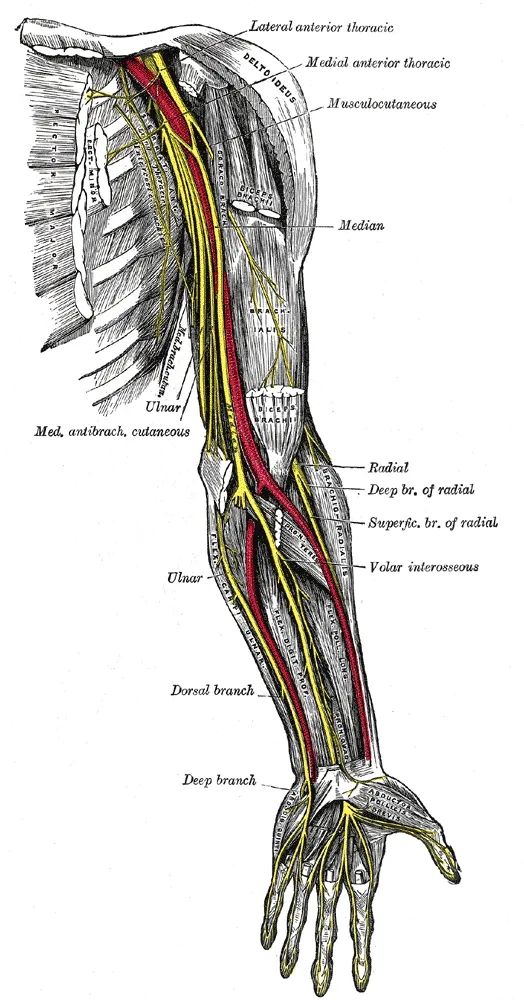
The cubital tunnel is a narrow passage at the inner elbow that the nerve runs through. One anatomy reference gives its floor as the elbow’s joint capsule (the sleeve of tough tissue around the joint) and bands of the inner-elbow ligament6. A review describes the true cubital tunnel as the space bounded by the ulna and both heads of the flexor carpi ulnaris7. The ulna is the forearm bone on the little-finger side.
The nerve enters the forearm between those heads2. It runs down the inner side of the forearm, lying on the flexor digitorum profundus2. About 5 cm above the wrist a dorsal branch leaves it for the little-finger side of the back of the hand2. A review describes Guyon’s canal as a narrow passage at the wrist for the nerve and its artery5.
How it moves as the arm bends
In 10 cadaver arms, the nerve had to slide about 5.1 mm at the elbow as the elbow moved from 10 to 90 degrees8. In 10 cadaver arms, elbow flexion (bending) strained the nerve 15% or more at the elbow8. Strain here means stretch as a share of resting length.
Twenty cadaver specimens were imaged with MRI, a scan that shows soft tissue in detail3. Moving the elbow from straight to 135 degrees of flexion cut the tunnel’s cross-sectional area by 30%, 39% and 41% at three levels3. The nerve’s own area fell by 33%, 50% and 34%3.
Breakdown
Where it gets squeezed at the elbow
A review names two main places where the nerve is compressed at the elbow7. One is the groove behind the medial epicondyle, and the other is under the arch joining the heads of the flexor carpi ulnaris7. A review lists the symptoms that suggest ulnar neuropathy at the elbow as inner elbow pain with tingling and numbness7. These are usually in the ring and little fingers, and commonly worse with the elbow bent7. In more severe cases, a review describes weakness and wasting of the muscles the nerve supplies, with clawing of the ring and little fingers7.
Who gets it
In Siena province, Italy, 311 new cases of ulnar neuropathy at the elbow were identified over 5 years9. That is 32.7 per 100,000 person-years in men and 17.2 in women9. Person-years are a count of people multiplied by the years each was followed. The incidence, meaning how many new cases appear over a set time, rose with each decade of age9.
A case-control study compares people who have a condition with similar people who do not. One with 220 cases and 460 controls linked the condition to male sex, with an odds ratio of 2.410. An odds ratio is how many times higher the odds are in one group than another. A hospital study of 110 people operated on and 192 controls with a herniated disc found that sex was not a risk factor11.
A nerve that slips out of its groove
Subluxation is a partial slip out of the usual place, and ultrasound is a scan made with sound waves. In 91 professional baseball pitchers, ultrasound showed the nerve subluxating in one or both elbows in 38.5%, and none of those had nerve symptoms12. A review states that whether repeated slipping contributes to neuropathy at the elbow is widely debated7. Because instability is common in volunteers without symptoms, it calls a causal link unclear7.
In one study, the nerve slipped fully out of place at full elbow flexion in 43.5% of the arms of 31 amateur bodybuilders13. The figure was 16.1% in 31 age-matched controls, and the authors suggest triceps muscle mass may contribute13.
In throwers
Seven cadaver specimens were moved passively through four phases of throwing14. Strain on the nerve at the cubital tunnel peaked at an average of 13.1%, in early acceleration with the elbow fully flexed14. The authors describe that as close to the nerve’s elastic and circulatory limits14. A pooled analysis of 17 studies found ulnar nerve symptoms or deficits, some brief, after 12.0% of 1518 reconstructions of the inner-elbow ligament15. The ulnar collateral ligament (UCL) tear page covers that operation15.
At the wrist: handlebar palsy
A review describes handlebar neuropathy as a pattern common in cyclists, from prolonged compression of the nerve at the wrist5. It may swell the nerve’s deep branch and weaken or waste some of the interossei5. A narrative review, one written without a set search method, describes it as appearing during a ride or several days after16.
In a study of 25 road or mountain bike riders, 23 had motor or sensory symptoms after a 600-km ride17. Peak pressure on the heel of the hand, over the nerve, was measured in 36 experienced cyclists on a stationary bicycle18. Without gloves it averaged 134 to 165 kPa (kilopascals, a unit of force per area)18. With padded gloves it was 10% to 28% lower18. A narrative review that found 13 articles on these injuries in cyclists, 11 of them case studies, judged the quality of the evidence generally low16.
Recovery
What was seen without an operation
One study followed 30 cases of ulnar neuropathy at the elbow for a year, 24 of them without an operation19. Around half of those not operated on reported better symptoms, and their nerve measurements improved significantly19. They had been told what the condition is and which postures worsen compression19. A second study re-examined 69 patients, with 74 affected arms, after a median (middle value) of 14 months20.
| Result in the 74 arms at a median of 14 months | Share of arms (%) |
|---|---|
| Fully recovered | 1620 |
| Improved | 2820 |
| Unchanged | 3420 |
| Worse | 2220 |
The 28 arms that had surgery did better than those managed without it20.
One randomised trial allocated 117 patients with mild ulnar neuropathy at the elbow to decompression or non-surgical care21. Decompression is surgery that takes pressure off a nerve. More of the surgery group had improved at 3 months, 85% against 50%, but there was no difference at 6 to 12 months21. The authors of the 2016 Cochrane review wrote that it is not known when a person is better managed with or without surgery22.
Freeing the nerve against moving it
The 2025 update of the Cochrane review on this condition included 15 randomised trials with 970 participants4. The sources below compared simply freeing the nerve with freeing it and moving it to a new position, called transposition4.
| Source | What was compared | What was found |
|---|---|---|
| 2008 meta-analysis of ten studies, some observational | 449 simple decompressions and 457 transpositions | No statistically significant difference in clinical improvement, with a trend toward a better outcome after transposition23 |
| Randomised trial of 152 patients | Simple decompression and transposition under the skin | Excellent or good at one year in 49 of 75 and 54 of 77, not a significant difference24 |
| 2025 Cochrane review | Simple decompression and transposition under the skin or under muscle | Probably little to no difference in improved function (1 study of 147 and 2 studies of 114 participants)4 |
In the trial of 152, complications were fewer after simple decompression, 9.6% against 31.1%24. The 2016 Cochrane version reported more wound infections with transposition, on moderate-quality evidence22. The 2025 update reported little or no difference in infection of the wound4. It concludes that function and surgical complications differ little or do not differ, including when the nerve impairment is severe4. That conclusion rests on low- to moderate-certainty evidence, in neuropathy with no known cause4.
After surgery
A systematic review, which sums up the research on a question in a checkable way, looked at 26 studies25. It asked what predicts the result of moving the nerve forward25. It found conflicting evidence on age, symptom duration and severity, among other factors, and could not conclude which affect outcome25.
Connections
Neighbours at the inner elbow
A review states that ulnar neuropathy at the elbow is often mistaken for golfer’s elbow, tendon pain on the inner side of the elbow7. The reason given is that the nerve lies so close to the origin of the common flexor tendon7. The ulnar collateral ligament of the elbow lies against the nerve, the triceps and the flexor carpi ulnaris2. In its groove the nerve gives several small branches to the elbow joint2.
Links with the median nerve
A meta-analysis pools the results of earlier studies. One, of 58 articles covering 10,562 arms, found a Martin-Gruber connection between the median and ulnar nerves in 19.5%26. In the Siena study, the incidence at the elbow was about one-thirteenth of that reported for carpal tunnel syndrome in part of the same area9.
Related exercises and stretches
One case report describes a 22-year-old man with snapping and intense pain at the inner elbow straight after push-ups27. It came from a snapping medial head of the triceps together with a subluxating ulnar nerve27. In 4 fresh cadavers, an arm-positioning sequence used to tension the nerve strained it by at most 2.1%28. Shoulder abduction, lifting the arm out to the side, was the step that added most28. Related exercise pages: push-up, doorway pec stretch27,28.
Ulnar nerve lies next to
Ulnar nerve lies against
Ulnar nerve sends branches to
Ulnar nerve crosses the medial head of
Ulnar nerve is joined in some forearms to
Ulnar nerve is compared with
Ulnar nerve has symptoms reported after reconstruction for
Ulnar nerve slipped out of place, in one case report, after
Ulnar nerve was strained in four cadavers by shoulder abduction, a position used in
Sources
- Becker RE, Manna B (2023). Anatomy, Shoulder and Upper Limb, Ulnar Nerve.. StatPearls. PMID 29763067
- Gray H; Lewis WH (editor) (1918). Anatomy of the Human Body. Lea & Febiger, Philadelphia (20th edition). Link
- Gelberman RH, Yamaguchi K, Hollstien SB, Winn SS, Heidenreich FP Jr, Bindra RR, Hsieh P, Silva MJ (1998). Changes in interstitial pressure and cross-sectional area of the cubital tunnel and of the ulnar nerve with flexion of the elbow. An experimental study in human cadavera.. The Journal of bone and joint surgery. American volume. doi:10.2106/00004623-199804000-00005 PMID 9563378
- Caliandro P, La Torre G, Padua R, Giannini F, Reale G, Padua L (2025). Treatment for ulnar neuropathy at the elbow.. The Cochrane database of systematic reviews. doi:10.1002/14651858.CD006839.pub5 PMID 40298125
- Saran S, Reddy PS, Shirodkar K, Shah AB, Agarwal A, Shah A, Iyengar KP, Botchu R (2025). Unveiling Guyon's Canal: Insights into Clinical Anatomy, Pathology, and Imaging.. Diagnostics (Basel, Switzerland). doi:10.3390/diagnostics15050592 PMID 40075839
- Range TL, Samra NS (2023). Anatomy, Shoulder and Upper Limb, Osborne Band.. StatPearls. PMID 30725684
- Mezian K, Jačisko J, Kaiser R, Machač S, Steyerová P, Sobotová K, Angerová Y, Naňka O (2021). Ulnar Neuropathy at the Elbow: From Ultrasound Scanning to Treatment.. Frontiers in neurology. doi:10.3389/fneur.2021.661441 PMID 34054704
- Wright TW, Glowczewskie F Jr, Cowin D, Wheeler DL (2001). Ulnar nerve excursion and strain at the elbow and wrist associated with upper extremity motion.. The Journal of hand surgery. doi:10.1053/jhsu.2001.26140 PMID 11466640
- Mondelli M, Giannini F, Ballerini M, Ginanneschi F, Martorelli E (2005). Incidence of ulnar neuropathy at the elbow in the province of Siena (Italy).. Journal of the neurological sciences. doi:10.1016/j.jns.2005.02.010 PMID 15993135
- Mondelli M, Mattioli S, Vinciguerra C, Ciaramitaro P, Aretini A, Greco G, Sicurelli F, Giorgi S, Curti S (2020). Comorbidities, anthropometric, demographic, and lifestyle risk factors for ulnar neuropathy at the elbow: A case control study.. Journal of the peripheral nervous system : JPNS. doi:10.1111/jns.12420 PMID 33140525
- Bartels RH, Verbeek AL (2007). Risk factors for ulnar nerve compression at the elbow: a case control study.. Acta neurochirurgica. doi:10.1007/s00701-007-1166-5 PMID 17502986
- Looney AM, Day HK, Reddy MP, Paul RW, Nazarian LN, Cohen SB (2024). Prevalence of bilateral ulnar nerve subluxation among professional baseball pitchers.. Journal of shoulder and elbow surgery. doi:10.1016/j.jse.2023.09.025 PMID 37890764
- Michael AE, Young P (2018). Is triceps hypertrophy associated with ulnar nerve luxation?. Muscle & nerve. doi:10.1002/mus.26183 PMID 30028514
- Aoki M, Takasaki H, Muraki T, Uchiyama E, Murakami G, Yamashita T (2005). Strain on the ulnar nerve at the elbow and wrist during throwing motion.. The Journal of bone and joint surgery. American volume. doi:10.2106/JBJS.D.02989 PMID 16264128
- Clain JB, Vitale MA, Ahmad CS, Ruchelsman DE (2019). Ulnar Nerve Complications After Ulnar Collateral Ligament Reconstruction of the Elbow: A Systematic Review.. The American journal of sports medicine. doi:10.1177/0363546518765139 PMID 29683338
- Sirisena DC, Sim SH, Lim I, Rajaratnam V (2021). Median and ulnar nerve injuries in cyclists: A narrative review.. BioMedicine. doi:10.37796/2211-8039.1143 PMID 35223414
- Patterson JM, Jaggars MM, Boyer MI (2003). Ulnar and median nerve palsy in long-distance cyclists. The American journal of sports medicine. doi:10.1177/03635465030310041801 PMID 12860549
- Slane J, Timmerman M, Ploeg HL, Thelen DG (2011). The influence of glove and hand position on pressure over the ulnar nerve during cycling.. Clinical biomechanics (Bristol, Avon). doi:10.1016/j.clinbiomech.2011.03.003 PMID 21458120
- Padua L, Aprile I, Caliandro P, Foschini M, Mazza S, Tonali P (2002). Natural history of ulnar entrapment at elbow.. Clinical neurophysiology : official journal of the International Federation of Clinical Neurophysiology. doi:10.1016/s1388-2457(02)00295-x PMID 12464337
- Beekman R, Wokke JH, Schoemaker MC, Lee ML, Visser LH (2004). Ulnar neuropathy at the elbow. Neurology. doi:10.1212/01.wnl.0000142535.24626.90 PMID 15534254
- Pompe SM, Schreuder T, Teunissen LL, Visser LH, Beekman R (2020). In situ decompression vs conservative treatment for mild ulnar neuropathy at the elbow.. Muscle & nerve. doi:10.1002/mus.26912 PMID 32369630
- Caliandro P, La Torre G, Padua R, Giannini F, Padua L (2016). Treatment for ulnar neuropathy at the elbow.. The Cochrane database of systematic reviews. doi:10.1002/14651858.CD006839.pub4 PMID 27845501
- Macadam SA, Gandhi R, Bezuhly M, Lefaivre KA (2008). Simple decompression versus anterior subcutaneous and submuscular transposition of the ulnar nerve for cubital tunnel syndrome: a meta-analysis.. The Journal of hand surgery. doi:10.1016/j.jhsa.2008.03.006 PMID 18929194
- Bartels RH, Verhagen WI, van der Wilt GJ, Meulstee J, van Rossum LG, Grotenhuis JA (2005). Prospective randomized controlled study comparing simple decompression versus anterior subcutaneous transposition for idiopathic neuropathy of the ulnar nerve at the elbow: Part 1.. Neurosurgery. doi:10.1227/01.neu.0000154131.01167.03 PMID 15730578
- Shi Q, MacDermid JC, Santaguida PL, Kyu HH (2011). Predictors of surgical outcomes following anterior transposition of ulnar nerve for cubital tunnel syndrome: a systematic review.. The Journal of hand surgery. doi:10.1016/j.jhsa.2011.09.024 PMID 22123047
- Roy J, Henry BM, Pękala PA, Vikse J, Saganiak K, Walocha JA, Tomaszewski KA (2016). Median and ulnar nerve anastomoses in the upper limb: A meta-analysis.. Muscle & Nerve. doi:10.1002/mus.24993 PMID 26599506
- Lim W, Han F (2022). Symptomatic Unilateral Triceps Medial Head Snapping and Subluxating Ulnar Nerve without Neuropathy after Push-Ups: A Case Report.. Malaysian orthopaedic journal. doi:10.5704/MOJ.2207.023 PMID 35992976
- Byl C, Puttlitz C, Byl N, Lotz J, Topp K (2002). Strain in the median and ulnar nerves during upper-extremity positioning.. The Journal of hand surgery. doi:10.1053/jhsu.2002.35886 PMID 12457354
Changes
- Links to the new cubital tunnel syndrome page
- Revised to report sources added after their published corrections were read