Carpal tunnel syndrome
Also called CTS
Squeezing of the median nerve where it passes through the wrist. How guidelines define it, who it affects, and what studies of splints, injections, nerve-gliding exercise and surgery found.
- Region
- Wrist & hand
- Updated
- October 6, 2026
- Reviewed
- October 6, 2026 · how entries are checked
What it is
How guidelines and reviews define it
A 2024 guideline from the American Academy of Orthopaedic Surgeons defines carpal tunnel syndrome as squeezing of the median nerve inside the carpal tunnel1. The guideline calls it the most common compressive neuropathy, meaning a nerve problem caused by squeezing1. A 2014 Cochrane review traces it to raised pressure on the nerve8. The nerve is squeezed between the carpal bones (wrist bones) and the transverse carpal ligament, a tough band holding bones together8.
A 2023 Cochrane review says the condition causes pain, numbness and tingling, most often in the thumb and the first two fingers9. The same review says it sometimes brings muscle wasting, reduced feeling and loss of fine hand skill9. The 2024 guideline says untreated, long-standing compression may cause lasting loss of use and feeling in the hand and the three thumb-side digits1.
The tunnel and what passes through it
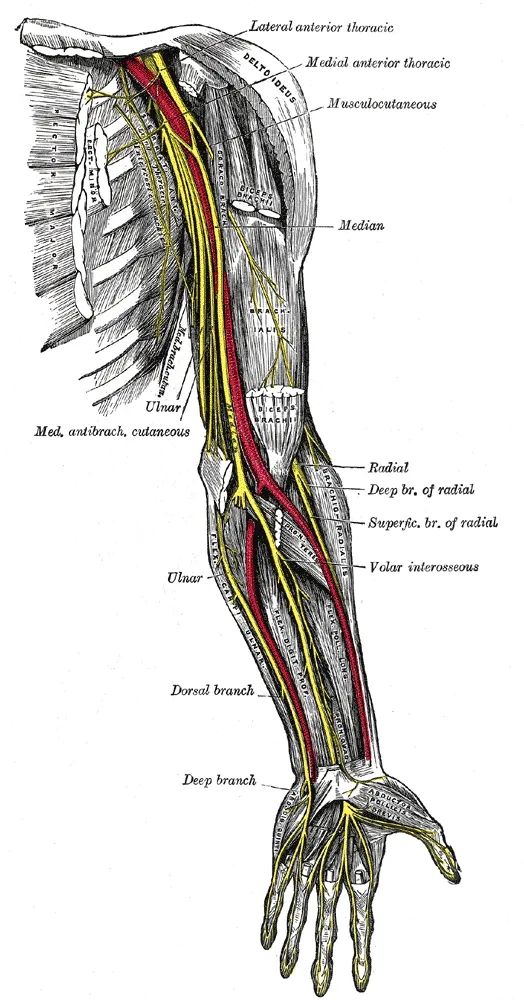
The carpal tunnel is a passage at the wrist2. The carpal bones form its walls and floor, and the flexor retinaculum, a band holding tendons in place, forms its roof2. The median nerve passes through it with nine tendons10. These are four tendons each from two finger-bending muscles, and one from a thumb-bending muscle10.
Inside the tunnel the nerve splits into a branch to the thenar muscles (the ball of the thumb) and a branch for feeling11. The feeling branch serves the thumb, index and middle fingers and the thumb side of the ring finger11.
What pressure does to the nerve
In 16 volunteers, 30 mmHg (millimetres of mercury, a unit of pressure) over the nerve at the tunnel caused mild changes and hand tingling12. At 60 and 90 mmHg, feeling signals stopped passing quickly, 10 to 30 minutes before movement signals did12.
Who it affects
How common it is
The 2024 guideline says the condition is most common between ages 40 and 60, and more common in women1. Incidence means new cases over time, and person-years are people multiplied by the years each was followed.
| Group studied | What was found |
|---|---|
| 2466 adults aged 25 to 74 in southern Sweden | Prevalence (share with the condition) of 2.7%, confirmed by examination and nerve conduction testing (an electrical nerve test)13 |
| 125 people in the same Swedish study who had not reported symptoms in the median nerve area of the hand | Nerve testing found median nerve changes in 23 (18.4%)13 |
| The Siena area of Italy, 120,000 people, over 8 years | 3142 new cases, 329 per 100,000 person-years; 506 per 100,000 person-years in women and 139 in men14 |
| 6256 adults in Finland | 3.1% had had carpal tunnel surgery in their lifetime: 4.1% of women and 1.9% of men15 |
| Pregnant women, in a systematic review | Reported incidence of 7% to 43% when confirmed by nerve testing, 31% to 62% when found by examination16 |
Health conditions linked with it
Meta-analyses, which pool the results of several studies, have linked it with other conditions after adjusting for confounders, other factors that could explain the link17,18,19,20.
- Diabetes: an odds ratio (how many times higher the odds are) of 1.69 for the condition or surgery for it, in 18 studies17. The link did not differ between type 1 and type 2 diabetes17.
- Body weight: about 1.5 times the odds of the condition or surgery for it with overweight and about twice with obesity, in 58 studies18.
- Arthritis: an odds ratio of 1.96 for rheumatoid arthritis (an immune disease of the joints) in eight studies19. For osteoarthritis (wear of joint cartilage) it was 1.87 in two19.
- Underactive thyroid: a modest link, which the authors said other factors and bias in what gets published may partly explain20.
What reviews found about work
Reviews of workplace studies agree on some exposures and differ on others3,4.
| Exposure | What reviews reported |
|---|---|
| Repetition and force | High-quality evidence linking both with the condition, in 17 cohort studies (which follow people over time) of over a million workers3 |
| Speed and combined exposures | Linked with higher risk in a review of nine cohort studies21 |
| Psychosocial (mental and social) work factors | No consistent link in the same review21 |
| Hand-arm vibration | Moderate-quality evidence as a risk factor in an overview of ten reviews4; no significant link in the 17-study meta-analysis3 |
| Wrist postures | Low-quality evidence as a risk factor in the overview4 |
On computer use, the 17-study meta-analysis linked high computer use with a lower rate of work-related cases3. The overview of ten reviews could not establish any link4. The 2024 guideline group, lacking reliable evidence, gave its opinion that heavy keyboard use is not linked with the condition1.
What studies found
How it changes over time
In 196 people followed for 10 to 15 months with no intervention, measures improved on average, and some got better on their own22. A short time with symptoms and younger age went with getting better22. Symptoms in both hands and a positive Phalen’s test, an examination test, went with a poorer course22.
A review of cohort studies of non-surgical care found a poor outcome at three years in 23% to 89% of people, depending on the study23. In the four studies that counted it, 57% to 66% later had surgery23. It linked longer symptoms, a positive Phalen’s test and thenar wasting (shrunken thumb-base muscles) with poorer outcomes23. Still, it judged this inconclusive and the course variable23. In pregnancy-related cases, symptoms lasted beyond one year in more than half of women, and beyond three years in about 30%16.
Splints and steroid injections
A 2023 Cochrane review of 29 trials found splints may give little or no short-term gain in symptoms over no active intervention9. It rated that evidence very low certainty9. It found splints probably give no short-term gain in hand function9. On the other side, one trial of 80 people in that review found night splints may bring more overall improvement early on, on low-certainty evidence9.
A 2023 Cochrane review found a corticosteroid (a drug that copies a hormone the body makes) injection probably improved symptoms up to three months5. The comparison was a placebo (a dummy version) or no injection5. The gain was still seen at six months in four trials5.
The 2024 guideline reports three studies that found no benefit beyond six months over a placebo or saline1. It recommends against injection for long-term improvement1.
Harms after injection were uncommon in the 2023 review, on low-certainty evidence5. In one trial of 111 people, 65% of the injection group and 16% of the placebo group had mild-to-moderate pain lasting under two weeks5. Of two 2024 Cochrane reviews comparing injection with surgery, one found the evidence too uncertain for reliable conclusions24. The other was uncertain whether improvement or symptom relief differed beyond three months, and found hand function and pain probably did not differ25.
Exercise and nerve gliding
Reviews of nerve-gliding exercises in people with the condition disagree6,7:
- A 2023 meta-analysis of 12 randomised trials (1003 people, mild-to-moderate cases) found lower symptom scores and less pain, but not stronger grip6. Its trials varied widely and had some risk of bias6.
- Another 2023 meta-analysis, of 25 randomised trials, found low to very low-quality evidence of no clinical benefit in mild-to-moderate cases7. It still found some statistical gains in pain and function over no intervention7.
A 2012 Cochrane review of 16 trials (741 people) found limited, very low-quality evidence of benefit for a wide mix of exercise and mobilisation approaches26. Two of its trials measured harms, too few for firm conclusions on safety26.
Surgery
Carpal tunnel release frees the nerve by dividing the transverse carpal ligament, through an open cut or endoscopically (through small cuts with a camera)8. A 2024 Cochrane review of 14 randomised trials, in which 84% of the 1231 people were women, called the benefit of surgery currently unclear25.
Against splinting, that review found both sides beyond three months25. Surgery probably gave a higher rate of clinical improvement, about twice as often (risk ratio 2.10), in 3 studies of 210 people25. Yet surgery probably gave no clinically important gain in symptoms or hand function25. In the splint groups, 41 of 93 people were referred for surgery, while 0 of 83 in the surgery groups had surgery again25.
On endoscopic against open release, the findings also point both ways8. A 2014 Cochrane review of 28 studies (2586 hands) found the two about as effective as each other for symptoms and function, on low-quality evidence8. But the 2014 review found endoscopic release appeared to have fewer minor complications, with no difference in major ones8. Endoscopic release more often caused short-lived nerve problems, while open release caused more wound problems8.
In 4 studies in that review, people returned to work or daily activities about eight days sooner after endoscopic release8.
Wrist position and pressure in the lab
Lab studies have measured pressure inside the tunnel as the wrist moves, with results that differ on bending the wrist forward27,28. In 37 healthy people moving the wrist slowly, pressure reached 30 mmHg in a quarter of them by about 33 degrees back or 49 forward27. In 15 people with the condition, pressure rose from 32 mmHg with the wrist straight to 110 mmHg with it bent back 90 degrees29.
In eight cadaver wrists (bodies donated for study), loading the finger-bending tendons raised pressure most with the wrist bent forward30. By contrast, in 14 healthy people measured directly, pressure typically did not rise as the wrist bent forward, and often fell28. In the same people, bending the wrist back against resistance while gripping raised pressure more than bending it forward28.
Connections
The condition centres on the median nerve, which can also be squeezed at other narrow points along the arm31. One review describes pronator syndrome as squeezing of the median nerve in the forearm32. The same review reports that 6% to 11.5% of people with carpal tunnel syndrome also have it32. A systematic review cites studies of people wrongly labelled with the condition33. In them, 32% to 49% were squeezed under the lacertus fibrosus, a flat sheet of tendon that fans off the lower biceps33.
Lab studies of the loaded wrist relate to the wrist curl and wrist extension28,34. In 25 healthy adults holding the wrist against half their maximum force, the nerve’s cross-section shrank during the hold34. That change did not differ significantly between bending forward and bending back34. Studies of the wrist bent back relate to the wrist flexor stretch35. In 49 people with the condition, the nerve glided less than in 48 people without it, with the wrist straight or bent back 30 degrees35.
Carpal tunnel syndrome involves
Carpal tunnel syndrome has lab studies of the nerve during the movement of
Carpal tunnel syndrome has lab studies of tunnel pressure during the movement of
Carpal tunnel syndrome has studies of the wrist-back position of
Sources
- Shapiro LM, Kamal R, Brault J, Chen K, Erickson M, Martin D, Naam N, Raizman N, Strelzow J, Chamberlain A, Murray J, Sevarino K, Casambre F, Jebamony K, Donnelly P, Rodriguez J, McGiveny A, Knowles L, Tiwari A, Verity T, Krause B (2025). American Academy of Orthopaedic Surgeons Clinical Practice Guideline Summary Management of Carpal Tunnel Syndrome.. Journal of the American Academy of Orthopaedic Surgeons. doi:10.5435/JAAOS-D-24-01179 PMID 39637428
- Betts JG, Young KA, Wise JA, Johnson E, Poe B, Kruse DH, Korol O, Johnson JE, Womble M, DeSaix P (2022). Anatomy and Physiology 2e. OpenStax. Link
- Hassan A, Beumer A, Kuijer PPFM, van der Molen HF (2022). Work-relatedness of carpal tunnel syndrome: Systematic review including meta-analysis and GRADE.. Health Science Reports. doi:10.1002/hsr2.888 PMID 36340637
- Kozak A, Schedlbauer G, Wirth T, Euler U, Westermann C, Nienhaus A (2015). Association between work-related biomechanical risk factors and the occurrence of carpal tunnel syndrome: an overview of systematic reviews and a meta-analysis of current research.. BMC Musculoskeletal Disorders. doi:10.1186/s12891-015-0685-0 PMID 26323649
- Ashworth NL, Bland JDP, Chapman KM, Tardif G, Albarqouni L, Nagendran A (2023). Local corticosteroid injection versus placebo for carpal tunnel syndrome.. Cochrane Database of Systematic Reviews. doi:10.1002/14651858.CD015148 PMID 36722795
- Zaheer SA, Ahmed Z (2023). Neurodynamic Techniques in the Treatment of Mild-to-Moderate Carpal Tunnel Syndrome: A Systematic Review and Meta-Analysis.. Journal of Clinical Medicine. doi:10.3390/jcm12154888 PMID 37568290
- Paraskevopoulos E, Karanasios S, Gioftsos G, Tatsios P, Koumantakis G, Papandreou M (2023). The effectiveness of neuromobilization exercises in carpal tunnel syndrome: Systematic review and meta-analysis.. Physiotherapy theory and practice. doi:10.1080/09593985.2022.2068097 PMID 35481794
- Vasiliadis HS, Georgoulas P, Shrier I, Salanti G, Scholten RJ (2014). Endoscopic release for carpal tunnel syndrome.. Cochrane Database of Systematic Reviews. doi:10.1002/14651858.CD008265.pub2 PMID 24482073
- Karjalainen TV, Lusa V, Page MJ, O'Connor D, Massy-Westropp N, Peters SE (2023). Splinting for carpal tunnel syndrome.. Cochrane Database of Systematic Reviews. doi:10.1002/14651858.CD010003.pub2 PMID 36848651
- Henry BM, Zwinczewska H, Roy J, Vikse J, Ramakrishnan PK, Walocha JA, Tomaszewski KA (2015). The Prevalence of Anatomical Variations of the Median Nerve in the Carpal Tunnel: A Systematic Review and Meta-Analysis.. PLoS One. doi:10.1371/journal.pone.0136477 PMID 26305098
- Löppönen P, Hulkkonen S, Ryhänen J (2022). Proximal Median Nerve Compression in the Differential Diagnosis of Carpal Tunnel Syndrome.. Journal of Clinical Medicine. doi:10.3390/jcm11143988 PMID 35887752
- Lundborg G, Gelberman RH, Minteer-Convery M, Lee YF, Hargens AR (1982). Median nerve compression in the carpal tunnel--functional response to experimentally induced controlled pressure.. Journal of Hand Surgery (American). doi:10.1016/s0363-5023(82)80175-5 PMID 7086092
- Atroshi I, Gummesson C, Johnsson R, Ornstein E, Ranstam J, Rosén I (1999). Prevalence of carpal tunnel syndrome in a general population.. JAMA. doi:10.1001/jama.282.2.153 PMID 10411196
- Mondelli M, Giannini F, Giacchi M (2002). Carpal tunnel syndrome incidence in a general population.. Neurology. doi:10.1212/wnl.58.2.289 PMID 11805259
- Pourmemari MH, Heliövaara M, Viikari-Juntura E, Shiri R (2018). Carpal tunnel release: Lifetime prevalence, annual incidence, and risk factors.. Muscle & Nerve. doi:10.1002/mus.26145 PMID 29665085
- Padua L, Di Pasquale A, Pazzaglia C, Liotta GA, Librante A, Mondelli M (2010). Systematic review of pregnancy-related carpal tunnel syndrome.. Muscle & Nerve. doi:10.1002/mus.21910 PMID 20976778
- Pourmemari MH, Shiri R (2016). Diabetes as a risk factor for carpal tunnel syndrome: a systematic review and meta-analysis.. Diabetic Medicine. doi:10.1111/dme.12855 PMID 26173490
- Shiri R, Pourmemari MH, Falah-Hassani K, Viikari-Juntura E (2015). The effect of excess body mass on the risk of carpal tunnel syndrome: a meta-analysis of 58 studies.. Obesity Reviews. doi:10.1111/obr.12324 PMID 26395787
- Shiri R (2016). Arthritis as a risk factor for carpal tunnel syndrome: a meta-analysis.. Scandinavian Journal of Rheumatology. doi:10.3109/03009742.2015.1114141 PMID 27022991
- Shiri R (2014). Hypothyroidism and carpal tunnel syndrome: a meta-analysis.. Muscle & Nerve. doi:10.1002/mus.24453 PMID 25204641
- Gerger H, Macri EM, Jackson JA, Elbers RG, van Rijn R, Søgaard K, Burdorf A, Koes B, Chiarotto A (2024). Physical and psychosocial work-related exposures and the incidence of carpal tunnel syndrome: A systematic review of prospective studies.. Applied Ergonomics. doi:10.1016/j.apergo.2023.104211 PMID 38199092
- Padua L, Padua R, Aprile I, Pasqualetti P, Tonali P (2001). Multiperspective follow-up of untreated carpal tunnel syndrome. Neurology. doi:10.1212/wnl.56.11.1459 PMID 11402101
- Burton CL, Chesterton LS, Chen Y, van der Windt DA (2016). Clinical Course and Prognostic Factors in Conservatively Managed Carpal Tunnel Syndrome: A Systematic Review.. Archives of Physical Medicine and Rehabilitation. doi:10.1016/j.apmr.2015.09.013 PMID 26440776
- Ashworth NL, Bland JD, Chapman KM, Tardif G, Albarqouni L, Nagendran A (2024). Local corticosteroid injection versus surgery for carpal tunnel syndrome.. Cochrane Database of Systematic Reviews. doi:10.1002/14651858.CD015101 PMID 39206746
- Lusa V, Karjalainen TV, Pääkkönen M, Rajamäki TJ, Jaatinen K (2024). Surgical versus non-surgical treatment for carpal tunnel syndrome.. Cochrane Database of Systematic Reviews. doi:10.1002/14651858.CD001552.pub3 PMID 38189479
- Page MJ, O'Connor D, Pitt V, Massy-Westropp N (2012). Exercise and mobilisation interventions for carpal tunnel syndrome.. Cochrane Database of Systematic Reviews. doi:10.1002/14651858.CD009899 PMID 22696387
- Keir PJ, Bach JM, Hudes M, Rempel DM (2007). Guidelines for wrist posture based on carpal tunnel pressure thresholds.. Human Factors. doi:10.1518/001872007779598127 PMID 17315846
- McGorry RW, Fallentin N, Andersen JH, Keir PJ, Hansen TB, Pransky G, Lin JH (2014). Effect of grip type, wrist motion, and resistance level on pressures within the carpal tunnel of normal wrists.. Journal of orthopaedic research : official publication of the Orthopaedic Research Society. doi:10.1002/jor.22571 PMID 24391059
- Gelberman RH, Hergenroeder PT, Hargens AR, Lundborg GN, Akeson WH (1981). The carpal tunnel syndrome. A study of carpal canal pressures.. The Journal of bone and joint surgery. American volume. PMID 7204435
- Keir PJ, Wells RP, Ranney DA, Lavery W (1997). The effects of tendon load and posture on carpal tunnel pressure.. The Journal of Hand Surgery. doi:10.1016/s0363-5023(97)80119-0 PMID 9260617
- Soubeyrand M, Melhem R, Protais M, Artuso M, Crézé M (2020). Anatomy of the median nerve and its clinical applications.. Hand Surgery & Rehabilitation. doi:10.1016/j.hansur.2019.10.197 PMID 31816428
- Binsaleem S (2025). Median nerve entrapment neuropathy: a review on the pronator syndrome.. JSES Reviews, Reports, and Techniques. doi:10.1016/j.xrrt.2024.10.001 PMID 39872334
- Shah Mardan QNM, Al-Khayarin A, Bouri F, Muneer M (2025). Lacertus fibrosus release in proximal median nerve entrapment- a systematic review.. International Orthopaedics. doi:10.1007/s00264-025-06493-5 PMID 40082299
- Li S, Kociolek AM, Loh PY (2026). Characterizing median nerve deformation and recovery processes in response to repeated isometric wrist torque exertions.. PeerJ. doi:10.7717/peerj.21724 PMID 42756933
- Liu CT, Liu DH, Chen CJ, Wang YW, Wu PS, Horng YS (2021). Effects of wrist extension on median nerve and flexor tendon excursions in patients with carpal tunnel syndrome: a case control study.. BMC musculoskeletal disorders. doi:10.1186/s12891-021-04349-8 PMID 34030693
Changes
- Re-reviewed after a published correction to a cited source was read and recorded; no change to the page.
- First published.