Median nerve
The nerve that runs down the middle of the arm to the thumb side of the hand. Where it runs, how it slides as the arm moves, where it gets squeezed, and what studies report about recovery.
- Region
- Wrist & hand
- Updated
- October 6, 2026
- Reviewed
- October 6, 2026 · how entries are checked
Function
Where it starts and what it does
The nerve takes its name from its middle position, both where it leaves the nerve network of the shoulder and in the forearm6. That network is the brachial plexus, the network of nerves, starting at the neck, that serves the arm1. The median nerve is one of its five end branches, formed where two of its bundles meet1.
Its fibres come from the spinal nerves labelled C5 to T1, a broad range of levels1. It is a mixed nerve, carrying both signals to muscles and feeling6. One review sums up its classic job6:
- turning the forearm palm down, called pronation6;
- bending the wrist, thumb, index and middle finger6;
- bringing the thumb across to meet the fingers6;
- feeling on the palm side of the first three fingers6.
Its path from armpit to hand
In the upper arm the nerve runs down the inner side with the brachial artery2. It lies between the biceps brachii (the two-headed muscle on the front of the upper arm) and the brachialis, a muscle under the biceps2. At the front of the elbow it lies deep to the artery and the bicipital aponeurosis4. That aponeurosis is a flat sheet of tendon fanning off the lower biceps.
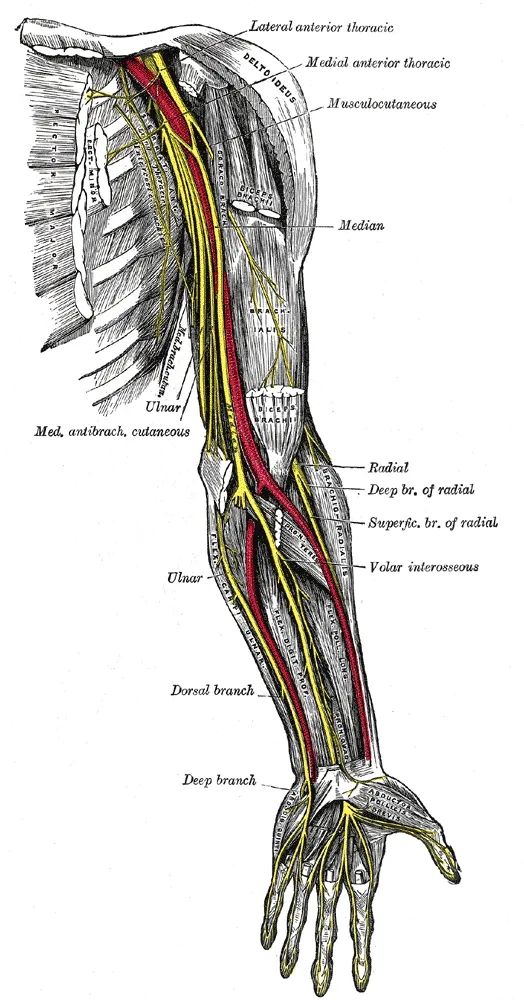
It sends branches to three forearm muscles4. They include the flexor carpi radialis, which bends the wrist, and the flexor digitorum superficialis, which bends the fingers4. It then passes between the two heads of the pronator teres, a forearm muscle that turns the palm down4.
Down the forearm it runs between the deep and shallow finger-bending muscles2. Near the pronator teres, a branch called the anterior interosseous nerve leaves it2. This branch supplies three muscles, including the long thumb bender and the index-finger part of the deep finger bender2.
At the wrist, the nerve passes through the carpal tunnel with nine tendons from the finger and thumb muscles7. The tunnel’s walls and floor are the small wrist bones, and its roof is a retinaculum (a band that holds tendons in place)8. Inside, the nerve splits into a branch to the thumb muscles and a branch for feeling in the fingers2. The thumb branch supplies three small thumb muscles7.
How it slides as the arm moves
The nerve slides as the joints it crosses move3. In ten arms from body donors, the wrist and fingers moved it most at the wrist3. The shoulder and elbow moved it most at the elbow, and moving several joints at once moved it much more3.
| Movement, in the same ten donor arms | Where the slide was measured | Mean slide (mm) |
|---|---|---|
| Wrist, from bent back to bent forward | Wrist | 19.63 |
| Fingers, from bent back to a full fist | Wrist | 9.73 |
| Elbow | Not stated | 12.33 |
| Shoulder | Elbow | 9.13 |
A review of 12 studies in living people, 8 on this nerve, found slides from 0.1 to 12.5 mm9. The highest strain reported, meaning stretch as a share of resting length, was 2.0%9. A systematic review, which sums up the research on a question in a checkable way, looked at 22 studies10. It found a lot of sliding with limb movement, but raised strain was not a main finding10.
Ultrasound is a scan made with sound waves. In one ultrasound study of healthy people, bending the wrist back 40 degrees added 1.1% forearm strain on average11. In 12 donor arms held at 60 degrees of extension, strain was higher inside the tunnel than just above it12.
Breakdown
Where it gets squeezed
On its way to the hand the nerve passes through several narrow gaps where it can be pressed on6. A review lists these sites above the wrist4:
- a bony spur on the humerus (upper arm bone), and the ligament of Struthers that can arch from it2,4;
- the bicipital aponeurosis4;
- between the two heads of the pronator teres, the most common of these sites4.
In up to 75% of forearms, the flexor digitorum superficialis has a tough leading edge that can be tight over the nerve2. In some forearms, straightening the elbow alone can squeeze the nerve there2.
At the wrist
A 2024 guideline from the American Academy of Orthopaedic Surgeons describes carpal tunnel syndrome as squeezing of this nerve in the carpal tunnel13. One review calls it the arm’s most common nerve squeeze, and squeezing higher up rare4. In a meta-analysis of 12 studies, the nerve moved significantly less in people with the syndrome than in people without it14.
In 16 volunteers, 30 mmHg (millimetres of mercury) pressed over the tunnel caused mild changes and tingling in the hand15. At 60 and 90 mmHg, feeling signals stopped quickly, 10 to 30 minutes before muscle signals did15.
In 37 healthy people, three quarters kept tunnel pressure below 30 mmHg up to about 33 degrees of bending back and 49 degrees forward16. In an MRI study (a scan that shows soft tissue in detail) of 34 volunteers, a held squeeze grip flattened the nerve in the tunnel17. Its cross-sectional area, the size of a slice across it, did not drop significantly17.
Near the elbow
At the elbow the nerve and artery pass under the bicipital aponeurosis, also called the lacertus fibrosus2. The nerve is prone to being squeezed there as the forearm turns2. A systematic review describes repeated pronation (turning the palm down) as driving the squeezing there18. It names athletes, dentists and surgeons among those prone to it18.
A review describes pronator syndrome, squeezing of the nerve in the forearm, as rare4. It describes it as more common in women, most often in their 40s and 50s, and in jobs with repeated forearm and wrist movement4. Another review lists forceful forearm turning, gripping work, weight training, rowing and racket sports as possible contributing factors2.
A systematic review cites studies in which 32–49% of patients wrongly labelled with carpal tunnel syndrome had symptoms coming from squeezing under the lacertus18. A review reports that, across different studies, 6% to 11.5% of patients with carpal tunnel syndrome also have pronator syndrome4.
The branch to the deep muscles
A review describes the anterior interosseous nerve as a motor nerve, so its problems cause no change in feeling2. The same review describes anterior interosseous nerve syndrome as weakness or paralysis of the three muscles this branch supplies, with no change in feeling2. Whether this comes from squeezing is debated2. Small, less mobile branches like this are at greater risk from injury, swelling or traction (a pull along the length), a review notes2.
How often it is injured
Twenty years of US emergency department records held 1,199 cases of nerve injury in the arm19. Median nerve injuries in that data were more often in women (59.6%) and in 96.5% of cases linked to an activity19. Just 0.6% led to a hospital stay19.
Recovery
Mild squeezing and severe injury
A review notes that squeezing usually causes only mild nerve changes, though the nerve fibres themselves can be damaged in severe cases2. The same review notes that symptoms from a brief, squeezing-related loss of blood supply fade quickly2. More severe nerve injury takes longer to heal, and nerve regrowth has a speed limit2. Muscle that stays cut off from its nerve for a long time becomes permanently scarred2.
What studies of squeezing report
| Group studied | What was reported |
|---|---|
| People with loss of power from an anterior interosseous nerve problem with no clear cause or injury, in a review | Most, even with total loss of power, can be watched for recovery on its own with good results; weakness stays in up to 30%2 |
| 24 patients who had surgery for anterior interosseous nerve syndrome | 8 regained full function within three months; the rest took up to two years2 |
| 55 patients who had surgery for squeezing above the wrist | 80% reported good outcomes; recovery was immediate in 51%2 |
| 446 people in seven studies who had the lacertus fibrosus released | 99.6% had pain relief straight away, and function and strength came back; mean follow-up was 16.1 months18 |
In the series of 55, people who had symptoms for longer were more likely to still have them2.
After a cut nerve is repaired
One meta-analysis pooled data on each patient from 623 median or ulnar nerve injuries repaired under a microscope5. Age, where the injury was, which nerve was hurt, and delay to repair each significantly affected recovery5. People under 16 had higher odds of good muscle recovery than those over 40 (odds ratio 4.3, meaning 4.3 times the odds)5. Each month of delay lowered the odds of muscle recovery5. In the same data, the chance of muscle recovery after an ulnar nerve injury was 71% lower than after a median nerve injury5.
Connections
Tendons, muscles and the biceps
Forearm tendons slide back and forth through the carpal tunnel beside the nerve8. In an ultrasound study of 197 people without median nerve problems, about half the nerves slid apart from the tendons during a full fist20. In 26.9% the nerve slid with the tendons, and in 21.3% it did not slide20.
The sheet that fans off the biceps brachii lies over the nerve at the elbow, and is one place it can be squeezed4. In nine donor arms, bending the neck away from the arm moved and strained the nerve at the elbow21. This happened mainly with the arm raised out to the side 60 or 90 degrees21. The biceps beside it did not change21.
Links with the ulnar nerve
A meta-analysis of 58 articles covering 10,562 arms found a Martin-Gruber connection between the median and ulnar nerves in 19.5%22. A review notes that because of it, a median nerve problem can sometimes cause symptoms on the little-finger side of the hand2.
Exercises and stretches that load it
In donor arms, moving the wrist and fingers slid the nerve most at the wrist3. From ultrasound in healthy people, one study estimated added forearm strain of 2.5–3.0% with the arm out, wrist back and elbow straight11. The authors judged this likely below levels that impair its blood flow or signals11.
In 25 healthy adults holding wrist bending or straightening force at half their maximum, the nerve’s cross-section shrank during the hold23. In 14 healthy people, pressure in the tunnel did not usually rise when bending the wrist, and often fell24. Resisted wrist straightening with a pinch or grip raised it more than wrist-bending movements did24. In donor arms held in one standard test position, bending the neck away from the arm strained the nerve at the wrist25. Related exercise pages: wrist curl, wrist flexor stretch, upper trapezius stretch3,23,25.
Median nerve is compressed in
Median nerve passes under the aponeurosis of
Median nerve is loaded by
Median nerve is strained, in one cadaver arm position, by the neck movement of
Sources
- Murphy KA, Ryan N, Fakoya AO (2025). Anatomy, Shoulder and Upper Limb, Median Nerve.. StatPearls. PMID 28846302
- Löppönen P, Hulkkonen S, Ryhänen J (2022). Proximal Median Nerve Compression in the Differential Diagnosis of Carpal Tunnel Syndrome.. Journal of Clinical Medicine. doi:10.3390/jcm11143988 PMID 35887752
- Wright TW, Glowczewskie F, Wheeler D, Miller G, Cowin D (1996). Excursion and strain of the median nerve.. The Journal of bone and joint surgery. American volume. doi:10.2106/00004623-199612000-00013 PMID 8986667
- Binsaleem S (2025). Median nerve entrapment neuropathy: a review on the pronator syndrome.. JSES Reviews, Reports, and Techniques. doi:10.1016/j.xrrt.2024.10.001 PMID 39872334
- Ruijs AC, Jaquet JB, Kalmijn S, Giele H, Hovius SE (2005). Median and ulnar nerve injuries: a meta-analysis of predictors of motor and sensory recovery after modern microsurgical nerve repair.. Plastic and Reconstructive Surgery. doi:10.1097/01.prs.0000172896.86594.07 PMID 16079678
- Soubeyrand M, Melhem R, Protais M, Artuso M, Crézé M (2020). Anatomy of the median nerve and its clinical applications.. Hand Surgery & Rehabilitation. doi:10.1016/j.hansur.2019.10.197 PMID 31816428
- Henry BM, Zwinczewska H, Roy J, Vikse J, Ramakrishnan PK, Walocha JA, Tomaszewski KA (2015). The Prevalence of Anatomical Variations of the Median Nerve in the Carpal Tunnel: A Systematic Review and Meta-Analysis.. PLoS One. doi:10.1371/journal.pone.0136477 PMID 26305098
- Betts JG, Young KA, Wise JA, Johnson E, Poe B, Kruse DH, Korol O, Johnson JE, Womble M, DeSaix P (2022). Anatomy and Physiology 2e. OpenStax. Link
- Silva A, Manso A, Andrade R, Domingues V, Brandão MP, Silva AG (2014). Quantitative in vivo longitudinal nerve excursion and strain in response to joint movement: A systematic literature review.. Clinical Biomechanics. doi:10.1016/j.clinbiomech.2014.07.006 PMID 25168082
- Szikszay T, Hall T, von Piekartz H (2017). In vivo effects of limb movement on nerve stretch, strain, and tension: A systematic review.. Journal of Back and Musculoskeletal Rehabilitation. doi:10.3233/BMR-169720 PMID 28869435
- Dilley A, Lynn B, Greening J, DeLeon N (2003). Quantitative in vivo studies of median nerve sliding in response to wrist, elbow, shoulder and neck movements.. Clinical biomechanics (Bristol, Avon). doi:10.1016/s0268-0033(03)00176-1 PMID 14580833
- Takashima K, Teramoto A, Aoki M, Miyamoto H, Hidaka E, Shirato R, Ozasa Y, Saito A, Emori M, Yamashita T, Iba K (2023). Measurement of the median nerve strain within the carpal tunnel using a capacitance-type strain sensor: A cadaver study.. Clinical biomechanics (Bristol, Avon). doi:10.1016/j.clinbiomech.2023.105894 PMID 36706625
- Shapiro LM, Kamal R, Brault J, Chen K, Erickson M, Martin D, Naam N, Raizman N, Strelzow J, Chamberlain A, Murray J, Sevarino K, Casambre F, Jebamony K, Donnelly P, Rodriguez J, McGiveny A, Knowles L, Tiwari A, Verity T, Krause B (2025). American Academy of Orthopaedic Surgeons Clinical Practice Guideline Summary Management of Carpal Tunnel Syndrome.. Journal of the American Academy of Orthopaedic Surgeons. doi:10.5435/JAAOS-D-24-01179 PMID 39637428
- Lin MT, Liu IC, Chang HP, Wu CH (2023). Impaired median nerve mobility in patients with carpal tunnel syndrome: a systematic review and meta-analysis.. European Radiology. doi:10.1007/s00330-022-09262-9 PMID 36394604
- Lundborg G, Gelberman RH, Minteer-Convery M, Lee YF, Hargens AR (1982). Median nerve compression in the carpal tunnel--functional response to experimentally induced controlled pressure.. Journal of Hand Surgery (American). doi:10.1016/s0363-5023(82)80175-5 PMID 7086092
- Keir PJ, Bach JM, Hudes M, Rempel DM (2007). Guidelines for wrist posture based on carpal tunnel pressure thresholds.. Human Factors. doi:10.1518/001872007779598127 PMID 17315846
- Nadar MS, Dashti MH, Cherian J (2013). Finger position alters the median nerve properties within the carpal tunnel: a pre-post MRI comparison study.. PLoS One. doi:10.1371/journal.pone.0079273 PMID 24265763
- Shah Mardan QNM, Al-Khayarin A, Bouri F, Muneer M (2025). Lacertus fibrosus release in proximal median nerve entrapment- a systematic review.. International Orthopaedics. doi:10.1007/s00264-025-06493-5 PMID 40082299
- Boroumand S, Ajjawi I, Gu E, Littleton A, Flores-Pérez P, Vafa AZ, Klimitz FJ, Diatta F (2026). Exploring 20 years of peripheral nerve injuries of the upper extremity: An analysis of median, radial, and ulnar nerve injuries presenting to US emergency departments.. Journal of Hand Therapy. doi:10.1016/j.jht.2026.02.012 PMID 41966926
- Yao B, Roll SC (2022). An ultrasound study of the mobility of the median nerve during composite finger movement in the healthy young wrist.. Muscle & Nerve. doi:10.1002/mus.27437 PMID 34648193
- Bueno-Gracia E, González-Rueda V, Pérez-Bellmunt A, Estébanez-de-Miguel E, López-de-Celis C, Shacklock M, Caudevilla-Polo S (2022). Differential movement of the median nerve and biceps brachii at the elbow in human cadavers.. Clinical Biomechanics. doi:10.1016/j.clinbiomech.2021.105370 PMID 33994041
- Roy J, Henry BM, Pękala PA, Vikse J, Saganiak K, Walocha JA, Tomaszewski KA (2016). Median and ulnar nerve anastomoses in the upper limb: A meta-analysis.. Muscle & Nerve. doi:10.1002/mus.24993 PMID 26599506
- Li S, Kociolek AM, Loh PY (2026). Characterizing median nerve deformation and recovery processes in response to repeated isometric wrist torque exertions.. PeerJ. doi:10.7717/peerj.21724 PMID 42756933
- McGorry RW, Fallentin N, Andersen JH, Keir PJ, Hansen TB, Pransky G, Lin JH (2014). Effect of grip type, wrist motion, and resistance level on pressures within the carpal tunnel of normal wrists.. Journal of orthopaedic research : official publication of the Orthopaedic Research Society. doi:10.1002/jor.22571 PMID 24391059
- Bueno-Gracia E, Pérez-Bellmunt A, Estébanez-de-Miguel E, López-de-Celis C, Caudevilla-Polo S, Shacklock M, González-Rueda V (2020). Effect of cervical contralateral lateral flexion on displacement and strain in the median nerve and flexor digitorum superficialis at the wrist during the ULNT1 - Cadaveric study.. Musculoskeletal science & practice. doi:10.1016/j.msksp.2020.102244 PMID 32906084
Changes
- Re-reviewed after a published correction to a cited source was read and recorded; no change to the page.
- First published.