Elbow UCL tear
Also called elbow ulnar collateral ligament tear, ulnar collateral ligament tear of the elbow, elbow UCL injury, medial ulnar collateral ligament tear, Tommy John surgery
A tear of the ulnar collateral ligament of the elbow, described most often in throwing athletes. How studies grade it, who it affects, and what studies of care without surgery, reconstruction and repair found.
- Region
- Elbow
- Updated
- October 8, 2026
- Reviewed
- October 8, 2026 · how entries are checked
What it is
How reviews and studies describe it
A 2021 review describes tears of the elbow’s ulnar collateral ligament as mostly an overuse injury1. It says they occur most often in throwing athletes, and particularly in baseball players1. A 2025 review gives two routes to the injury6. One is repeated small injury, above all in throwers and other overhead athletes6. The other is acute elbow trauma that produces excessive valgus stress6.
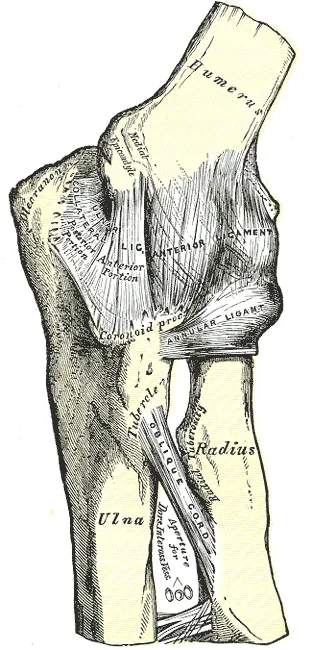
Valgus is an angle at a joint where the lower part points away from the body’s midline. A 2018 review says the ligament has been shown to be the elbow’s main stabiliser against valgus stress7. The same structure is also called the medial ulnar collateral ligament, the medial collateral ligament and the anterior bundle7. The elbow ulnar collateral ligament page covers its anatomy and how throwing loads it7.
How studies grade a tear
The grading below comes from single studies that used MRI (magnetic resonance imaging, a scan that shows soft tissue in detail)8,9. A study of elbow injuries in one professional baseball organisation graded the ligament on MRI in four steps8:
- Grade I: intact, with or without oedema (swelling caused by fluid building up in body tissue)8.
- Grade IIA: a partial tear8.
- Grade IIB: a chronic healed injury8.
- Grade III: a complete tear8.
A separate six-stage MRI classification sorts tears by location and severity9. In a retrospective study (one that looks back at past cases) of 58 patients with tears, distal and complete tears more often went to surgery9. Distal means farther from the centre of the body.
The operations studies report on
Two operations appear in the studies below: reconstruction and repair of the ligament11. Reconstruction with a free tendon graft is known as Tommy John surgery12. A graft is a piece of tissue moved from one place to rebuild a damaged part. The authors of a 2025 meta-analysis noted that repair is feasible only in specific instances of partial injury11.
Who it affects
Mostly baseball players in the surgical studies
A 2015 systematic review pooled 20 studies of reconstruction, with 2019 patients of mean age about 222. Of them, 97% were male, 94.5% were baseball players and 80% were pitchers2. Collegiate was the most common level of play, at 44.6%2.
Other studies describe other groups, as the table shows6,13.
| Group studied | What was found |
|---|---|
| 5,088 professional baseball players, by survey | 25% of major league pitchers (96 of 382) and 15% of minor league pitchers had had a reconstruction14 |
| 25 college sports in the NCAA Injury Surveillance Program, 2009-10 to 2013-14 | 109 injuries, 0.29 per 10,000 athlete-exposures (one athlete in one practice or game); 76.1% came from contact and 23.9% from throwing15 |
| National Football League players other than quarterbacks, 2015 to 2022 | 268 had an isolated injury; linemen had 56.0% of them, 98% were managed without surgery and 72% missed no time13 |
| Female athletes who had surgery on the ligament, in a systematic review | Four retrospective studies and 49 athletes in all; gymnastics, softball and cheerleading were the most common sports6 |
| Non-throwing athletes, in a systematic review | Six articles covering 95 athletes in 11 sports; the authors called the available evidence limited16 |
The 2025 review that gives the two routes says injuries in female athletes often come from trauma or from something other than overhead throwing6.
What is said about risk factors
Sources differ on how settled the risk factors are17,18. A 2023 consensus panel (a group of experts who meet to agree a shared view) had 26 elbow surgeons and 3 therapists or athletic trainers17. It agreed unanimously that high velocity, overuse, previous injury and poor mechanics are among the risk factors17. The paper rates itself as level V evidence, expert opinion, the lowest rung on a scale that ranks study designs17.
A systematic review of 21 studies in baseball players found pitch velocity inconsistent across the literature, though most studies found it a risk19. A meta-analysis of 13 studies began from the position that risk factors in baseball players are unclear18.
What studies found
How strong the evidence is
Reviews of this injury comment on the design of the studies behind them2,20,21.
- A 2015 systematic review of reconstruction rated overall study quality as low, because all 20 of its studies were single-centre retrospective case series2.
- The authors of a 2018 systematic review wrote that the published data on reconstruction were mostly small retrospective studies20.
- A systematic review of 29 articles on professional baseball players concluded that return-to-play definitions are vague and prevent comparison between studies21.
Care without surgery
A systematic review pooled 15 studies of athletes managed without surgery, with 365 patients of mean age about 203. It found that 79.7% returned to sport and 77.9% returned to their previous level of play3. The authors rated their own evidence as level 4 and wrote that the efficacy of this approach was unclear3. Among 544 professional baseball players managed without surgery between 2011 and 2015, 54% returned to play22.
Studies disagree on whether the place of the tear matters3,22. In the 15-study review, 89.7% (61 of 68) returned with tears at the upper end of the ligament3. With tears at the lower end, 41.2% (14 of 34) returned3. In the study of 544 professional players, 243 MRI scans were read for tear location and grade22. Neither was a statistically significant predictor of return to play or of going on to surgery22.
A systematic review of 15 studies (513 patients) compared surgical with non-surgical management23. Its patients were non-professional athletes and people injured outside sport23. It concluded the evidence was not enough to establish statistically significant differences in functional outcomes23.
Platelet-rich plasma injections
Platelet-rich plasma is a part of a person’s own blood with extra platelets, prepared for injection. Studies of it for this injury point in different directions22,24.
- A case series followed 34 athletes with partial-thickness tears who had not improved after at least two months without surgery24. After one injection each, 30 (88%) were back at the same level of play at an average follow-up of 70 weeks24.
- In the 15-study review, 189 patients had injections with an exercise-based programme and 176 had the programme alone3. The return-to-sport rate did not differ significantly between them3.
- Among the 544 professional players, 133 had injections and 411 did not22. The injection group took significantly longer to return to throwing and to play22. Preparations and protocols varied in that retrospective comparison22.
- A systematic review of five studies (156 patients) of injections for partial tears in athletes called the literature heterogeneous and of low quality25.
Return to sport after reconstruction
A case series and three systematic reviews of reconstruction report these rates of return2,12,26,27.
| Who was studied | What was found |
|---|---|
| 743 athletes followed at least two years, in a case series | 617 (83%) returned to their previous level of competition or higher; full competition took 11.6 months on average12 |
| 20 studies, in a 2015 systematic review | A pooled return-to-sport rate of 86.2%: 95.5% of collegiate, 89.4% of high school and 86.4% of professional athletes2 |
| 21 studies (2,452 patients) with at least two years of follow-up | Between 62.5% and 100% returned to play; the mean time ranged from 9.5 to 18.5 months26 |
| Adolescent throwing athletes, in nine studies (404 baseball, 10 javelin) | 349 of 414 (84.30%) returned to the same level of competition or higher27 |
A meta-analysis of 26 studies (1019 athletes) put the pooled rate of failure to return after reconstruction or repair at 11.4%28. Persistent pain was the most common reason given, in 29 of 10328. That analysis found moderate evidence of publication bias, when studies with striking results are more likely to be published28. In a review of eight studies (378 patients), psychological factors made up 40.4% of the reasons for not returning29.
Performance and the long term
In 147 Major League Baseball pitchers, performance fell on several measures after reconstruction, including innings pitched and average fastball velocity30. The declines were not statistically different from those of age-matched pitchers who had not had the surgery30.
One study contacted 256 baseball players an average of 12.6 years after reconstruction31. Of them, 92% could throw without pain after their baseball careers, and 3% reported persistent elbow pain31.
Complications and the ulnar nerve
The 743-athlete case series recorded complications in 148 athletes (20%)12. It counted 16% as minor and 4% as major12.
Some reported complications involve the ulnar nerve, the nerve that runs past the inner side of the elbow5,32. A 1986 report of reconstruction in 16 athletes noted a high incidence of ulnar nerve complications32. A meta-analysis of 17 retrospective studies (1518 cases) found ulnar nerve symptoms or deficits after 12.0% of reconstructions5. That figure includes brief ones that resolved, and 0.8% of cases had a further operation for them5.
Repair and repeat surgery
A 2025 meta-analysis pooled 31 studies, none of them comparative11. In it, 91.1% of 496 repair patients and 88.7% of 2277 reconstruction patients returned to sport11.
In a 2019 case series, athletes had a repair with an internal brace and were followed for at least a year33. Of 111 eligible overhead athletes who wanted to return to the same or a higher level, 102 (92%) did so33. The mean time was 6.7 months33. Candidates were chosen after non-operative care had failed, when imaging showed no sign of poor tissue quality33. Imaging also had to suggest the ligament was completely or partly pulled off one of its bony ends33.
A cohort study, one that follows a group over time, covered 461 competitive athletes of mean age 19.134. Those who had a repair returned to competition sooner than those who had a reconstruction, at 9.2 against 13.4 months on average34. The share needing revision surgery (a repeat operation) did not differ significantly, at 9% against 8%34. The repair group had been followed for a shorter time, 4.4 against 6.3 years34.
A meta-analysis of six studies covering 27,366 baseball players put the pooled incidence of revision surgery at 8.42%35. Its studies differed widely from one another35. Of 191 professional pitchers who had a revision reconstruction between 2010 and 2023, 72% returned to play at any level36.
Connections
The injury is to the elbow ulnar collateral ligament, part of the elbow joint7.
The ligament lies against the ulnar nerve37. Among 500 baseball pitchers who had reconstruction at one institution, 97 (19.4%) had ulnar neuritis when they presented with the ligament injury38.
The common flexor tendon attaches just in front of the ligament’s anterior bundle, as found in 52 cadaver elbows39. Among 187 male baseball players who had reconstruction by one surgeon, 8 (4%) also had a flexor-pronator injury40.
Elbow UCL tear involves
Elbow UCL tear has studies of nerve symptoms after surgery involving
Elbow UCL tear sometimes comes with injury to
Sources
- Davey MS, Hurley ET, Gaafar M, Galbraith JG, Mullett H, Pauzenberger L (2021). Ulnar collateral ligament reconstruction of the elbow at minimum 48-month mean follow-up demonstrates excellent clinical outcomes with low complication and revision rates: systematic review.. Journal of ISAKOS : joint disorders & orthopaedic sports medicine. doi:10.1136/jisakos-2021-000614 PMID 34001506
- Erickson BJ, Chalmers PN, Bush-Joseph CA, Verma NN, Romeo AA (2015). Ulnar Collateral Ligament Reconstruction of the Elbow. Orthopaedic journal of sports medicine. doi:10.1177/2325967115618914 PMID 26740956
- Gopinatth V, Batra AK, Khan ZA, Jackson GR, Jawanda HS, Mameri ES, McCormick JR, Knapik DM, Chahla J, Verma NN (2023). Return to Sport After Nonoperative Management of Elbow Ulnar Collateral Ligament Injuries: A Systematic Review and Meta-analysis.. The American journal of sports medicine. doi:10.1177/03635465221150507 PMID 36876746
- Anderson MJJ, Crockatt WK, Mueller JD, Hellwinkel JE, Alexander FJ, Trofa DP, Ahmad CS (2022). Return-to-Competition Criteria After Ulnar Collateral Ligament Reconstruction: A Systematic Review and Meta-analysis.. The American journal of sports medicine. doi:10.1177/03635465211016839 PMID 34181472
- Clain JB, Vitale MA, Ahmad CS, Ruchelsman DE (2019). Ulnar Nerve Complications After Ulnar Collateral Ligament Reconstruction of the Elbow: A Systematic Review.. The American journal of sports medicine. doi:10.1177/0363546518765139 PMID 29683338
- Dave U, Chang N, Rubin J, Harkin W, Atkins M, Bi AS, Verma NN (2025). Female athletes have high return to sport and low complication rates following ulnar collateral ligament (UCL) repair or reconstruction: a systematic review.. JSES reviews, reports, and techniques. doi:10.1016/j.xrrt.2025.02.007 PMID 40697295
- Labott JR, Aibinder WR, Dines JS, Camp CL (2018). Understanding the medial ulnar collateral ligament of the elbow: Review of native ligament anatomy and function.. World journal of orthopedics. doi:10.5312/wjo.v9.i6.78 PMID 29984194
- Ford GM, Genuario J, Kinkartz J, Githens T, Noonan T (2016). Return-to-Play Outcomes in Professional Baseball Players After Medial Ulnar Collateral Ligament Injuries. The American journal of sports medicine. doi:10.1177/0363546515621756 PMID 26764237
- Ramkumar PN, Haeberle HS, Navarro SM, Frangiamore SJ, Farrow LD, Schickendantz MS (2019). Clinical Utility of an MRI-Based Classification System for Operative Versus Nonoperative Management of Ulnar Collateral Ligament Tears: A 2-Year Follow-up Study.. Orthopaedic journal of sports medicine. doi:10.1177/2325967119839785 PMID 31065552
- Garcia GH, Gowd AK, Cabarcas BC, Liu JN, Meyer JR, White GM, Romeo AA, Verma NN (2019). Magnetic Resonance Imaging Findings of the Asymptomatic Elbow Predict Injuries and Surgery in Major League Baseball Pitchers.. Orthopaedic journal of sports medicine. doi:10.1177/2325967118818413 PMID 30729142
- Dave U, Rubin J, Chang N, Kumar N, Madden D, Mamonov A, Atkins M, Harkin W, Bi AS, Verma NN (2025). Ulnar collateral ligament repair and reconstruction have similar return to sport rates with low complication rates: a systematic review and meta-analysis.. JSES reviews, reports, and techniques. doi:10.1016/j.xrrt.2025.02.005 PMID 41179443
- Cain EL Jr, Andrews JR, Dugas JR, Wilk KE, McMichael CS, Walter JC 2nd, Riley RS, Arthur ST (2010). Outcome of ulnar collateral ligament reconstruction of the elbow in 1281 athletes. The American journal of sports medicine. doi:10.1177/0363546510378100 PMID 20929932
- Patel NK, Hanna A, Johns WL, Dhanota AS, Dodson CC, Pepe M (2025). Incidence, management, and outcomes following elbow ulnar collateral ligament injuries in nonquarterback professional football players.. JSES international. doi:10.1016/j.jseint.2025.04.010 PMID 41049625
- Conte SA, Fleisig GS, Dines JS, Wilk KE, Aune KT, Patterson-Flynn N, ElAttrache N (2015). Prevalence of Ulnar Collateral Ligament Surgery in Professional Baseball Players.. The American journal of sports medicine. doi:10.1177/0363546515580792 PMID 25925603
- Li NY, Goodman AD, Lemme NJ, Owens BD (2019). Epidemiology of Elbow Ulnar Collateral Ligament Injuries in Throwing Versus Contact Athletes of the National Collegiate Athletic Association: Analysis of the 2009-2010 to 2013-2014 Seasons.. Orthopaedic journal of sports medicine. doi:10.1177/2325967119836428 PMID 31008136
- Miltenberg B, Johns WL, Baumann AN, Martinazzi BJ, Anaspure O, Thomas TL, Ciccotti MG, Cohen SB (2025). Outcomes after ulnar collateral ligament injuries in non-throwing athletes: a systematic review.. JSES reviews, reports, and techniques. doi:10.1016/j.xrrt.2025.04.012 PMID 40697296
- Erickson BJ, Hurley ET, Mojica ES, Jazrawi LM, Ulnar Collateral Ligament – Delphi Consensus Group (UCL-DCG) (2023). Elbow Ulnar Collateral Ligament Tears: A Modified Consensus Statement.. Arthroscopy : the journal of arthroscopic & related surgery : official publication of the Arthroscopy Association of North America and the International Arthroscopy Association. doi:10.1016/j.arthro.2022.12.033 PMID 36796550
- Reiman MP, Walker MD, Peters S, Kilborn E, Thigpen CA, Garrigues GE (2019). Risk factors for ulnar collateral ligament injury in professional and amateur baseball players: a systematic review with meta-analysis.. Journal of shoulder and elbow surgery. doi:10.1016/j.jse.2018.08.018 PMID 30392938
- Labott JR, Leland DP, Till SE, Diamond A, Hintz C, Dines JS, Camp CL (2023). A Number of Modifiable and Nonmodifiable Factors Increase the Risk for Elbow Medial Ulnar Collateral Ligament Injury in Baseball Players: A Systematic Review.. Arthroscopy : the journal of arthroscopic & related surgery : official publication of the Arthroscopy Association of North America and the International Arthroscopy Association. doi:10.1016/j.arthro.2022.12.036 PMID 36649826
- Somerson JS, Petersen JP, Neradilek MB, Cizik AM, Gee AO (2018). Complications and Outcomes After Medial Ulnar Collateral Ligament Reconstruction. JBJS reviews. doi:10.2106/JBJS.RVW.17.00138 PMID 29738408
- Buchanan TR, Kaiser AHA, Hones KM, Kamarajugadda S, Portnoff B, Bindi VE, Wright JO, Roach RP, Farmer KW, Li X, King JJ, Hao KA (2025). Current Definitions of Return to Play After Medial Ulnar Collateral Ligament Injuries and Surgery in Professional Baseball Players Prohibit Cross-Study Comparison: A Systematic Review.. Arthroscopy : the journal of arthroscopic & related surgery : official publication of the Arthroscopy Association of North America and the International Arthroscopy Association. doi:10.1016/j.arthro.2025.01.030 PMID 39892430
- Chauhan A, McQueen P, Chalmers PN, Ciccotti MG, Camp CL, D'Angelo J, Potter HG, Fealy SA, Erickson BJ, Hoenecke HR, Keefe D, McCauley J, Fronek J (2019). Nonoperative Treatment of Elbow Ulnar Collateral Ligament Injuries With and Without Platelet-Rich Plasma in Professional Baseball Players: A Comparative and Matched Cohort Analysis.. The American journal of sports medicine. doi:10.1177/0363546519876305 PMID 31589470
- Biz C, Crimì A, Belluzzi E, Maschio N, Baracco R, Volpin A, Ruggieri P (2019). Conservative Versus Surgical Management of Elbow Medial Ulnar Collateral Ligament Injury: A Systematic Review.. Orthopaedic surgery. doi:10.1111/os.12571 PMID 31773896
- Podesta L, Crow SA, Volkmer D, Bert T, Yocum LA (2013). Treatment of partial ulnar collateral ligament tears in the elbow with platelet-rich plasma.. The American journal of sports medicine. doi:10.1177/0363546513487979 PMID 23666850
- Ifarraguerri AM, Berk AN, Rao AJ, Trofa DP, Ahmad CS, Martin A, Fleischli JE, Saltzman BM (2024). A systematic review of the outcomes of partial ulnar collateral ligament tears of the elbow in athletes treated non-operatively with platelet-rich plasma injection.. Shoulder & elbow. doi:10.1177/17585732241235631 PMID 39318405
- Jackson GR, Mowers CC, Sachdev D, Knapik DM, Lapica H, Sabesan VJ (2025). Ulnar Collateral Ligament Reconstruction Is Commonly Performed Using a Palmaris Graft and Provides Favorable Patient Outcomes With Variable Return-to-Play and Postoperative Complication Rates: A Systematic Review.. Arthroscopy : the journal of arthroscopic & related surgery : official publication of the Arthroscopy Association of North America and the International Arthroscopy Association. doi:10.1016/j.arthro.2024.03.039 PMID 38599535
- Hadley CJ, Edelman D, Arevalo A, Patel N, Ciccotti MG, Dodson CC (2021). Ulnar Collateral Ligament Reconstruction in Adolescents: A Systematic Review.. The American journal of sports medicine. doi:10.1177/0363546520934778 PMID 32791013
- Fathi A, Haratian A, Treloar J, Bolia IK, Hasan LK, Weber AE, Petrigliano FA (2022). Pain Is the Most Frequently Cited Reason Athletes Fail to Return to Sport After Ulnar Collateral Ligament Surgery: A Systematic Review and Meta-analysis.. Orthopaedic journal of sports medicine. doi:10.1177/23259671221128257 PMID 36313005
- Chen AZ, Greaves KM, Fortney TA, Saltzman BM, Trofa DP, Ahmad CS (2022). Psychological Factors Associated With Return to Play After Ulnar Collateral Ligament Reconstruction: A Systematic Review.. Orthopaedic journal of sports medicine. doi:10.1177/23259671221125746 PMID 36225388
- Makhni EC, Lee RW, Morrow ZS, Gualtieri AP, Gorroochurn P, Ahmad CS (2014). Performance, Return to Competition, and Reinjury After Tommy John Surgery in Major League Baseball Pitchers. The American journal of sports medicine. doi:10.1177/0363546514528864 PMID 24705898
- Osbahr DC, Cain EL Jr, Raines BT, Fortenbaugh D, Dugas JR, Andrews JR (2014). Long-term Outcomes After Ulnar Collateral Ligament Reconstruction in Competitive Baseball Players. The American journal of sports medicine. doi:10.1177/0363546514528870 PMID 24705899
- Jobe FW, Stark H, Lombardo SJ (1986). Reconstruction of the ulnar collateral ligament in athletes.. The Journal of bone and joint surgery. American volume. PMID 3771597
- Dugas JR, Looze CA, Capogna B, Walters BL, Jones CM, Rothermich MA, Fleisig GS, Aune KT, Drogosz M, Wilk KE, Emblom BA, Cain EL Jr (2019). Ulnar Collateral Ligament Repair With Collagen-Dipped FiberTape Augmentation in Overhead-Throwing Athletes.. The American journal of sports medicine. doi:10.1177/0363546519833684 PMID 30943085
- Dugas JR, Froom RJ, Mussell EA, Carlson SM, Crawford AE, Tulowitzky GE, Dias T, Wilk KE, Patel AN, Kidwell-Chandler AL, Ryan MK, Atkinson AW, Manush AH, Rothermich MA, Ithurburn MP, Emblom BA, Cain EL Jr (2025). Clinical Outcomes of Ulnar Collateral Ligament Repair With Internal Brace Versus Ulnar Collateral Ligament Reconstruction in Competitive Athletes.. The American journal of sports medicine. doi:10.1177/03635465251314054 PMID 39891035
- Sáez A, Mariscal G, Barrios C (2025). Incidence of Ulnar Collateral Ligament Surgery and Revision in Baseball Players: A Systematic Review and Meta-Analysis.. Sports (Basel, Switzerland). doi:10.3390/sports13090299 PMID 41003605
- Erickson BJ, Camp CL, Chalmers PN, Griffith TB, Simon KN, Hebert E, Meister K (2025). Outcomes of Revision Elbow Medial Ulnar Collateral Ligament Reconstruction in Professional Baseball Players: An Analysis of 191 Pitchers From 2010 to 2023.. The American journal of sports medicine. doi:10.1177/03635465251322780 PMID 40035615
- Gray H; Lewis WH (editor) (1918). Anatomy of the Human Body. Lea & Febiger, Philadelphia (20th edition). Link
- De Giacomo AF, Keller RA, Banffy M, ElAttrache NS (2022). Ulnar Neuritis and Its Affect on Outcomes of Elbow Ulnar Collateral Ligament Reconstruction.. The American journal of sports medicine. doi:10.1177/03635465211053866 PMID 34797176
- Otoshi K, Kikuchi S, Shishido H, Konno S (2014). The proximal origins of the flexor-pronator muscles and their role in the dynamic stabilization of the elbow joint: an anatomical study.. Surgical and radiologic anatomy : SRA. doi:10.1007/s00276-013-1168-3 PMID 23884470
- Osbahr DC, Swaminathan SS, Allen AA, Dines JS, Coleman SH, Altchek DW (2010). Combined flexor-pronator mass and ulnar collateral ligament injuries in the elbows of older baseball players.. The American journal of sports medicine. doi:10.1177/0363546509351558 PMID 20139331
Changes
- Revised to report sources added after their published corrections were read