Common flexor tendon
Also called flexor-pronator tendon, common flexor origin, anterior common tendon
The shared tendon that anchors forearm muscles to the inner elbow. How it is built, how it sits beside the inner-elbow ligament, what studies of golfer's elbow found, and what loads it.
- Region
- Elbow
- Muscles
- pronator teres, flexor carpi radialis, palmaris longus, flexor digitorum superficialis, flexor carpi ulnaris
- Updated
- October 8, 2026
- Reviewed
- October 8, 2026 · how entries are checked
Function
Which muscles share the tendon
Five forearm muscles have a common origin on the medial epicondyle of the humerus (upper arm bone)2:
- The pronator teres, a forearm muscle that turns the palm down2.
- The flexor carpi radialis, a forearm muscle that bends the wrist2.
- The palmaris longus, another forearm muscle2.
- The flexor digitorum superficialis, a forearm muscle that bends the fingers, which the 1918 figure below labels flexor digitorum sublimis2.
- One part of the flexor carpi ulnaris, a forearm muscle that bends the wrist toward the little finger2.
In 52 elbows from 26 cadavers, the first four muscles joined into one tendon at their upper origin1. The authors named it the anterior common tendon1.
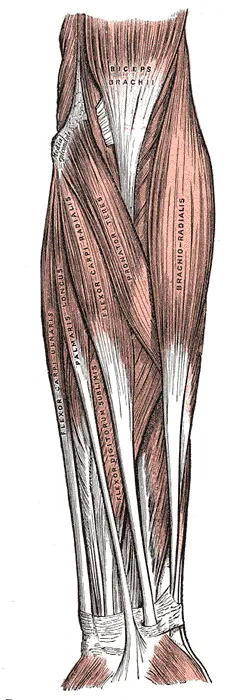
Where it sits beside the inner-elbow ligament
A clinical reference describes the common flexor tendon as lying next to and in front of the ulnar collateral ligament2. There, it says, the tendon acts as a dynamic stabiliser against valgus stress2. A stabiliser holds a joint steady, and valgus stress is a sideways push that opens the inner side of the elbow.
In those 52 elbows, the common tendon was fixed to the medial epicondyle and to the joint capsule, the sleeve enclosing the joint1. It lay just in front of the ligament’s anterior (front) bundle and parallel to it1. Under the microscope the tendon looked much like that bundle1. The authors suggest it might share the traction (pulling) forces on the inner elbow1.
How the muscles share load with the ligament
Three cadaver studies loaded these muscles, and they differ on which muscle did most6,7,8. The valgus angle is how far the forearm points away from the body’s midline at the elbow.
- Six elbows with a simulated full tear of the ligament. Simulated flexor carpi ulnaris force reduced the valgus angle most, and pronator teres force least6. The authors named the flexor carpi ulnaris the primary dynamic stabiliser and the flexor digitorum superficialis the secondary one6.
- Eight elbows with strain (stretch) measured in the ligament. Loading the flexor carpi ulnaris, flexor digitorum superficialis or flexor carpi radialis one at a time significantly relieved it7. That held at 45 and 90 degrees of elbow bend7. The flexor carpi ulnaris gave the most relief, and the pronator teres produced no significant change7.
- Eight specimens tested with the ligament intact, stretched and cut. Loading the flexor-pronator muscles lowered the valgus angle in each condition8. The authors found the flexor digitorum superficialis the biggest contributor8.
In 17 healthy men, a 50-newton valgus load widened the inner elbow joint gap on ultrasound from 4.1 mm to 5.4 mm9. Ultrasound is a scan made with sound waves. Contracting the flexor digitorum superficialis of one finger under the same load brought the gap back to 4.6 mm9.
Breakdown
What medial epicondylitis is
A review describes medial epicondylitis, often called golfer’s elbow, as degeneration of the flexor-pronator tendon3. It occurs during activities that involve wrist flexion (bending the wrist forward) and pronation (turning the palm down)3. In these the wrist is repeatedly forced back and the forearm forced palm-up3. The same review describes a staged process of change in the tendon3. It can end in structural breakdown and irreparable fibrosis (scarring) or calcification (calcium deposits)3.
A surgical technique article notes that it typically follows overuse of the flexor-pronator muscles10. Occasionally it may follow one sudden injury, such as an avulsion, a tear in which the common flexor tendon pulls away from the bone10.
What the tissue and scans show
Two surgical series describe the tissue, and their accounts differ11,12. In 50 cases operated on after non-operative care had failed, microscopy showed angiofibroblastic tendinosis and fibrillary degeneration of collagen11. Tendinosis is tendon wear seen in the tissue, and collagen is the main building material of tendons. In 35 other patients, surgeons consistently found residual tears with incomplete healing in the flexor origin12. Under the microscope there was reactive fibrous tissue, with inflammation that varied in degree12.
Ultrasound of 21 elbows with clinical medial epicondylitis was abnormal in 2013. It showed tendinosis in 15 and a partial-thickness tear, a tear through part of the tendon, in 513.
Changes in people without symptoms
In 111 healthy volunteers, ultrasound showed signs of tendinosis in 24 of 222 common flexor tendons14. It showed calcification in 11 and a bony spur at the attachment in 3314. The authors note that ultrasound signs of tendinosis may be found in people without symptoms14.
How common it is
Studies in different groups give these figures4,15,16. Prevalence is the share of a group with a condition at a given time. Incidence is how many new cases appear over a set time. Lateral epicondylitis is pain where the forearm extensor tendons attach at the outer elbow, covered on the common extensor tendon page16.
| Who was studied | Medial epicondylitis | Lateral epicondylitis |
|---|---|---|
| 4,783 people aged 30 to 64 in Finland | Prevalence 0.4%4 | 1.3%, definite cases4 |
| US military health records, 1998 to 2006 | Incidence 0.81 per 1,000 person-years15 | 2.98 per 1,000 person-years15 |
| South Korea, national insurance data, 2013 to 2017 | Mean yearly incidence 2.9 per 1,000 people, adjusted for age16 | 9.7 per 1,000 people16 |
Person-years count people multiplied by the years each was followed. In the Korean data, yearly incidence was higher in females than in males16.
What goes with it
Studies of work and habits do not agree17,18. An odds ratio shows how many times higher the odds of an outcome are in one group than in another. A systematic review searches for the research on a question in a set, checkable way.
- 1,757 workers. Forceful work was a risk factor, with an odds ratio of 1.95, but exposure to repetitive work was not5.
- A 2009 systematic review of occupational studies. It found associations with repeated handling of heavy loads, high grip forces, repetitive movements and vibrating tools17.
- A 2021 systematic review. It accepted studies measuring work exposure directly or by video, and found four18. Not one showed an association, and it judged the evidence insufficient to support a causal link with work load18.
What a golf study recorded
One study used electromyography (EMG), which measures a muscle’s electrical activity, during the golf swing19. It took golfers with and without medial epicondylitis19. The common flexor muscles produced a consistent burst at ball contact, reaching about 91% of their hardest voluntary effort19. Golfers with medial epicondylitis had significantly greater average forearm flexor activity than golfers without it19. That held both when addressing the ball and during the swing19.
Recovery
How it changes over time
Of workers in repetitive jobs who had medial epicondylitis, 81% had recovered when examined again three years later5. In a clinic series of 95 cases, most recovered without an operation, and 12% had one20.
A 2004 review notes that limited literature exists on medial epicondylitis21. It states that the large majority of people with the condition respond to a well-structured non-surgical programme21.
What injection and shock wave studies found
One randomised, double-blind study took 58 patients (60 elbows) with medial epicondylitis22. Double-blind means neither the participants nor their assessors know who is in which group. Those given a methylprednisolone (steroid) injection had less pain at six weeks than those given saline (salt water)22. The groups did not differ at three months or one year22. The authors believed the improvement in both groups mainly reflected the natural history of the disorder, its course when left alone22.
Shock waves are pulses of sound energy aimed at a painful area through the skin. One study gave low-energy shock waves to 30 patients with chronic (long-lasting) medial epicondylitis23. Seven had an excellent or good result at one year, and pain fell by an average of 32%23. That was significantly worse than in identically managed patients with chronic tennis elbow, the outer-elbow condition23.
What exercise studies found
A 2013 systematic review looked for randomised trials of exercise, including stretching, and mobilisation in medial and lateral epicondylitis24. It found 12 trials in lateral epicondylitis and not one in medial epicondylitis24.
A 2026 systematic review found five clinical studies, with 143 patients, of eccentric wrist flexor-pronator exercise for medial epicondylitis25. Eccentric work is muscle work done while the muscle lengthens. The studies were too varied and small to pool25. Pain and function improved within the exercise groups, but a single randomised trial showed the exercise doing better than a comparison25. The review judged the certainty of this evidence to be low25.
What studies of surgery report
In South Korea’s national data for 2013 to 2017, 1.0% of patients with medial epicondylitis had surgery16. Two systematic reviews gathered the surgical studies26,27:
- 2023 review, 16 studies, 479 elbows. Reported success ran from 63% to 100%, and the complication rate was 4.3%26. The review notes that no standard technique has been established26.
- 2025 review, 17 studies, 442 patients. Fourteen looked back at records, and the review describes a scarcity of high-quality research27.
Sources differ on what an ulnar nerve problem means for the result27,28. One review looked back at 30 elbows operated on for medial epicondylitis28. Sixteen also had ulnar neuropathy (a nerve disorder) at the elbow28. A good or excellent result followed in 24 of 25 with no or mild neuropathy, and in 2 of 5 with moderate or severe neuropathy28. The 2025 review reports two studies in which ulnar neuritis before the operation had minimal impact on outcomes27.
The healthy tendon and workload
In 111 healthy volunteers measured by ultrasound, the tendon was thicker on the dominant side at each of three points measured14. Thickness correlated with heavy manual work and with body mass index, a measure of weight for height, at some measurement points14.
Connections
The ligament and nerves beside it
The tendon lies next to and in front of the ulnar collateral ligament2. One study took 123 Major League Baseball pitchers who returned after a forearm flexor strain managed without surgery29. Within a year of returning, 9.8% had surgery on that ligament, against 4.1% of 246 matched controls29. The difference was no longer statistically significant at two years29.
The ulnar nerve supplies the flexor carpi ulnaris, and the median nerve the other four muscles of the shared origin2.
What a study of wrist flexion exercise showed
Related exercise pages: wrist curl, wrist flexor stretch24,30. In 30 volunteers, a repeated wrist-flexion exercise protocol lowered wrist flexion strength by 7.5%30. It also widened the inner-elbow joint space under a valgus stress test by about 0.9 mm30.
Common flexor tendon is loaded by
Common flexor tendon lies next to
Common flexor tendon is compared with
Common flexor tendon has one of its muscles supplied by
Common flexor tendon has four of its muscles supplied by
Sources
- Otoshi K, Kikuchi S, Shishido H, Konno S (2014). The proximal origins of the flexor-pronator muscles and their role in the dynamic stabilization of the elbow joint: an anatomical study.. Surgical and radiologic anatomy : SRA. doi:10.1007/s00276-013-1168-3 PMID 23884470
- Li D, Hammad A, Kaiser K (2026). Medial Epicondylitis (Golfer's Elbow).. StatPearls. PMID 30085542
- Amin NH, Kumar NS, Schickendantz MS (2015). Medial epicondylitis. The Journal of the American Academy of Orthopaedic Surgeons. doi:10.5435/JAAOS-D-14-00145 PMID 26001427
- Shiri R, Viikari-Juntura E, Varonen H, Heliövaara M (2006). Prevalence and determinants of lateral and medial epicondylitis: a population study.. American journal of epidemiology. doi:10.1093/aje/kwj325 PMID 16968862
- Descatha A, Leclerc A, Chastang JF, Roquelaure Y, Study Group on Repetitive Work (2003). Medial epicondylitis in occupational settings: prevalence, incidence and associated risk factors.. Journal of occupational and environmental medicine. doi:10.1097/01.jom.0000085888.37273.d9 PMID 14506342
- Park MC, Ahmad CS (2004). Dynamic contributions of the flexor-pronator mass to elbow valgus stability.. The Journal of bone and joint surgery. American volume. doi:10.2106/00004623-200410000-00020 PMID 15466738
- Lin F, Kohli N, Perlmutter S, Lim D, Nuber GW, Makhsous M (2007). Muscle contribution to elbow joint valgus stability.. Journal of shoulder and elbow surgery. doi:10.1016/j.jse.2007.03.024 PMID 17936028
- Udall JH, Fitzpatrick MJ, McGarry MH, Leba TB, Lee TQ (2009). Effects of flexor-pronator muscle loading on valgus stability of the elbow with an intact, stretched, and resected medial ulnar collateral ligament.. Journal of shoulder and elbow surgery. doi:10.1016/j.jse.2009.03.008 PMID 19487136
- Hoshika S, Nimura A, Takahashi N, Sugaya H, Akita K (2020). Valgus stability is enhanced by flexor digitorum superficialis muscle contraction of the index and middle fingers.. Journal of orthopaedic surgery and research. doi:10.1186/s13018-020-01640-7 PMID 32238189
- Alrabaa RG, Sonnenfeld J, Trofa D, Ahmad C (2019). Elbow Common Flexor Tendon Repair Technique.. Arthroscopy techniques. doi:10.1016/j.eats.2019.07.016 PMID 31890509
- Ollivierre CO, Nirschl RP, Pettrone FA (1995). Resection and repair for medial tennis elbow. The American journal of sports medicine. doi:10.1177/036354659502300215 PMID 7778708
- Vangsness CT Jr, Jobe FW (1991). Surgical treatment of medial epicondylitis. Results in 35 elbows.. The Journal of bone and joint surgery. British volume. doi:10.1302/0301-620X.73B3.1670439 PMID 1670439
- Park GY, Lee SM, Lee MY (2008). Diagnostic value of ultrasonography for clinical medial epicondylitis.. Archives of physical medicine and rehabilitation. doi:10.1016/j.apmr.2007.09.048 PMID 18374006
- Parlak S, Beşler MS, Ozer H, Baskan B, Toprak U (2019). A comprehensive ultrasonographic investigation of the common flexor tendon and medial epicondyle in asymptomatic individuals.. Medical ultrasonography. doi:10.11152/mu-1926 PMID 31476207
- Wolf JM, Mountcastle S, Burks R, Sturdivant RX, Owens BD (2010). Epidemiology of lateral and medial epicondylitis in a military population.. Military medicine. doi:10.7205/milmed-d-09-00086 PMID 20486505
- Lee BG, Lee YS, Lee CH, Choi WS, Baek SH, Jo YH (2025). Epidemiology of lateral and medial epicondylitis in South Korea: A nationwide population-based study.. Medicine. doi:10.1097/MD.0000000000041588 PMID 40020113
- van Rijn RM, Huisstede BM, Koes BW, Burdorf A (2009). Associations between work-related factors and specific disorders at the elbow: a systematic literature review.. Rheumatology (Oxford, England). doi:10.1093/rheumatology/kep013 PMID 19224937
- Curti S, Mattioli S, Bonfiglioli R, Farioli A, Violante FS (2021). Elbow tendinopathy and occupational biomechanical overload: A systematic review with best-evidence synthesis.. Journal of occupational health. doi:10.1002/1348-9585.12186 PMID 33534951
- Glazebrook MA, Curwin S, Islam MN, Kozey J, Stanish WD (1994). Medial epicondylitis. The American journal of sports medicine. doi:10.1177/036354659402200516 PMID 7810792
- O'Dwyer KJ, Howie CR (1995). Medial epicondylitis of the elbow.. International orthopaedics. doi:10.1007/BF00179962 PMID 7649686
- Ciccotti MC, Schwartz MA, Ciccotti MG (2004). Diagnosis and treatment of medial epicondylitis of the elbow.. Clinics in sports medicine. doi:10.1016/j.csm.2004.04.011 PMID 15474230
- Stahl S, Kaufman T (1997). The efficacy of an injection of steroids for medial epicondylitis. The Journal of bone and joint surgery. American volume. doi:10.2106/00004623-199711000-00006 PMID 9384424
- Krischek O, Hopf C, Nafe B, Rompe JD (1999). Shock-wave therapy for tennis and golfer's elbow--1 year follow-up.. Archives of orthopaedic and trauma surgery. doi:10.1007/s004020050356 PMID 10076947
- Hoogvliet P, Randsdorp MS, Dingemanse R, Koes BW, Huisstede BM (2013). Does effectiveness of exercise therapy and mobilisation techniques offer guidance for the treatment of lateral and medial epicondylitis? A systematic review.. British journal of sports medicine. doi:10.1136/bjsports-2012-091990 PMID 23709519
- See ZH, Loo CE, Jaafar Z (2026). Eccentric exercise therapy for medial epicondylitis: A systematic review of clinical outcomes.. Complementary therapies in medicine. doi:10.1016/j.ctim.2026.103364 PMID 41887339
- Arevalo A, Rao S, Willier DP 3rd, Schrock CI, Erickson BJ, Jack RA 2nd, Cohen SB, Ciccotti MG (2023). Surgical Techniques and Clinical Outcomes for Medial Epicondylitis: A Systematic Review.. The American journal of sports medicine. doi:10.1177/03635465221095565 PMID 35658623
- Barakat A, Jha G, Raval P, Abourisha E, Divall P, Singh HP, Pandey R (2025). Systematic review of surgical techniques for medial epicondylitis: evaluating the impact of preoperative injections and concomitant ulnar neuritis on postoperative outcomes.. Annals of the Royal College of Surgeons of England. doi:10.1308/rcsann.2025.0005 PMID 40131732
- Gabel GT, Morrey BF (1995). Operative treatment of medical epicondylitis. Influence of concomitant ulnar neuropathy at the elbow.. The Journal of bone and joint surgery. American volume. doi:10.2106/00004623-199507000-00013 PMID 7608229
- Dillon MR, Mastroianni MA, Frappa N, Manzi J, Fuller SI, Luzzi AJ, Alexander FJ, Ablove R, Chalmers PN, Ahmad CS (2026). Forearm Flexor Strain and Subsequent Ulnar Collateral Ligament Surgery Risk in Major League Baseball Pitchers: A Covariate-Matched Survival Analysis.. The American journal of sports medicine. doi:10.1177/03635465261486103 PMID 42802907
- Millard N, DeMoss A, McIlvain G, Beckett JA, Jasko JJ, Timmons MK (2019). Wrist Flexion Exercise Increases the Width of the Medial Elbow Joint Space During a Valgus Stress Test.. Journal of ultrasound in medicine : official journal of the American Institute of Ultrasound in Medicine. doi:10.1002/jum.14779 PMID 30280397
Changes
- Revised to report sources added after their published corrections were read