Common extensor tendon
Also called common extensor origin
The shared tendon that anchors several wrist and finger muscles to the outer elbow. How it is built, how it breaks down in tennis elbow, how symptoms change over time, and what loads it.
- Region
- Elbow
- Muscles
- extensor carpi radialis brevis, extensor digitorum, extensor digiti minimi, extensor carpi ulnaris
- Updated
- September 29, 2026
- Reviewed
- September 29, 2026 · how entries are checked
Function
Which muscles start at the outer elbow
The muscles in the surface layer at the back of the forearm start on the humerus (upper arm bone)6. There are five6:
- The extensor carpi radialis longus, a forearm muscle on the thumb side that pulls the wrist back and toward the thumb6.
- The extensor carpi radialis brevis, described as the main muscle that pulls the wrist back1,6.
- The extensor digitorum, a forearm muscle that straightens the fingers6.
- The extensor carpi ulnaris, which pulls the wrist back and toward the little finger6.
- The extensor digiti minimi, which straightens the little finger6.
The extensor carpi radialis brevis (ECRB) starts from the lateral epicondyle through a tendon it shares with three of the others1. Those three are the extensor carpi ulnaris, the extensor digiti minimi and the extensor digitorum1. This page calls that shared tendon the common extensor tendon1.
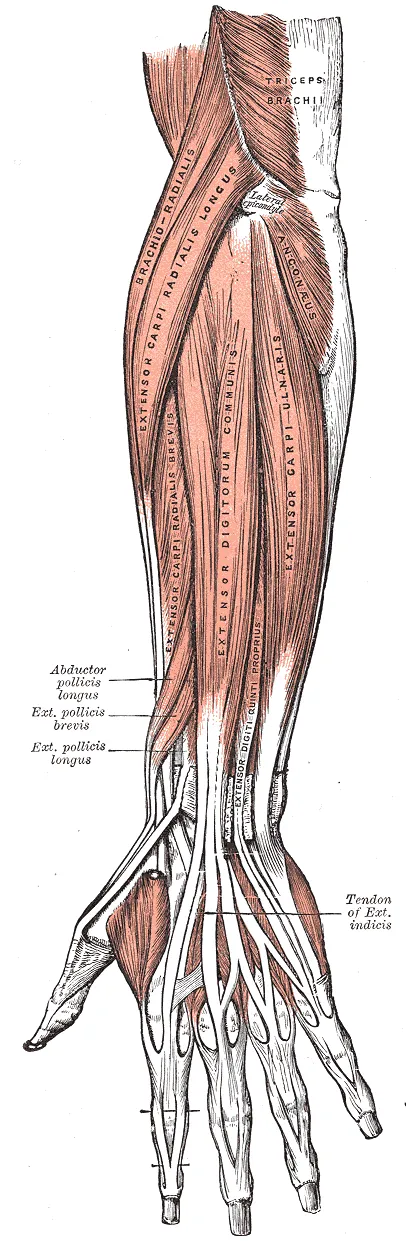
Where the fibres attach
Sources do not agree on which muscles share the tendon1,7. An MRI and anatomy study looked at 10 cadaver (donated body) elbows and 33 dried humerus bones7. It found the ECRB, extensor digitorum and extensor digiti minimi sharing one origin on the upper part of the lateral epicondyle7. In its 10 elbows, the extensor carpi ulnaris tendon started lower and further back, and the study did not list it with that shared origin7. A reference text instead lists the extensor carpi ulnaris among the muscles sharing the tendon1.
In 40 cadaver specimens, the ECRB and extensor digitorum tendons had no clear border between them where they met bone8. The microscope confirmed this8.
The capitellum is the rounded knob at the lower end of the humerus that meets the radius, the forearm bone on the thumb side. In a separate study of 10 cadaver elbows, the ECRB attachment reached a mean 5.9 mm below the capitellum-radius joint line9. No other attachment on the humerus crossed that line9.
What the muscles do
The ECRB is described as the main muscle that pulls the wrist back, a movement called wrist extension1. Lower down, it attaches to the third metacarpal (one of the long bones of the hand), at the back of its base, thumb side1. The ECRB shares a synovial sheath, a fluid-lined sleeve a tendon glides in, with the extensor carpi radialis longus1.
In one study, healthy volunteers gripped at 10 to 30% of their maximum10. A small outside force pushing the palm back lowered activity in their wrist extensors, the muscles that pull the wrist back, for the same grip10. The ECRB and extensor digitorum showed the most significant drop10.
How elbow and wrist position change strain
In 85 cadaver elbows, the underside of the ECRB rubbed on the edge of the capitellum as the elbow straightened11. The extensor carpi radialis longus pressed it against the bone11.
A study of 8 cadaver arms measured strain, how much tissue stretches as a share of its resting length, at the ECRB origin12. With the forearm turned palm-down, bending the wrist down and toward the little finger raised strain significantly12. The rise was significant with the elbow bent 0, 15 or 30 degrees12. Adding finger bending and a varus load, a sideways force that bends the elbow inward, raised strain further12. The highest value was 5.3%, with the elbow bent 15 degrees12.
Breakdown
What tennis elbow is
Lateral epicondylitis is commonly called tennis elbow2. It is described as a common, painful disorder of the enthesis at the outer elbow, the place where tendon attaches to bone3. It limits use of the arm and often costs people time off work3.
The authors of a 40-specimen cadaver study questioned blaming the pain of lateral epicondylitis on the ECRB alone8. They suggested it comes more from the common extensor origin8.
What changes inside the tendon
A review describes one stage of lateral elbow tendinopathy, grade 2, as tendinosis15. Collagen is a strong, rope-like protein, the main building material of tendons. At this stage the collagen fibres are disorganised and broken up, and there are more cells15. The tendon cells are rounded, and new blood vessels grow15.
How common it is
Studies from different places give these figures4,16,17,18:
| Where and when | What the study found |
|---|---|
| US population, 2000 to 2012 | 3.4 new cases of lateral elbow tendinosis per 1,000 people a year4 |
| US population, 2000 against 2012 | New cases fell from 4.5 to 2.4 per 1,000 a year4 |
| South Korea, national data, 2013 to 2017 | 9.7 new cases per 1,000 people a year, adjusted for age16 |
| Hong Kong public hospitals, 2000 to 2024 | 8.84 cases per 100,000 people a year, the highest of the tendinopathies (tendon pain that comes with loading) studied17 |
| Finland, 4,783 people aged 30 to 64 | 1.3% had definite lateral epicondylitis at the time18 |
Who it affects by age and sex
A review says lateral epicondylitis usually affects people aged 35 to 5519. US new cases peaked at ages 40 to 49, at 7.8 per 1,000 men and 10.2 per 1,000 women4. In South Korea, the peak came at ages 50 to 59, at 23.3 per 1,00016.
Studies differ on sex16,18,20. It was recorded more often in women in South Korea, and was higher in females in Hong Kong16,17. A meta-analysis, a study that pools the results of several earlier studies, found females had 1.29 times the odds of males20. It pooled 15 studies20. In the Finnish sample, men and women showed no difference, and it was most common at ages 45 to 5418.
What goes with it
Studies have linked several factors with lateral epicondylitis, each in its own group of people20,21. An odds ratio shows how many times higher the odds of an outcome are in one group than in another.
- Dominant arm. A records review took 1,029 patients at one institution with one of five hand or elbow conditions on one side21. Lateral epicondylitis affected the dominant side significantly more often21.
- Repetitive, forceful arm work. In the Finnish sample, some people’s arm work was both18. They had 5.6 times the odds of possible or definite lateral epicondylitis, against those doing neither18.
- Forearm rotation at work. In a review of five worker studies, moderate-quality evidence linked forearm rotation with an odds ratio of 1.8522. That was rotation for over 4 hours a day, or by 45 degrees or more for at least 45% of the time22.
- Twisting in new jobs. In newly hired US workers followed three years, reported wrist bending or twisting and forearm twisting went with later inner or outer epicondylitis23.
- Smoking. A meta-analysis of 15 studies found 1.49 times the odds in current or past smokers compared with people who had never smoked20.
The Strain Index is a job rating score of how hard the work is on the hand and wrist. A review of five worker studies found high-quality evidence linking a score above 5.1 with lateral epicondylitis22. The odds ratio was 1.7522.
The same review found no significant link with gripping, wrist bending and straightening, or repeated movements at work22. In a meta-analysis of 15 studies, a body mass index (weight measured against height) of 25 or more did not change the odds significantly20.
What tennis studies show
In nine professional and college tennis players, wrist-extensor activity was high as the racquet sped up in both forehand and backhand24. In one lab study, 8 new players hit the backhand with the wrist bent down about 13 degrees25. Their wrist extensors worked while lengthening, called eccentric work, throughout the stroke25. The 8 expert players hit with the wrist tipped back about 23 degrees25.
In a one-handed backhand, 8 competitive players with lateral epicondylitis had significantly more wrist-extensor activity at impact and early follow-through than 14 uninjured players26.
Strength on the painful side
A systematic review searches for the research on a question in a set, checkable way. One such review, with a meta-analysis, gathered 14 studies of people with lateral elbow tendinopathy27. Grip and wrist extension were weaker on the painful side than in pain-free controls27. So were shoulder abduction, lifting the arm out to the side, and external rotation, turning the arm outward27.
Changes on scans without pain
In 30 volunteers aged 35 to 65 with no elbow pain, MRI showed a change in this tendon in 37%5. The share rose with age, from 10% at 35 to 44 to 67% at 55 to 655. Ultrasound is a scan made with sound waves. Of 102 pain-free senior tennis players, 58.8% had at least one ultrasound change in the tendon, mostly in the dominant elbow28. Twenty-one of them had tendon tears28.
Recovery
How symptoms change over a year
One meta-analysis pooled the placebo and no-intervention groups of 24 tennis elbow trials3. A placebo is a dummy version of an intervention with no active part. Of the 213 people in these groups with one-year data, 89% reported feeling much better or completely recovered3. A review likewise describes lateral epicondylitis as generally self-limiting, meaning it usually settles on its own, though in some people symptoms persist19.
In those groups, half of those still with symptoms reported recovery or great improvement every 2.5 to 3 months3. Mean pain and disability halved every 3 to 4 months3. By one year, 88% of pain and 85% of disability had gone3.
A separate meta-analysis pooled six trials with wait-and-see groups, covering 518 people with tendinopathy13. It found that those with lateral elbow tendinopathy given no intervention did not fully clear their symptoms within 12 to 16 weeks13.
What trials of a steroid injection found
A randomised trial assigns people to groups by chance, then compares the groups. One such trial took 185 family-practice patients with lateral epicondylitis29. It compared corticosteroid injections with physiotherapy and with a wait-and-see policy29. A corticosteroid is a drug that copies a type of hormone the body makes.
| Time point | Injection group reporting success | Wait-and-see group reporting success |
|---|---|---|
| 6 weeks | 92%29 | 32%29 |
| 52 weeks | 69%29 | 83%29 |
At 6 weeks the injection group’s success rate was higher than the other groups’29. Symptoms came back often in that group, and its success rate had fallen by 52 weeks29. Two other trials compared a corticosteroid injection with other options14,30:
- 198 adults with tennis elbow. The injection group did better at six weeks, but 47 of its 65 early successes later slipped back30. Long-term results were poorer than in a group given elbow manipulation and exercise30.
- 165 adults with lateral epicondylalgia (pain at the outer elbow) lasting over 6 weeks. At one year, 83% given a corticosteroid injection reported complete recovery or much improvement14. So did 96% given a placebo injection14. Symptoms returned within the year in 54% against 12%14.
What exercise trials found
In the trial of 198 adults, the manipulation-and-exercise group did better than wait-and-see over the first six weeks30. At 52 weeks the two groups did not differ, and most people in both reported success30.
A randomised trial of 40 people with lateral elbow tendinopathy compared 8 weeks of unsupervised isometric exercise with wait-and-see31. Isometric work is a contraction in which the muscle works but the joint does not move. The exercise group ended with lower pain-and-disability scores31. Self-rated success did not differ: 29% against 26%31. Pain-free grip strength did not differ either31.
A meta-analysis of 30 randomised trials took in 2,123 people with lateral elbow tendinopathy32. It found exercise gave better outcomes than passive interventions, but the effect was small32. The authors rated the certainty of this evidence as low or very low32.
How often it returns, and surgery
In the US population-based study, 8.5% of cases of lateral elbow tendinosis came back within two years4. The share of cases that had surgery within two years rose from 1.1% in 2000 to 2002 to 3.2% after 20094. About 1 in 10 people still with symptoms at six months had surgery4.
What is known about adaptation
This page found no study of how the healthy common extensor tendon adapts to training. In 12 healthy untrained people, hard eccentric wrist-extensor work lowered the pressure needed to cause pain over the elbow 24 hours later33. A second bout seven days later did not33.
Connections
The muscles it serves
The common extensor tendon carries the pull of these muscles to the lateral epicondyle, as one reference text lists them1:
- The extensor carpi radialis brevis, described as the main muscle that pulls the wrist back1.
- The extensor digitorum, a forearm muscle that straightens the fingers1.
- The extensor digiti minimi1.
- The extensor carpi ulnaris, which one cadaver study found starting lower on the epicondyle, not listed with the shared origin1,7.
What studies of wrist extension show
Related exercise pages: wrist extension34. In 18 healthy people, ECRB activity rose as eccentric wrist-extensor and forearm-turning exercises on a prototype device got harder34. In 40 healthy arms holding a wrist-extension effort, the ECRB worked harder with the forearm palm-down35. Extensor carpi ulnaris activity did not change with forearm position35.
In 13 healthy men, repeated hard eccentric wrist-extensor work made the outer elbow more tender to pressure 24 hours later36. The most sensitive points lay over the ECRB muscle36.
Common extensor tendon is loaded by
Sources
- Walkowski AD, Goldman EM (2023). Anatomy, Shoulder and Upper Limb, Forearm Extensor Carpi Radialis Brevis Muscle.. StatPearls. PMID 30969541
- Buchanan BK, Varacallo MA (2023). Lateral Epicondylitis (Tennis Elbow).. StatPearls. PMID 28613744
- Ikonen J, Lähdeoja T, Ardern CL, Buchbinder R, Reito A, Karjalainen T (2022). Persistent Tennis Elbow Symptoms Have Little Prognostic Value: A Systematic Review and Meta-analysis.. Clinical orthopaedics and related research. doi:10.1097/CORR.0000000000002058 PMID 34874323
- Sanders TL Jr, Maradit Kremers H, Bryan AJ, Ransom JE, Smith J, Morrey BF (2015). The Epidemiology and Health Care Burden of Tennis Elbow. The American journal of sports medicine. doi:10.1177/0363546514568087 PMID 25656546
- Paluch AJ, Burden EG, Batten TJ, Knight B, Anaspure R, Aboelmagd S, Evans JP, Smith CD (2022). Defining tennis elbow characteristics - The assessment of magnetic resonance imaging defined tendon pathology in an asymptomatic population.. Shoulder & elbow. doi:10.1177/17585732221146731 PMID 38655416
- Betts JG, Young KA, Wise JA, Johnson E, Poe B, Kruse DH, Korol O, Johnson JE, Womble M, DeSaix P (2022). Anatomy and Physiology 2e. OpenStax. Link
- Zoner CS, Buck FM, Cardoso FN, Gheno R, Trudell DJ, Randall TD, Resnick D (2010). Detailed MRI-anatomic study of the lateral epicondyle of the elbow and its tendinous and ligamentous attachments in cadavers.. AJR. American journal of roentgenology. doi:10.2214/AJR.09.3173 PMID 20729438
- Greenbaum B, Itamura J, Vangsness CT, Tibone J, Atkinson R (1999). Extensor carpi radialis brevis. The Journal of bone and joint surgery. British volume. doi:10.1302/0301-620x.81b5.9566 PMID 10530864
- Bernholt DL, Rosenberg SI, Brady AW, Storaci HW, Viola RW, Hackett TR (2020). Quantitative and Qualitative Analyses of the Lateral Ligamentous Complex and Extensor Tendon Origins of the Elbow: An Anatomic Study.. Orthopaedic journal of sports medicine. doi:10.1177/2325967120961373 PMID 33195726
- van Elk N, Faes M, Degens H, Kooloos JG, de Lint JA, Hopman MT (2004). The application of an external wrist extension force reduces electromyographic activity of wrist extensor muscles during gripping.. The Journal of orthopaedic and sports physical therapy. doi:10.2519/jospt.2004.34.5.228 PMID 15189014
- Bunata RE, Brown DS, Capelo R (2007). Anatomic factors related to the cause of tennis elbow.. The Journal of bone and joint surgery. American volume. doi:10.2106/JBJS.F.00727 PMID 17768192
- Shirato R, Aoki M, Iba K, Wada T, Hidaka E, Fujimiya M, Yamashita T (2017). Effect of wrist and finger flexion in relation to strain on the tendon origin of the extensor carpi radialis brevis: A cadaveric study simulating stretching exercises.. Clinical biomechanics (Bristol, Avon). doi:10.1016/j.clinbiomech.2017.08.008 PMID 28826010
- Garzón M, Balasch-Bernat M, Cook C, Ezzatvar Y, Álvarez-Lliso Ó, Dueñas L, Lluch E (2024). How long does tendinopathy last if left untreated? Natural history of the main tendinopathies affecting the upper and lower limb: A systematic review and meta-analysis of randomized controlled trials.. Musculoskeletal science & practice. doi:10.1016/j.msksp.2024.103103 PMID 38879981
- Coombes BK, Bisset L, Brooks P, Khan A, Vicenzino B (2013). Effect of corticosteroid injection, physiotherapy, or both on clinical outcomes in patients with unilateral lateral epicondylalgia: a randomized controlled trial.. JAMA. doi:10.1001/jama.2013.129 PMID 23385272
- Bhabra G, Wang A, Ebert JR, Edwards P, Zheng M, Zheng MH (2016). Lateral Elbow Tendinopathy. Orthopaedic journal of sports medicine. doi:10.1177/2325967116670635 PMID 27833925
- Lee BG, Lee YS, Lee CH, Choi WS, Baek SH, Jo YH (2025). Epidemiology of lateral and medial epicondylitis in South Korea: A nationwide population-based study.. Medicine. doi:10.1097/MD.0000000000041588 PMID 40020113
- Lau KKL, Ng JP, Ling SKK, Ong MTY, Yung PSH, Lui PPY (2026). Incidence rates of tendinopathies and non-traumatic tendon ruptures in Hong Kong: a 25-year epidemiological study using big data from public hospitals.. Scientific reports. doi:10.1038/s41598-025-33465-x PMID 41526611
- Shiri R, Viikari-Juntura E, Varonen H, Heliövaara M (2006). Prevalence and determinants of lateral and medial epicondylitis: a population study.. American journal of epidemiology. doi:10.1093/aje/kwj325 PMID 16968862
- Ahmad Z, Siddiqui N, Malik SS, Abdus-Samee M, Tytherleigh-Strong G, Rushton N (2013). Lateral epicondylitis. The bone & joint journal. doi:10.1302/0301-620X.95B9.29285 PMID 23997125
- Sayampanathan AA, Basha M, Mitra AK (2020). Risk factors of lateral epicondylitis: A meta-analysis.. The surgeon : journal of the Royal Colleges of Surgeons of Edinburgh and Ireland. doi:10.1016/j.surge.2019.08.003 PMID 31543312
- Lutsky K, Kim N, Medina J, Maltenfort M, Beredjiklian PK (2016). Hand Dominance and Common Hand Conditions.. Orthopedics. doi:10.3928/01477447-20160315-02 PMID 27018604
- Bretschneider SF, Los FS, Eygendaal D, Kuijer PPFM, van der Molen HF (2022). Work-relatedness of lateral epicondylitis: Systematic review including meta‐analysis and GRADE work-relatedness of lateral epicondylitis. American journal of industrial medicine. doi:10.1002/ajim.23303 PMID 34674287
- Descatha A, Dale AM, Jaegers L, Herquelot E, Evanoff B (2013). Self-reported physical exposure association with medial and lateral epicondylitis incidence in a large longitudinal study.. Occupational and environmental medicine. doi:10.1136/oemed-2012-101341 PMID 23825198
- Morris M, Jobe FW, Perry J, Pink M, Healy BS (1989). Electromyographic analysis of elbow function in tennis players.. The American journal of sports medicine. doi:10.1177/036354658901700215 PMID 2757127
- Blackwell JR, Cole KJ (1994). Wrist kinematics differ in expert and novice tennis players performing the backhand stroke: implications for tennis elbow.. Journal of biomechanics. doi:10.1016/0021-9290(94)90062-0 PMID 8027087
- Kelley JD, Lombardo SJ, Pink M, Perry J, Giangarra CE (1994). Electromyographic and cinematographic analysis of elbow function in tennis players with lateral epicondylitis.. The American journal of sports medicine. doi:10.1177/036354659402200311 PMID 8037277
- Heales LJ, Bout N, Dines B, Parker T, Reddiex K, Kean CO, Obst SJ (2021). An Investigation of Maximal Strength of the Upper Limb Bilaterally in Individuals With Lateral Elbow Tendinopathy: A Systematic Review With Meta-Analysis.. Physical therapy. doi:10.1093/ptj/pzab230 PMID 34636922
- Crema MD, Guillard V, Levavasseur G, Li L, Montalvan B (2026). Prevalence of ultrasound-detected changes in the common extensor tendon of the elbow in asymptomatic amateur senior tennis players: associations with dominant arm and backhand technique.. Skeletal radiology. doi:10.1007/s00256-026-05253-9 PMID 42171635
- Smidt N, van der Windt DA, Assendelft WJ, Devillé WL, Korthals-de Bos IB, Bouter LM (2002). Corticosteroid injections, physiotherapy, or a wait-and-see policy for lateral epicondylitis: a randomised controlled trial.. Lancet (London, England). doi:10.1016/S0140-6736(02)07811-X PMID 11879861
- Bisset L, Beller E, Jull G, Brooks P, Darnell R, Vicenzino B (2006). Mobilisation with movement and exercise, corticosteroid injection, or wait and see for tennis elbow: randomised trial.. BMJ (Clinical research ed.). doi:10.1136/bmj.38961.584653.AE PMID 17012266
- Vuvan V, Vicenzino B, Mellor R, Heales LJ, Coombes BK (2020). Unsupervised Isometric Exercise versus Wait-and-See for Lateral Elbow Tendinopathy.. Medicine and science in sports and exercise. doi:10.1249/MSS.0000000000002128 PMID 31425384
- Karanasios S, Korakakis V, Whiteley R, Vasilogeorgis I, Woodbridge S, Gioftsos G (2021). Exercise interventions in lateral elbow tendinopathy have better outcomes than passive interventions, but the effects are small: a systematic review and meta-analysis of 2123 subjects in 30 trials.. British journal of sports medicine. doi:10.1136/bjsports-2020-102525 PMID 33148599
- Delfa de la Morena JM, Samani A, Fernández-Carnero J, Hansen EA, Madeleine P (2013). Pressure pain mapping of the wrist extensors after repeated eccentric exercise at high intensity.. Journal of strength and conditioning research. doi:10.1519/JSC.0b013e31828bf2c9 PMID 23442281
- Navsaria R, Ryder DM, Lewis JS, Alexander CM (2013). The Elbow-EpiTrainer: a method of delivering graded resistance to the extensor carpi radialis brevis. Effectiveness of a prototype device in a healthy population.. British journal of sports medicine. doi:10.1136/bjsports-2013-092563 PMID 24184588
- Ikeda K, Kaneoka K, Matsunaga N, Ikumi A, Yamazaki M, Yoshii Y (2025). Effects of forearm rotation on wrist flexor and extensor muscle activities.. Journal of orthopaedic surgery and research. doi:10.1186/s13018-024-05363-x PMID 39819577
- Fernández-Carnero J, Binderup AT, Ge HY, Fernández-de-las-Peñas C, Arendt-Nielsen L, Madeleine P (2010). Pressure pain sensitivity mapping in experimentally induced lateral epicondylalgia.. Medicine and science in sports and exercise. doi:10.1249/MSS.0b013e3181c29eab PMID 19996999
Changes
- Tidy pass: minor review findings fixed, glosses aligned with the reviewed glossary.
- First published.