Cubital tunnel syndrome
Also called ulnar neuropathy at the elbow
Squeezing of the ulnar nerve at the inner elbow. How a 2025 expert panel defined it, who it affects, and what studies of splints, injections and operations found.
- Region
- Elbow
- Updated
- October 22, 2026
- Reviewed
- October 22, 2026 · how entries are checked
What it is
Where the nerve is squeezed
The ulnar nerve runs past the inner elbow to the little-finger side of the hand. At the elbow it rests on the back of the medial epicondyle, the inner bony bump at the elbow end of the upper arm bone7. It reaches the forearm by passing between the two heads of a forearm muscle, the flexor carpi ulnaris7. A review names two main places where it is squeezed at the elbow8. These are the groove behind the epicondyle, and under a fibrous arch at the inner elbow8.
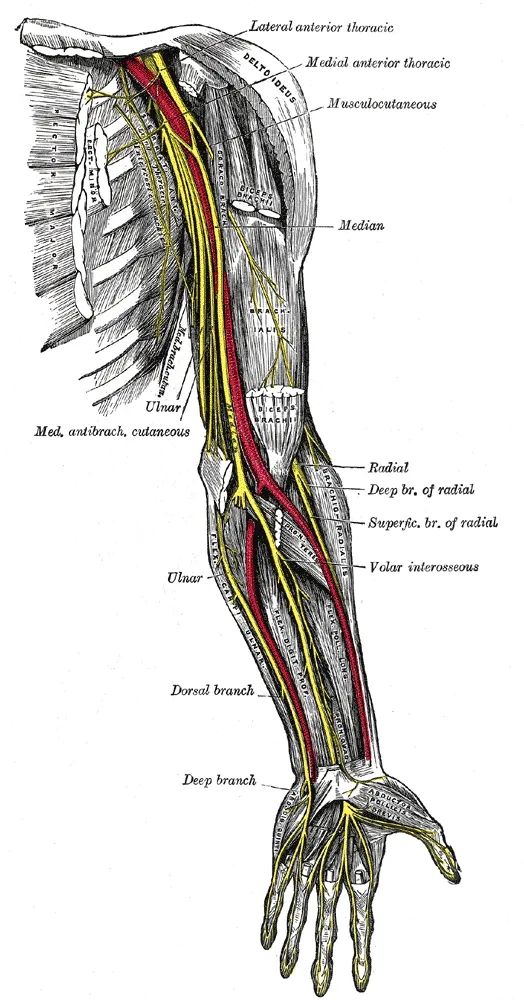
A 2025 Cochrane review describes ulnar neuropathy at the elbow as the second most common entrapment neuropathy1. Entrapment is a nerve being squeezed by the tissue around it. The most common is carpal tunnel syndrome1. A review lists the symptoms that suggest it as inner elbow pain with tingling and numbness, usually in the ring and little fingers8. It says these are commonly worse with the elbow bent8.
How an expert panel defined it
A Delphi study polls a panel of experts in rounds to work toward agreement. In a 2025 Delphi study, 12 hand and upper-limb surgeons agreed six clinical criteria2:
- tingling in the area the ulnar nerve serves2;
- symptoms brought on by bending the elbow2;
- a positive Tinel sign at the inner elbow, an examination test2;
- wasting or weakness of the hand muscles the nerve supplies2;
- loss of two-point discrimination, an examination test of feeling, in the ulnar area2;
- similar symptoms on one side after successful care of the other2.
The panel’s authors call this a first step, with criteria that need weighting and testing before a formal scale can be built2. In a follow-up, two groups of 8 hand surgeons judged 64 made-up cases built from the six criteria9. They did not agree on how much each criterion mattered, but the number present predicted the condition well9. The authors propose that three criteria present can help clinicians make the call9.
A 2021 Delphi study of 15 experts concluded that each investigation should include nerve conduction testing, an electrical nerve test, and ultrasound, a sound-wave scan10.
Who it affects
How common it is
Incidence means how many new cases appear in a group over a set time. Person-years are a count of people multiplied by the years each was followed. A 2019 study of US service members notes that earlier reported rates ranged from 0.08 to 8.0 per 1,000 person-years11. A case-control study compares people who have a condition with similar people who do not. An odds ratio is how many times higher the odds are in one group.
| Group studied | What was found |
|---|---|
| Siena province, Italy, over 5 years | 311 new cases; 32.7 per 100,000 person-years in men and 17.2 in women12 |
| 253 UK general practices in 2000 | 25.2 new presentations of ulnar neuropathy, site not stated, per 100,000 a year in men and 18.9 in women13 |
| A US insurance claims database, 2006 to 2012 | 30.0 per 100,000 person-years, rising with age; 41.3% of 53,401 new cases had surgery14 |
| US active duty service members, over 10 years | 31,568 first-time cases, 2.3 per 1,000 person-years11 |
Sex, age and sport
Studies differ on sex. Two linked the condition with men: a case-control study of 220 cases (odds ratio 2.4) and a UK Biobank study (odds ratio 1.77)15,16. A hospital study of 110 people operated on found that sex was not a risk factor17. Among US service members, the adjusted rate was significantly higher in women, and highest at ages 35 to 3911.
Among 38 wheelchair marathon athletes screened before a race in Japan, 11 (29%) had ulnar neuropathy at the elbow18.
Health and work factors linked with it
The UK Biobank study compared 1,971 cases with 398,639 controls16. It linked the condition with:
- smoking, odds ratio 2.0816;
- diabetes with small-vessel complications (1.80), high blood pressure (1.37) and higher body mass index, a measure of weight for height (1.13)16;
- carpal tunnel syndrome (11.7), osteoarthritis, joint cartilage wearing away (2.12), and rheumatoid arthritis, an immune disease of the joints (1.72)16.
It found no link with ethnicity, height, alcohol intake or underactive thyroid16. A Korean cohort, a group followed over time, included 43,189 people newly recorded with the condition without a known cause19. Its authors report that regular exercise went with lower risk of the condition and of surgery19.
At work, one study linked ulnar neuropathy confirmed by nerve testing, at any site, with forceful work20. The odds ratio reached 3.85, and there was no link with repetitive movements20. A systematic review linked it with holding a tool in position (odds ratio 3.53)21.
What studies found
How it changes without an operation
In one year-long study of 30 cases, around half of those not operated on reported better symptoms22. Each had been told what the condition is and which postures worsen compression22.
A 2020 trial randomly assigned 117 people with mild cases to decompression, surgery that takes pressure off a nerve, or to non-surgical care3. More of the surgery group had improved at 3 months, 85% against 50%3. There was no difference at 6 to 12 months3. The 2016 Cochrane review authors wrote that it is unknown when a person is better managed with or without surgery23.
Splints, advice and exercise
For mild or moderate cases, the 2025 Cochrane review found a single trial each of education, night splinting, nerve gliding and injections around the nerve1. Nerve gliding means exercises that move a nerve by moving the joints it crosses. In one randomised study, 70 people with mild or moderate cases were assigned to night splinting, nerve gliding or a control group24. Each was also told the cause of their symptoms24. Most of the 57 followed for six months had improved, with no significant differences between groups24.
A 2025 systematic review found one randomised trial of night splints against advice alone4. That trial was at high risk of bias, meaning flaws may have skewed it, lost many participants and found no difference between groups4. Another trial and three single-group studies, each at high or critical risk of bias, suggested most mild or moderate cases improve with night splints4. But it was unclear whether the splint or time explained this, and certainty was very low4. The authors judged the evidence too weak to say whether night splints should be recommended4.
A 2022 systematic review found 11 studies, in 187 participants, of approaches delivered by therapists, mostly hands-on, nerve-gliding and electrical methods25. Its authors concluded that no one approach could be called best25.
Injections around the nerve
A corticosteroid is a drug that copies a type of hormone the body makes. A placebo is a dummy version with no active part. The trials and review below reported different results1,26,27:
- In a trial of 55 people, symptoms had improved at 3 months in 30% after a steroid injection and 28% after a placebo26. Its authors suggest the good results in both groups may reflect the natural course or patient education26.
- The 2025 Cochrane review judged the effect of steroid injection against placebo unclear, on very low-certainty evidence1.
- A double-blind trial is one where neither participants nor assessors know the groups. In one such trial of 40 people, two dextrose (simple sugar) injections beat saline, sterile salt water, on pain and disability27. Its authors limit their conclusion to 12 weeks27.
- In a trial of 36 people, dextrose and steroid injections did about equally at most time points28. The dextrose group had larger falls in symptom severity from the third month28.
A 2026 meta-analysis pooled 9 studies (357 cases) of steroid injection29. It compared scores before and after injection, with no control group29. Questionnaire scores were better after injection, but ultrasound and nerve tests showed no significant gain29.
Freeing the nerve or moving it
Transposition is surgery that moves a nerve to a new position. The sources below compared it with simple decompression, which frees the nerve where it lies1.
| Source | What was found |
|---|---|
| 2005 trial of 152 patients, against moving the nerve under the skin | No significant difference at one year; complications in 9.6% after decompression and 31.1% after transposition30 |
| 2025 Cochrane review | Probably little to no difference in improved function1 |
| Review of 10 comparative studies from 2000 to 2024 | No statistical difference against moving it under the skin; decompression may go with more recurrences and repeat operations, but neither was clearly better31 |
Two network meta-analyses reached different conclusions5,6. A 2020 analysis of 30 studies found that 87% of patients improved with surgery5. It judged freeing the nerve in place more effective than moving it5. A 2024 analysis of 10 randomised trials found no difference in response between open, endoscopic and two kinds of transposition surgery6. It found no difference in return to work or repeat surgery either6.
On keyhole surgery, the 2025 Cochrane review found no difference in improvement between endoscopic and open decompression1. Endoscopic means done through small cuts with a camera. A 2025 meta-analysis of 11 studies found that endoscopic surgery took longer32. It brought more haematoma, a pocket of collected blood, and more wound-site pain32. It also brought less elbow numbness and better grip and pinch strength, with no difference in function scores32.
When it comes back
The 2020 network meta-analysis authors write that up to 30% of patients fail to improve after an operation5. They caution that most studies were too short to capture recurrences, which typically appear 6 to 21 months after surgery5. A 2025 review of 14 studies found repeat surgery rates of 1.2% to 23.8%33. Ten of those studies named younger age as a risk factor33.
Connections
The ulnar nerve page covers the nerve’s path, how elbow bending loads it, and the trials of surgery at the elbow. In 20 cadaver (donated body) specimens, bending the elbow to 135 degrees shrank the nerve’s cross-sectional area by 33% to 50%34. In the UK Biobank study, carpal tunnel syndrome was linked with the condition, with an odds ratio of 11.716.
A review states that ulnar neuropathy at the elbow is often mistaken for golfer’s elbow8. The reason given is how close the nerve lies to the start of the common flexor tendon8. Ulnar neuritis is irritation or inflammation of the ulnar nerve. Among 500 pitchers who had surgery for an ulnar collateral ligament tear, 19.4% had it at presentation35.
Cubital tunnel syndrome involves
Cubital tunnel syndrome is linked in a large case-control study with
Cubital tunnel syndrome is often mistaken for pain at
Cubital tunnel syndrome is seen alongside, in some pitchers, the
Sources
- Caliandro P, La Torre G, Padua R, Giannini F, Reale G, Padua L (2025). Treatment for ulnar neuropathy at the elbow.. The Cochrane database of systematic reviews. doi:10.1002/14651858.CD006839.pub5 PMID 40298125
- Collins DW, Rehak D, Dawes A, Collins DP, Daly C, Wagner ER, Gottschalk MB (2025). Cubital Tunnel Syndrome: Does a Consensus Exist for Diagnosis?. The Journal of hand surgery. doi:10.1016/j.jhsa.2023.05.014 PMID 37422755
- Pompe SM, Schreuder T, Teunissen LL, Visser LH, Beekman R (2020). In situ decompression vs conservative treatment for mild ulnar neuropathy at the elbow.. Muscle & nerve. doi:10.1002/mus.26912 PMID 32369630
- Bateman M, Swaile H, Tambe A (2025). Effectiveness of night splints for cubital tunnel syndrome - A systematic review.. Hand therapy. doi:10.1177/17589983251336157 PMID 40385935
- Wade RG, Griffiths TT, Flather R, Burr NE, Teo M, Bourke G (2020). Safety and Outcomes of Different Surgical Techniques for Cubital Tunnel Decompression: A Systematic Review and Network Meta-analysis.. JAMA network open. doi:10.1001/jamanetworkopen.2020.24352 PMID 33231636
- Abourisha E, Srinivasan AS, Barakat A, Chong HH, Singh HP (2024). Surgical management of cubital tunnel syndrome: A systematic review and meta-analysis of randomised trials.. Journal of orthopaedics. doi:10.1016/j.jor.2024.02.041 PMID 38456175
- Gray H; Lewis WH (editor) (1918). Anatomy of the Human Body. Lea & Febiger, Philadelphia (20th edition). Link
- Mezian K, Jačisko J, Kaiser R, Machač S, Steyerová P, Sobotová K, Angerová Y, Naňka O (2021). Ulnar Neuropathy at the Elbow: From Ultrasound Scanning to Treatment.. Frontiers in neurology. doi:10.3389/fneur.2021.661441 PMID 34054704
- Cuneo KR, Collins DW, Sullivan CM, Suh N, Wagner ER, Gottschalk MB (2025). Identifying Diagnostic Criteria for Cubital Tunnel Syndrome.. Plastic and reconstructive surgery. doi:10.1097/PRS.0000000000012169 PMID 40327807
- Pelosi L, Arányi Z, Beekman R, Bland J, Coraci D, Hobson-Webb LD, Padua L, Podnar S, Simon N, van Alfen N, Verhamme C, Visser L, Walker FO, Yoon JS, Cartwright MS (2021). Expert consensus on the combined investigation of ulnar neuropathy at the elbow using electrodiagnostic tests and nerve ultrasound.. Clinical neurophysiology : official journal of the International Federation of Clinical Neurophysiology. doi:10.1016/j.clinph.2021.04.018 PMID 34229959
- Pisquiy JJ, Chan AG, Prabhakar G, Kusnezov N, Dunn JC (2019). Incidence of Cubital Tunnel Syndrome in the U.S. Military Population.. The Journal of hand surgery. doi:10.1016/j.jhsa.2018.08.003 PMID 30266478
- Mondelli M, Giannini F, Ballerini M, Ginanneschi F, Martorelli E (2005). Incidence of ulnar neuropathy at the elbow in the province of Siena (Italy).. Journal of the neurological sciences. doi:10.1016/j.jns.2005.02.010 PMID 15993135
- Latinovic R, Gulliford MC, Hughes RA (2006). Incidence of common compressive neuropathies in primary care.. Journal of neurology, neurosurgery, and psychiatry. doi:10.1136/jnnp.2005.066696 PMID 16421136
- Osei DA, Groves AP, Bommarito K, Ray WZ (2017). Cubital Tunnel Syndrome: Incidence and Demographics in a National Administrative Database.. Neurosurgery. doi:10.1093/neuros/nyw061 PMID 28362959
- Mondelli M, Mattioli S, Vinciguerra C, Ciaramitaro P, Aretini A, Greco G, Sicurelli F, Giorgi S, Curti S (2020). Comorbidities, anthropometric, demographic, and lifestyle risk factors for ulnar neuropathy at the elbow: A case control study.. Journal of the peripheral nervous system : JPNS. doi:10.1111/jns.12420 PMID 33140525
- Lucey M, Lassen FH, Furniss D, Wiberg A (2026). The epidemiology of cubital tunnel syndrome: a UK Biobank case-control study.. The Journal of hand surgery, European volume. doi:10.1177/17531934261426700 PMID 41808616
- Bartels RH, Verbeek AL (2007). Risk factors for ulnar nerve compression at the elbow: a case control study.. Acta neurochirurgica. doi:10.1007/s00701-007-1166-5 PMID 17502986
- Kakita M, Mikami Y, Ibusuki T, Shimoe T, Kamijo YI, Hoekstra SP, Tajima F (2020). The prevalence of ulnar neuropathy at the elbow and ulnar nerve dislocation in recreational wheelchair marathon athletes.. PloS one. doi:10.1371/journal.pone.0243324 PMID 33315922
- Lee JI, Park JW, Park CM, Kong S, Lee DH (2026). Risk factors for idiopathic cubital tunnel syndrome : development and surgical intervention from a nationwide population-based cohort study.. The bone & joint journal. doi:10.1302/0301-620X.108B5.BJJ-2025-0884.R2 PMID 42061880
- Svendsen SW, Johnsen B, Fuglsang-Frederiksen A, Frost P (2012). Ulnar neuropathy and ulnar neuropathy-like symptoms in relation to biomechanical exposures assessed by a job exposure matrix: a triple case-referent study.. Occupational and environmental medicine. doi:10.1136/oemed-2011-100499 PMID 22843442
- van Rijn RM, Huisstede BM, Koes BW, Burdorf A (2009). Associations between work-related factors and specific disorders at the elbow: a systematic literature review.. Rheumatology (Oxford, England). doi:10.1093/rheumatology/kep013 PMID 19224937
- Padua L, Aprile I, Caliandro P, Foschini M, Mazza S, Tonali P (2002). Natural history of ulnar entrapment at elbow.. Clinical neurophysiology : official journal of the International Federation of Clinical Neurophysiology. doi:10.1016/s1388-2457(02)00295-x PMID 12464337
- Caliandro P, La Torre G, Padua R, Giannini F, Padua L (2016). Treatment for ulnar neuropathy at the elbow.. The Cochrane database of systematic reviews. doi:10.1002/14651858.CD006839.pub4 PMID 27845501
- Svernlöv B, Larsson M, Rehn K, Adolfsson L (2009). Conservative treatment of the cubital tunnel syndrome.. The Journal of hand surgery, European volume. doi:10.1177/1753193408098480 PMID 19282413
- Wolny T, Fernández-de-Las Peñas C, Buczek T, Domin M, Granek A, Linek P (2022). The Effects of Physiotherapy in the Treatment of Cubital Tunnel Syndrome: A Systematic Review.. Journal of clinical medicine. doi:10.3390/jcm11144247 PMID 35888010
- vanVeen KE, Alblas KC, Alons IM, Kerklaan JP, Siegersma MC, Wesstein M, Visser LH, Vankasteel V, Jellema K (2015). Corticosteroid injection in patients with ulnar neuropathy at the elbow: A randomized, double-blind, placebo-controlled trial.. Muscle & nerve. doi:10.1002/mus.24551 PMID 25522919
- Mansiz-Kaplan B, Nacir B, Pervane-Vural S, Tosun-Meric O, Duyur-Cakit B, Genc H (2022). Effect of Perineural Dextrose Injection on Ulnar Neuropathy at the Elbow: A Randomized, Controlled, Double-Blind Study.. Archives of physical medicine and rehabilitation. doi:10.1016/j.apmr.2022.04.013 PMID 35690093
- Chen LC, Ho TY, Shen YP, Su YC, Li TY, Tsai CK, Wu YT (2020). Perineural Dextrose and Corticosteroid Injections for Ulnar Neuropathy at the Elbow: A Randomized Double-blind Trial.. Archives of physical medicine and rehabilitation. doi:10.1016/j.apmr.2020.03.016 PMID 32325164
- Ali AA, Ali Z, Eid A, Kakkar R, Arshad M (2026). Perineural Steroid Injections in Cubital Tunnel Syndrome: A Systematic Review and Meta-Analysis.. Cureus. doi:10.7759/cureus.104271 PMID 41909354
- Bartels RH, Verhagen WI, van der Wilt GJ, Meulstee J, van Rossum LG, Grotenhuis JA (2005). Prospective randomized controlled study comparing simple decompression versus anterior subcutaneous transposition for idiopathic neuropathy of the ulnar nerve at the elbow: Part 1.. Neurosurgery. doi:10.1227/01.neu.0000154131.01167.03 PMID 15730578
- Pokharel B, Fossati C, Bhattarai S, Vaja F, Kemetse A, Traverso A, Randelli PS (2026). Simple decompression vs. subcutaneous anterior transposition of the ulnar nerve: the 2025 update on the optimal treatment for cubital tunnel syndrome.. JSES reviews, reports, and techniques. doi:10.1016/j.xrrt.2025.100630 PMID 41799871
- Alghamdi AM, Alkulli OA, Faidah DE, Alqazenli MK, Fathi AB, Allarakia YF, Alghamdi A, Baaqeel R (2025). Endoscopic Versus Open In situ Decompression of Cubital Tunnel Syndrome: A Systematic Review and Meta-analysis of 686 Cases.. Annals of plastic surgery. doi:10.1097/SAP.0000000000004248 PMID 39903603
- Gu AS, Bingi P, Ginder J, Flynn J, Khak M, Ilyas AM (2025). A Systematic Review of Retrospective Evidence on Patient and Surgical Factors in Recurrent Cubital Tunnel Syndrome.. Archives of bone and joint surgery. PMID 41180978
- Gelberman RH, Yamaguchi K, Hollstien SB, Winn SS, Heidenreich FP Jr, Bindra RR, Hsieh P, Silva MJ (1998). Changes in interstitial pressure and cross-sectional area of the cubital tunnel and of the ulnar nerve with flexion of the elbow. An experimental study in human cadavera.. The Journal of bone and joint surgery. American volume. doi:10.2106/00004623-199804000-00005 PMID 9563378
- De Giacomo AF, Keller RA, Banffy M, ElAttrache NS (2022). Ulnar Neuritis and Its Affect on Outcomes of Elbow Ulnar Collateral Ligament Reconstruction.. The American journal of sports medicine. doi:10.1177/03635465211053866 PMID 34797176
Changes
- First published.