Nerve flossing
Also called nerve gliding, nerve glides, nerve sliding, nerve sliders, neural mobilisation, nerve mobilisation, neurodynamics
An informal name for nerve sliders, joint movements that slide a nerve along its path. How research defines sliders and tensioners, how far they move and stretch nerves, and what reviews found for range and for pain.
- Region
- Across the body
- Updated
- October 23, 2026
- Reviewed
- October 23, 2026 · how entries are checked
What it is
One method, many names
A 2026 study uses “nerve flossing” for nerve gliding or sliding1. It describes alternating movements at joints nearer to and further from the trunk1. These slide the nerve further while avoiding too much tension1. One 2008 systematic review (a set, checkable search of the research) used other names: neural mobilisation, nerve glides, nerve stretching and neurodynamics10.
A 2017 review describes neural mobilisation, also called neurodynamics, as a movement-based approach2. Its stated aim is restoring balance in and around the nervous system2. A 2024 review describes it as combinations of joint movements that slide or tension a nerve and the tissues around it3. A 2022 review gives two aims: helping nerves move against nearby tissue, or easing their load through posture11.
Sliders and tensioners
Reviews describe two types3:
- Sliders lengthen the nerve’s path at one joint while shortening it at another3. Movements loading the nerves are balanced by ones unloading them11.
- Tensioners move both ends of the nerve in opposite directions, or move one end while the other stays fixed3. One 2026 study describes tensioning as holding the nerve stretched at the end of a joint’s range, with little sliding1.
A 2022 review reports that tensioners came first, derived from neurodynamic tests, once called neural tension tests11. Sliders were developed later to move the nerves without provoking or worsening symptoms11. One 2026 study gives a slider for the sciatic nerve (the large nerve that runs from the lower back down the back of the thigh)1. Tipping the head back while pulling the foot up is followed by bending the head forward while pointing the foot down1.
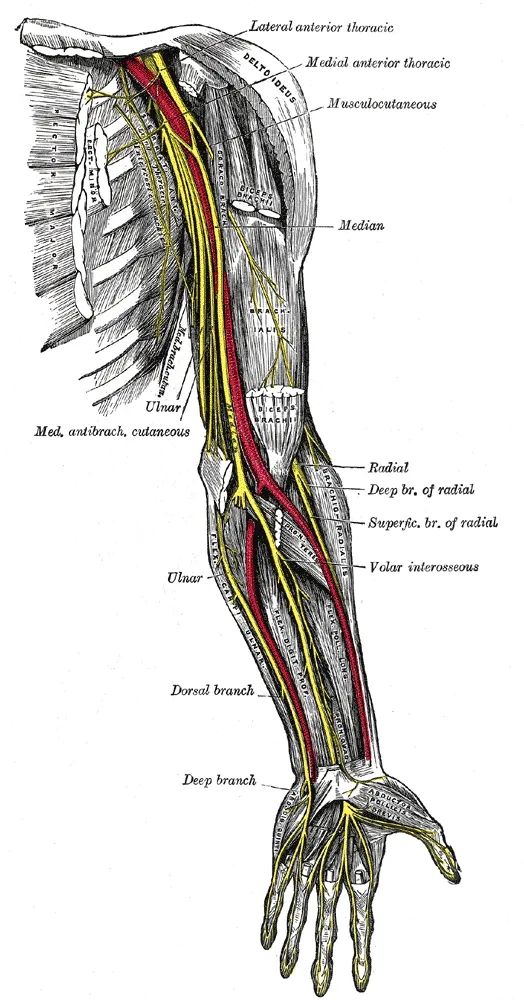
The same movement can slide one nerve and tension another11. A 2022 review gives throwing a dart as an example11. It slides the median nerve (a main nerve of the forearm and hand) but tensions the ulnar nerve11. A backhand frisbee throw does the reverse11.
How studies dosed it
A systematic review of ten studies in people in sport, aged 18 to 33, found sliding and tensioning techniques given in 3 to 8 sets12. Sets ran 5 to 20 repetitions and 60 seconds, over 1 to 6 weeks12. Across 13 trials in healthy people with limited hamstring flexibility, programmes ran 1 to 6 weeks at 1 to 7 sessions a week13.
What it loads
A review describes nerves outside the brain and spinal cord as built to keep working while tolerating the stresses of posture and movement14. Those stresses make nerves slide (excursion), lengthen (strain) and narrow14. A 2022 review reports that tensioners bring a considerable rise in nerve strain, while sliders can move nerves without much rise11.
How far the nerve slides
Single studies have measured how far each type moves a nerve4,5,15:
| Study | Slider (mm) | Tensioner (mm) |
|---|---|---|
| Median nerve, upper arm, 15 volunteers without symptoms, ultrasound (sound-wave scan) | 10.24 | 1.84 |
| Sciatic nerve, thigh, 15 people without symptoms | 17.05 | 3.25 |
| Median nerve, wrist, cadavers (bodies donated for study) | 12.615 | 6.115 |
In 31 healthy people, pairing knee straightening with neck movement slid the sciatic nerve at most 3.2 mm on average16. In an ultrasound study of 34 healthy people, sciatic sliding did not differ significantly between slumped and upright sitting17.
How much the nerve stretches
In the cadaver study, tensioners changed median nerve strain at the wrist by 6.8%, against 0.8% for sliders15. A 2022 review reports that combined limb movements usually lengthen nerves by about 5 to 10%, with some authors reporting up to 20%11. It lists these reported strains11:
| Nerve | Movement | Reported strain (%) |
|---|---|---|
| Median | Combined arm movements | 1811 |
| Tibial | Lifting a straight leg (straight leg raise test) | 12.511 |
| Radial | Combined arm movements | 1211 |
| Sciatic | Standing forward bend | 10.511 |
| Ulnar | Combined arm movements | 1011 |
| Median | Its own test, near the wrist | 411 |
The review cautions that strain values are hard to compare between cadaver and animal studies11. Each study needs a resting nerve length, and studies measure it differently11. It also notes that strain has been hard to measure directly in people11.
How much load nerves tolerate
The 2022 review reports that, in the laboratory, nerves need tensile load (a pulling force that stretches a tissue) to adapt11. Animal and cell models also show that too much pulling force harms nerves11. In animal nerves, 8% strain at once reduced blood flow inside the nerve and impaired signalling11. Held for up to an hour, 15% stopped blood flow and 10 to 12% blocked signals11.
In an animal nerve inflamed on purpose, as little as 3 to 5% strain made it more sensitive to physical forces11. The review states that loads a healthy nervous system handles easily may aggravate symptoms in patients11. It adds that animal studies of tensioners all used nerve injuries far more severe than those people usually seek care for11. That makes their findings hard to apply to people11.
How the body adapts
Hamstring range in healthy adults
Several reviews pooled hamstring trials in adults with limited flexibility6,13,20:
- A 2025 meta-analysis of 13 trials in 624 people found flexibility rose straight away and in the short term13. The techniques beat static stretching in the short term13.
- A meta-analysis of 30 trials in 1,379 adults found 3.48 degrees more passive straight leg raise than static stretching6. It found 9.44 degrees more than no intervention6. Static stretching means lengthening a muscle and holding it there21.
- A 2019 meta-analysis of 6 trials in 294 people found gains over no intervention and over other techniques such as stretching20.
In the 30-trial analysis, sliders were marginally ahead of tensioners, by about 1.1 degrees on the active knee extension test (a hamstring flexibility test)6. PNF stretching beat these techniques by about 3 degrees, on low-certainty evidence6. The authors urge caution, given high heterogeneity (how much results differ between studies) and risk of bias (the chance that study flaws skewed results)6. The 13-trial review found too few trials to compare sliders with tensioners13. Some of its trials also mixed the techniques with static stretching13.
In that review, programmes of 42 sessions, six a week, gave no significant gain, while 3, 10 or 12 sessions did13. Its authors suggest possible nerve irritation, but say more research is needed13. A 2017 meta-analysis of lower-body techniques found a moderate effect on flexibility in healthy adults, from five studies22. A review of ten studies in sport found the clearest benefit for range and for lower felt muscle tension, on limited evidence12.
Nerve stiffness in single studies
In 20 physically active volunteers, range on the slump test (a seated nerve-stretch test) rose after every stretching condition1. The largest gain came after nerve flossing at maximal intensity1. Only that condition lowered sciatic nerve stiffness significantly, while biceps femoris (a hamstring muscle) stiffness fell in every condition1.
In a randomised trial of 60 healthy adults, 12 weeks of stretching aimed at the sciatic nerve lowered its stiffness23. Ankle dorsiflexion (pulling the foot up toward the shin) range rose 9.9 degrees against control23. In 30 healthy adults, femoral nerve sliders, tensioners and static stretching showed no significant differences in immediate changes to the quadriceps (front-thigh muscles)24. That study had no control group, and its authors say this does not show the methods are equivalent24.
Back and leg pain
These reviews pooled trials in back and leg pain2,3,25,26:
- A 2017 meta-analysis of 40 studies found pain and disability scores in long-lasting low back pain improved2.
- A 2024 meta-analysis of 39 trials favoured neural mobilisation for pain and function in low back pain, with very low confidence in every estimate3.
- A 2023 meta-analysis of 20 trials in 877 people with lumbar radiculopathy (a nerve root problem in the lower back) found less pain and disability25. It noted high heterogeneity and possible publication bias (when studies with striking results are more likely to be published)25.
- A 2025 network meta-analysis (one comparing many options at once) of 50 trials covered 4,920 adults with sciatica lasting 3 months or more26. Exercise plus neural mobilisation was among the largest short-term drops in leg pain, on very low confidence evidence26.
In the 2024 review, the effect in low back pain appeared to depend on the type used: significant for tensioners, but not sliders3. It found no significant gain in flexibility or range in back or neck pain, with very low certainty3.
Neck, arm and wrist
A 2017 meta-analysis found pain in long-lasting neck-arm pain fell by 1.89 points on average, on a 0 to 10 scale2. A review of 27 trials in nerve-related neck and arm pain found it cut pain and disability more than no intervention27. It did no better than neck traction (a pull along the neck)27. A review of 25 trials in neck, shoulder and arm pain found sliders more effective in recent conditions28. Tensioners seemed to add to the drop in pain in long-lasting pain28.
The carpal tunnel reviews disagree8,9. A 2023 meta-analysis of 12 trials in 1,003 people with mild to moderate cases found lower symptom scores and pain, but not stronger grip8. It noted high heterogeneity and some risk of bias8. Another 2023 meta-analysis of 25 trials found low to very low-quality evidence of no clinical benefit in mild to moderate cases9.
Connections
These techniques slide or tension nerves and the tissues around them3. Studies above measured sliding of the median and sciatic nerves4,5. One used femoral nerve sliders and tensioners24. Reported strains include the tibial, radial and ulnar nerves11.
Trials have compared these techniques with stretching, including PNF stretching6. Single studies set them beside the hamstring stretch and quadriceps stretch1,24.
Reviews have studied them in people with low back pain and sciatica2,26. Others covered neck pain and carpal tunnel syndrome8,29. For cubital tunnel syndrome (compression of the ulnar nerve at the elbow), a 2017 review found the effect uncertain2.
Nerve flossing loads
Nerve flossing is compared with
Nerve flossing has been studied in people with
Sources
- Hitier M, Vieira DCL, Cometti C, Durigan JLQ, Babault N (2026). Technique-specific reduction of sciatic nerve stiffness through neurodynamic stretches at submaximal and maximal intensity in asymptomatic individuals.. European journal of applied physiology. doi:10.1007/s00421-026-06320-8 PMID 42371082
- Basson A, Olivier B, Ellis R, Coppieters M, Stewart A, Mudzi W (2017). The Effectiveness of Neural Mobilization for Neuromusculoskeletal Conditions: A Systematic Review and Meta-analysis.. The Journal of orthopaedic and sports physical therapy. doi:10.2519/jospt.2017.7117 PMID 28704626
- Baptista FM, Nery E, Cruz EB, Afreixo V, Silva AG (2024). Effectiveness of Neural Mobilisation on Pain Intensity, Functional Status, and Physical Performance in Adults with Musculoskeletal Pain - A Systematic Review with Meta-Analysis.. Clinical Rehabilitation. doi:10.1177/02692155231215216 PMID 37990512
- Coppieters MW, Hough AD, Dilley A (2009). Different nerve-gliding exercises induce different magnitudes of median nerve longitudinal excursion: an in vivo study using dynamic ultrasound imaging.. Journal of Orthopaedic & Sports Physical Therapy. doi:10.2519/jospt.2009.2913 PMID 19252262
- Coppieters MW, Andersen LS, Johansen R, Giskegjerde PK, Høivik M, Vestre S, Nee RJ (2015). Excursion of the Sciatic Nerve During Nerve Mobilization Exercises: An In Vivo Cross-sectional Study Using Dynamic Ultrasound Imaging.. The Journal of orthopaedic and sports physical therapy. doi:10.2519/jospt.2015.5743 PMID 26304637
- Bertacchini P, Gaucci M, Contri A (2025). Effectiveness of neurodynamic treatment on hamstring flexibility: A systematic review and meta-analysis of randomized controlled trials.. Journal of Back and Musculoskeletal Rehabilitation. doi:10.1177/10538127251372333 PMID 41032628
- Cuenca-Martínez F, La Touche R, Varangot-Reille C, Sardinoux M, Bahier J, Suso-Martí L, Fernández-Carnero J (2022). Effects of Neural Mobilization on Pain Intensity, Disability, and Mechanosensitivity: An Umbrella Review With Meta-Meta-Analysis.. Physical Therapy. doi:10.1093/ptj/pzac040 PMID 35421227
- Zaheer SA, Ahmed Z (2023). Neurodynamic Techniques in the Treatment of Mild-to-Moderate Carpal Tunnel Syndrome: A Systematic Review and Meta-Analysis.. Journal of Clinical Medicine. doi:10.3390/jcm12154888 PMID 37568290
- Paraskevopoulos E, Karanasios S, Gioftsos G, Tatsios P, Koumantakis G, Papandreou M (2023). The effectiveness of neuromobilization exercises in carpal tunnel syndrome: Systematic review and meta-analysis.. Physiotherapy theory and practice. doi:10.1080/09593985.2022.2068097 PMID 35481794
- Ellis RF, Hing WA (2008). Neural mobilization: a systematic review of randomized controlled trials with an analysis of therapeutic efficacy.. Journal of Manual & Manipulative Therapy. doi:10.1179/106698108790818594 PMID 19119380
- Ellis R, Carta G, Andrade RJ, Coppieters MW (2022). Neurodynamics: is tension contentious?. Journal of Manual & Manipulative Therapy. doi:10.1080/10669817.2021.2001736 PMID 34781843
- Heredia Macías C, Paredes Hernández V, Fernández Seguín LM (2024). A systematic review of the efficacy of neural mobilisation in sport: A tool for the neural tension assessment.. Journal of Bodywork and Movement Therapies. doi:10.1016/j.jbmt.2023.04.034 PMID 39593463
- Núñez de Arenas-Arroyo S, Martínez-Vizcaíno V, Torres-Costoso A, Reina-Gutiérrez S, Bizzozero-Peroni B, Cavero-Redondo I (2025). Immediate and short-term effects of neurodynamic techniques on hamstring flexibility: A systematic review with meta-analysis.. PLoS One. doi:10.1371/journal.pone.0318671 PMID 39913497
- Topp KS, Boyd BS (2006). Structure and biomechanics of peripheral nerves: nerve responses to physical stresses and implications for physical therapist practice.. Physical Therapy. doi:10.1093/ptj/86.1.92 PMID 16386065
- Coppieters MW, Butler DS (2008). Do 'sliders' slide and 'tensioners' tension? An analysis of neurodynamic techniques and considerations regarding their application.. Manual therapy. doi:10.1016/j.math.2006.12.008 PMID 17398140
- Ellis RF, Hing WA, McNair PJ (2012). Comparison of longitudinal sciatic nerve movement with different mobilization exercises: an in vivo study utilizing ultrasound imaging.. The Journal of orthopaedic and sports physical therapy. doi:10.2519/jospt.2012.3854 PMID 22711174
- Ellis R, Osborne S, Whitfield J, Parmar P, Hing W (2017). The effect of spinal position on sciatic nerve excursion during seated neural mobilisation exercises: an in vivo study using ultrasound imaging.. The Journal of manual & manipulative therapy. doi:10.1179/2042618615Y.0000000020 PMID 28559669
- Nuñez de Arenas-Arroyo S, Martínez-Vizcaíno V, Cavero-Redondo I, Álvarez-Bueno C, Reina-Gutierrez S, Torres-Costoso A (2022). The Effect of Neurodynamic Techniques on the Dispersion of Intraneural Edema: A Systematic Review with Meta-Analysis.. International Journal of Environmental Research and Public Health. doi:10.3390/ijerph192114472 PMID 36361353
- Salniccia F, de Vidania S, Martinez-Caro L (2024). Peripheral and central changes induced by neural mobilization in animal models of neuropathic pain: a systematic review.. Frontiers in Neurology. doi:10.3389/fneur.2023.1289361 PMID 38249743
- López López L, Torres JR, Rubio AO, Torres Sánchez I, Cabrera Martos I, Valenza MC (2019). Effects of neurodynamic treatment on hamstrings flexibility: A systematic review and meta-analysis.. Physical Therapy in Sport. doi:10.1016/j.ptsp.2019.10.005 PMID 31655484
- Behm DG, Alizadeh S, Daneshjoo A, Anvar SH, Graham A, Zahiri A, et al. (2023). Acute Effects of Various Stretching Techniques on Range of Motion: A Systematic Review with Meta-Analysis.. Sports medicine - open. doi:10.1186/s40798-023-00652-x PMID 37962709
- Neto T, Freitas SR, Marques M, Gomes L, Andrade R, Oliveira R (2017). Effects of lower body quadrant neural mobilization in healthy and low back pain populations: A systematic review and meta-analysis.. Musculoskeletal Science and Practice. doi:10.1016/j.msksp.2016.11.014 PMID 28637597
- Andrade RJ, Freitas SR, Hug F, Le Sant G, Lacourpaille L, Gross R, Quillard JB, McNair PJ, Nordez A (2020). Chronic effects of muscle and nerve-directed stretching on tissue mechanics.. Journal of applied physiology (Bethesda, Md. : 1985). doi:10.1152/japplphysiol.00239.2019 PMID 32853116
- Anestaki P, Mandalidis D, Paraskevopoulos E (2026). Comparative Effects of Femoral Nerve Neurodynamic Techniques and Static Stretching on Quadriceps Muscle Mechanical Properties.. Bioengineering (Basel, Switzerland). doi:10.3390/bioengineering13080927 PMID 42649816
- Lin LH, Lin TY, Chang KV, Wu WT, Özçakar L (2023). Neural Mobilization for Reducing Pain and Disability in Patients with Lumbar Radiculopathy: A Systematic Review and Meta-Analysis.. Life (Basel). doi:10.3390/life13122255 PMID 38137856
- Zhu Z, Schouten T, Strijkers R, Koes B, Gerger H, Chiarotto A (2025). Effectiveness of non-surgical interventions for patients with chronic sciatica: A systematic review with network meta-analysis.. The Journal of Pain. doi:10.1016/j.jpain.2025.105431 PMID 40373933
- Lascurain-Aguirrebeña I, Dominguez L, Villanueva-Ruiz I, Ballesteros J, Rueda-Etxeberria M, Rueda JR, Casado-Zumeta X, Araolaza-Arrieta M, Arbillaga-Etxarri A, Tampin B (2024). Effectiveness of neural mobilisation for the treatment of nerve-related cervicobrachial pain: a systematic review with subgroup meta-analysis.. Pain. doi:10.1097/j.pain.0000000000003071 PMID 37870223
- Papacharalambous C, Savva C, Karagiannis C, Giannakou K (2022). The effectiveness of slider and tensioner neural mobilization techniques in the management of upper quadrant pain: A systematic review of randomized controlled trials.. Journal of Bodywork and Movement Therapies. doi:10.1016/j.jbmt.2022.03.002 PMID 35710209
- Varangot-Reille C, Cuenca-Martínez F, Arribas-Romano A, Bertoletti-Rodríguez R, Gutiérrez-Martín Á, Mateo-Perrino F, Suso-Martí L, Blanco-Díaz M, Calatayud J, Casaña J (2022). Effectiveness of Neural Mobilization Techniques in the Management of Musculoskeletal Neck Disorders with Nerve-Related Symptoms: A Systematic Review and Meta-Analysis with a Mapping Report.. Pain Medicine. doi:10.1093/pm/pnab300 PMID 34633462
Changes
- First published.