Sciatic nerve
The body's largest nerve, running from the lower back down the back of the thigh. Where it runs, what it supplies, how it slides, where it gets trapped or injured, and what studies report about recovery.
- Region
- Hip
- Updated
- October 7, 2026
- Reviewed
- October 7, 2026 · how entries are checked
Function
Its path from the lower back to the knee
The sciatic nerve is the body’s largest nerve1. It starts in the lower back and runs down the back of the leg as far as the heel1. Its fibres come from the spinal nerves labelled L4 to S31.
The nerve exits the pelvis by way of the greater sciatic foramen, a large opening at the back of the pelvis1. It comes out below the piriformis, a small muscle deep in the buttock1. One meta-analysis (a study that pools earlier studies) of 44 cadaver studies found the nerve passing undivided below the piriformis in a pooled 90%6. A cadaver is a body donated for study. The nerve ran through or above the muscle in more than 10%, patterns the deep hip rotators page describes6.
From there the nerve runs down behind the short external rotator muscles7. It reaches the back of the thigh through a tunnel between the femur (thigh bone) and the ischial tuberosity, the “sitting bone”7.
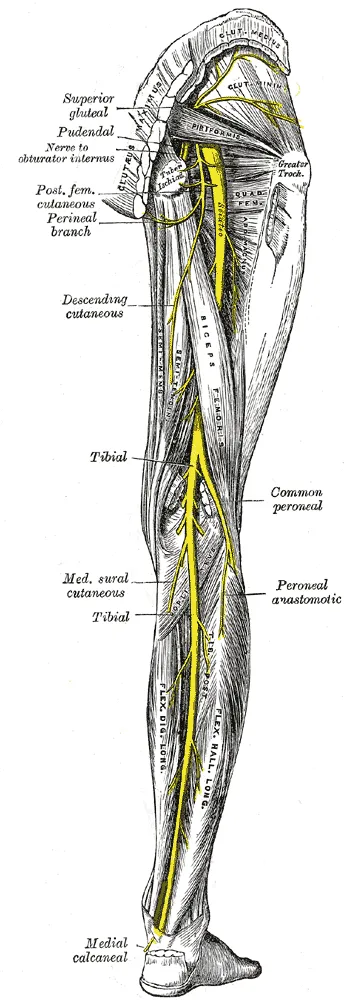
In the thigh the nerve runs under the biceps femoris long head, part of the hamstrings1. It lies on the surface of the adductor magnus, a large muscle on the inner side of the thigh1.
Just before the popliteal fossa, the hollow behind the knee, the nerve divides into two branches1. The tibial nerve continues down the back of the leg and into the foot1. The common fibular nerve, also called the common peroneal nerve, serves the outer and front compartments of the leg and the foot1. One meta-analysis of 20 cadaver studies put variation in where the nerve divides at about 31%8.
What it supplies
The sciatic nerve supplies the muscles of the back of the thigh and of every compartment of the lower leg and foot6. It is the motor nerve, the one carrying signals to muscle, of the hamstrings and of the calf and foot muscles2. Almost all feeling and movement below the knee depends on the sciatic nerve2.
In the thigh it gives motor branches to these muscles9:
- the long and short heads of the biceps femoris9;
- the semitendinosus and semimembranosus, the two hamstring muscles on the inner side9;
- the adductor magnus, one of the hip adductors9.
How these branches are laid out differs a great deal from person to person9.
Inside the main trunk, the tibial and common peroneal parts share one epineurium, the outer wrapping around a whole nerve6. A partition of connective tissue keeps their fascicles (bundles of fibres) apart6.
How it slides and stretches
A review describes nerves as built to keep working while posture and movement make them slide, lengthen and narrow10. Two studies of people without symptoms measured how far the sciatic nerve moved in the thigh3,11.
| Movement | People studied | Mean movement (mm) |
|---|---|---|
| Knee straightened with the hip bent to 30° | 16 | 9.93 |
| Knee straightened with the hip bent to 60° | The same 16 | 12.43 |
| A sliding movement of the hip and knee | 15 | 17.011 |
| A tensioning movement | The same 15 | 3.211 |
Strain is how far something stretches as a share of its resting length. One study measured ten patients, mean age 72, during hip replacement surgery, before the hip was dislocated12. Sciatic nerve strain rose by a mean of 26% when the hip was flexed (bent) and the knee straightened12.
Shear wave velocity is how fast an ultrasound-made ripple travels through a tissue, used as a measure of its stiffness. In sixty healthy young adults with the knee straight, flexing the hip to 90° raised it by 54% in the sciatic and tibial nerves13.
Breakdown
What the word sciatica means
A 2010 review states that sciatica is a symptom, not a specific condition4. The same review notes that the word is used in two ways4. Most researchers and clinicians mean a nerve-root problem in one leg, related to a disc herniation4. A nerve root is the part of a nerve where it leaves the spinal cord. Patients and many clinicians use the word for any pain that begins in the low back and travels down the leg4.
Where it gets trapped in the buttock
Structures that can be involved in trapping the nerve in the buttock include14:
- the piriformis, and the gemelli and obturator internus, which are deep hip muscles14;
- the gluteal muscles and the hamstrings14;
- fibrous bands containing blood vessels14;
- abnormal blood vessels and space-occupying lesions14.
Anything that disrupts how the nerve moves during hip motion may lead to trapping, which is also called dynamic entrapment7.
A 2015 review states that the term deep gluteal syndrome is now preferred over piriformis syndrome14. Its reason is that the nerve can be trapped at several places14. A 2010 meta-analysis of 18 studies found a piriformis and sciatic nerve anomaly in 16.9% of 6,062 cadavers15. The figure in surgical case series of patients with piriformis syndrome was 16.2%, and the difference was not significant15.
Beside the hamstring origin
A review places the nerve about 1.2 cm from the outer edge of the ischial tuberosity, where the proximal hamstring tendon attaches16.
One study looked at 96 hamstring strain injuries in US college American football players17. MRI, a scan that shows soft tissue in detail, showed swelling touching or surrounding the sciatic nerve in 75 of them17. Swelling that completely surrounded the nerve was associated with a longer return to sport than no nerve involvement17. The means were 33.7 and 21.5 days, after allowing for the grade of muscle injury17.
An avulsion is a tear in which a tendon pulls away from its bone. In a review of the records of 162 people with a proximal hamstring avulsion, 45 had sciatic nerve symptoms below the knee18.
Hip dislocation, fracture and surgery
In traumatic dislocation of the hip the sciatic nerve is the nerve most often injured, usually its peroneal part19. It can be cut, stretched or compressed at the time of injury19. It can also be encased later in bone that forms in the soft tissue19.
| Setting | What was reported |
|---|---|
| Traumatic hip dislocation and fracture-dislocation, in a review of the literature | Nerve injury in about 10% of adults and 5% of children19 |
| Fractures of the acetabulum (hip socket), in a meta-analysis of twenty studies | Pooled rate of sciatic nerve palsy 5.1% from the injury and 1.4% from medical care20 |
| Total hip replacement, in a meta-analysis of 17 studies | Pooled rate of nerve injury 0.36%21 |
| Hip arthroscopy (keyhole surgery) under traction, in sixty patients with monitoring | 35 showed nerve dysfunction on the monitor during the operation; four had a clinical nerve injury22 |
Palsy is loss of power in a muscle from a nerve problem. Sciatic nerve palsy is rare after total hip replacement, but accounts for more than 90% of the nerve injuries that follow it23.
The hip replacement meta-analysis found the peroneal division consistently identified as the most vulnerable21. Three features are offered to explain why it is more easily injured than the tibial part23. It lies further to the outside, and it has a thinner covering of connective tissue23. It is also tethered at two points, the sciatic notch of the hip bone and the head of the fibula23.
Recovery
How long recovery takes
A review on the nerve tissue page gives the average rate at which axons (nerve fibres) regrow in humans as about 1 mm a day24.
One series followed 73 patients referred for nerve testing with sciatic neuropathy5. By 1 year, 30% had moderate or better recovery; the share was 50% at 2 years and 75% at 35. The authors conclude that most patients recover well, though not completely, over 2 to 3 years5.
After injury or surgery around the hip
| Group studied | What was reported |
|---|---|
| Nerve injury in traumatic hip dislocation, in a review | 60% to 70% of patients recovered at least partly; the type of injury showed no clear link19 |
| Sciatic nerve palsy with acetabular fracture, in a meta-analysis | Complete recovery in a pooled 64.7% of cases caused by the injury, though the estimate is imprecise20 |
| Nerve injury after total hip replacement, in a meta-analysis of 17 studies | A pooled 48.6% recovered completely and 39.8% had permanent impairment21 |
| 100 patients having hip arthroscopy with traction, 13 of whom had a nerve injury | One injury was to the sciatic nerve; 8 of the 13 resolved within 2 weeks and all within 9 months25 |
How the two parts compare
One analysis looked back at 353 operated sciatic nerve injuries26. A graft is a piece of tissue moved from one place to rebuild a damaged part. Graft repair gave good recovery in 62% of tibial parts at buttock level and 80% at thigh level26. For peroneal parts the figures were 24% and 45%26.
A review of 806 operated nerve injuries from one centre gives five reasons the tibial part recovers better27. Two of them are a better blood supply and more shock-absorbing connective tissue27. Another is that the calf muscles need less regrown nerve to work than the long, thin muscles the deep peroneal nerve supplies27.
Connections
Branches and neighbours
The nerve’s two branches are the tibial nerve and the common fibular nerve1. The tibial portion supplies three parts of the hamstrings: the semimembranosus, the semitendinosus and the biceps femoris long head29. The biceps femoris is the only muscle the peroneal nerve supplies above the knee30.
High in its course, below the piriformis, the nerve rests on the deep hip rotators and is covered by the gluteus maximus31.
Stretches and the nerve
Dorsiflexion is pulling the foot up toward the shin. In 11 legs from 6 fresh cadavers, dorsiflexing the ankle during a straight leg raise strained the nerve in the upper thigh32. It did not change strain in the biceps femoris32.
One randomised controlled study, which assigns people to groups by chance, followed sixty healthy adults33. Twelve weeks of stretching aimed at the sciatic nerve tract lowered the nerve’s shear wave velocity compared with control33.
In nine healthy participants, passive ankle dorsiflexion raised sciatic nerve stiffness with the knee straight34. No change was seen with the knee bent to 90 degrees34. In the buttock, the nerve shifts backwards and outwards when the knee is bent14. With the knee straight it moves deep into the tunnel beside the ischium, the lower rear part of the hip bone14. Related exercise pages: hamstring stretch, figure-4 stretch, soleus stretch13,14,34.
Sciatic nerve divides into
Sciatic nerve supplies
Sciatic nerve supplies part of the adductor magnus, one of the
Sciatic nerve leaves the pelvis below the piriformis, one of the
Sciatic nerve runs close to the bone attachment of
Sciatic nerve is the nerve described as trapped in
Sciatic nerve was reached by swelling, in one MRI study, in
Sciatic nerve is an example of
Sciatic nerve is loaded by
Sciatic nerve lies beside the muscles stretched in
Sciatic nerve was measured in a study of
Sources
- Giuffre BA, Black AC, Jeanmonod R (2023). Anatomy, Sciatic Nerve. StatPearls. PMID 29494038
- Liu Z, Tao F, Xu W, Liu F, Dong J, Li L, Hao Z, Zhou D, Lu S (2023). Incidence of traumatic sciatic nerve injury in patients with acetabular fractures and factors affecting recovery: a retrospective study.. Journal of orthopaedic surgery and research. doi:10.1186/s13018-023-03515-z PMID 36635756
- Ridehalgh C, Moore A, Hough A (2014). Normative sciatic nerve excursion during a modified straight leg raise test.. Manual therapy. doi:10.1016/j.math.2013.07.012 PMID 24034944
- Valat JP, Genevay S, Marty M, Rozenberg S, Koes B (2010). Sciatica.. Best practice & research. Clinical rheumatology. doi:10.1016/j.berh.2009.11.005 PMID 20227645
- Yuen EC, Olney RK, So YT (1994). Sciatic neuropathy. Neurology. doi:10.1212/wnl.44.9.1669 PMID 7936294
- Poutoglidou F, Piagkou M, Totlis T, Tzika M, Natsis K (2020). Sciatic Nerve Variants and the Piriformis Muscle: A Systematic Review and Meta-Analysis. Cureus. doi:10.7759/cureus.11531 PMID 33354475
- Geler Külcü D (2024). Deep Gluteal syndrome: An underestimated cause of posterior hip pain.. Turkish journal of physical medicine and rehabilitation. doi:10.5606/tftrd.2024.14668 PMID 38549816
- Liyew WA, Abebe S (2026). Anatomical variation of the sciatic nerve division in the cadaver studies: a systematic review and meta-analysis.. Anatomy & cell biology. doi:10.5115/acb.25.139 PMID 41851007
- Kozioł T, Plutecki D, Janda P, Larysz W, Dąbrowa J, Walocha J (2024). The anatomy of the motor branches of the sciatic nerve: an anatomical study with clinical implications.. Folia morphologica. doi:10.5603/fm.99935 PMID 38757498
- Topp KS, Boyd BS (2006). Structure and biomechanics of peripheral nerves: nerve responses to physical stresses and implications for physical therapist practice.. Physical Therapy. doi:10.1093/ptj/86.1.92 PMID 16386065
- Coppieters MW, Andersen LS, Johansen R, Giskegjerde PK, Høivik M, Vestre S, Nee RJ (2015). Excursion of the Sciatic Nerve During Nerve Mobilization Exercises: An In Vivo Cross-sectional Study Using Dynamic Ultrasound Imaging.. The Journal of orthopaedic and sports physical therapy. doi:10.2519/jospt.2015.5743 PMID 26304637
- Fleming P, Lenehan B, O'Rourke S, McHugh P, Kaar K, McCabe JP (2003). Strain on the human sciatic nerve in vivo during movement of the hip and knee.. The Journal of bone and joint surgery. British volume. doi:10.1302/0301-620x.85b3.13220 PMID 12729110
- Andrade RJ, Freitas SR, Hug F, Coppieters MW, Sierra-Silvestre E, Nordez A (2022). Spatial variation in mechanical properties along the sciatic and tibial nerves: An ultrasound shear wave elastography study.. Journal of biomechanics. doi:10.1016/j.jbiomech.2022.111075 PMID 35390647
- Martin HD, Reddy M, Gómez-Hoyos J (2015). Deep gluteal syndrome.. Journal of hip preservation surgery. doi:10.1093/jhps/hnv029 PMID 27011826
- Smoll NR (2010). Variations of the piriformis and sciatic nerve with clinical consequence: a review.. Clinical anatomy (New York, N.Y.). doi:10.1002/ca.20893 PMID 19998490
- Grimaldi A, Mellor R, Nasser A, Vicenzino B, Hunter DJ (2024). Current and future advances in practice: tendinopathies of the hip.. Rheumatology Advances in Practice. doi:10.1093/rap/rkae022 PMID 38601140
- Lee KS, Miller A, Mosiman S, Joachim MR, Heiderscheit B (2026). Sciatic nerve involvement is associated with longer return to sport in collegiate American football players with acute hamstring injuries.. British journal of sports medicine. doi:10.1136/bjsports-2026-111940 PMID 42785966
- Wilson TJ, Spinner RJ, Mohan R, Gibbs CM, Krych AJ (2017). Sciatic Nerve Injury After Proximal Hamstring Avulsion and Repair.. Orthopaedic journal of sports medicine. doi:10.1177/2325967117713685 PMID 28758137
- Cornwall R, Radomisli TE (2000). Nerve injury in traumatic dislocation of the hip.. Clinical orthopaedics and related research. doi:10.1097/00003086-200008000-00012 PMID 10943188
- Stavrakakis IM, Kritsotakis EI, Giannoudis PV, Kapsetakis P, Dimitriou R, Bastian JD, Tosounidis TH (2022). Sciatic nerve injury after acetabular fractures: a meta-analysis of incidence and outcomes.. European journal of trauma and emergency surgery : official publication of the European Trauma Society. doi:10.1007/s00068-022-01896-0 PMID 35169868
- Alturki A, Almugren T, Alhandi A, Alqahtani A, Aqeel M, Alammari A, Alhoshan F, Aljaafri Z (2026). Nerve Injuries After Total Hip Arthroplasty: A Systematic Review and Meta-Analysis.. Orthopedic reviews. doi:10.52965/001c.160594 PMID 42040246
- Telleria JJ, Safran MR, Harris AH, Gardi JN, Glick JM (2012). Risk of sciatic nerve traction injury during hip arthroscopy—is it the amount or duration?. The Journal of bone and joint surgery. American volume. doi:10.2106/JBJS.K.01597 PMID 23052834
- De Fine M, Romagnoli M, Zaffagnini S, Pignatti G (2017). Sciatic Nerve Palsy following Total Hip Replacement: Are Patients Personal Characteristics More Important than Limb Lengthening? A Systematic Review.. BioMed research international. doi:10.1155/2017/8361071 PMID 29270435
- Grinsell D, Keating CP (2014). Peripheral nerve reconstruction after injury: a review of clinical and experimental therapies.. BioMed Research International. doi:10.1155/2014/698256 PMID 25276813
- Kern MJ, Murray RS, Sherman TI, Postma WF (2018). Incidence of Nerve Injury After Hip Arthroscopy.. The Journal of the American Academy of Orthopaedic Surgeons. doi:10.5435/JAAOS-D-17-00230 PMID 30180092
- Kim DH, Murovic JA, Tiel R, Kline DG (2004). Management and outcomes in 353 surgically treated sciatic nerve lesions.. Journal of neurosurgery. doi:10.3171/jns.2004.101.1.0008 PMID 15255245
- Murovic JA (2009). Lower-extremity peripheral nerve injuries. Neurosurgery. doi:10.1227/01.NEU.0000339123.74649.BE PMID 19927065
- Turkman A, Thanaraaj V, Soleimani-Nouri P, Harb E, Thakkar M (2023). Outcomes of Sciatic Nerve Injury Repairs: A Systematic Review.. Eplasty. PMID 37664809
- Koolmees DS, Klott JD, Poppe TR, Bernholt DL (2025). Distal Hamstring Injuries and Disorders.. Journal of the American Academy of Orthopaedic Surgeons: Global Research & Reviews. doi:10.5435/JAAOSGlobal-D-25-00248 PMID 40972536
- Van den Bergh FR, Vanhoenacker FM, De Smet E, Huysse W, Verstraete KL (2013). Peroneal nerve: Normal anatomy and pathologic findings on routine MRI of the knee. Insights into imaging. doi:10.1007/s13244-013-0255-7 PMID 23709403
- Gray H; Lewis WH (editor) (1918). Anatomy of the Human Body. Lea & Febiger, Philadelphia (20th edition). Link
- Bueno-Gracia E, Pérez-Bellmunt A, Estébanez-de-Miguel E, López-de-Celis C, Shacklock M, Caudevilla-Polo S, González-Rueda V (2019). Differential movement of the sciatic nerve and hamstrings during the straight leg raise with ankle dorsiflexion: Implications for diagnosis of neural aspect to hamstring disorders.. Musculoskeletal science & practice. doi:10.1016/j.msksp.2019.07.011 PMID 31374476
- Andrade RJ, Freitas SR, Hug F, Le Sant G, Lacourpaille L, Gross R, Quillard JB, McNair PJ, Nordez A (2020). Chronic effects of muscle and nerve-directed stretching on tissue mechanics.. Journal of applied physiology (Bethesda, Md. : 1985). doi:10.1152/japplphysiol.00239.2019 PMID 32853116
- Andrade RJ, Nordez A, Hug F, Ates F, Coppieters MW, Pezarat-Correia P, Freitas SR (2016). Non-invasive assessment of sciatic nerve stiffness during human ankle motion using ultrasound shear wave elastography.. Journal of biomechanics. doi:10.1016/j.jbiomech.2015.12.017 PMID 26725218
Changes
- First published.