Hip adductors
Also called adductors, adductor muscles, inner thigh muscles
The group of inner-thigh muscles that pull the leg in toward the other one. What each muscle does, how often they are hurt in sport, how they grow with training, and what they work with.
- Region
- Thigh
- Starts on
- mostly the front and underside of the pelvis1,2
- Starts on (adductor longus)
- the anterior pubic ramus, at the front of the pubic bone (Pelvis)7
- Starts on (adductor brevis)
- the front and underside of the pubic bone, by a tendon sheet shared with the gracilis and rectus abdominis (Pelvis)1,2,37
- Starts on (adductor magnus, hamstring portion)
- the ischial tuberosity (the sitting bone), shared with the hamstrings (Pelvis)1,9,32,38
- Starts on (gracilis)
- the inferior pubic ramus (Pelvis)2,8
- Ends on
- mostly the thigh bone; the gracilis instead reaches the upper inner shinbone1
- Ends on (adductor longus)
- the linea aspera, a rough ridge down the back of the thigh bone6,7
- Ends on (gracilis)
- the inner surface of the shinbone, where it joins the sartorius and semitendinosus tendons (the pes anserinus)1,8
- Muscles
- pectineus, adductor longus, adductor brevis, gracilis, adductor magnus
- Updated
- September 30, 2026
- Reviewed
- September 30, 2026 · how entries are checked
Function
Which muscles make up the group
The adductor group fills the medial (inner) compartment of the thigh1. Its muscles generally start on the pelvis and attach to the femur (thigh bone)1. One source names five muscles in this compartment: the pectineus, adductor longus, adductor brevis, gracilis and adductor magnus1. Another source counts six, adding the obturator externus, a small, deep muscle of the upper inner thigh close to the hip joint2. That source says the group generally attaches at the top to the front and underside of the pelvis2.
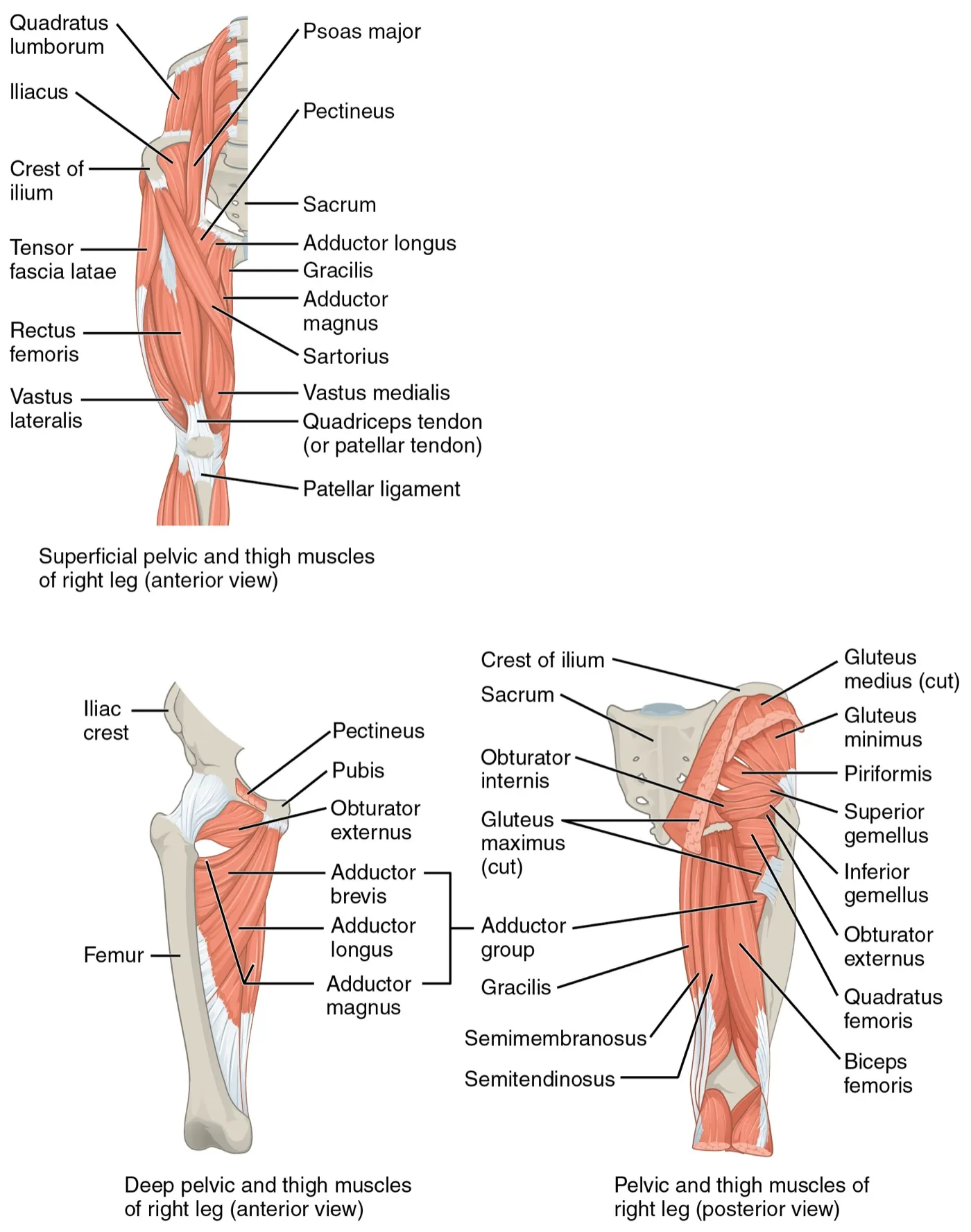
| Muscle | What sources describe |
|---|---|
| Pectineus (a muscle at the top of the inner thigh, near the groin) | Adducts and bends the thigh at the hip6 |
| Adductor longus | Runs from the front of the pubic bone to the linea aspera, a long ridge down the back of the femur7 |
| Adductor brevis (a short muscle of the inner thigh) | Mainly adducts the thigh7 |
| Gracilis (a long, thin muscle on the inner side of the thigh) | Adducts the hip, bends the knee and turns the leg inward8 |
| Adductor magnus | The largest of the group and the one furthest back1 |
What the group does
The muscles of the inner thigh adduct the femur at the hip6. One source adds that the group helps steady the trunk and helps bend and straighten the thigh in running2.
The adductor longus, brevis and magnus can turn the thigh inward or outward, depending on where the foot is placed6. The adductor longus bends the thigh at the hip, while the adductor magnus extends it6. One imaging study notes the adductor magnus ranks among the biggest leg muscles, yet walking and running need little inward turning force at the hip3.
The adductor magnus also extends the hip
The adductor magnus has two parts, an adductor part and a hamstring part1. The hamstring part also starts from the ischial tuberosity, the “sitting bone”9. It shares the hamstrings’ nerve supply and action, so some count it as a hamstring9. The back half of the adductor magnus attaches to the adductor tubercle, near the lower end of the femur10. Some regard it as the group’s most powerful and most complex muscle1.
In one MRI study (a detailed scan) of 15 young adults, two parts of the adductor magnus made up over 80% of its volume3. Both had a longer moment arm (leverage) for hip extension than for adduction3. In the same 15 young adults, the adductor magnus could make more than twice as much turning force for hip extension as for adduction3. Its estimated capacity for hip extension was correlated with the hardest hip extension each person made on a dynamometer (a machine that measures force)3.
The gracilis crosses the knee
The gracilis is a long, strap-like muscle that lies near the skin8. Unlike the others, which attach to the femur, it attaches to the upper inner tibia (shinbone)1. It starts on the lower part of the pubic bone8. At the tibia, its tendon joins those of the sartorius and semitendinosus (a hamstring muscle) to form the pes anserinus8.
How it attaches varies a lot: one study of 102 limbs described six patterns, with a single tendon in 50–74%8. Surgeons take tendons from this spot for operations such as rebuilding the anterior cruciate ligament, one of two ligaments that cross inside the knee8.
Their nerves
The obturator nerve, a nerve that runs to the inner-thigh muscles, supplies most of the adductors2,7. The gracilis gets its supply from the front branch of this nerve8.
The femoral nerve is a large nerve at the front of the thigh that works the quadriceps. In a dissection of 100 thighs from 52 cadavers (bodies donated for study), it supplied the pectineus in each thigh12. A branch of the obturator nerve also reached the pectineus in 10%, and a branch of an extra obturator nerve in 2%12.
Breakdown
How often adductor injuries happen
Studies of sport count adductor injuries in different ways: some count the adductors alone, and some count groin injuries as a whole13,14:
| Group studied | What was found |
|---|---|
| 2,299 professional footballers | Adductors were 23% of muscle injuries, second to the hamstrings at 37%4 |
| European professional football, seven seasons | Adductor-related injuries were the most common hip and groin injuries, 399 of 62815 |
| A meta-analysis (a study that pools earlier results) of 71 studies | 6% of injuries affected the hip adductors, at 0.41 per 1,000 hours13 |
A review of 34 studies of senior football compared men and women14. Groin injuries made up 4–19% of club-season injuries in men and 2–14% in women14. Pooling 23 studies, the groin injury rate in men was more than twice that in women14. The review judged many of its studies at high risk of bias14. One clinical review reports that adductor strains often recur, at a rate of 18% among professional soccer players and 24% among professional hockey players2.
Where and how they tear
In 71 male athletes with sudden adductor injuries seen on MRI, 62 of 111 injured muscles were the adductor longus16. A systematic review, which searches for and sums up the research on a question, looked at sudden adductor injuries in athletes17. It found complete tears in 21% to 25% of cases on MRI17.
Videos of 17 professional male football players showed most sudden adductor longus injuries happened without contact (71%)18. The actions were a change of direction, kicking, reaching and jumping18. The authors concluded that fast activation while the muscle is stretched fast appears to be the main mechanism18.
A study of 22 male teenage soccer players looked at the first step of a sprint start19. Forces in the adductor longus and gracilis peaked late in that step, as the hip swung quickly inward19. These forces were higher than earlier studies had reported for inside passing and change of direction19. The authors read the load as eccentric work, done while the muscle lengthens, combined with high force19.
What goes with groin injury
A systematic review of 29 studies linked four factors with higher groin injury risk20:
- A previous groin injury20.
- A higher level of play20.
- Weaker hip adductors, measured alone or against the hip abductors, the muscles that move the thigh out to the side20.
- Less training specific to the sport20.
Studies disagree on the ratio of inward to outward strength21,22. A meta-analysis of 13 studies that followed athletes over time found stronger adduction in athletes who did not go on to have groin pain21. In that analysis, the ratio showed no link with later groin pain21. In a smaller study of 47 NHL hockey players, those with adduction below 80% of abduction were 17 times likelier to have an adductor strain22.
Groin pain from the adductors
A 2014 meeting of 24 experts defined adductor-related groin pain as adductor tenderness together with pain when adduction is resisted23. Among 100 athletes seen at one groin pain clinic, mostly male soccer players, this was the most common cause, found in 61%24. A systematic review of 17 studies found strong evidence on the adductor squeeze test in athletes with hip or groin pain25. In this test, the athlete presses the legs together against resistance25. Compared with athletes without that pain, they had pain and lower strength on the test25.
Recovery
How the adductors grow with training
In 17 men randomly split into full-squat and half-squat groups, adductor volume rose over 10 weeks5. It grew by 6.2% with full squats and by 2.7% with half squats5. A systematic review of 11 studies found full range of motion grew the adductors more than partial range done at the end of the movement26. The effect sizes (a standard measure of how large a difference between groups is) were 0.24 to 0.2526.
Two trials of the Copenhagen adductor plank measured muscle thickness, with different results27,28. In 45 active adults, 8 weeks of the exercise made the adductors about 18% thicker27. The gain was gone 4 weeks after training stopped27. In 12 male under-17 soccer players, 8 weeks of it did not add thickness beyond regular training28.
How their strength changes
A 2026 systematic review of ten randomised trials, which assign people to groups by chance, looked at the Copenhagen adductor exercise29. In male athletes and active people, it reported that the exercise consistently raised eccentric adduction strength29. A trial in 57 male youth football players (average age 16.7) compared it with a volume-matched adductor squeeze30. After 8 weeks, there was no significant difference between the groups in hip adductor torque (turning force)30. In 31 male amateur rugby players, holds without added weight gave no significant change in hip strength, while weighted holds raised adduction strength by 10%31.
In the football trial, the Copenhagen group reported more delayed-onset muscle soreness (starting hours to days after exercise) than the squeeze group30.
Connections
The adductor longus tendon
The adductor longus arises from the front of the pubic bone; its tendon has its own page, the adductor longus tendon7. The adductor longus is the adductor most often involved in adductor-related groin pain2.
The hamstrings and the knee
The adductor magnus overlaps with the hamstrings, the three long muscles at the back of the thigh9. Its hamstring part shares their starting point, nerve supply and action9. In 97 cadaver half-pelves, the start of the semimembranosus (a hamstring) extended into the adductor magnus32.
At the knee, the gracilis and the sartorius both bend the joint6. The gracilis reaches the tibia at the pes anserinus8. The group generally starts on the pelvis and ends on the femur1.
Exercises that load them
Studies describe how several exercises work the adductors33:
| Exercise | What studies found |
|---|---|
| Copenhagen adductor plank | In a modelling study (which estimates forces with a model) of 15 people, it gave the highest forces in most adductor muscles of eight exercises33 |
| Copenhagen adductor plank | In 24 adults, the hip adductor moment (turning effect) was largest with the support at the ankle and smallest with it at the knee34 |
| Deadlift | In the same modelling study, the deadlift and sumo deadlift were in the top force group for the gracilis and the adductor magnus’s hamstring part33 |
| Back squat | A 2017 review says the low-bar squat can show greater adductor activity than the high-bar squat35 |
| Nordic hamstring curl | In 36 professional soccer players split into four exercise groups, scans after Nordic curls found the gracilis signal rose by 39%36 |
Hip adductors pulls through
Hip adductors shares the adductor magnus with
Hip adductors grows alongside in the squat
Hip adductors crosses through the gracilis
Hip adductors attaches to
Hip adductors starts on
Hip adductors attaches through the gracilis to
Hip adductors is loaded by
Sources
- Jeno SH, Launico MV, Schindler GS (2023). Anatomy, Bony Pelvis and Lower Limb: Thigh Adductor Magnus Muscle.. StatPearls. PMID 30521263
- McHugh MP, Nicholas SJ, Tyler TF (2023). Adductor Strains in Athletes.. International journal of sports physical therapy. doi:10.26603/001c.72626 PMID 37020448
- Takahashi K, Tozawa H, Kawama R, Wakahara T (2025). Redefining muscular action: human "adductor" magnus is designed to act primarily for hip "extension" rather than adduction in living young individuals.. Journal of applied physiology. doi:10.1152/japplphysiol.00600.2024 PMID 40139264
- Ekstrand J, Hägglund M, Waldén M (2011). Epidemiology of muscle injuries in professional football (soccer).. The American Journal of Sports Medicine. doi:10.1177/0363546510395879 PMID 21335353
- Kubo K, Ikebukuro T, Yata H (2019). Effects of squat training with different depths on lower limb muscle volumes.. European Journal of Applied Physiology. doi:10.1007/s00421-019-04181-y PMID 31230110
- Betts JG, Young KA, Wise JA, Johnson E, Poe B, Kruse DH, Korol O, Johnson JE, Womble M, DeSaix P (2022). Anatomy and Physiology 2e. OpenStax. Link
- Opara K, Pinkerman S, Kaiser K (2025). Adductor Strain.. StatPearls. PMID 29630218
- Landfald IC, Aragonés P, Pilewski D, Olewnik Ł (2026). The Gracilis Muscle Reappraised: An Integrative Synthesis of Anatomy, Embryology, Imaging, and Surgical Applications.. Journal of clinical medicine. doi:10.3390/jcm15082988 PMID 42074790
- Obey MR, Broski SM, Spinner RJ, Collins MS, Krych AJ (2016). Anatomy of the Adductor Magnus Origin. Orthopaedic Journal of Sports Medicine. doi:10.1177/2325967115625055 PMID 26798764
- Chang A, Breeland G, Black AC, Hubbard JB (2023). Anatomy, Bony Pelvis and Lower Limb: Femur.. StatPearls. PMID 30422577
- Miller R, Balshaw TG, Massey GJ, Maeo S, Lanza MB, Haug B, Johnston M, Allen SJ, Folland JP (2022). The Muscle Morphology of Elite Female Sprint Running.. Medicine and science in sports and exercise. doi:10.1249/MSS.0000000000002999 PMID 36170567
- Kim H, Kim WK, Kim YS, Nam YS (2021). Morphologic classification and innervation patterns of the pectineus muscle.. Anatomical science international. doi:10.1007/s12565-021-00619-6 PMID 34156649
- Quintana-Cepedal M, Maniar N, Del Valle Soto M, Crespo I, Olmedillas H (2026). Epidemiology of hip and groin injuries in sport: a systematic review with meta-analysis and meta-regression of 5914 injuries from over 9 million exposure hours.. British journal of sports medicine. doi:10.1136/bjsports-2024-109441 PMID 41565445
- Waldén M, Hägglund M, Ekstrand J (2015). The epidemiology of groin injury in senior football: a systematic review of prospective studies.. British journal of sports medicine. doi:10.1136/bjsports-2015-094705 PMID 25833901
- Werner J, Hägglund M, Waldén M, Ekstrand J (2009). UEFA injury study: a prospective study of hip and groin injuries in professional football over seven consecutive seasons.. British journal of sports medicine. doi:10.1136/bjsm.2009.066944 PMID 19945984
- Serner A, Weir A, Tol JL, Thorborg K, Roemer F, Guermazi A, Yamashiro E, Hölmich P (2018). Characteristics of acute groin injuries in the adductor muscles: A detailed MRI study in athletes.. Scandinavian journal of medicine & science in sports. doi:10.1111/sms.12936 PMID 28649700
- Farrell SG, Hatem M, Bharam S (2023). Acute Adductor Muscle Injury: A Systematic Review on Diagnostic Imaging, Treatment, and Prevention.. The American journal of sports medicine. doi:10.1177/03635465221140923 PMID 36661128
- Serner A, Mosler AB, Tol JL, Bahr R, Weir A (2019). Mechanisms of acute adductor longus injuries in male football players: a systematic visual video analysis.. British journal of sports medicine. doi:10.1136/bjsports-2018-099246 PMID 30006458
- Dupré T, Potthast W (2022). Are sprint accelerations related to groin injuries? A biomechanical analysis of adolescent soccer players.. Sports biomechanics. doi:10.1080/14763141.2022.2133740 PMID 36260511
- Whittaker JL, Small C, Maffey L, Emery CA (2015). Risk factors for groin injury in sport: an updated systematic review.. British journal of sports medicine. doi:10.1136/bjsports-2014-094287 PMID 25833903
- Quintana-Cepedal M, Vicente-Rodríguez G, Crespo I, Olmedillas H (2025). Is hip adductor or abductor strength in healthy athletes associated with future groin pain? A systematic review and meta-analysis.. British journal of sports medicine. doi:10.1136/bjsports-2024-108836 PMID 39532315
- Tyler TF, Nicholas SJ, Campbell RJ, McHugh MP (2001). The association of hip strength and flexibility with the incidence of adductor muscle strains in professional ice hockey players.. The American journal of sports medicine. doi:10.1177/03635465010290020301 PMID 11292035
- Weir A, Brukner P, Delahunt E, Ekstrand J, Griffin D, Khan KM, Lovell G, Meyers WC, Muschaweck U, Orchard J, Paajanen H, Philippon M, Reboul G, Robinson P, Schache AG, Schilders E, Serner A, Silvers H, Thorborg K, Tyler T, Verrall G, de Vos RJ, Vuckovic Z, Hölmich P (2015). Doha agreement meeting on terminology and definitions in groin pain in athletes.. British journal of sports medicine. doi:10.1136/bjsports-2015-094869 PMID 26031643
- Taylor R, Vuckovic Z, Mosler A, Agricola R, Otten R, Jacobsen P, Holmich P, Weir A (2018). Multidisciplinary Assessment of 100 Athletes With Groin Pain Using the Doha Agreement: High Prevalence of Adductor-Related Groin Pain in Conjunction With Multiple Causes.. Clinical journal of sport medicine : official journal of the Canadian Academy of Sport Medicine. doi:10.1097/JSM.0000000000000469 PMID 28654441
- Mosler AB, Agricola R, Weir A, Hölmich P, Crossley KM (2015). Which factors differentiate athletes with hip/groin pain from those without? A systematic review with meta-analysis.. British journal of sports medicine. doi:10.1136/bjsports-2015-094602 PMID 26031646
- Kassiano W, Costa B, Nunes JP, Ribeiro AS, Schoenfeld BJ, Cyrino ES (2023). Which ROMs Lead to Rome? A Systematic Review of the Effects of Range of Motion on Muscle Hypertrophy.. Journal of Strength and Conditioning Research. doi:10.1519/JSC.0000000000004415 PMID 36662126
- Alonso-Fernández D, Fernández-Rodríguez R, Taboada-Iglesias Y, Gutiérrez-Sánchez Á (2022). Effects of Copenhagen Adduction Exercise on Muscle Architecture and Adductor Flexibility.. International journal of environmental research and public health. doi:10.3390/ijerph19116563 PMID 35682148
- Alonso-Calvete A, Lorenzo-Martínez M, Padrón-Cabo A, Rey E (2021). Effects of Copenhagen Adduction Exercise on the Architectural Characteristics of Adductors in U-17 Male Soccer Players: A Randomized Controlled Trial.. International journal of environmental research and public health. doi:10.3390/ijerph182412956 PMID 34948565
- Fernández-Galván LM, López-Nuevo C, Romero-Martínez JA (2026). The influence of Copenhagen adduction exercise on the management of groin pain: A systematic review. Apunts Sports Medicine. doi:10.1016/j.apunsm.2026.100514
- Pippas C, Gioftsos G, Korakakis V, Serner A (2025). Strength effects of the Copenhagen adduction exercise vs an adductor squeeze exercise in male football players - A randomized controlled trial.. Science & medicine in football. doi:10.1080/24733938.2024.2419659 PMID 39444266
- O' Connor C, Coyle E, Mc Intyre M, Delahunt E, Thorborg K (2025). Exploring the effects of a weighted vs unweighted low-dose isometric Copenhagen adduction exercise training programme on hip adduction and abduction strength: a randomised controlled trial in senior-level male amateur rugby union players.. Physical therapy in sport : official journal of the Association of Chartered Physiotherapists in Sports Medicine. doi:10.1016/j.ptsp.2025.07.004 PMID 40674890
- Miguel-Pérez M, Iglesias-Chamorro P, Ortiz-Miguel S, Ortiz-Sagristà JC, Möller I, Blasi J, Agullò J, Martinoli C, Pérez-Bellmunt A (2024). Anatomical Relationships of the Proximal Attachment of the Hamstring Muscles with Neighboring Structures: From Ultrasound, Anatomical and Histological Findings to Clinical Implications.. Diagnostics (Basel). doi:10.3390/diagnostics14161725 PMID 39202213
- Collings TJ, Horsman A, Hams AH, McGill A, Watts D, Hambly MJ, Barrett RS, Diamond LE, Bourne MN (2026). Hip Adductor Muscle Forces during Strength Training and Rehabilitation Exercises.. Medicine and science in sports and exercise. doi:10.1249/MSS.0000000000004002 PMID 41931009
- Dæhlin TE, Dmytriieva D, Rutherford E, Chiu LZF (2026). Three-dimensional hip and knee loading during the Copenhagen adductor exercise.. Journal of biomechanics. doi:10.1016/j.jbiomech.2025.113116 PMID 41370869
- Glassbrook DJ, Helms ER, Brown SR, Storey AG (2017). A Review of the Biomechanical Differences Between the High-Bar and Low-Bar Back-Squat.. Journal of Strength and Conditioning Research. doi:10.1519/JSC.0000000000002007 PMID 28570490
- Fernandez-Gonzalo R, Tesch PA, Linnehan RM, Kreider RB, Di Salvo V, Suarez-Arrones L, Alomar X, Mendez-Villanueva A, Rodas G (2016). Individual Muscle use in Hamstring Exercises by Soccer Players Assessed using Functional MRI.. International journal of sports medicine. doi:10.1055/s-0042-100290 PMID 27116347
- Tharnmanularp S, Muro S, Nimura A, Ibara T, Akita K (2024). Significant relationship between musculoaponeurotic attachment of the abdominal and thigh adductor muscles to the pubis: implications for the diagnosis of groin pain.. Anatomical Science International. doi:10.1007/s12565-023-00750-6 PMID 37985575
- Koolmees DS, Klott JD, Poppe TR, Bernholt DL (2025). Distal Hamstring Injuries and Disorders.. Journal of the American Academy of Orthopaedic Surgeons: Global Research & Reviews. doi:10.5435/JAAOSGlobal-D-25-00248 PMID 40972536
Changes
- First published.