Adductor longus tendon
The tendon that anchors the adductor longus, an inner-thigh muscle, to the front of the pubic bone. How it is built, how and in whom groin injuries happen, what studies report after a tear, and what it connects to.
- Region
- Hip
- Muscles
- adductor longus
- Updated
- September 29, 2026
- Reviewed
- September 29, 2026 · how entries are checked
Function
Where the tendon attaches
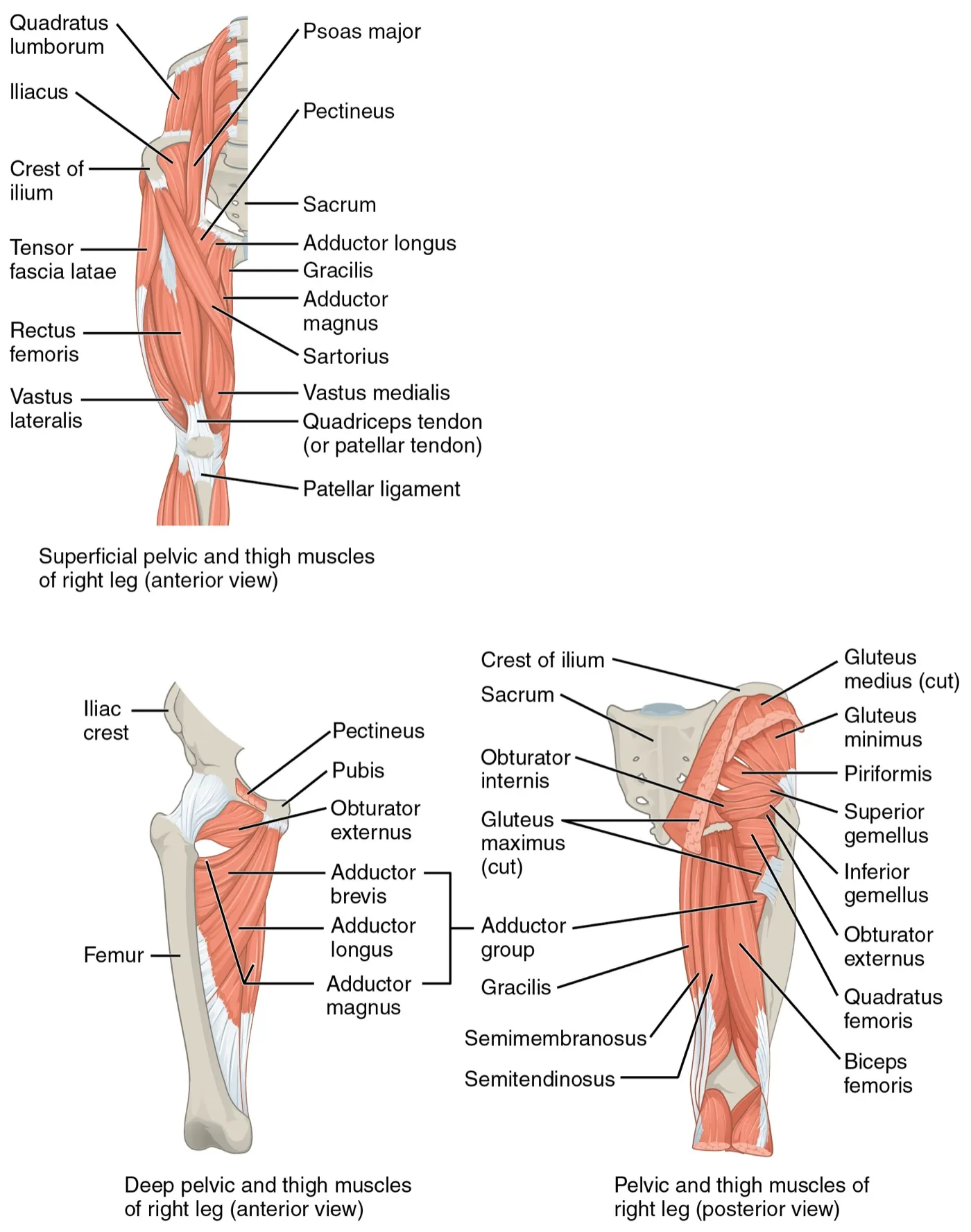
The adductor longus arises from the front of the pubic bone1. It inserts on the linea aspera, a long ridge down the back of the femur (thigh bone)1.
The adductor longus is one of six adductors, the inner thigh muscles that pull the leg in toward the other one6. The other five are the gracilis, pectineus, adductor brevis, obturator externus and adductor magnus6. At the top, they generally attach to the front and underside of the pelvis6. The obturator nerve supplies most of these muscles1,6.
How the attachment is built
Dissection studies describe where the tendon meets the pubis8,9:
- In seven male cadavers, it attached to the pubic crest, the ridge along the top of the pubic bone8. It also attached to the anterior pubic ligament, a band of tissue across the front of the joint between the pubic bones8.
- In 10 embalmed cadavers, it attached to the front and underside of the pubis10. In 18 of 20 limbs, the surface side was tendon and the deep side was muscle10.
- In 37 cadavers, tendon fibres lay mostly on the front surface, and the back surface was mostly muscle9.
- In 10 attachments from five cadaver pelves, the footprint on the pubis was about 12.0 mm wide and 10.9 mm long11.
How much of it is tendon
A study of 42 muscles from 28 cadavers measured the tendon at its origin2. Most of the attachment was muscle, with less than two fifths made of tendon2. At the origin, the tendon averaged 11.6 mm long and 3.7 mm wide2. The authors describe its cross-sectional area, the size of a slice cut straight across it, as relatively small2. The area also shrank further down2:
| Distance below the origin | Average cross-sectional area |
|---|---|
| 0 cm | 49.3 mm²2 |
| 1 cm | 27.9 mm²2 |
| 2 cm | 25.7 mm²2 |
What the muscle moves
The adductor group mainly produces adduction, moving the thigh toward the midline of the body6. One source says the adductor longus also turns the thigh inward to some degree1. Another says it can turn the thigh either inward or outward, depending on where the foot is placed12. The adductor longus flexes the thigh, bending it at the hip12. The adductor magnus, a large inner-thigh muscle, extends it instead12.
The adductor group has other jobs too6. It helps steady the trunk and helps bend and straighten the thigh in running6. Soccer players also use it to kick the ball with the inner side of the foot6.
Breakdown
How common adductor and groin injuries are
The counts below cover the adductor group or all groin injuries, not the adductor longus alone6,7,13. A strain is a pulled muscle.
| Group studied | What the study found |
|---|---|
| 25 college sports | 1.29 adductor strains per 1,000 exposures, highest in men’s soccer at 3.15 and men’s hockey at 2.476 |
| 71 studies pooled, 5,914 injuries | Hip and groin injuries were 11% of sports injuries; 6% involved the hip adductors, a rate of 0.41 per 1,000 hours7 |
| 2,299 professional footballers | Adductors had 23% of muscle injuries, second to the hamstrings (the muscles at the back of the thigh) at 37%14 |
| European professional clubs, seven seasons | Adductor-related injuries were the most common hip and groin injury, 399 of 62813 |
| National Hockey League, six seasons | Most of 617 groin and abdominal strains were adductor strains, and over 90% involved no contact15 |
Which adductor is hurt, and where
In 71 male athletes with acute adductor injuries on MRI (magnetic resonance imaging), 62 of 111 muscle injuries involved the adductor longus3. That made it the adductor injured most often3. Its injuries clustered in three places3:
- At the attachment on the pubis: 26%3.
- Where the muscle meets its upper, or proximal, tendon: 26%3.
- Where the muscle meets its lower, or distal, tendon: 37%3.
At the pubis, 12 of 16 injuries were complete avulsions, where the tendon pulls away from the bone3. Injury to the part of the tendon that runs inside the muscle was seen once3. In one cadaver study, fibrocartilage, a tough kind of cartilage, lay under the tendon on the front of the pubis8. The authors describe sudden avulsions as tearing through this layer8.
A review of adductor strains states that tears at the adductor longus origin are common, and so is adductor longus tendinopathy6. Tendinopathy means local pain in a tendon that comes with activities that load it. The same review notes that adductor strains can often start gradually, without one clear injury6.
How sudden injuries happen
Videos showed how 17 professional male football players injured the adductor longus4. Most (71%) involved no contact with another player4. The actions were4:
| Action at the moment of injury | Share of injuries |
|---|---|
| Change of direction | 35%4 |
| Kicking | 29%4 |
| Reaching | 24%4 |
| Jumping | 12%4 |
A second video study looked at 20 severe injuries in professional male soccer players16. Of these, 70% happened in closed-chain actions, with the foot fixed against the ground16. The most common was reaching with the uninjured leg, at 55%16. These injuries consistently involved hip extension (moving the thigh backward), abduction (moving it away from the midline) and turning the thigh outward16. The authors add that eccentric work, fast activation while the muscle lengthens fast, appears to be a key part of these injuries16.
Groin pain in athletes
A 2014 meeting of 24 international experts agreed on names for groin pain in athletes17. Adductor-related groin pain is one of four defined types, beside hip-related pain and other causes17. It means adductor tenderness plus pain when adduction is tested against resistance17. The adductor longus is the adductor most often involved6.
What goes with higher risk
Earlier injury comes up again and again18,19,20:
- A systematic review searches for all the research on a question in a set, checkable way and sums it up. One review of 29 studies linked higher groin injury risk to previous groin injury, higher level of play, weaker adductors and less sport-specific training18.
- A review of 30 studies of sudden adductor injury covered 594 male patients, mostly soccer players19. It reported previous groin injury and weaker adductors than on the other side19. Any injury the season before and less hip rotation were also listed19.
- Among 1,292 National Hockey League players, a previous groin or abdominal strain went with more than twice the risk of another in training camp20.
Studies disagree on the balance between the inner and outer thigh muscles21,22. In 47 National Hockey League players, those with adduction strength under 80% of abduction strength were 17 times more likely to strain an adductor21. The 29-study review also linked lower adductor strength relative to the abductors to higher risk18.
A meta-analysis pools the results of several earlier studies to get one combined answer. One pooled 13 cohort studies, which follow a group of people over time, and found that athletes who stayed uninjured had stronger adduction22. In that meta-analysis, abduction strength and the ratio between the two showed no relationship with groin pain22.
Adductor strains often come back, in 18% of cases among professional soccer players and 24% among hockey players6.
Recovery
What is known about tendon healing in general
A review describes tendons in general as having a poor blood supply and healing poorly compared with bone or skin23. After a sudden tendon injury, healing is described in three stages: inflammation, new tissue growth, and remodelling24. Healed tendon does not get back its original mechanical properties24.
Return to sport after a sudden adductor injury
One study followed 81 male athletes with a sudden adductor injury through a criteria-based exercise programme5. MRI graded each injury from 0, where the scan showed no injury, to 3, a complete tear or avulsion5. The times below are medians, the middle value in each group5:
| MRI grade | Median time to full team training |
|---|---|
| 0 to 2 | 18 days5 |
| 3, complete tear or avulsion | 78 days5 |
Over the next year, 8% of the 81 athletes were injured again5. Reinjury was less common in athletes who were free of pain on examination before they returned: 5% against 21%5.
What studies report after a complete tear
Some of these figures count all adductor injuries, not the adductor longus alone19,25:
| Group followed | What the study reported |
|---|---|
| 19 National Football League players, adductor tendon ruptures | All returned to play; on average 6.1 weeks without surgery and 12.0 weeks after surgical repair25 |
| A review of sudden adductor injuries | Complete tears: average return to play 8.9 weeks without surgery and 14.2 weeks with it19 |
| A review pooling 46 male athletes, avulsions at the tendon’s upper end | Similar rates of return to earlier level with or without surgery; 3.9 months with surgery and 2.2 without26 |
A case series reports on a group of patients with the same condition, without a comparison group. One followed 16 adult male competitive athletes with a complete adductor longus avulsion27. They were managed with an exercise programme, without surgery27. Their median time to return to sport was 69 days27. A year later, MRI showed partial tendon continuity in 10 (71%) and complete continuity in 4 (29%)27.
At one year, their eccentric adduction strength was about 92% to 93% of the other side27. They also rated their own function as high27.
Trials in long-standing groin pain
A randomised trial assigns people to groups by chance, then compares the groups. One such trial included 68 athletes with adductor-related groin pain that had lasted a long time28. One group did active training to build strength and coordination in the muscles that act on the pelvis, especially the adductors28. The comparison group received care that did not include active training28. Afterwards, 23 athletes in the training group and 4 in the comparison group returned to sport without groin pain28.
A systematic review of 19 studies looked at managing long-standing adductor-related groin pain without surgery29. It judged the evidence limited and of a low level29.
How the muscle responds to training
A randomised trial split two under-19 sub-elite football teams, 24 players, into groups30. An 8-week Copenhagen adductor plank programme raised eccentric hip adduction strength by 35.7%30. The control group showed no significant change30. The outcome was strength30.
Connections
Links across the front of the pelvis
In 10 embalmed cadavers, the tendon usually had extra links to nearby tissue10. One was the rectus sheath of the other side, the casing around the rectus abdominis10. The rectus abdominis is the long, flat muscle running down the front of the abdomen.
Other links were the front of the pubic symphysis, the joint where the two pubic bones meet, and the other adductor longus tendon10. In seven embalmed cadavers, pulling on one adductor longus stretched the opposite rectus sheath by 0.23% on average, with large differences between cadavers10. The authors see the tendon’s attachment as part of a path across the front of the pelvis10. They describe that path as likely needed for large forces in sports with many changes of direction10.
Other dissections differ on the rectus abdominis8,31. In seven male cadavers, the rectus abdominis was not attached to the adductor longus8. The same dissection found a strong direct link, through the anterior pubic ligament, to the pyramidalis8. The pyramidalis is a small muscle at the bottom of the belly wall. A systematic review of 76 cadavers called an old idea outdated: that the rectus abdominis and adductor longus fuse through a tendon sheet31.
The external oblique is the outermost flat muscle on each side of the abdomen. In 10 dissected pelvic halves, its aponeurosis ran into that of the adductor longus32. An aponeurosis is a broad, flat sheet of tendon. The two formed one shared sheet, attached just below the pubic crest32.
Exercises that load it
In 40 elite male soccer players, peak adductor longus activity across eight exercises ranged from 14% to 108%33. That scale compares with the muscle’s hardest effort with the joint held still33. This study used electromyography, measuring a muscle’s activity by picking up its electrical signals, so it shows muscle activity, not tendon load33. The authors classed the Copenhagen exercise and hip adduction against an elastic band as high-intensity for this muscle33.
In a modelling study of 15 injury-free people, long and short versions of the exercise were both in the top force group for this muscle34. Related exercise pages: Copenhagen adductor plank33.
Studies of adductor programmes and groin problems disagree35,36,37. The Copenhagen adductor plank page gives more detail on each.
- In 35 semiprofessional Norwegian men’s football teams, groin problems during the season averaged 13.5% with an adductor programme and 21.3% in control teams35. The programme was based on the Copenhagen exercise35.
- In 202 Japanese high school soccer players over 16 weeks, the risk of groin pain was lower than with usual training36. It was 0.42 times as high with the Copenhagen exercise alone, and 0.19 times with the Nordic hamstring exercise added36.
- In 502 amateur football players aged 14 to 46, groin injury rates did not differ between an adductor strength programme and two other programmes37. One of those, a self-selected programme, was not assigned by chance37. The adductor group had more groin injury in a given week than both other groups37.
- A cohort study of 162 rink hockey players, not a trial, followed them for a season38. The number of Copenhagen sessions a month was not linked to how often groin problems occurred38.
Adductor longus tendon is loaded by
Adductor longus tendon neighbours at the pubis
Adductor longus tendon shares an aponeurosis with
Sources
- Opara K, Pinkerman S, Kaiser K (2025). Adductor Strain.. StatPearls. PMID 29630218
- Strauss EJ, Campbell K, Bosco JA (2007). Analysis of the cross-sectional area of the adductor longus tendon. The American journal of sports medicine. doi:10.1177/0363546506298583 PMID 17307894
- Serner A, Weir A, Tol JL, Thorborg K, Roemer F, Guermazi A, Yamashiro E, Hölmich P (2018). Characteristics of acute groin injuries in the adductor muscles: A detailed MRI study in athletes.. Scandinavian journal of medicine & science in sports. doi:10.1111/sms.12936 PMID 28649700
- Serner A, Mosler AB, Tol JL, Bahr R, Weir A (2019). Mechanisms of acute adductor longus injuries in male football players: a systematic visual video analysis.. British journal of sports medicine. doi:10.1136/bjsports-2018-099246 PMID 30006458
- Serner A, Weir A, Tol JL, Thorborg K, Lanzinger S, Otten R, Hölmich P (2020). Return to Sport After Criteria-Based Rehabilitation of Acute Adductor Injuries in Male Athletes: A Prospective Cohort Study.. Orthopaedic journal of sports medicine. doi:10.1177/2325967119897247 PMID 32064292
- McHugh MP, Nicholas SJ, Tyler TF (2023). Adductor Strains in Athletes.. International journal of sports physical therapy. doi:10.26603/001c.72626 PMID 37020448
- Quintana-Cepedal M, Maniar N, Del Valle Soto M, Crespo I, Olmedillas H (2026). Epidemiology of hip and groin injuries in sport: a systematic review with meta-analysis and meta-regression of 5914 injuries from over 9 million exposure hours.. British journal of sports medicine. doi:10.1136/bjsports-2024-109441 PMID 41565445
- Schilders E, Bharam S, Golan E, Dimitrakopoulou A, Mitchell A, Spaepen M, Beggs C, Cooke C, Holmich P (2017). The pyramidalis-anterior pubic ligament-adductor longus complex (PLAC) and its role with adductor injuries: a new anatomical concept.. Knee surgery, sports traumatology, arthroscopy : official journal of the ESSKA. doi:10.1007/s00167-017-4688-2 PMID 28866812
- Tuite DJ, Finegan PJ, Saliaris AP, Renström PA, Donne B, O'Brien M (1998). Anatomy of the proximal musculotendinous junction of the adductor longus muscle.. Knee surgery, sports traumatology, arthroscopy : official journal of the ESSKA. doi:10.1007/s001670050086 PMID 9604200
- Norton-Old KJ, Schache AG, Barker PJ, Clark RA, Harrison SM, Briggs CA (2013). Anatomical and mechanical relationship between the proximal attachment of adductor longus and the distal rectus sheath.. Clinical anatomy (New York, N.Y.). doi:10.1002/ca.22116 PMID 23553712
- Perrone MA, Noorzad A, Hamula M, Metzger M, Banffy M, Gerhardt M (2021). Hip Adductor Longus Tendon Origin Anatomy Is Consistent and May Inform Surgical Reattachment.. Arthroscopy, sports medicine, and rehabilitation. doi:10.1016/j.asmr.2020.09.015 PMID 33615269
- Betts JG, Young KA, Wise JA, Johnson E, Poe B, Kruse DH, Korol O, Johnson JE, Womble M, DeSaix P (2022). Anatomy and Physiology 2e. OpenStax. Link
- Werner J, Hägglund M, Waldén M, Ekstrand J (2009). UEFA injury study: a prospective study of hip and groin injuries in professional football over seven consecutive seasons.. British journal of sports medicine. doi:10.1136/bjsm.2009.066944 PMID 19945984
- Ekstrand J, Hägglund M, Waldén M (2011). Epidemiology of muscle injuries in professional football (soccer).. The American Journal of Sports Medicine. doi:10.1177/0363546510395879 PMID 21335353
- Emery CA, Meeuwisse WH, Powell JW (1999). Groin and abdominal strain injuries in the National Hockey League.. Clinical journal of sport medicine : official journal of the Canadian Academy of Sport Medicine. doi:10.1097/00042752-199907000-00006 PMID 10512343
- Jokela A, Pasta G, Della Villa F, Abrantes A, Kalogiannidis D, García-Romero-Pérez A, Marano M, Skibinskyi D, Mazzoni S, Pruna R, Valle X, Lempainen L (2025). Mechanisms of Severe Adductor Longus Injuries in Professional Soccer Players: A Systematic Visual Video Analysis.. Orthopaedic journal of sports medicine. doi:10.1177/23259671241309647 PMID 39944769
- Weir A, Brukner P, Delahunt E, Ekstrand J, Griffin D, Khan KM, Lovell G, Meyers WC, Muschaweck U, Orchard J, Paajanen H, Philippon M, Reboul G, Robinson P, Schache AG, Schilders E, Serner A, Silvers H, Thorborg K, Tyler T, Verrall G, de Vos RJ, Vuckovic Z, Hölmich P (2015). Doha agreement meeting on terminology and definitions in groin pain in athletes.. British journal of sports medicine. doi:10.1136/bjsports-2015-094869 PMID 26031643
- Whittaker JL, Small C, Maffey L, Emery CA (2015). Risk factors for groin injury in sport: an updated systematic review.. British journal of sports medicine. doi:10.1136/bjsports-2014-094287 PMID 25833903
- Farrell SG, Hatem M, Bharam S (2023). Acute Adductor Muscle Injury: A Systematic Review on Diagnostic Imaging, Treatment, and Prevention.. The American journal of sports medicine. doi:10.1177/03635465221140923 PMID 36661128
- Emery CA, Meeuwisse WH (2001). Risk factors for groin injuries in hockey.. Medicine and science in sports and exercise. doi:10.1097/00005768-200109000-00002 PMID 11528328
- Tyler TF, Nicholas SJ, Campbell RJ, McHugh MP (2001). The association of hip strength and flexibility with the incidence of adductor muscle strains in professional ice hockey players.. The American journal of sports medicine. doi:10.1177/03635465010290020301 PMID 11292035
- Quintana-Cepedal M, Vicente-Rodríguez G, Crespo I, Olmedillas H (2025). Is hip adductor or abductor strength in healthy athletes associated with future groin pain? A systematic review and meta-analysis.. British journal of sports medicine. doi:10.1136/bjsports-2024-108836 PMID 39532315
- Tempfer H, Traweger A (2015). Tendon Vasculature in Health and Disease.. Frontiers in Physiology. doi:10.3389/fphys.2015.00330 PMID 26635616
- Darrieutort-Laffite C, Blanchard F, Soslowsky LJ, Le Goff B (2024). Biology and physiology of tendon healing.. Joint Bone Spine. doi:10.1016/j.jbspin.2024.105696 PMID 38307405
- Schlegel TF, Bushnell BD, Godfrey J, Boublik M (2009). Success of nonoperative management of adductor longus tendon ruptures in National Football League athletes.. The American journal of sports medicine. doi:10.1177/0363546509332501 PMID 19329786
- Migliorini F, Maffulli N, Eschweiler J, Tingart M, Baroncini A (2022). Surgical versus conservative management of traumatic proximal adductor longus avulsion injuries: A systematic review.. The surgeon : journal of the Royal Colleges of Surgeons of Edinburgh and Ireland. doi:10.1016/j.surge.2021.01.015 PMID 33692004
- Serner A, Hölmich P, Arnaiz J, Tol JL, Thorborg K, Weir A (2021). One-Year Clinical and Imaging Follow-up After Exercise-Based Treatment for Acute Complete Adductor Longus Tendon Avulsions in Athletes: A Prospective Case Series.. The American journal of sports medicine. doi:10.1177/03635465211015996 PMID 34161743
- Hölmich P, Uhrskou P, Ulnits L, Kanstrup IL, Nielsen MB, Bjerg AM, Krogsgaard K (1999). Effectiveness of active physical training as treatment for long-standing adductor-related groin pain in athletes: randomised trial.. Lancet (London, England). doi:10.1016/S0140-6736(98)03340-6 PMID 9989713
- Bisciotti GN, Chamari K, Cena E, Garcia GR, Vuckovic Z, Bisciotti A, Bisciotti A, Zini R, Corsini A, Volpi P (2021). The conservative treatment of longstanding adductor-related groin pain syndrome: a critical and systematic review.. Biology of sport. doi:10.5114/biolsport.2020.97669 PMID 33795914
- Ishøi L, Sørensen CN, Kaae NM, Jørgensen LB, Hölmich P, Serner A (2016). Large eccentric strength increase using the Copenhagen Adduction exercise in football: A randomized controlled trial.. Scandinavian journal of medicine & science in sports. doi:10.1111/sms.12585 PMID 26589483
- Mathieu T, Van Glabbeek F, Van Nassauw L, Van Den Plas K, Denteneer L, Stassijns G (2022). New insights into the musculotendinous and ligamentous attachments at the pubic symphysis: A systematic review.. Annals of anatomy = Anatomischer Anzeiger : official organ of the Anatomische Gesellschaft. doi:10.1016/j.aanat.2022.151959 PMID 35659520
- Tharnmanularp S, Muro S, Nimura A, Ibara T, Akita K (2024). Significant relationship between musculoaponeurotic attachment of the abdominal and thigh adductor muscles to the pubis: implications for the diagnosis of groin pain.. Anatomical Science International. doi:10.1007/s12565-023-00750-6 PMID 37985575
- Serner A, Jakobsen MD, Andersen LL, Hölmich P, Sundstrup E, Thorborg K (2014). EMG evaluation of hip adduction exercises for soccer players: implications for exercise selection in prevention and treatment of groin injuries.. British journal of sports medicine. doi:10.1136/bjsports-2012-091746 PMID 23511698
- Collings TJ, Horsman A, Hams AH, McGill A, Watts D, Hambly MJ, Barrett RS, Diamond LE, Bourne MN (2026). Hip Adductor Muscle Forces during Strength Training and Rehabilitation Exercises.. Medicine and science in sports and exercise. doi:10.1249/MSS.0000000000004002 PMID 41931009
- Harøy J, Clarsen B, Wiger EG, Øyen MG, Serner A, Thorborg K, Hölmich P, Andersen TE, Bahr R (2019). The Adductor Strengthening Programme prevents groin problems among male football players: a cluster-randomised controlled trial.. British journal of sports medicine. doi:10.1136/bjsports-2017-098937 PMID 29891614
- Fujisaki K, Akasaka K, Otsudo T, Hattori H, Hasebe Y, Hall T (2022). Effects of a Groin Pain Prevention Program in Male High School Soccer Players: A Cluster-Randomized Controlled Trial.. International journal of sports physical therapy. doi:10.26603/001c.36631 PMID 35949380
- Lindblom H, Sonesson S, Torvaldsson K, Waldén M, Hägglund M (2023). Extended Knee Control programme lowers weekly hamstring, knee and ankle injury prevalence compared with an adductor strength programme or self-selected injury prevention exercises in adolescent and adult amateur football players: a two-armed cluster-randomised trial with an additional comparison arm.. British journal of sports medicine. doi:10.1136/bjsports-2022-105890 PMID 36316115
- Quintana-Cepedal M, López-Pérez E, Del Valle M, Crespo I, Olmedillas H (2026). The dose-response of the Copenhagen adduction exercise on prevention of groin problems in rink hockey: A prospective cohort study.. Journal of sports sciences. doi:10.1080/02640414.2026.2713905 PMID 42557745
Changes
- Tidy pass: minor review findings fixed, glosses aligned with the reviewed glossary.
- First published.