Athletic groin pain
Also called groin pain in athletes, athletic pubalgia, sports hernia, sportsman's hernia, inguinal disruption, osteitis pubis, core muscle injury
Groin pain in people who play sport, often long-standing. How expert agreements name and sort it, who it affects, and what trials of exercise and surgery found.
- Region
- Hip
- Updated
- October 7, 2026
- Reviewed
- October 7, 2026 · how entries are checked
What it is
What the name covers
A 2015 systematic review describes athletic groin pain as an umbrella term5. It covers the many chronic conditions that show up as pain in the inguinal region (the groin)5.
The Doha agreement reports that a systematic review of 72 studies found 33 different names in use, often with different meanings for one name1.
The Doha agreement came from a one-day meeting in November 2014 of 24 experts from 14 countries1. Its subject was groin pain in athletes1. The group chose not to recommend a number of popular names1. Among them were sports hernia, sportsman’s hernia, osteitis pubis, athletic pubalgia and athletic groin pain, the title of this page1. Its reasons included a lack of specificity and wide variation in how the names had been used1.
How the Doha agreement sorts it
The agreement has three groups: defined clinical entities, hip-related groin pain, and other causes1. In each defined entity, pain in the affected region worsens on exercise1.
| Defined entity | How the Doha agreement describes it |
|---|---|
| Adductor-related | Tenderness of the adductors (the inner thigh muscles), with pain when adduction (moving a limb toward the midline) is tested against resistance1 |
| Iliopsoas-related | Tenderness of the iliopsoas, a deep hip muscle1. It is more likely with pain on resisted hip bending or on stretching the hip flexors (the muscles that bend the hip)1 |
| Inguinal-related | Pain and tenderness around the inguinal canal, a passage through the lower wall of the abdomen1. No inguinal hernia (a bulge of tissue through the groin wall) can be felt1 |
| Pubic-related | Local tenderness of the pubic symphysis (the joint where the left and right pubic bones meet) and the bone right beside it1 |
Under the agreement, more than one entity can be present in the same athlete at once1. The group also accepted that hip-related groin pain is sometimes hard to tell apart from other causes1. It may sit alongside other types of groin pain1.
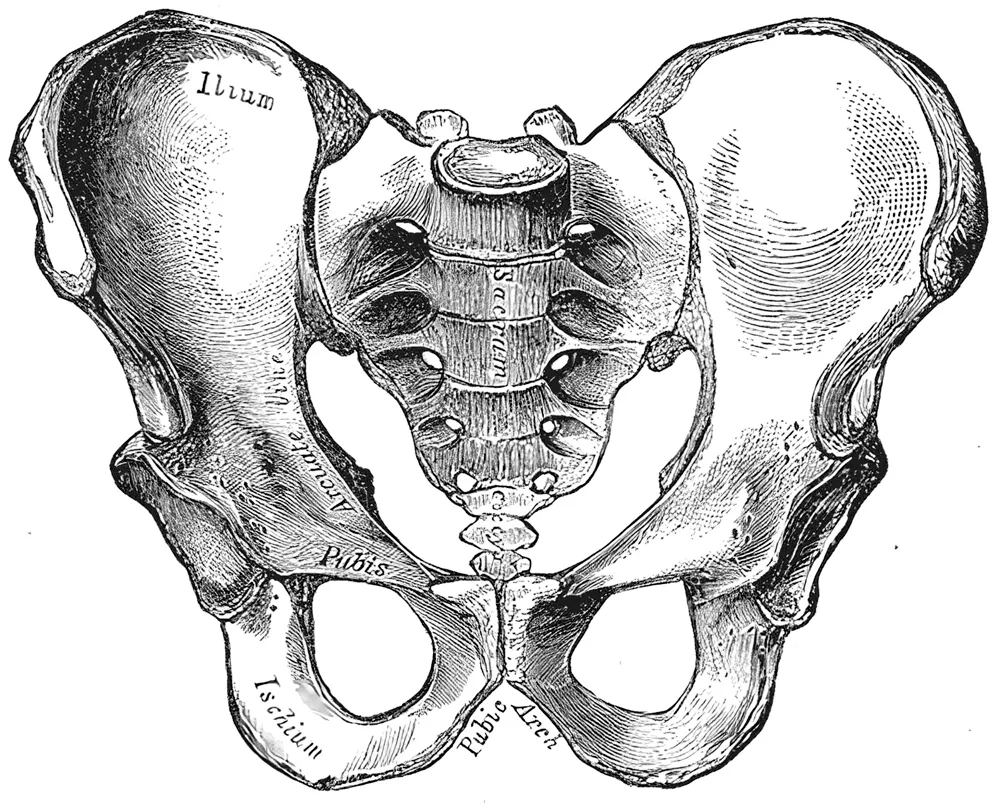
At the front of the pelvis, the pubis of each hip bone joins the other at the pubic symphysis6.
Other agreements
A 2012 British Hernia Society conference agreed on “inguinal disruption” as its preferred term7. It rejected “sportsman’s hernia”, because no true hernia exists7.
A 2026 European formal consensus drew on 57 experts from 22 countries8. For athletes and physically active adults, it recommended naming groin pain as adductor-related, iliopsoas-related, inguinal-related, pubic-related or hip joint-related8. Its 13 statements were each graded C, on a scale from A (high-level scientific evidence) to D (expert opinion)8.
Who it affects
Which type is most common
Two studies sorted athletes by clinical entity, and the adductor-related type was the most common in both2,9:
- A clinic series. Among 207 athletes with groin pain, mostly football players and runners, the main entity was adductor-related in 58% and iliopsoas-related in 36%9. More than one entity was present in 33%9.
- A professional league. Among 206 time-loss groin injuries in men’s professional football, 68% were adductor-related, 12% iliopsoas-related and 9% pubic-related2.
The hip adductors and adductor longus tendon pages cover the adductor-related type2. The hip flexor strain page covers the iliopsoas-related type2.
How common it is in football
Two studies of men’s professional football counted time-loss injuries2,10:
- In 606 players followed for two seasons, groin injuries occurred at 1.0 per 1000 hours2. They affected 21% of players at a club each season2.
- Across 15 seasons in 47 European teams, hip and groin injuries made up 14% of time-loss injuries10.
Studies that also count problems without missed play report more3. Prevalence is the share of people in a group who have a condition at a given time. Among 407 amateur male players followed for 39 weeks, an average of 11.7% had a groin problem in any given week3. In a season-long study of amateur male football teams in Spain, counting only time-loss injuries captured 10% of all groin problems3.
Ice hockey
In 163 professional and semiprofessional male ice hockey players in Sweden, 45.4% had a hip or groin problem during one season11.
Men and women
Two reviews reached different results12,13. A systematic review of 31 studies in team sports looked at incidence, the number of new cases over a set time12. Men had a higher incidence than women playing the same sport12.
A 2026 meta-analysis (a study that pools the results of earlier studies) covered nine studies and 3133 team-sport athletes13. It found no significant difference between men and women in the prevalence of hip and groin injuries overall13. Male football players, though, had higher odds of groin problems13.
What goes with it
Three studies point to an earlier groin problem14,15,16:
- A systematic review of seven high-quality studies in field sports found previous groin or hip injury the most prominent risk factor, identified in four studies14. Older age and weak adductor muscles followed, in two studies each14.
- In 245 male amateur football players, groin pain in the past season was associated with 2.4 times the risk of an in-season groin problem15.
- In 632 male semiprofessional football players, a previous hip or groin injury was associated with 74% more weeks with groin symptoms16.
A systematic review found strong evidence that a combined rotation of the two hips under 85°, measured at preseason screening, was a risk factor17. A review of hip range and groin pain in athletes concluded that range-of-motion screening is unlikely to correctly pick out an athlete at risk17. The adductor stretch page covers studies of hip range in more detail17.
What studies found
How long it lasts and who was studied
Among 382 male patients presenting with athletic groin pain, the median time in pain was 36 weeks18. In a systematic review of 72 studies, 95% of the athletes studied were male, and most studies were in football players4.
One study of amateur football players with groin pain and signs of pubic overload included a control group that only stopped sport19. Those 51 players returned to football after 240 days, and 26 of them had groin pain again19.
Exercise compared with passive approaches
A 2013 Cochrane review, a systematic review done to the Cochrane Collaboration’s standards, looked at conservative (non-surgical) approaches to exercise-related groin pain20. It found two randomised trials, which assign people to groups by chance20. The 122 participants had had adductor-related groin pain for two months or longer20. The review judged the evidence low quality and insufficient to favour any specific approach20.
Two trials in athletes with adductor-related groin pain point in different directions20,21:
- Exercise against passive methods. At 16 weeks, 74% of the strengthening and coordination group had a successful outcome20. In the group given stretching and other passive methods, 29% did20.
- A mixed programme with a manual technique against home exercise. Athletes given heat, a manual technique and stretching returned to sport sooner than those given home-based exercise, at 12.8 against 17.3 weeks21. Yet 50 to 55% of athletes in either group made a full return to sport21.
Readings of the first trial’s long-term follow-up differ. The trial’s authors re-examined 47 of the 59 original participants after 8 to 12 years22. They reported that a significant effect of active training remained22. The Cochrane review found that the difference at 8 to 12 years still favoured exercise but was not statistically significant20.
A 2015 systematic review found moderate evidence that active exercises were more successful than passive approaches for adductor-related groin pain in athletes4. A 2015 systematic review of 72 studies rated four of them as high quality4. Among 72 studies of approaches to groin pain in athletes, the lower-quality ones reported significantly higher success4.
Surgery
One randomised trial compared surgery with non-surgical care in 60 patients with chronic groin pain and suspected sportsman’s hernia23. Of 30 who had endoscopic (keyhole) mesh repair, 27 had returned to sport at 3 months23. In the group given at least two months of non-surgical care, 8 of 30 had23. Seven of the 30 in the non-surgical group later had an operation because of persistent groin pain23.
A 2015 systematic review found moderate evidence that surgery had better success than non-surgical management for athletes with sportsman’s hernia4. A meta-analysis of 56 papers and 3332 athletes found comparable return-to-play rates after surgery and after exercise-based programmes5. That held for abdominal wall, adductor and pubic-related groin pain, on evidence that was mostly level IV and of poor quality5. Level IV evidence is a low rung on a scale that ranks study designs.
Programmes aimed at lowering groin injury rates
A 2015 meta-analysis of seven randomised trials, with 4191 participants, found no statistically significant reduction in groin injuries24. A cluster-randomised trial assigns whole groups, such as teams, by chance. In one such trial of 55 football clubs, a six-exercise programme did not significantly change the risk of groin injury compared with usual training25.
Another trial assigned 35 semiprofessional Norwegian men’s football teams by chance26. The average in-season prevalence of groin problems was 13.5% in teams doing an adductor strengthening programme and 21.3% in controls26. A statement paper that searched the literature and graded the evidence looked at two programmes, the FIFA 11+ and the Copenhagen adductor strengthening programme27. It found both reduced groin injury risk compared with usual care, on low to moderate quality evidence27. The Copenhagen adductor plank page sets out the trials of that exercise26.
Connections
Structures
- Inner thigh. The adductor longus is the adductor most often involved in adductor-related groin pain28. See the hip adductors and the adductor longus tendon.
- Hip flexors. A 2026 systematic review of iliopsoas-related groin pain included 71 studies of management approaches and identified no randomised controlled trials29. See the hip flexors and hip flexor strain.
- Hip joint. A systematic review of 73 articles covered athletic groin pain that led to surgery30. Causes inside and outside the hip joint were equally common, and the most frequent was femoroacetabular impingement, at 32%30. A 2021 paper describes that condition as early contact between the upper femur (thigh bone) and the hip socket that causes symptoms31.
Exercises and stretches
In a randomised trial of 30 male soccer players with adductor-related groin pain, two 8-week programmes were compared32. The one that included the Copenhagen adductor plank gave a larger drop in pain than the same kind of programme without it32.
In the two trials described above, stretching was given together with other methods20,21. The adductor stretch page covers that stretch21.
Athletic groin pain most often involves
Athletic groin pain has a pubic-related type at the front of
Athletic groin pain has an iliopsoas-related type involving
Athletic groin pain shares the iliopsoas-related type with
Athletic groin pain can be hard to tell apart from
Athletic groin pain has a hip-related type involving
Athletic groin pain has been studied in athletes with
Sources
- Weir A, Brukner P, Delahunt E, Ekstrand J, Griffin D, Khan KM, Lovell G, Meyers WC, Muschaweck U, Orchard J, Paajanen H, Philippon M, Reboul G, Robinson P, Schache AG, Schilders E, Serner A, Silvers H, Thorborg K, Tyler T, Verrall G, de Vos RJ, Vuckovic Z, Hölmich P (2015). Doha agreement meeting on terminology and definitions in groin pain in athletes.. British journal of sports medicine. doi:10.1136/bjsports-2015-094869 PMID 26031643
- Mosler AB, Weir A, Eirale C, Farooq A, Thorborg K, Whiteley RJ, Hӧlmich P, Crossley KM (2018). Epidemiology of time loss groin injuries in a men's professional football league: a 2-year prospective study of 17 clubs and 606 players.. British journal of sports medicine. doi:10.1136/bjsports-2016-097277 PMID 28666981
- Esteve E, Clausen MB, Rathleff MS, Vicens-Bordas J, Casals M, Palahí-Alcàcer A, Hölmich P, Thorborg K (2020). Prevalence and severity of groin problems in Spanish football: A prospective study beyond the time-loss approach.. Scandinavian journal of medicine & science in sports. doi:10.1111/sms.13615 PMID 31849116
- Serner A, van Eijck CH, Beumer BR, Hölmich P, Weir A, de Vos RJ (2015). Study quality on groin injury management remains low: a systematic review on treatment of groin pain in athletes.. British journal of sports medicine. doi:10.1136/bjsports-2014-094256 PMID 25633830
- King E, Ward J, Small L, Falvey E, Franklyn-Miller A (2015). Athletic groin pain: a systematic review and meta-analysis of surgical versus physical therapy rehabilitation outcomes.. British journal of sports medicine. doi:10.1136/bjsports-2014-093715 PMID 26130700
- Betts JG, Young KA, Wise JA, Johnson E, Poe B, Kruse DH, Korol O, Johnson JE, Womble M, DeSaix P (2022). Anatomy and Physiology 2e. OpenStax. Link
- Sheen AJ, Stephenson BM, Lloyd DM, Robinson P, Fevre D, Paajanen H, de Beaux A, Kingsnorth A, Gilmore OJ, Bennett D, Maclennan I, O'Dwyer P, Sanders D, Kurzer M (2014). 'Treatment of the sportsman's groin': British Hernia Society's 2014 position statement based on the Manchester Consensus Conference.. British journal of sports medicine. doi:10.1136/bjsports-2013-092872 PMID 24149096
- Hölmich P, Weir A, Papadopoulou T, Papavasiliou A, Thorborg K, Canata GL, Villa FD, Laver L, Marin-Peña O, Paajanen H, Badhe N, Ahmad SS, Aydingöz Ü, Hanff D, Ayeni O, Thoreux P, Beaufils P, ESSKA‐EHPA‐ESMA Rating Group, Khanduja V (2026). Hip and groin pain in physically active adults with a focus on terminology, clinical examination and imaging: A formal ESSKA-EHPA-ESMA Consensus.. Knee surgery, sports traumatology, arthroscopy : official journal of the ESSKA. doi:10.1002/ksa.70565 PMID 42704670
- Hölmich P (2007). Long-standing groin pain in sportspeople falls into three primary patterns, a "clinical entity" approach: a prospective study of 207 patients.. British journal of sports medicine. doi:10.1136/bjsm.2006.033373 PMID 17261557
- Werner J, Hägglund M, Ekstrand J, Waldén M (2019). Hip and groin time-loss injuries decreased slightly but injury burden remained constant in men's professional football: the 15-year prospective UEFA Elite Club Injury Study.. British journal of sports medicine. doi:10.1136/bjsports-2017-097796 PMID 29691289
- Wörner T, Thorborg K, Clarsen B, Eek F (2022). Incidence, Prevalence, and Severity of and Risk Factors for Hip and Groin Problems in Swedish Male Ice Hockey Players: A 1-Season Prospective Cohort Study.. Journal of athletic training. doi:10.4085/1062-6050-0522.20 PMID 34038950
- Orchard JW (2015). Men at higher risk of groin injuries in elite team sports: a systematic review.. British journal of sports medicine. doi:10.1136/bjsports-2014-094272 PMID 26031645
- Bailén-García T, Quintana-Cepedal M, de la Calle O, Medina-Sánchez M, Crespo I, Olmedillas H (2026). Sex differences in hip and groin injury prevalence: a systematic review and meta-analysis of 3133 team-sport athletes.. Biology of sport. doi:10.5114/biolsport.2026.158668 PMID 42220598
- Ryan J, DeBurca N, Mc Creesh K (2014). Risk factors for groin/hip injuries in field-based sports: a systematic review.. British journal of sports medicine. doi:10.1136/bjsports-2013-092263 PMID 24795341
- Esteve E, Casals M, Saez M, Rathleff MS, Clausen MB, Vicens-Bordas J, Hölmich P, Pizzari T, Thorborg K (2022). Past-season, pre-season and in-season risk assessment of groin problems in male football players: a prospective full-season study.. British journal of sports medicine. doi:10.1136/bjsports-2020-102606 PMID 33692032
- Harøy J, Bache-Mathiesen LK, Andersen TE (2024). Lower HAGOS subscale scores associated with a longer duration of groin problems in football players in the subsequent season.. BMJ open sport & exercise medicine. doi:10.1136/bmjsem-2023-001812 PMID 38685919
- Tak I, Engelaar L, Gouttebarge V, Barendrecht M, Van den Heuvel S, Kerkhoffs G, Langhout R, Stubbe J, Weir A (2017). Is lower hip range of motion a risk factor for groin pain in athletes? A systematic review with clinical applications.. British journal of sports medicine. doi:10.1136/bjsports-2016-096619 PMID 28432076
- Falvey ÉC, King E, Kinsella S, Franklyn-Miller A (2016). Athletic groin pain (part 1): a prospective anatomical diagnosis of 382 patients--clinical findings, MRI findings and patient-reported outcome measures at baseline.. British journal of sports medicine. doi:10.1136/bjsports-2015-094912 PMID 26626272
- Schöberl M, Prantl L, Loose O, Zellner J, Angele P, Zeman F, Spreitzer M, Nerlich M, Krutsch W (2017). Non-surgical treatment of pubic overload and groin pain in amateur football players: a prospective double-blinded randomised controlled study.. Knee surgery, sports traumatology, arthroscopy : official journal of the ESSKA. doi:10.1007/s00167-017-4423-z PMID 28093636
- Almeida MO, Silva BN, Andriolo RB, Atallah AN, Peccin MS (2013). Conservative interventions for treating exercise-related musculotendinous, ligamentous and osseous groin pain.. The Cochrane database of systematic reviews. doi:10.1002/14651858.cd009565.pub2 PMID 23740671
- Weir A, Jansen JA, van de Port IG, Van de Sande HB, Tol JL, Backx FJ (2011). Manual or exercise therapy for long-standing adductor-related groin pain: a randomised controlled clinical trial.. Manual therapy. doi:10.1016/j.math.2010.09.001 PMID 20952244
- Hölmich P, Nyvold P, Larsen K (2011). Continued significant effect of physical training as treatment for overuse injury. The American journal of sports medicine. doi:10.1177/0363546511416075 PMID 21813441
- Paajanen H, Brinck T, Hermunen H, Airo I (2011). Laparoscopic surgery for chronic groin pain in athletes is more effective than nonoperative treatment: a randomized clinical trial with magnetic resonance imaging of 60 patients with sportsman's hernia (athletic pubalgia).. Surgery. doi:10.1016/j.surg.2011.02.016 PMID 21549403
- Esteve E, Rathleff MS, Bagur-Calafat C, Urrútia G, Thorborg K (2015). Prevention of groin injuries in sports: a systematic review with meta-analysis of randomised controlled trials.. British journal of sports medicine. doi:10.1136/bjsports-2014-094162 PMID 25730819
- Hölmich P, Larsen K, Krogsgaard K, Gluud C (2010). Exercise program for prevention of groin pain in football players: a cluster-randomized trial.. Scandinavian journal of medicine & science in sports. doi:10.1111/j.1600-0838.2009.00998.x PMID 19883386
- Harøy J, Clarsen B, Wiger EG, Øyen MG, Serner A, Thorborg K, Hölmich P, Andersen TE, Bahr R (2019). The Adductor Strengthening Programme prevents groin problems among male football players: a cluster-randomised controlled trial.. British journal of sports medicine. doi:10.1136/bjsports-2017-098937 PMID 29891614
- Ishøi L, Krommes K, Husted RS, Juhl CB, Thorborg K (2020). Diagnosis, prevention and treatment of common lower extremity muscle injuries in sport - grading the evidence: a statement paper commissioned by the Danish Society of Sports Physical Therapy (DSSF).. British journal of sports medicine. doi:10.1136/bjsports-2019-101228 PMID 31937579
- McHugh MP, Nicholas SJ, Tyler TF (2023). Adductor Strains in Athletes.. International journal of sports physical therapy. doi:10.26603/001c.72626 PMID 37020448
- Frans-Jozef V, Abner S, Stijn R, Annick T, Kristoff C (2026). Clinical Diagnosis and Treatment of Iliopsoas-Related Groin Pain: A Systematic Review.. Journal of clinical medicine. doi:10.3390/jcm15155912 PMID 42590015
- de Sa D, Hölmich P, Phillips M, Heaven S, Simunovic N, Philippon MJ, Ayeni OR (2016). Athletic groin pain: a systematic review of surgical diagnoses, investigations and treatment.. British journal of sports medicine. doi:10.1136/bjsports-2015-095137 PMID 27153868
- Hunter DJ, Eyles J, Murphy NJ, Spiers L, Burns A, Davidson E, Dickenson E, Fary C, Foster NE, Fripp J, Griffin DR, Hall M, Kim YJ, Linklater JM, Molnar R, Neubert A, O'Connell RL, O'Donnell J, O'Sullivan M, Randhawa S, Reichenbach S, Schmaranzer F, Singh P, Tran P, Wilson D, Zhang H, Bennell KL (2021). Multi-centre randomised controlled trial comparing arthroscopic hip surgery to physiotherapist-led care for femoroacetabular impingement (FAI) syndrome on hip cartilage metabolism: the Australian FASHIoN trial.. BMC musculoskeletal disorders. doi:10.1186/s12891-021-04576-z PMID 34399702
- Alsirhani AA, Muaidi QI, Nuhmani S, Thorborg K, Husain MA, Al Attar WSA (2024). The effectiveness of the Copenhagen adduction exercise on improving eccentric hip adduction strength among soccer players with groin injury: a randomized controlled trial.. The Physician and sportsmedicine. doi:10.1080/00913847.2024.2321958 PMID 38376593
Changes
- First published.