Hip flexor strain
Also called hip flexor tear, hip flexor muscle injury, iliopsoas strain, iliopsoas injury
An overstretched or torn muscle at the front of the hip. How studies label it, which muscles are injured, who it affects, how long it kept athletes out, and how little has been compared in trials.
- Region
- Hip
- Muscles
- iliopsoas, rectus femoris
- Updated
- October 7, 2026
- Reviewed
- October 7, 2026 · how entries are checked
What it is
How studies use the name
As an injury, a strain is an overstretched or torn muscle. The hip flexors are the muscles that bend the hip. The psoas major and the iliacus together make up the iliopsoas group5. The rectus femoris, a quadriceps muscle, assists them in flexing the thigh on the pelvis6. The hip flexors page covers the anatomy in full.
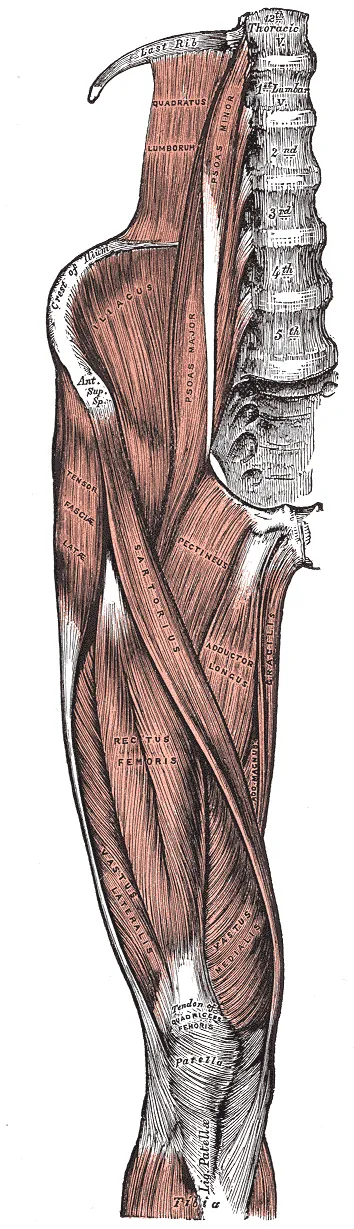
Studies have counted these injuries under more than one label1,7,8. The Doha agreement on groin pain in athletes describes iliopsoas-related groin pain as iliopsoas tenderness1. It calls this more likely when bending the hip against resistance, or stretching the hip flexors, brings on pain1. The Doha group chose not to recommend the terms iliopsoas tendinitis or tendinopathy for groin pain in athletes1. A 2026 European formal consensus of 57 experts from 22 countries listed iliopsoas-related groin pain among the terms it recommended9.
Injury counts in sport use looser labels7,8. A study of National Hockey League players counted hip flexor, hip adductor (inner thigh) and abdominal muscle strains under one heading7. In a US college surveillance programme, athletic trainers reported the injuries8. The authors note that a physician did not routinely confirm the label8.
Which muscles are injured
The authors of one MRI study of athletes state that hip flexor injuries make up one-third of acute groin injuries2. They add that little is known about the specific features of these injuries2. That study scanned 33 male athletes within 7 days of an acute hip flexor muscle injury2. The table shows the injuries it found in each muscle2.
| Muscle | What it is | Injuries on MRI |
|---|---|---|
| Rectus femoris | The quadriceps muscle at the front of the thigh that also bends the hip | 162 |
| Iliacus | A muscle lining the inside of the pelvis | 122 |
| Psoas major | A deep muscle that bends the hip | 72 |
| Sartorius | A long, thin muscle that runs across the front of the thigh | 42 |
| Tensor fasciae latae | A small muscle at the upper outer thigh | 12 |
In that study, 10 of the 16 rectus femoris injuries (63%) involved tendon2. Iliacus and psoas major injuries sat mainly at the myotendinous junction, the place where muscle fibres join their tendon2. Rectus femoris injuries happened mostly during kicking (10 of 16) and sprinting (4)2. Injuries during a change of direction were to the iliacus or psoas major only2.
What scans of the iliopsoas show
Among 638 consecutive athletes with groin pain who had MRI, 134 (21.0%) showed signal changes in the iliopsoas10. The study sorted these into two types10. A muscle-strain type, seen in 68 athletes, showed as a large, clearly bordered bright area in the belly of the muscle10. The other type, seen in 66, was a long thin bright area running up along the tendon10. Of the 68 athletes with the muscle-strain type, 53 (77.9%) reported no clear history of trauma10.
Where examination and scans disagree
In 110 male athletes with acute groin pain, some injuries were judged on examination to be iliopsoas or upper rectus femoris injuries11. Of those, 35% to 46% showed a different location on imaging, against 3% to 6% of those judged to be adductor injuries11. In a second study, of 81 male athletes, hip flexor tests were poor at predicting and locating the hip flexor injuries seen on MRI12.
Who it affects
Rates in US college sport
One count comes from surveillance of a convenience sample of US college teams in 25 sports, from 2009/10 to 2014/153. It recorded 770 hip flexor strains, a rate of 1.60 per 10,000 athlete-exposures3. An athlete-exposure is one athlete taking part in one practice or game. The same data showed:
- Sport: men’s soccer and men’s ice hockey had the highest hip flexor and hip adductor strain rates, 2.47 to 3.77 per 10,0003.
- Sex: in sports played by both sexes, men and women did not differ in hip flexor strain rate3.
- Contact: 59.4% of hip flexor strains happened without contact, the most common mechanism3.
- Repeats: 10.1% of hip flexor strains were recurrences3. Recurrence of hip flexor and hip adductor strains was highest in men’s and women’s ice hockey, at 16.0% to 30.6%3.
Second to the adductors in three counts
Three counts of hip and groin injuries place hip flexor or iliopsoas-related injuries second, behind those of the hip adductors13,14,15. A time-loss injury is one that causes missed training or matches.
| Group studied | What was counted |
|---|---|
| US college American football, ten seasons to 2013-2014: 1618 hip injuries | Hip flexor strains 28.55%, second to adductor strains at 38.63%13 |
| 606 male professional footballers at 17 clubs in Qatar, followed 2 years | Iliopsoas-related groin pain 12% of 206 time-loss groin injuries, second to adductor-related groin pain at 68%14 |
| European professional football clubs, seven seasons | 52 iliopsoas-related injuries among 628 hip and groin injuries, second to 399 adductor-related injuries15 |
Kicking and the rectus femoris
Two studies of the rectus femoris point to kicking16,17. Elite Australian Football League players had 164 quadriceps muscle strains from 2014 to 202016. Of these, 91.3% involved the rectus femoris, 48.4% happened during kicking and 72% were in the dominant kicking leg16. In a video analysis of 20 acute rectus femoris injuries in 19 professional male soccer players, 80% happened while kicking17. Two of those kicking injuries were to the supporting leg, not the kicking leg17.
The quadriceps page covers rectus femoris injury further18,19. Reviews of rectus femoris injury call it the quadriceps muscle most often injured18,19.
What studies found
How long athletes were away
Two surveillance studies recorded time away from sport3,20. In the US college data, 83.8% of hip flexor strains led to less than one week of restricted participation3. The UEFA Elite Club Injury Study of professional football recorded 264 first-time cases as hip flexor pain20. They kept players out for a mean of 13.8 days and a median (middle value) of 8 days20. The re-injury rate recorded for hip flexor pain was 13.3%20.
Where the injury sits and time away
Where the injury sat in the muscle went with how long athletes were out10,21,22,23. An aponeurosis is a broad, flat sheet of tendon. A free tendon is the part of a tendon clear of its muscle.
| Group studied | Injury | Time |
|---|---|---|
| 40 professional Australian Rules footballers, followed 3 years | Rectus femoris strain around the central tendon | Mean 26.9 days to full training, in 7 cases21 |
| The same footballers | Rectus femoris strain at the edge of the muscle | Mean 9.2 days to full training, in 8 cases21 |
| 163 quadriceps strains in 127 elite Australian Football players | Rectus femoris injury of the upper free tendon | 50.4 days to return to play22 |
| The same players | Rectus femoris injury of the central aponeurosis | 33.7 days to return to play22 |
| Athletes with groin pain and iliopsoas changes on MRI | Iliopsoas, muscle-strain type | 8.6 weeks from onset to return to play10 |
| The same athletes | Iliopsoas, type running along the tendon | 20.1 weeks from onset to return to play10 |
In the Australian Football study, those two sites took longest22. In 38 rectus femoris injuries in 27 elite track and field athletes, those reaching into the tendon took significantly longer to return to full training23.
What reviews say about approaches compared
Three systematic reviews describe the studies of management approaches4,19,24.
The first covered 72 studies of approaches to groin pain in athletes24. One study was of acute groin injuries, and the other 71 were of long-standing groin pain24. Iliopsoas-related pain was the studied condition in 3% of the studies24.
A 2026 systematic review of iliopsoas-related groin pain included 71 studies of management approaches and found no randomised controlled trials among them4. Most were retrospective case series or retrospective cohort studies, which look back at past cases or records4. It reported these findings:
- Exercise programmes: in younger and athletic groups, 77% of patients in one study returned to full activity after a structured home-based exercise programme4. All of a cohort of dancers improved without injections or surgery4. The review calls these small single-centre case series at high risk of bias4.
- Injections: image-guided injections gave short-term improvement in 50% to 70% of patients, in studies of generally low to moderate quality4.
- Surgical release: four matched comparative cohort studies, in hips without a joint replacement, looked at arthroscopic (keyhole) release of the iliopsoas4. They indicated no clear benefit beyond dealing with the accompanying problems inside the joint4. Release was associated with measurable iliopsoas wasting and loss of hip-bending strength4.
Its authors conclude that there is substantial uncertainty about how this pain is identified and how it is managed4. They call for comparative intervention trials4.
The third review covered 38 studies of rectus femoris injuries, with 152 participants19. Of its 37 operations, 73% followed non-surgical management that had failed19. No re-injury was reported within 24 months of follow-up after either approach19. The authors rate their findings as low certainty and call for high-level studies19.
Full tears and avulsions
A systematic review of 18 studies covered 132 athletes, mean age 24.0, with isolated full-thickness tears or bony avulsions of the upper rectus femoris25. An avulsion is a tear in which a tendon pulls away from the bone it attaches to. Most happened in soccer (70.5%) and rugby (15.2%)25.
| Approach in that review | Return to play | Complications reported |
|---|---|---|
| Surgery | 100% (106 athletes), at a mean of 22.1 weeks after surgery25 | 18% (19 of 106)25 |
| No surgery | 93.3% (14 athletes), at a mean of 11.7 weeks25 | 7.7% (2 of 26)25 |
Its authors rated the quality of the 18 studies as poor, with no large randomised prospective studies in the literature25. A meta-analysis, which pools the results of earlier studies, covered nine studies of upper rectus femoris avulsions in 82 patients26. It found similar overall outcomes and similar return to sport with and without surgery, in studies of low methodological quality26.
In adolescents, avulsion fractures of the lesser trochanter, a bony bump near the top of the thigh bone, are described as rare27. They are described as the result of a sudden, forceful contraction of the iliopsoas27. The pelvis page covers avulsion fractures in adolescents.
Connections
The injury involves the hip flexors, and that page covers their anatomy5. The rectus femoris belongs to the quadriceps18. Among the quadriceps muscles, it alone crosses two joints, bending the hip as well as straightening the knee18. The Doha agreement groups groin pain in athletes into clinical entities, and iliopsoas-related groin pain is one of them1. The athletic groin pain page covers those groupings1.
One study on the hip flexor stretch page followed 36 elite male soccer players for a season28. Players who went on to strain a hip flexor or knee flexor had lower preseason range of motion in those muscle groups than uninjured players28.
Hip flexor strain involves
Hip flexor strain involves the rectus femoris of
Hip flexor strain overlaps with the iliopsoas-related entity of
Hip flexor strain has one study of hip flexor range before
Hip flexor strain includes in adolescents avulsion from
Hip flexor strain is one kind of injury to
Sources
- Weir A, Brukner P, Delahunt E, Ekstrand J, Griffin D, Khan KM, Lovell G, Meyers WC, Muschaweck U, Orchard J, Paajanen H, Philippon M, Reboul G, Robinson P, Schache AG, Schilders E, Serner A, Silvers H, Thorborg K, Tyler T, Verrall G, de Vos RJ, Vuckovic Z, Hölmich P (2015). Doha agreement meeting on terminology and definitions in groin pain in athletes.. British journal of sports medicine. doi:10.1136/bjsports-2015-094869 PMID 26031643
- Serner A, Weir A, Tol JL, Thorborg K, Roemer F, Guermazi A, Yamashiro E, Hölmich P (2018). Characteristics of acute groin injuries in the hip flexor muscles - a detailed MRI study in athletes.. Scandinavian journal of medicine & science in sports. doi:10.1111/sms.12939 PMID 28649793
- Eckard TG, Padua DA, Dompier TP, Dalton SL, Thorborg K, Kerr ZY (2017). Epidemiology of Hip Flexor and Hip Adductor Strains in National Collegiate Athletic Association Athletes, 2009/2010-2014/2015.. The American journal of sports medicine. doi:10.1177/0363546517716179 PMID 28745561
- Frans-Jozef V, Abner S, Stijn R, Annick T, Kristoff C (2026). Clinical Diagnosis and Treatment of Iliopsoas-Related Groin Pain: A Systematic Review.. Journal of clinical medicine. doi:10.3390/jcm15155912 PMID 42590015
- Betts JG, Young KA, Wise JA, Johnson E, Poe B, Kruse DH, Korol O, Johnson JE, Womble M, DeSaix P (2022). Anatomy and Physiology 2e. OpenStax. Link
- Gray H; Lewis WH (editor) (1918). Anatomy of the Human Body. Lea & Febiger, Philadelphia (20th edition). Link
- Emery CA, Meeuwisse WH, Powell JW (1999). Groin and abdominal strain injuries in the National Hockey League.. Clinical journal of sport medicine : official journal of the Canadian Academy of Sport Medicine. doi:10.1097/00042752-199907000-00006 PMID 10512343
- Kerbel YE, Smith CM, Prodromo JP, Nzeogu MI, Mulcahey MK (2018). Epidemiology of Hip and Groin Injuries in Collegiate Athletes in the United States.. Orthopaedic journal of sports medicine. doi:10.1177/2325967118771676 PMID 29780846
- Hölmich P, Weir A, Papadopoulou T, Papavasiliou A, Thorborg K, Canata GL, Villa FD, Laver L, Marin-Peña O, Paajanen H, Badhe N, Ahmad SS, Aydingöz Ü, Hanff D, Ayeni O, Thoreux P, Beaufils P, ESSKA‐EHPA‐ESMA Rating Group, Khanduja V (2026). Hip and groin pain in physically active adults with a focus on terminology, clinical examination and imaging: A formal ESSKA-EHPA-ESMA Consensus.. Knee surgery, sports traumatology, arthroscopy : official journal of the ESSKA. doi:10.1002/ksa.70565 PMID 42704670
- Tsukada S, Niga S, Nihei T, Imamura S, Saito M, Hatanaka J (2018). Iliopsoas Disorder in Athletes with Groin Pain. JB & JS open access. doi:10.2106/JBJS.OA.17.00049 PMID 30229237
- Serner A, Tol JL, Jomaah N, Weir A, Whiteley R, Thorborg K, Robinson M, Hölmich P (2015). Diagnosis of Acute Groin Injuries. The American journal of sports medicine. doi:10.1177/0363546515585123 PMID 25977522
- Serner A, Weir A, Tol JL, Thorborg K, Roemer F, Guermazi A, Hölmich P (2016). Can standardised clinical examination of athletes with acute groin injuries predict the presence and location of MRI findings?. British journal of sports medicine. doi:10.1136/bjsports-2016-096290 PMID 27531521
- Makovicka JL, Chhabra A, Patel KA, Tummala SV, Hartigan DE (2019). A Decade of Hip Injuries in National Collegiate Athletic Association Football Players: An Epidemiologic Study Using National Collegiate Athletic Association Surveillance Data.. Journal of athletic training. doi:10.4085/1062-6050-59-18 PMID 31084503
- Mosler AB, Weir A, Eirale C, Farooq A, Thorborg K, Whiteley RJ, Hӧlmich P, Crossley KM (2018). Epidemiology of time loss groin injuries in a men's professional football league: a 2-year prospective study of 17 clubs and 606 players.. British journal of sports medicine. doi:10.1136/bjsports-2016-097277 PMID 28666981
- Werner J, Hägglund M, Waldén M, Ekstrand J (2009). UEFA injury study: a prospective study of hip and groin injuries in professional football over seven consecutive seasons.. British journal of sports medicine. doi:10.1136/bjsm.2009.066944 PMID 19945984
- Pietsch S, Green B, Schache AG, Pizzari T (2024). Epidemiology of quadriceps muscle strain injuries in elite male Australian football players.. Scandinavian journal of medicine & science in sports. doi:10.1111/sms.14542 PMID 37994173
- Jokela A, Mechó S, Pasta G, Pleshkov P, García-Romero-Pérez A, Mazzoni S, Kosola J, Vittadini F, Yanguas J, Pruna R, Valle X, Lempainen L (2023). Indirect Rectus Femoris Injury Mechanisms in Professional Soccer Players: Video Analysis and Magnetic Resonance Imaging Findings.. Clinical journal of sport medicine : official journal of the Canadian Academy of Sport Medicine. doi:10.1097/JSM.0000000000001131 PMID 36853900
- Begum FA, Kayani B, Chang JS, Tansey RJ, Haddad FS (2020). The management of proximal rectus femoris avulsion injuries.. EFORT Open Reviews. doi:10.1302/2058-5241.5.200055 PMID 33312709
- Bogwasi L, Holtzhausen L, Janse van Rensburg DC, Jansen van Rensburg A, Botha T (2023). Management of proximal rectus femoris injuries - do we know what we're doing?: A systematic review.. Biology of Sport. doi:10.5114/biolsport.2023.116454 PMID 37077795
- Ekstrand J, Krutsch W, Spreco A, van Zoest W, Roberts C, Meyer T, Bengtsson H (2020). Time before return to play for the most common injuries in professional football: a 16-year follow-up of the UEFA Elite Club Injury Study.. British Journal of Sports Medicine. doi:10.1136/bjsports-2019-100666 PMID 31182429
- Cross TM, Gibbs N, Houang MT, Cameron M (2004). Acute Quadriceps Muscle Strains. The American journal of sports medicine. doi:10.1177/0363546503261734 PMID 15090389
- Pietsch S, Green B, Schache AG, Rotstein A, MacBain M, Paks M, Pizzari T (2026). Imaging and Clinical Factors Associated With Return to Play and Recurrence After Quadriceps Muscle Strain Injury.. Sports health. doi:10.1177/19417381261476889 PMID 42661294
- McAleer S, Macdonald B, Lee J, Zhu W, Giakoumis M, Maric T, Kelly S, Brown J, Pollock N (2022). Time to return to full training and recurrence of rectus femoris injuries in elite track and field athletes 2010-2019; a 9-year study using the British Athletics Muscle Injury Classification.. Scandinavian journal of medicine & science in sports. doi:10.1111/sms.14160 PMID 35332596
- Serner A, van Eijck CH, Beumer BR, Hölmich P, Weir A, de Vos RJ (2015). Study quality on groin injury management remains low: a systematic review on treatment of groin pain in athletes.. British journal of sports medicine. doi:10.1136/bjsports-2014-094256 PMID 25633830
- Knapik DM, Alter TD, Ganapathy A, Smith MV, Brophy RH, Matava MJ (2023). Isolated, Full-Thickness Proximal Rectus Femoris Injury in Competitive Athletes: A Systematic Review of Injury Characteristics and Return to Play.. Orthopaedic journal of sports medicine. doi:10.1177/23259671221144984 PMID 36743725
- Dalal S, Kotwal R, Chandratreya A (2021). Operative versus conservative treatment of proximal rectus femoris avulsions: A systematic review with meta-analysis of clinical outcomes, complications and return to sports.. Journal of clinical orthopaedics and trauma. doi:10.1016/j.jcot.2020.10.030 PMID 33717921
- Ruffing T, Rückauer T, Bludau F, Hofmann A, Muhm M, Suda AJ (2018). Avulsion fracture of the lesser trochanter in adolescents.. Injury. doi:10.1016/j.injury.2018.04.030 PMID 29747942
- Bradley PS, Portas MD (2007). The relationship between preseason range of motion and muscle strain injury in elite soccer players.. Journal of strength and conditioning research. doi:10.1519/R-20416.1 PMID 18076233
Changes
- First published.