Tensor fasciae latae
Also called TFL, tensor fascia lata, tensor fascia latae
A small muscle at the upper outer front of the thigh that ends in the iliotibial band. Where it attaches, what it does at the hip, what studies of its size and activity found, and what it works with.
- Region
- Hip
- Starts on
- the anterior superior iliac spine (bony point at the hip's front), mostly its front and outer borders, by one account (Pelvis)2,32; the front lip of the iliac crest (hip bone's top rim), anchored by the fascia lata, by another account (Pelvis)3,32; no bone, in a dissection of 12 cadavers that found the muscle enclosed in the fascia lata4
- Ends on
- the fascia lata (the tough sheet wrapping the thigh muscles), where it thickens into the iliotibial band2,37
- Updated
- October 7, 2026
- Reviewed
- October 7, 2026 · how entries are checked
Function
Where it sits and how big it is
The tensor fasciae latae sits in the upper outer front of the thigh1. It lies between the superficial and deep fibres of the iliotibial band, a long band of tough tissue running down the outer thigh1. Its belly varies widely in length, but in most patients it ends before the greater trochanter, the bony bump at the outer hip1.
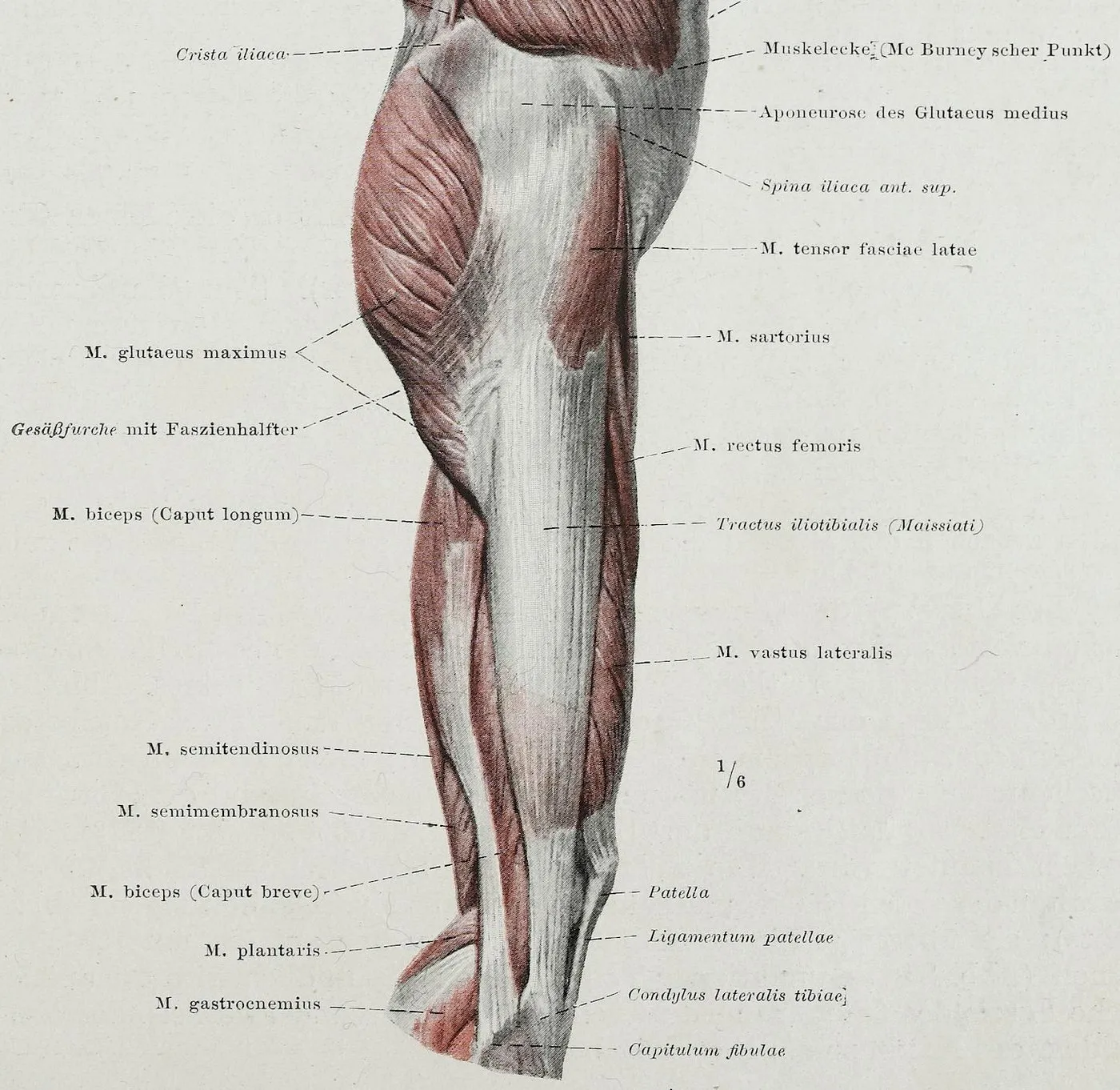
Two studies measured it beside the other two hip abductors, the muscles that move the thigh out to the side4,8. Those two are the gluteus medius and gluteus minimus, both buttock muscles4,8. One used MRI, a scan that shows soft tissue in detail, and the other dissected cadavers, bodies donated for study4,8. It was the smallest of the three in both4,8.
| Muscle | Volume on MRI in 20 women, cm³ | Volume in 12 cadavers, cm³ |
|---|---|---|
| Gluteus medius | 292.58 | 27.64 |
| Gluteus minimus | 82.18 | 14.14 |
| Tensor fasciae latae | 49.78 | 1.84 |
Where it starts and ends
The muscle’s fibres insert onto the fascia lata, the sheet of tough connective tissue that wraps the thigh muscles2. They do so where that sheet thickens into the iliotibial band2. A review describes the muscle and the gluteus maximus, the large muscle of the buttock, as sharing this attachment9.
Sources disagree about the upper end2,3,4:
- One description has its upper tendon start on the anterior superior iliac spine, the bony point at the front of the hip2. The tendon comes mostly from the front and outer borders of that point2.
- A second description has it attach at the front lip of the iliac crest, the curved top rim of the hip bone3. There the fascia lata splits, wraps the muscle and anchors it to the crest3.
- In a dissection of 12 cadavers, the tensor fasciae latae was wrapped in the fascia lata and had no attachment to bone4.
The three accounts agree on one point: the fascia lata wraps the muscle2,3,4.
What it does at the hip and knee
An anatomy reference says the muscle works with the three gluteal muscles in hip movements that include flexion, abduction and internal rotation1. Flexion here is bending the hip, abduction is moving the thigh away from the midline, and internal rotation is turning it inward. With the gluteus medius and gluteus minimus, the muscle abducts the hip and turns it inward2. With the rectus femoris, a muscle at the front of the thigh, it helps bend the hip2. The reference describes helping to keep the pelvis steady in standing and walking as its most important role clinically1.
Sources differ on the knee. The anatomy reference says the muscle assists with bending the knee and turning it outward, through the band’s attachment to the tibia (shinbone)1. A review reports a current consensus that it steadies the knee through the band, and does not actively move the knee5.
How much it abducts and rotates is disputed
One review reports a consensus that the muscle helps with internal rotation and flexion of the hip, and with steadying the knee5. The review calls its role in hip abduction more contested5. Because its electrical activity is high in isolated abduction, some call abduction a primary function5.
One experiment tested this in ten participants with nerve blocks, injections that numb a nerve for a short time10. Each block weakened one muscle at a time, and the participants then pushed the thigh out to the side while lying on their side10. The table gives the average force with the hip in the neutral position10.
| Muscle blocked | Average abduction force, N |
|---|---|
| No block | 21310 |
| Tensor fasciae latae | 20010 |
| Gluteus maximus | 11510 |
| Gluteus medius and gluteus minimus | 8210 |
Blocking the tensor fasciae latae lowered the force by 15% with the hip bent 30 degrees10. It did not lower the force in the other positions tested10. The authors judged the muscle not highly relevant as an abductor10.
Inward rotation is questioned too. Turning the hip inward is typically attributed to this muscle11. Yet experiments in cadavers suggest it lacks a moment arm, meaning leverage, for that movement11.
What it does in walking and running
One study recorded the muscle in ten adults with fine-wire electrodes, very thin wire sensors placed into a muscle12. Two groups of fibres behaved differently12. The front inner fibres have better leverage for bending the hip12. The back outer fibres have better leverage for abduction and internal rotation12.
| Activity | Front inner fibres | Back outer fibres |
|---|---|---|
| Walking | Electrically silent12 | Active near heel-strike12 |
| Faster movement: jogging, running and sprinting | More activity near toe-off12 | More activity at heel-strike12 |
Its nerve supply
The superior gluteal nerve supplies the tensor fasciae latae, the gluteus medius and the gluteus minimus13. Two muscles lie to its inner side: the rectus femoris and the sartorius, a long, thin muscle across the front of the thigh14. Branches of the femoral nerve supply those two14.
Breakdown
Injuries of the muscle and its upper attachment
An imaging review states that conditions of this muscle have not been widely reported15. One MRI study counted acute hip flexor muscle injuries in 33 male athletes16. One injury was in the tensor fasciae latae, against 16 in the rectus femoris16. The hip flexor strain page covers those injuries.
Two sources describe trouble where the muscle starts17,18. An apophysis is a bony bump where a muscle attaches that grows from its own growth plate while the bone is still growing. The one at the iliac crest, where this muscle attaches, can be pulled off the pelvis17.
The second source is an ultrasound study of about 200 patients aged 16 to 55 with pain at the front of the groin18. It found 12 abnormal tensor fasciae latae origins18. The authors described tendinopathy of the muscle as a cause of such pain18. Tendinopathy is local pain in a tendon that comes with activities that load it.
Enlargement and wasting
The imaging review calls true and false enlargement of the muscle relatively common imaging findings that often go unrecognised15. Two reports describe patients found with such changes19,20:
- In eight cases of one-sided enlargement, seven presented with a lump that could be felt at the upper front of the thigh19. The authors called it an uncommon finding that can mimic a soft tissue tumour19.
- One orthopaedic referral centre searched 13 years of imaging records and found 35 patients, mean age 6620. Atrophy (wasting) and false enlargement were the commonest findings, making up two thirds of the cases20.
Its size in people with hip conditions
A systematic review concluded that common clinical assumptions about the tensor fasciae latae’s role in lower limb conditions are poorly supported by research6. Such a review searches for the research on a question in a set, checkable way and sums it up. This one compared the muscle in people with and without a condition, across 17 studies with 556 participants6. The conditions included iliotibial band syndrome, hip joint pathology and lateral (outer) hip pain6. The review called the findings on the muscle’s size contradictory6.
Four MRI studies show the spread21,22,23,24:
| Who was compared | What was found for the tensor fasciae latae |
|---|---|
| 35 patients, 16 with a torn tendon of the gluteus medius or gluteus minimus | Its area relative to the sartorius was significantly higher in those with a tear21 |
| 180 sub-elite and amateur football players with hip-related pain for over six months, 48 without pain | Adjusted volume was 9.3% larger in the group with pain22 |
| 16 women with greater trochanteric pain syndrome (pain at the outer hip), 15 women without symptoms | Volume did not differ23 |
| 19 people with mild-to-moderate hip osteoarthritis (a long-term joint disease), 23 healthy controls | Volume was not significantly lower24 |
Three more MRI studies found no difference, or no significant difference, in its volume8,25,26. They studied women with lateral hip pain, women with chronic hip joint pain, and people with osteoarthritis of one hip8,25,26.
Its activity in people with hip and knee conditions
Electromyography (EMG) measures a muscle’s activity by picking up its electrical signals. In the systematic review, the muscle’s normalised EMG amplitude did not differ between people with and without a condition, whichever condition was studied6. Some differences in the pattern of activity were seen between people with lateral hip pain and controls6. The timing of its activity did not differ between people with knee conditions and controls6.
Two studies looked at runners with iliotibial band syndrome27,28:
- In 15 runners with the syndrome and 15 matched controls, the muscle’s surface EMG was higher in the injured runners three minutes into a run27. It was 11% against 7% of a maximal voluntary isometric contraction, a muscle’s hardest effort while the joint stays still27. The authors advised caution given the small difference27.
- In 12 female runners with the syndrome and 20 healthy female runners, the timing of the muscle’s onset during overground running did not differ28.
Recovery
Three studies report the muscle’s size in people who train7,30,31:
- In 23 collegiate male sprinters followed through one year of their usual training, its volume relative to body mass increased7. That change was not significantly correlated with the change in sprint velocity over the 50 to 60 m interval7.
- An MRI comparison covered 5 elite male sprinters, 26 sub-elite sprinters and 11 untrained men30. The tensor fasciae latae, sartorius and gluteus maximus were the three muscles consistently larger in elite than in sub-elite sprinters30.
- In a randomised trial of 27 people with hip osteoarthritis, 12 weeks of targeted gluteal exercise increased gluteus minimus volume31. Tensor fasciae latae volume did not change significantly31.
Connections
The iliotibial band and gluteus maximus
Through the iliotibial band, the tensor fasciae latae generally pulls forward and upward to bend the hip5. The gluteus maximus pulls backward to straighten it5.
The other hip abductors
The muscle is described as a synergist, a muscle that helps another make the same movement, of the gluteus medius32. A study of fibre directions in 18 adult cadavers looked at the medius and the gluteus minimus33. It suggests parts of both start abduction, which the tensor fasciae latae then completes33.
Exercises that load it
EMG studies report how active the muscle is beside the gluteal muscles34,35,36:
| Exercise | Who was studied | What was found |
|---|---|---|
| Side-lying hip abduction with an ankle weight of 5% of body mass | 20 healthy distance runners | Its activity was 54% of maximum, against 70% for the gluteus medius34 |
| The same exercise with the hip turned outward | The same 20 runners | Its activity was 71% of maximum, against 53% for the gluteus medius34 |
| Glute bridge hold | 40 healthy, physically active adults | In the standard bridge, gluteus maximus activity was significantly higher than tensor fasciae latae activity35. With the left leg lifted, it was significantly lower35 |
| Step-up | 12 people with patellofemoral pain (pain around or behind the kneecap) | Its activity was 31.7% of a maximal isometric contraction, against 15.0% for the upper gluteus maximus36 |
The muscle also helps bend the hip, working with the rectus femoris2. Related stretch page: hip flexor stretch.
Tensor fasciae latae ends in
Tensor fasciae latae shares the iliotibial band with
Tensor fasciae latae works with as a hip abductor
Tensor fasciae latae works with to bend the hip
Tensor fasciae latae was studied in runners with
Tensor fasciae latae is loaded by
Tensor fasciae latae is stretched by
Sources
- Trammell AP, Nahian A, Pilson H (2023). Anatomy, Bony Pelvis and Lower Limb: Tensor Fasciae Latae Muscle. StatPearls. PMID 29763045
- Sunil Kumar KH, Rawal J, Nakano N, Sarmento A, Khanduja V (2021). Pathogenesis and contemporary diagnoses for lateral hip pain: a scoping review.. Knee Surgery, Sports Traumatology, Arthroscopy. doi:10.1007/s00167-020-06354-1 PMID 33341914
- Szczerba N, Waleszczyńska J, Jerka D, Bonowicz-Kozłowska K, Gagat M (2026). Fascia Lata and Tensor Fasciae Latae in Lower-Limb Reconstruction.. Journal of Clinical Medicine. doi:10.3390/jcm15145547 PMID 42513461
- Flack NA, Nicholson HD, Woodley SJ (2014). The anatomy of the hip abductor muscles.. Clinical Anatomy. doi:10.1002/ca.22248 PMID 23625344
- Hutchinson LA, Lichtwark GA, Willy RW, Kelly LA (2022). The Iliotibial Band: A Complex Structure with Versatile Functions.. Sports medicine (Auckland, N.Z.). doi:10.1007/s40279-021-01634-3 PMID 35072941
- Besomi M, Maclachlan L, Mellor R, Vicenzino B, Hodges PW (2020). Tensor Fascia Latae Muscle Structure and Activation in Individuals With Lower Limb Musculoskeletal Conditions: A Systematic Review and Meta-Analysis.. Sports Medicine. doi:10.1007/s40279-019-01251-1 PMID 31898217
- Kawama R, Takahashi K, Tozawa H, Obata T, Fujii N, Arai A, Hojo T, Wakahara T (2024). Muscle morphological changes and enhanced sprint running performance: A 1-year observational study of well-trained sprinters.. European Journal of Sport Science. doi:10.1002/ejsc.12155 PMID 39223954
- Flack NA, Meikle GR, Reddy M, Nicholson HD, Woodley SJ (2012). Hip abductor muscle volume in women with lateral hip pain: a case-controlled study.. Surgical and Radiologic Anatomy. doi:10.1007/s00276-012-0970-7 PMID 22526168
- Duke MPR, Jones A, Takla A, Johnson MI (2025). The Relationship Between Tensor Fascia Latae and Gluteus Maximus Has the Potential to Indicate Early Intra-articular and Degenerative Pathologies of the Femoral-Acetabular Joint: A Narrative Review.. International Journal of Sports Physical Therapy. doi:10.26603/001c.129974 PMID 40041534
- Hoch A, Dimitriou D, Wolf-Wettstein J, Rosner J, Schubert M, Aguirre J, Eichenberger U, Zingg P, Borbas P (2025). Tensor Fasciae Latae and Gluteus Maximus Muscles: Do They Contribute to Hip Abduction?. Journal of Orthopaedic Research. doi:10.1002/jor.26036 PMID 39733244
- Martins EC, Ruschel C, Roesler EM, Silvano GA, de Castro MP, Herzog W, de Brito Fontana H (2022). Tensor fascia latae and gluteal muscles myoelectric responses to increasing levels of hip medial rotation torque.. Journal of Biomechanics. doi:10.1016/j.jbiomech.2022.110944 PMID 35016091
- Paré EB, Stern JT, Schwartz JM (1981). Functional differentiation within the tensor fasciae latae. A telemetered electromyographic analysis of its locomotor roles.. Journal of Bone and Joint Surgery. American Volume. PMID 7320037
- Lung K, Lui F (2023). Anatomy, Abdomen and Pelvis: Superior Gluteal Nerve.. StatPearls. PMID 30571029
- Putzer D, Haselbacher M, Hörmann R, Thaler M, Nogler M (2018). The distance of the gluteal nerve in relation to anatomical landmarks: an anatomic study.. Archives of Orthopaedic and Trauma Surgery. doi:10.1007/s00402-017-2847-z PMID 29177540
- Pumar Pérez M, Marsico S, Rodríguez Baeza A, Solano López A (2022). Role of imaging techniques in the diagnosis of selective hypertrophy of the tensor fascia lata.. Radiologia. doi:10.1016/j.rxeng.2021.06.006 PMID 36030083
- Serner A, Weir A, Tol JL, Thorborg K, Roemer F, Guermazi A, Yamashiro E, Hölmich P (2018). Characteristics of acute groin injuries in the hip flexor muscles - a detailed MRI study in athletes.. Scandinavian journal of medicine & science in sports. doi:10.1111/sms.12939 PMID 28649793
- Eberbach H, Hohloch L, Feucht MJ, Konstantinidis L, Südkamp NP, Zwingmann J (2017). Operative versus conservative treatment of apophyseal avulsion fractures of the pelvis in the adolescents: a systematical review with meta-analysis of clinical outcome and return to sports.. BMC musculoskeletal disorders. doi:10.1186/s12891-017-1527-z PMID 28420360
- Bass CJ, Connell DA (2002). Sonographic findings of tensor fascia lata tendinopathy: another cause of anterior groin pain.. Skeletal Radiology. doi:10.1007/s00256-001-0459-7 PMID 11935198
- Ilaslan H, Wenger DE, Shives TC, Unni KK (2003). Unilateral hypertrophy of tensor fascia lata: a soft tissue tumor simulator.. Skeletal Radiology. doi:10.1007/s00256-003-0687-0 PMID 14586575
- Iyengar KP, Azzopardi C, Kiernan G, Botchu R (2022). Isolated pathologies of Tensor Fasciae Latae: Retrospective cohort analysis from a tertiary referral centre.. Journal of Clinical Orthopaedics and Trauma. doi:10.1016/j.jcot.2022.101870 PMID 35515343
- Sutter R, Kalberer F, Binkert CA, Graf N, Pfirrmann CW, Gutzeit A (2013). Abductor tendon tears are associated with hypertrophy of the tensor fasciae latae muscle.. Skeletal Radiology. doi:10.1007/s00256-012-1514-2 PMID 22940837
- Stewart C, Wesselink EO, Perraton Z, Weber KA, King MG, Kemp JL, Mentiplay BF, Crossley KM, Elliott JM, Heerey JJ, Scholes MJ, Lawrenson PR, Calabrese C, Semciw AI (2024). Muscle Fat and Volume Differences in People With Hip-Related Pain Compared With Controls: A Machine Learning Approach.. Journal of Cachexia, Sarcopenia and Muscle. doi:10.1002/jcsm.13608 PMID 39343707
- Cowan RM, Semciw AI, Pizzari T, Cook J, Rixon MK, Gupta G, Plass LM, Ganderton CL (2020). Muscle Size and Quality of the Gluteal Muscles and Tensor Fasciae Latae in Women with Greater Trochanteric Pain Syndrome.. Clinical Anatomy. doi:10.1002/ca.23510 PMID 31689358
- Loureiro A, Constantinou M, Diamond LE, Beck B, Barrett R (2018). Individuals with mild-to-moderate hip osteoarthritis have lower limb muscle strength and volume deficits.. BMC Musculoskeletal Disorders. doi:10.1186/s12891-018-2230-4 PMID 30131064
- Mastenbrook MJ, Commean PK, Hillen TJ, Salsich GB, Meyer GA, Mueller MJ, Clohisy JC, Harris-Hayes M (2017). Hip Abductor Muscle Volume and Strength Differences Between Women With Chronic Hip Joint Pain and Asymptomatic Controls.. Journal of Orthopaedic and Sports Physical Therapy. doi:10.2519/jospt.2017.7380 PMID 28992772
- Grimaldi A, Richardson C, Durbridge G, Donnelly W, Darnell R, Hides J (2009). The association between degenerative hip joint pathology and size of the gluteus maximus and tensor fascia lata muscles.. Manual Therapy. doi:10.1016/j.math.2008.11.002 PMID 19121974
- Baker RL, Souza RB, Rauh MJ, Fredericson M, Rosenthal MD (2018). Differences in Knee and Hip Adduction and Hip Muscle Activation in Runners With and Without Iliotibial Band Syndrome.. PM&R. doi:10.1016/j.pmrj.2018.04.004 PMID 29705166
- Brown AM, Zifchock RA, Lenhoff M, Song J, Hillstrom HJ (2019). Hip muscle response to a fatiguing run in females with iliotibial band syndrome.. Human Movement Science. doi:10.1016/j.humov.2019.02.002 PMID 30743163
- Besomi M, van den Hoorn W, Vicenzino B, Hodges PW (2025). Methodological influences on tensor fascia latae EMG during dynamic tasks: Electrode- and normalisation-dependent variability.. Journal of Electromyography and Kinesiology. doi:10.1016/j.jelekin.2025.103079 PMID 41172796
- Miller R, Balshaw TG, Massey GJ, Maeo S, Lanza MB, Johnston M, Allen SJ, Folland JP (2021). The Muscle Morphology of Elite Sprint Running.. Medicine and science in sports and exercise. doi:10.1249/MSS.0000000000002522 PMID 33009196
- Rostron ZPJ, Zacharias A, Semciw AI, Kingsley M, Pizzari T, Woodley SJ, Green R (2022). Effects of a targeted resistance intervention compared to a sham intervention on gluteal muscle hypertrophy, fatty infiltration and strength in people with hip osteoarthritis: analysis of secondary outcomes from a randomised clinical trial.. BMC Musculoskeletal Disorders. doi:10.1186/s12891-022-05907-4 PMID 36309690
- Betts JG, Young KA, Wise JA, Johnson E, Poe B, Kruse DH, Korol O, Johnson JE, Womble M, DeSaix P (2022). Anatomy and Physiology 2e. OpenStax. Link
- Al-Hayani A (2009). The functional anatomy of hip abductors.. Folia Morphologica. PMID 19449297
- McBeth JM, Earl-Boehm JE, Cobb SC, Huddleston WE (2012). Hip muscle activity during 3 side-lying hip-strengthening exercises in distance runners.. Journal of Athletic Training. doi:10.4085/1062-6050-47.1.15 PMID 22488226
- Khosrokiani Z, Letafatkar A, Sheikhi B, Thomas AC, Aghaie-Ataabadi P, Hedayati MT (2022). Hip and Core Muscle Activation During High-Load Core Stabilization Exercises.. Sports Health. doi:10.1177/19417381211015225 PMID 34060953
- Selkowitz DM, Beneck GJ, Powers CM (2024). Comparison of electromyographic activity of the gluteal muscles and tensor fascia lata in persons with patellofemoral pain: evaluation of selected, hip-targeted exercises using indwelling fine-wire electrodes.. Physiotherapy Theory and Practice. doi:10.1080/09593985.2023.2215389 PMID 37212292
- Cho KH, Jin ZW, Abe H, Wilting J, Murakami G, Rodríguez-Vázquez JF (2018). Tensor fasciae latae muscle in human embryos and foetuses with special reference to its contribution to the development of the iliotibial tract.. Folia Morphologica. PMID 29500891
Changes
- First published.