Gluteal tendons
Also called gluteus medius tendon, gluteus minimus tendon, hip abductor tendons
The tendons of the gluteus medius and minimus at the outer hip. Where they attach, what they do in walking, how they become painful or tear, how long that can last, and what loads them.
- Region
- Hip
- Muscles
- gluteus medius, gluteus minimus
- Updated
- September 29, 2026
- Reviewed
- September 29, 2026 · how entries are checked
Function
Where the tendons attach
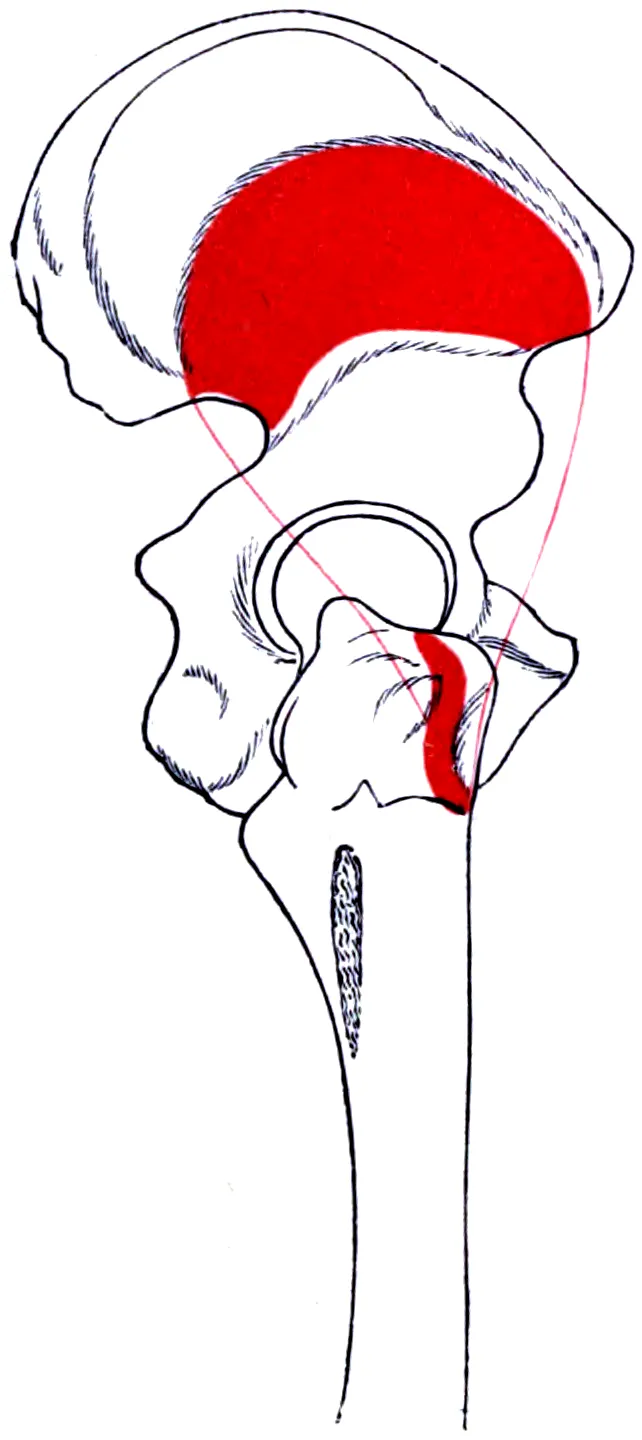
The gluteus medius lies beneath the gluteus maximus, and the gluteus minimus lies beneath the medius9. Both end in tendons on the greater trochanter, the bony bump at the outer hip1,2,3. A study of cadavers (donated bodies) and MRI scans described its surface as four facets, or small flat areas1. These were the front, outer, back and upper back facets1.
Cadaver studies found the gluteus medius tendon attaching at two of these sites1,2:
| Attachment site | Size in 8 cadaver hips |
|---|---|
| Outer facet | About 438 mm², 34.8 mm long, set at about 37 degrees to the thigh bone2 |
| Upper back facet | About 197 mm², roughly round and about 17 mm across2 |
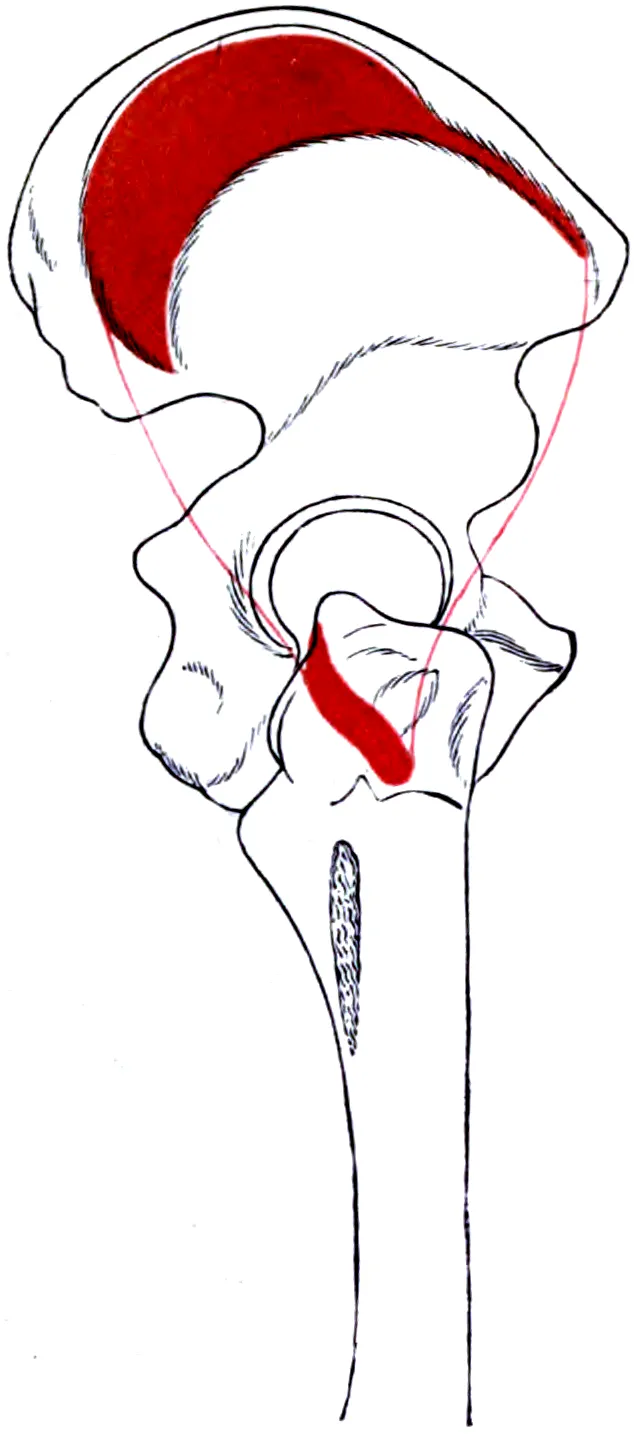
The gluteus minimus tendon attaches to the front facet1,3. In 16 cadaver hips, the muscle started on the outer surface of the ilium, the wide upper part of the hip bone10. On its way down, it also attached to the joint capsule of the hip, the sleeve of tough tissue that encloses the joint3,10.
In a cadaver and MRI study, three bursae (small fluid-filled sacs that cushion tissues where they rub) sat around these tendons1. One lay over the back facet and the outer gluteus medius attachment1. The other two lay beneath the gluteus medius tendon and beneath the gluteus minimus tendon1.
What the two muscles do
Together, the gluteus medius and minimus act as hip abductors, moving the thigh out to the side, and are important for normal walking4. The gluteus minimus acts mainly to steady the hip and move the thigh outward11.
In cadavers and a plastic bone model, the minimus did different jobs depending on thigh position and which part was working10. It could bend the hip, move the thigh out, or turn it in or out10. One of its roles was to hold the ball of the thigh bone in the hip socket10.
The superior gluteal nerve supplies the gluteus medius, the gluteus minimus and the tensor fasciae latae, a small muscle at the upper outer thigh12. Damage to this nerve paralyses the gluteus medius12. The result is a typical walking and standing pattern called the Trendelenburg gait12.
In 18 adult cadavers, the gluteus medius had three distinct parts and the minimus had two13. Each part had its own branch of the superior gluteal nerve13. From their fibre directions, the parts seemed suited to different jobs13:
- The front and middle parts of the medius, and the front part of the minimus, appeared suited to starting the outward lift13.
- The back parts of both appeared suited to steadying the ball of the hip in its socket during walking13.
How much force the muscles make in walking
One computer model of walking was scaled to one healthy adult man14. At peak loading early in each step, the ground pushed up with about 120% of body weight14. The model’s gluteus medius then made about 897 newtons and the minimus about 158 newtons14.
The same study then changed the shape of the hip in its model14. A high angle at the femoral neck (the angled part of the thigh bone below the ball) and a narrow pelvis gave the shortest leverage14. That shape also gave the highest peak gluteus medius force, 1,240 newtons14. A wide pelvis with a low neck angle gave the longest leverage and the lowest force, 742 newtons14.
Breakdown
What gluteal tendinopathy is
Gluteal tendinopathy is now seen mainly as a problem of the gluteus medius or minimus tendons where they attach to bone, without inflammation6. It is described as the most common tendinopathy of the leg5,6. Levels of disability and quality of life have been reported as equal to those in end-stage hip osteoarthritis, a long-term disease of a joint6.
It brings pain and tenderness over the greater trochanter, which sometimes spreads down the outer thigh6. The pain disturbs sleep6. Loading one leg at a time brings it on, as in climbing stairs, walking and dressing6.
In tendinopathy, the fibres of collagen, the strong, rope-like protein that tendons are mainly built from, become disorganised6. More small blood vessels form and new nerves grow in, and the tendon loses its integrity6.
From bursitis to a full tear
A systematic review searches for the research on a question in a set, checkable way and sums it up. One such review used four grades of worsening tendon change5:
- Bursitis, a swollen bursa5.
- Tendinopathy5.
- A tear through part of the tendon’s thickness5.
- A tear through its full thickness5.
Tears of the medius, minimus or both sit at the more severe end of gluteal tendon problems15. People whose tears cause symptoms show disability like that of end-stage hip osteoarthritis15. These tears show up in three ways16:
- Tears from wear or injury, sometimes called rotator cuff tears of the hip, in older people with outer hip pain, weakness and no hip arthritis16.
- Tears that may cause few symptoms, found during hip replacement16.
- Tears or failed repairs after hip replacement through one particular surgical approach16.
One prospective study (a study that follows people forward in time) took in 176 people having hip replacement for osteoarthritis17. Of these, 34 (20%) had wear-related tears of the hip abductor mechanism17. These tears were more common in elderly women17.
What scans show at the outer hip
Bursa changes alone are uncommon in pain at the greater trochanter, and inflammatory cells are rarely found6. Bursa changes may still occur alongside tendon changes6. One retrospective study looked back at ultrasound scans of 877 people with pain at the greater trochanter18. One finding involved the iliotibial band, a long band of tough tissue running down the outer thigh18:
| Finding on ultrasound | Share of the 877 people |
|---|---|
| Gluteal tendon change (tendinosis) | 49.9%18 |
| Thickened iliotibial band | 28.5%18 |
| Trochanteric bursitis | 20.2%18 |
| Gluteal tendon tear | 0.5%18 |
In an MRI study of 40 people with pain in one outer hip, the pain-free hips also showed changes, especially bursitis19.
Who is affected
One cross-sectional study, looking at a group once, took in 3,026 community adults aged 50 to 797. It counted greater trochanteric pain syndrome (pain and tenderness at the outer hip, over the greater trochanter)7:
| Group | One side | Both sides |
|---|---|---|
| Women | 15.0%7 | 8.5%7 |
| Men | 6.6%7 | 1.9%7 |
In that study, women had about 3.4 times the odds of the condition, while age and race were not significantly linked7. After adjustment, tenderness of the iliotibial band, knee osteoarthritis and low back pain were linked to it7. Body mass index, a measure of weight for height, was not7.
Age, sex and hormonal status are described as risk factors for hip tendinopathy6. It is common in postmenopausal women, those after menopause6. In one review of 27 studies testing approaches to gluteal tendinopathy, the people studied had a mean age of 53.7 years5. Women outnumbered men 7 to 15.
Counts from family doctors’ records differ20,21:
- In one Dutch general practice in 2012, the figure for prevalence (how many people have a condition at one time) was 4.2220. New cases were 3.29 per 1,000 person-years, a count of people times the years each was followed20.
- That was the highest of the five leg tendinopathies counted there20.
- In records from 39 family doctors, there were 1.8 new cases of pain at the greater trochanter per 1,000 patients a year21.
Load patterns and body shape linked to it
In tendinopathy, high tensile load, a pulling force that stretches a tissue, combined with compressive load is considered most harmful6. That is especially so when repeated6. Low tensile load with compression can also lower how much load a tendon can take6.
Hip adduction, moving the thigh toward the midline, can raise the pressure of the iliotibial band on tissues over the greater trochanter6. Sitting with the legs crossed is one example6. In 18 unfixed corpses and 12 patients during hip replacement, force under the band there rose with adduction and fell with abduction22. It rose by up to 106 newtons at 40 degrees of adduction22.
Studies of standing and walking found these differences6,23:
- Standing on one leg, 20 people with gluteal tendinopathy moved the hip more toward the midline than 20 pain-free people of the same age23.
- In that study, the opposite side of the pelvis also rose less23.
- Biomechanical studies show changed walking in people with the condition, leading to much higher loads on these tendons6.
A more acute angle between the femoral neck and the shaft of the thigh bone may add to squeezing forces on the tendons6. People with the condition show bigger differences between the width of the pelvis at the ilium and the width across the greater trochanters6. A systematic review of 13 studies compared 229 people with greater trochanteric pain syndrome and 193 without it24. On very low quality evidence, the first group had wider greater trochanters, higher body mass index and weaker hip abductors24. They also showed changed loading on one leg and changed walking24.
Weaker, smaller muscles
One study compared 50 people with gluteal tendinopathy on one side with 50 people without it25. Hip abductor strength was 32% lower on the painful side25. In the same study, the pain-free side was also weaker than in the comparison group25. Its strength was 23% lower25. It was not clear whether the weakness came before the condition or resulted from it25.
In gluteal tendinopathy, the weakness comes with wasting of the gluteal muscles and fat building up within them6.
Recovery
How long the pain can last
Hip tendinopathies are described as common, with a real impact, and as not settling on their own6. One retrospective study followed 164 family-doctor patients with pain at the greater trochanter21. Their mean age was 55, and 80% were women21. At least 36% still had pain after one year, and 29% after five years21. In this group, those with osteoarthritis in the leg had a 4.8-fold risk of pain lasting a year21.
What trials of exercise and injection found
One randomised trial took in 204 people aged 35 to 70 with gluteal tendinopathy confirmed on MRI8. It compared an eight-week education and exercise programme, one corticosteroid injection, and waiting to see8. A corticosteroid is a drug that copies a type of hormone the body makes. The table shows how many in each group rated their overall change a success8:
| Group | Success at 8 weeks | Success at 52 weeks |
|---|---|---|
| Education and exercise | 51 of 668 | 51 of 658 |
| Corticosteroid injection | 38 of 658 | 36 of 638 |
| Wait and see | 20 of 688 | 31 of 608 |
At 52 weeks, pain did not differ between the exercise group and the injection group8.
A meta-analysis (a study that pools the results of several earlier studies) combined 3 trials with 383 people with gluteal tendinopathy26. Exercise programmes improved function more than minimal care, in both the short and long term26. The certainty of that evidence was rated low to very low26. In the same review, exercise and corticosteroid injection had similar effects on pain26. More people counted as a success after exercise than after injection26.
A network meta-analysis compares many options at once, including ones never tested against each other directly. One pooled 19 randomised trials of non-surgical approaches, with 1,701 people with greater trochanteric pain syndrome27. Of the approaches it compared, exercise programmes showed the largest gains in pain scores and in a function score for gluteal problems27.
Corticosteroids have been reported to lower tendon cell survival, collagen production and the tendon’s mechanical properties6.
What studies of tears report
A systematic review of gluteal tendon tears took in 38 papers with 1,584 people15. It found no studies of non-surgical approaches15. Every paper studied surgery, most were case series (reports on a group of patients without a comparison group), and none were randomised trials15. After surgery, quality of life and pain had improved at 12 months or more15. The certainty of that evidence was very low15.
A second review pooled 34 studies of 1,278 people who had surgical repair28. It compared open repair with endoscopic (keyhole) repair28. Both gave similar short-term gains in function and pain28. Complications occurred in 33 of 371 open repairs and in 25 of 433 endoscopic repairs28.
How load shapes tendon tissue
Mechanical load is an important trigger for both breaking down and building up tendon6. Both too much and too little load affect how sound a tendon is6.
Another meta-analysis, of 27 exercise studies, found that tendons respond to many kinds of loading29. Its data strongly suggested that how heavy the load was mattered more than the type of muscle contraction29. Those studies looked at the Achilles and patellar tendons, so they are not evidence about the gluteal tendons29.
Connections
The muscles around them
The gluteus maximus covers the gluteus medius, which in turn covers the gluteus minimus9. The gluteus maximus’s line of pull suits it to help lift the thigh out to the side30. The tensor fasciae latae is a small muscle in the upper outer thigh that pulls the iliotibial band taut9. The iliopsoas is a deep hip muscle, made of the psoas and iliacus, that bends the hip. The tensor fasciae latae works with it and the gluteus medius to bend the hip and move the thigh outward9.
Exercises that work these muscles
Related exercise pages: side-lying hip abduction and single-leg Romanian deadlift31,32. The studies below measured muscle activity or estimated muscle force, rather than load on the tendons themselves31,32.
- In an EMG (muscle activity) review of healthy people, side-lying hip abduction worked the middle gluteus medius at about 40% of maximum, a moderate level31.
- In a modelling study of 14 female footballers, the loaded single-leg Romanian deadlift was among the top exercises for estimated gluteus medius force32.
- In that study, it and the body-weight side plank were the top exercises for estimated gluteus minimus force32.
- There, a 12-repetition maximum load (liftable 12 times) raised peak gluteal muscle forces by 28 to 150 newtons over body weight32.
Gluteal tendons is loaded by
Gluteal tendons has its muscles worked by
Gluteal tendons lies beneath
Sources
- Pfirrmann CW, Chung CB, Theumann NH, Trudell DJ, Resnick D (2001). Greater trochanter of the hip: attachment of the abductor mechanism and a complex of three bursae--MR imaging and MR bursography in cadavers and MR imaging in asymptomatic volunteers.. Radiology. doi:10.1148/radiol.2211001634 PMID 11687692
- Robertson WJ, Gardner MJ, Barker JU, Boraiah S, Lorich DG, Kelly BT (2008). Anatomy and dimensions of the gluteus medius tendon insertion.. Arthroscopy. doi:10.1016/j.arthro.2007.11.015 PMID 18237695
- Philippon MJ, Michalski MP, Campbell KJ, Goldsmith MT, Devitt BM, Wijdicks CA, LaPrade RF (2014). Surgically Relevant Bony and Soft Tissue Anatomy of the Proximal Femur.. Orthopaedic Journal of Sports Medicine. doi:10.1177/2325967114535188 PMID 26535335
- Shah A, Bordoni B (2023). Anatomy, Bony Pelvis and Lower Limb, Gluteus Medius Muscle.. StatPearls. PMID 32491441
- Ladurner A, Fitzpatrick J, O'Donnell JM (2021). Treatment of Gluteal Tendinopathy: A Systematic Review and Stage-Adjusted Treatment Recommendation.. Orthopaedic Journal of Sports Medicine. doi:10.1177/23259671211016850 PMID 34377713
- Grimaldi A, Mellor R, Nasser A, Vicenzino B, Hunter DJ (2024). Current and future advances in practice: tendinopathies of the hip.. Rheumatology Advances in Practice. doi:10.1093/rap/rkae022 PMID 38601140
- Segal NA, Felson DT, Torner JC, Zhu Y, Curtis JR, Niu J, Nevitt MC (2007). Greater trochanteric pain syndrome: epidemiology and associated factors.. Archives of Physical Medicine and Rehabilitation. doi:10.1016/j.apmr.2007.04.014 PMID 17678660
- Mellor R, Bennell K, Grimaldi A, Nicolson P, Kasza J, Hodges P, Wajswelner H, Vicenzino B (2018). Education plus exercise versus corticosteroid injection use versus a wait and see approach on global outcome and pain from gluteal tendinopathy: prospective, single blinded, randomised clinical trial.. BMJ. doi:10.1136/bmj.k1662 PMID 29720374
- Betts JG, Young KA, Wise JA, Johnson E, Poe B, Kruse DH, Korol O, Johnson JE, Womble M, DeSaix P (2022). Anatomy and Physiology 2e. OpenStax. Link
- Beck M, Sledge JB, Gautier E, Dora CF, Ganz R (2000). The anatomy and function of the gluteus minimus muscle.. The Journal of Bone and Joint Surgery. British Volume. doi:10.1302/0301-620x.82b3.10356 PMID 10813169
- Greco AJ, Vilella RC (2023). Anatomy, Bony Pelvis and Lower Limb, Gluteus Minimus Muscle.. StatPearls. PMID 32310604
- Lung K, Lui F (2023). Anatomy, Abdomen and Pelvis: Superior Gluteal Nerve.. StatPearls. PMID 30571029
- Al-Hayani A (2009). The functional anatomy of hip abductors.. Folia Morphologica. PMID 19449297
- Wang S, Serbin R, Bonvillain K, Jolissaint J, Habet N, Weeks D (2025). Influence of hip morphology on gluteal muscle biomechanics: a computational modeling study.. BMC Musculoskeletal Disorders. doi:10.1186/s12891-024-08136-z PMID 39789570
- Spencer T, Nasser A, Brown NAT, Grimaldi A, Vicenzino B, Smith PN, Fearon A (2026). Low quality evidence supports surgery for gluteal tendon tears, no non-surgical evidence was identified: a systematic review.. BMC Musculoskeletal Disorders. doi:10.1186/s12891-026-09519-0 PMID 41634705
- Lachiewicz PF (2011). Abductor tendon tears of the hip: evaluation and management.. The Journal of the American Academy of Orthopaedic Surgeons. doi:10.5435/00124635-201107000-00001 PMID 21724917
- Howell GE, Biggs RE, Bourne RB (2001). Prevalence of abductor mechanism tears of the hips in patients with osteoarthritis.. The Journal of Arthroplasty. doi:10.1054/arth.2001.19158 PMID 11172282
- Long SS, Surrey DE, Nazarian LN (2013). Sonography of greater trochanteric pain syndrome and the rarity of primary bursitis.. AJR. American Journal of Roentgenology. doi:10.2214/AJR.12.10038 PMID 24147479
- Woodley SJ, Nicholson HD, Livingstone V, Doyle TC, Meikle GR, Macintosh JE, Mercer SR (2008). Lateral hip pain: findings from magnetic resonance imaging and clinical examination.. The Journal of Orthopaedic and Sports Physical Therapy. doi:10.2519/jospt.2008.2685 PMID 18515960
- Albers IS, Zwerver J, Diercks RL, Dekker JH, Van den Akker-Scheek I (2016). Incidence and prevalence of lower extremity tendinopathy in a Dutch general practice population: a cross sectional study.. BMC Musculoskeletal Disorders. doi:10.1186/s12891-016-0885-2 PMID 26759254
- Lievense A, Bierma-Zeinstra S, Schouten B, Bohnen A, Verhaar J, Koes B (2005). Prognosis of trochanteric pain in primary care.. The British Journal of General Practice. PMID 15808035
- Birnbaum K, Siebert CH, Pandorf T, Schopphoff E, Prescher A, Niethard FU (2004). Anatomical and biomechanical investigations of the iliotibial tract.. Surgical and Radiologic Anatomy. doi:10.1007/s00276-004-0265-8 PMID 15378277
- Allison K, Bennell KL, Grimaldi A, Vicenzino B, Wrigley TV, Hodges PW (2016). Single leg stance control in individuals with symptomatic gluteal tendinopathy.. Gait & Posture. doi:10.1016/j.gaitpost.2016.06.020 PMID 27395451
- Plinsinga ML, Ross MH, Coombes BK, Vicenzino B (2019). Physical findings differ between individuals with greater trochanteric pain syndrome and healthy controls: A systematic review with meta-analysis.. Musculoskeletal Science & Practice. doi:10.1016/j.msksp.2019.07.009 PMID 31369906
- Allison K, Vicenzino B, Wrigley TV, Grimaldi A, Hodges PW, Bennell KL (2016). Hip Abductor Muscle Weakness in Individuals with Gluteal Tendinopathy.. Medicine and Science in Sports and Exercise. doi:10.1249/MSS.0000000000000781 PMID 26418561
- Patricio Cordeiro TT, Rocha EAB, Scattone Silva R (2024). Effects of exercise-based interventions on gluteal tendinopathy. Systematic review with meta-analysis.. Scientific Reports. doi:10.1038/s41598-024-53283-x PMID 38336959
- Wang SQ, Guo NY, Liu W, Huang HJ, Xu BB, Wang JQ (2025). Effect of conservative treatment on greater trochanteric pain syndrome: a systematic review and network meta-analysis of randomized controlled trials.. Journal of Orthopaedic Surgery and Research. doi:10.1186/s13018-025-05477-w PMID 39891188
- Ramadanov N, Voss M, Lott A, Hable R, Prill R, Becker R, Ostojic M, Penchev P, Banke IJ (2026). Endoscopic gluteal tendon repair reduces complication rates while achieving outcomes comparable to open repair: A multilevel meta-analysis.. Knee Surgery, Sports Traumatology, Arthroscopy. doi:10.1002/ksa.70309 PMID 41618800
- Bohm S, Mersmann F, Arampatzis A (2015). Human tendon adaptation in response to mechanical loading: a systematic review and meta-analysis of exercise intervention studies on healthy adults.. Sports Medicine - Open. doi:10.1186/s40798-015-0009-9 PMID 27747846
- Pourahmadi M, Asadi M, Dommerholt J, Yeganeh A (2020). Changes in the macroscopic morphology of hip muscles in low back pain.. Journal of Anatomy. doi:10.1111/joa.13086 PMID 31475359
- Moore D, Semciw AI, Pizzari T (2020). A SYSTEMATIC REVIEW AND META-ANALYSIS OF COMMON THERAPEUTIC EXERCISES THAT GENERATE HIGHEST MUSCLE ACTIVITY IN THE GLUTEUS MEDIUS AND GLUTEUS MINIMUS SEGMENTS.. International Journal of Sports Physical Therapy. doi:10.26603/ijspt20200856 PMID 33344003
- Collings TJ, Bourne MN, Barrett RS, Meinders E, Gonçalves BAM, Shield AJ, Diamond LE (2023). Gluteal Muscle Forces during Hip-Focused Injury Prevention and Rehabilitation Exercises.. Medicine and Science in Sports and Exercise. doi:10.1249/MSS.0000000000003091 PMID 36918403
Changes
- Tidy pass: minor review findings fixed, glosses aligned with the reviewed glossary.
- First published.