Bursitis
Also called olecranon bursitis, student's elbow, prepatellar bursitis, trochanteric bursitis, retrocalcaneal bursitis, subacromial bursitis, septic bursitis
Inflammation of a bursa, a fluid-filled sac that cushions tissues where they rub. How sources define it, who studies found it in, and what reviews of the elbow, knee, hip, heel and shoulder found.
- Region
- Across the body
- Updated
- October 15, 2026
- Reviewed
- October 15, 2026 · how entries are checked
What it is
How sources define it
An anatomy textbook defines bursitis as inflammation of a bursa near a joint1. Inflammation is the body’s response to injury or irritation. In the textbook’s account, bursitis brings pain, swelling or tenderness in and around the bursa, and sometimes a stiff joint1. The same textbook says it can be short, lasting a few days (acute), or long-lasting (chronic)1.
The textbook describes a bursa as a thin sac of connective tissue filled with lubricating liquid1. Bursae sit where skin, ligaments, muscles or tendons could rub together, usually near a joint, and keep those structures apart1. The textbook sorts them by where they sit1:
- Subcutaneous, between skin and bone, such as the bursa over the kneecap and the one at the tip of the elbow1.
- Submuscular, between a muscle and a bone, or between two muscles1.
- Subtendinous, between a tendon and a bone1.
Infected or not
A review states that bursitis at the elbow tip can be septic (infected) or aseptic (not infected)6. A 2019 review of septic bursitis states that telling the two apart usually needs a look at fluid drawn from the bursa7. French recommendations from 2023 put septic cases at one third of all inflammatory bursitis, often linked to work8.
Where it happens
The textbook links bursitis most often with bursae around the shoulder, hip, knee or elbow1.
| Site | Bursa | Where it sits |
|---|---|---|
| Shoulder | Subacromial | Between the acromion (the bony point at the top of the shoulder) and a shoulder tendon passing beneath it1 |
| Elbow | Olecranon | Under the skin at the tip of the elbow1 |
| Hip | Trochanteric | Between the greater trochanter (the bony bump at the outer hip) and the gluteus maximus over it1 |
| Hip | Ischial | Between the skin and the ischial tuberosity, the bone that bears weight in sitting1 |
| Knee | Prepatellar | Between the skin and the kneecap1 |
| Heel | Retrocalcaneal | Between the lower front of the Achilles tendon and the upper back corner of the heel bone9 |
| Heel | Superficial calcaneal | Between the skin and either a heel-bone prominence or the Achilles tendon9 |
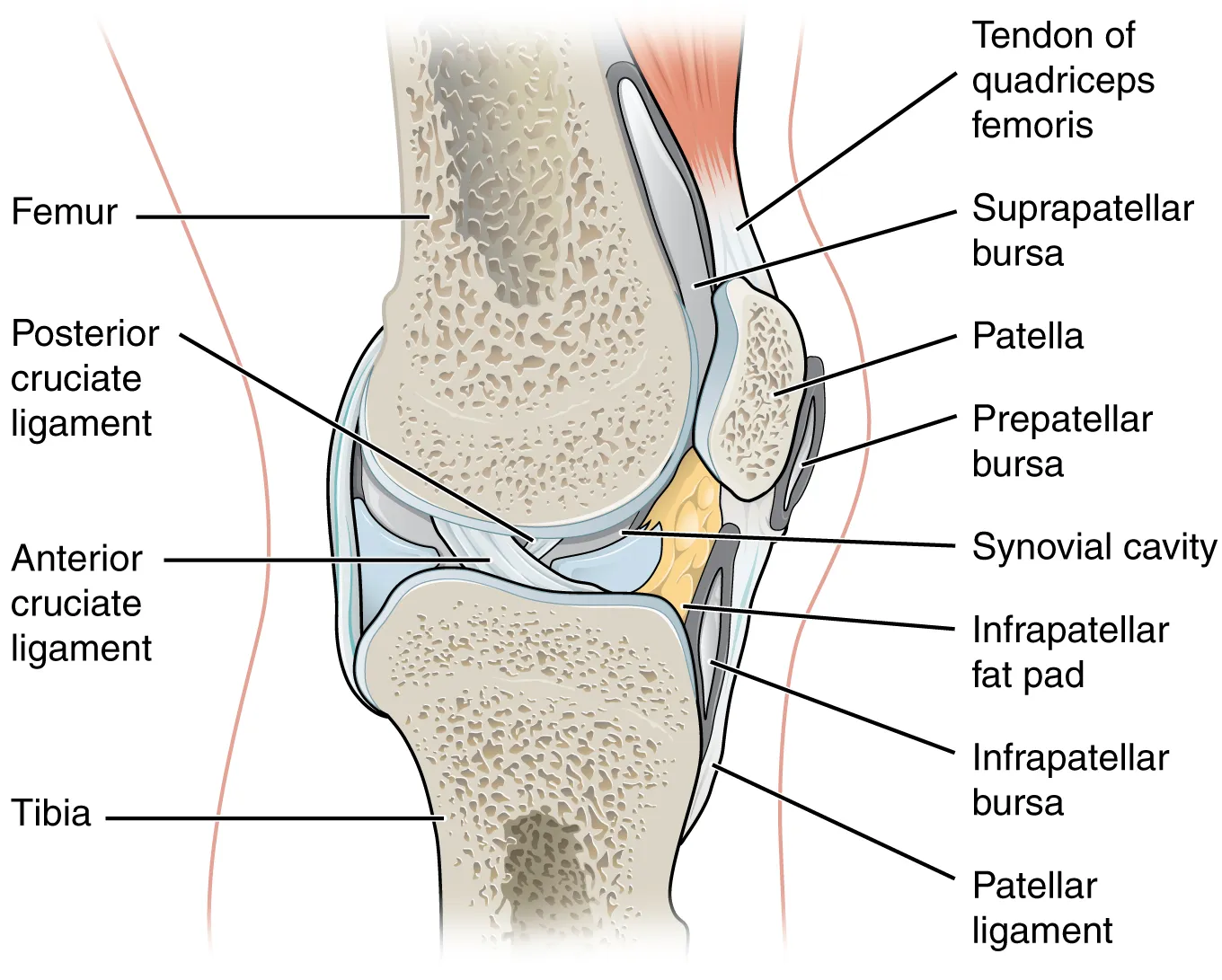
A clinical reference names four major bursae at the knee: the suprapatellar, infrapatellar, pes anserine and prepatellar10.
What the tissue shows
A 2024 systematic review gathered 32 articles on the tissue of inflamed bursae13. It found the same kinds of change whether bursitis was linked to rheumatic disease, wear-related conditions or mechanical stress13. These were altered tissue structure, immune cells moving in, and raised inflammatory signalling molecules13. Fibrosis (scarring) was reported only in subacromial bursitis caused by mechanical stress13. The same review judged current knowledge of these tissue changes to be outdated13.
In a blinded study of six bursae removed during hip replacement, the tissue was mainly fibrous and fatty, with no signs of inflammation14. Specimens from people with and without trochanteric bursitis did not differ14. A 2024 review of hip tendon pain states that bursal change alone is uncommon there, and may sit alongside tendon change15. In MRI scans of 120 people with outer hip pain that had not settled, 2% had bursitis there without relevant tendon changes5. A further 25% had bursal changes together with tendon changes5.
Who it affects
The elbow and the knee
A review built on a systematic search reports a minimum yearly incidence of 10 per 100,000 for elbow-tip and kneecap bursitis together2. In its account, 80% of cases are men aged 40 to 60, and about one third are septic2. The studies below were in workers, soldiers and hospital patients:
| Group studied | What was found |
|---|---|
| Israeli soldiers, 2005 to 2015 | Elbow-tip bursitis at 29 per 100,000 person-years overall and 97 in combat duty; 24% septic16 |
| 10,301 people with elbow-tip bursitis and 44,608 without | Linked with male sex, high blood lipids, smoking, older age and higher body mass index17 |
| 3,710 randomly chosen French workers | Knee bursitis in 0.6% of men and 0.2% of women18 |
| Floor layers, carpenters and compositors | Knee-straining work was positively linked with bursitis on examination19 |
| 272 people with septic bursitis at five French hospitals | Median age 53; 85.3% male20 |
In the French workers, cases were most common in construction and concentrated among men with heavy workloads who knelt often18. A 2019 review names the elbow tip and kneecap as the sites of septic bursitis most often affected7. It reports that one bacterium, Staphylococcus aureus, causes 80% of septic bursitis near the skin7.
The hip, the heel and young players
At the hip, in the MRI study, 94% were women and the median age was 545. In ultrasound scans of 877 people with pain over the greater trochanter, 20.2% had trochanteric bursitis and 49.9% had gluteal tendon changes21.
At the heel, the retrocalcaneal bursa is squeezed between bone and tendon each time the ankle bends upward, especially in uphill running22. One study compared 30 runners with past retrocalcaneal bursitis and 30 people without it22. A flat back surface of the heel bone went with about four times the odds of bursitis22. A 2026 review describes Haglund deformity, a bony enlargement where the Achilles tendon attaches, as a common cause of retrocalcaneal bursitis23. In its account, young active people, particularly women, are more often affected23.
In young athletes, one ultrasound study examined 261 knees of junior baseball players with a mean age of 10.524. Thirty knees showed bursitis deep below the kneecap, linked with longer weekly practice and tighter thigh muscles24.
What studies found
How it tends to run
A 2011 systematic review describes trochanteric bursitis as self-limiting in most patients, with some persistent cases needing repeated care or surgery25. A 2024 review describes hip tendinopathies as not self-limiting15. Tendinopathy is local pain in a tendon that comes with activities that load it, so the two reviews describe different conditions at one site. In Israeli soldiers with elbow-tip bursitis, symptoms lasted a mean of 17.58 weeks16.
Bursitis at the elbow tip
A 2014 systematic review of 29 studies (1,278 patients) found surgery less likely than non-surgical approaches to clear olecranon bursitis3. Surgery also had higher rates of complications, ongoing drainage and bursal infection3. The same review found steroid injection for aseptic cases linked with more complications and skin thinning, without better outcomes3. Its conclusions rested mainly on level IV evidence, a low rung on the scale that ranks study designs3.
A 2023 systematic review of aseptic cases found only two randomised trials and two observational studies4. Both trials had a high risk of bias, and neither found a significant difference in resolution or tenderness between the options4. The two trials were a 2016 Korean trial and a 1989 trial in 42 people4. The review did not combine the four studies in a meta-analysis, because they differed too much4.
The 2023 review linked steroid injection with shorter symptoms but more complications, including infection and skin thinning4. So both reviews link the injection with more complications, while only the 2023 review reports shorter symptoms3,4. The 2023 review’s authors concluded that these cases appear able to clear without surgery when that care starts earlier4.
Septic bursitis at the elbow and knee
A 2019 review reports that care for septic bursitis varies a lot between centres, especially in the use of surgery7. It states that accurate incidence data are lacking and that controlled trials are needed7. A 2014 review of 52 papers found the evidence did not support removing the bursa straight away in septic cases2.
Two studies looked back at records20,28:
- In 272 people at five French hospitals, 26% had surgery, failure was 5.9%, and success was similar with and without surgery20.
- In one emergency department, 134 people with suspected septic elbow-tip bursitis got antibiotics with no fluid drawn; 88.1% cleared with no later procedure28.
A randomised trial in Geneva compared removing the bursa in one operation or two, in 164 people in hospital29. The trial registry lists University Hospital, Geneva as lead sponsor30. Failure occurred in 10% after one stage and 16% after two29. The one-stage group had less wound breakdown after elbow surgery, 1 of 66 against 9 of 6429. Its median hospital stay was 4.5 days against 6.0, and its costs were lower29.
For the kneecap, a 2022 systematic review states there is no consensus on the best approach31. Across 10 studies (702 people), keyhole and open removal of the bursa did not differ in recurrence after a year or in complications31.
Bursitis at the outer hip
A 2011 systematic review covered 24 studies and more than 950 cases, mostly level IV evidence25. With steroid injection as the main approach, symptoms cleared and people returned to activity in 49% to 100% of cases25. The same review found two comparative studies favouring low-energy shockwave therapy (pulses of sound energy aimed through the skin) over other non-surgical approaches25.
A 2021 review covered 15 studies of bursa removal for persistent outer hip pain32. Scores improved after both open and keyhole surgery, and the two did not differ, on level IV evidence32. Complication rates in those studies ranged from 0% to 33%32.
Bursitis at the heel
Two reviews of surgery reach different conclusions. A 2012 systematic review of 15 studies of chronic retrocalcaneal bursitis found satisfaction and complication rates favoured endoscopic (keyhole, with a camera) over open surgery33. It noted the evidence level was relatively low33. A 2026 meta-analysis of five cohort studies, in 226 adults with Haglund deformity, found no significant difference between open and endoscopic surgery23. All five studies had a serious risk of bias23.
Bursitis under the shoulder tip
A Dutch guideline from 2014 counts bursitis as one part of subacromial pain syndrome34. One randomised trial in people with chronic subacromial bursitis compared two steroid injections, an 8-week exercise programme, or both35. The publisher’s Crossref record lists two awards from the National Science and Technology Council as its funding35. Pain and patients’ ratings favoured the injection and combined groups35. Recurrence was 36.1% after injection alone, 7.5% after exercise and 17.1% after both35.
Connections
Bursitis at the tip of the elbow joint is also called student’s elbow1. The prepatellar bursa, one of four major bursae of the knee, lies in front of the patella10. At the hip, the gluteal tendons have three bursae around them36. A large bursa also lies under the hip flexors tendon12.
At the heel, the calcaneus and the Achilles tendon frame the retrocalcaneal bursa9. At the shoulder, the subacromial bursa reduces friction for the rotator cuff tendons1. Its bursitis is counted within subacromial shoulder pain34. At the hip, bursal change may sit alongside tendon change, which the tendinopathy page covers15.
Bursitis involves
Bursitis often occurs with changes in
Bursitis is counted as part of
Bursitis has been searched for beneath
Bursitis is compared with
Sources
- Betts JG, Young KA, Wise JA, Johnson E, Poe B, Kruse DH, Korol O, Johnson JE, Womble M, DeSaix P (2022). Anatomy and Physiology 2e. OpenStax. Link
- Baumbach SF, Lobo CM, Badyine I, Mutschler W, Kanz KG (2014). Prepatellar and olecranon bursitis: literature review and development of a treatment algorithm.. Archives of orthopaedic and trauma surgery. doi:10.1007/s00402-013-1882-7 PMID 24305696
- Sayegh ET, Strauch RJ (2014). Treatment of olecranon bursitis: a systematic review.. Archives of orthopaedic and trauma surgery. doi:10.1007/s00402-014-2088-3 PMID 25234151
- Kaur IP, Mughal MS, Aslam F, Schram J, Bansal P (2023). Non-surgical treatment of aseptic olecranon bursitis: A systematic review.. Reumatologia clinica. doi:10.1016/j.reumae.2023.05.004 PMID 37945181
- Lange J, Tvedesøe C, Lund B, Bohn MB (2022). Low prevalence of trochanteric bursitis in patients with refractory lateral hip pain.. Danish medical journal. PMID 35781127
- Reilly D, Kamineni S (2016). Olecranon bursitis. Journal of shoulder and elbow surgery. doi:10.1016/j.jse.2015.08.032 PMID 26577126
- Lormeau C, Cormier G, Sigaux J, Arvieux C, Semerano L (2019). Management of septic bursitis.. Joint bone spine. doi:10.1016/j.jbspin.2018.10.006 PMID 31615686
- Darrieutort-Laffite C, Coiffier G, Aïm F, Banal F, Bart G, Chazerain P, Couderc M, Coquerelle P, Ducourau Barbary E, Flipo RM, Faudemer M, Godot S, Hoffmann C, Lecointe T, Lormeau C, Mulleman D, Piot JM, Senneville E, Seror R, Voquer C, Vrignaud A, Guggenbuhl P, Salliot C (2024). 2023 French recommendations for diagnosing and managing prepatellar and olecranon septic bursitis.. Joint bone spine. doi:10.1016/j.jbspin.2023.105664 PMID 37995861
- van Dijk CN, van Sterkenburg MN, Wiegerinck JI, Karlsson J, Maffulli N (2011). Terminology for Achilles tendon related disorders. Knee surgery, sports traumatology, arthroscopy : official journal of the ESSKA. doi:10.1007/s00167-010-1374-z PMID 21222102
- Rishor-Olney CR, Taqi M, Pozun A (2024). Prepatellar Bursitis.. StatPearls. PMID 32491440
- Fairclough J, Hayashi K, Toumi H, Lyons K, Bydder G, Phillips N, Best TM, Benjamin M (2006). The functional anatomy of the iliotibial band during flexion and extension of the knee: implications for understanding iliotibial band syndrome.. Journal of anatomy. doi:10.1111/j.1469-7580.2006.00531.x PMID 16533314
- Gray H; Lewis WH (editor) (1918). Anatomy of the Human Body. Lea & Febiger, Philadelphia (20th edition). Link
- Zhang A, Brouwer E, Sandovici M, Diepstra A, Jiemy WF, van der Geest KSM (2024). The immune pathology of bursitis in rheumatic inflammatory diseases, degenerative conditions and mechanical stress: A systematic review.. Seminars in arthritis and rheumatism. doi:10.1016/j.semarthrit.2024.152527 PMID 39146915
- Silva F, Adams T, Feinstein J, Arroyo RA (2008). Trochanteric bursitis: refuting the myth of inflammation.. Journal of clinical rheumatology : practical reports on rheumatic & musculoskeletal diseases. doi:10.1097/RHU.0b013e31816b4471 PMID 18391676
- Grimaldi A, Mellor R, Nasser A, Vicenzino B, Hunter DJ (2024). Current and future advances in practice: tendinopathies of the hip.. Rheumatology Advances in Practice. doi:10.1093/rap/rkae022 PMID 38601140
- Schermann H, Karakis I, Dolkart O, Maman E, Kadar A, Chechik O (2017). Olecranon Bursitis in a Military Population: Epidemiology and Evidence for Prolonged Morbidity in Combat Recruits. Military medicine. doi:10.7205/MILMED-D-16-00402 PMID 28885965
- Shemesh S, Itzikovitch R, Atzmon R, Kadar A (2024). Risk Factors for the Development of Olecranon Bursitis-A Large-Scale Population-Based Study. Journal of clinical medicine. doi:10.3390/jcm13247801 PMID 39768728
- Le Manac'h AP, Ha C, Descatha A, Imbernon E, Roquelaure Y (2012). Prevalence of knee bursitis in the workforce.. Occupational medicine (Oxford, England). doi:10.1093/occmed/kqs113 PMID 22778241
- Jensen LK, Mikkelsen S, Loft IP, Eenberg W (2000). Work-related knee disorders in floor layers and carpenters.. Journal of occupational and environmental medicine. doi:10.1097/00043764-200008000-00015 PMID 10953822
- Charret L, Bart G, Hoppe E, Dernis E, Cormier G, Boutoille D, Le Goff B, Darrieutort-Laffite C (2021). Clinical characteristics and management of olecranon and prepatellar septic bursitis in a multicentre study.. The Journal of antimicrobial chemotherapy. doi:10.1093/jac/dkab265 PMID 34293150
- Long SS, Surrey DE, Nazarian LN (2013). Sonography of greater trochanteric pain syndrome and the rarity of primary bursitis.. AJR. American Journal of Roentgenology. doi:10.2214/AJR.12.10038 PMID 24147479
- Wnuk-Scardaccione A, Mizia E, Zawojska K, Bilski J, Wojdyła J (2021). Surface Shape of the Calcaneal Tuberosity and the Occurrence of Retrocalcaneal Bursitis among Runners. International journal of environmental research and public health. doi:10.3390/ijerph18062860 PMID 33799691
- Guedes A, de Mattos ESR, Barreto ESR, Antunes Júnior CR (2026). Open vs Endoscopic Surgical Treatment for Haglund Deformity: A Systematic Review, Meta-analysis, and Meta-regression.. Foot & ankle orthopaedics. doi:10.1177/24730114261435962 PMID 42099536
- Omae H, Ohsawa T, Omodaka T, Hashimoto S, Oshima A, Takase R, Kobayashi H, Takamine S, Tajika T, Chikuda H (2022). Deep Infrapatellar Bursitis in Preadolescent Baseball Players: A Cross-Sectional Study.. Orthopaedic journal of sports medicine. doi:10.1177/23259671221083584 PMID 35321209
- Lustenberger DP, Ng VY, Best TM, Ellis TJ (2011). Efficacy of treatment of trochanteric bursitis: a systematic review.. Clinical journal of sport medicine : official journal of the Canadian Academy of Sport Medicine. doi:10.1097/JSM.0b013e318221299c PMID 21814140
- Smith DL, McAfee JH, Lucas LM, Kumar KL, Romney DM (1989). Treatment of nonseptic olecranon bursitis. A controlled, blinded prospective trial.. Archives of internal medicine. PMID 2684077
- Kim JY, Chung SW, Kim JH, Jung JH, Sung GY, Oh KS, Lee JS (2016). A Randomized Trial Among Compression Plus Nonsteroidal Antiinflammatory Drugs, Aspiration, and Aspiration With Steroid Injection for Nonseptic Olecranon Bursitis.. Clinical orthopaedics and related research. doi:10.1007/s11999-015-4579-0 PMID 26463567
- Beyde A, Thomas AL, Colbenson KM, Sandefur BJ, Kisirwan I, Mullan AF, O'Driscoll SW, Campbell RL (2022). Efficacy of empiric antibiotic management of septic olecranon bursitis without bursal aspiration in emergency department patients.. Academic emergency medicine : official journal of the Society for Academic Emergency Medicine. doi:10.1111/acem.14406 PMID 34698411
- Uçkay I, von Dach E, Perez C, Agostinho A, Garnerin P, Lipsky BA, Hoffmeyer P, Pittet D (2017). One- vs 2-Stage Bursectomy for Septic Olecranon and Prepatellar Bursitis. Mayo Clinic proceedings. doi:10.1016/j.mayocp.2017.03.011 PMID 28602435
- Uckay I (principal investigator); University Hospital, Geneva (sponsor) (2011). Optimisation of the Treatment of Infectious Bursitis (ClinicalTrials.gov NCT01406652). ClinicalTrials.gov. Link
- Brown OS, Smith TO, Parsons T, Benjamin M, Hing CB (2022). Management of septic and aseptic prepatellar bursitis: a systematic review.. Archives of orthopaedic and trauma surgery. doi:10.1007/s00402-021-03853-9 PMID 33721054
- Crutchfield CR, Padaki AS, Holuba KS, Arney MM, O'Connor MJ, Menge TJ, Lynch TS (2021). Open Versus Arthroscopic Surgical Management for Recalcitrant Trochanteric Bursitis: A Systematic Review.. The Iowa orthopaedic journal. PMID 34924870
- Wiegerinck JI, Kok AC, van Dijk CN (2012). Surgical treatment of chronic retrocalcaneal bursitis.. Arthroscopy : the journal of arthroscopic & related surgery : official publication of the Arthroscopy Association of North America and the International Arthroscopy Association. doi:10.1016/j.arthro.2011.09.019 PMID 22244103
- Diercks R, Bron C, Dorrestijn O, Meskers C, Naber R, de Ruiter T, Willems J, Winters J, van der Woude HJ, Dutch Orthopaedic Association (2014). Guideline for diagnosis and treatment of subacromial pain syndrome. Acta orthopaedica. doi:10.3109/17453674.2014.920991 PMID 24847788
- Hsieh LF, Kuo YC, Huang YH, Liu YF, Hsieh TL (2023). Comparison of corticosteroid injection, physiotherapy and combined treatment for patients with chronic subacromial bursitis - A randomised controlled trial.. Clinical rehabilitation. doi:10.1177/02692155231166220 PMID 37021475
- Pfirrmann CW, Chung CB, Theumann NH, Trudell DJ, Resnick D (2001). Greater trochanter of the hip: attachment of the abductor mechanism and a complex of three bursae--MR imaging and MR bursography in cadavers and MR imaging in asymptomatic volunteers.. Radiology. doi:10.1148/radiol.2211001634 PMID 11687692
Changes
- First published.