Subacromial shoulder pain (shoulder impingement)
Also called shoulder impingement, subacromial pain syndrome, subacromial impingement syndrome, SAPS, impingement syndrome
Pain around the bony point at the top of the shoulder, long called impingement. How guidelines define and name it, who it affects, and what trials of surgery, exercise and injections found.
- Region
- Shoulder
- Updated
- October 8, 2026
- Reviewed
- October 8, 2026 · how entries are checked
What it is
How guidelines define it
A Dutch multidisciplinary guideline published in 2014 defines subacromial pain syndrome, or SAPS1. It covers non-traumatic, usually one-sided shoulder problems that cause pain around the acromion1. The pain is often worse during or after lifting the arm1. The guideline counts six named problems as part of it, among them bursitis (a swollen bursa) and partial rotator cuff tears1.
A 2016 paper uses a wider term, rotator cuff related shoulder pain, for a spectrum of shoulder conditions6. That spectrum includes rotator cuff tendinopathy, subacromial pain (impingement) syndrome, and partial and full-thickness cuff tears that cause symptoms6.
Where the name impingement comes from
Impingement means pinching of soft tissue between other structures. The Dutch guideline credits Neer (1983) with developing the concept of impingement syndrome1. In that concept, the acromion touching the rotator cuff while the arm lifts can cause or aggravate the problem1. A 2013 paper describes the most prevalent theory of rotator cuff conditions7. In it, the cuff tendons, especially the supraspinatus, touch the acromion and the coracoacromial ligament, and pain and eventual tearing follow7.
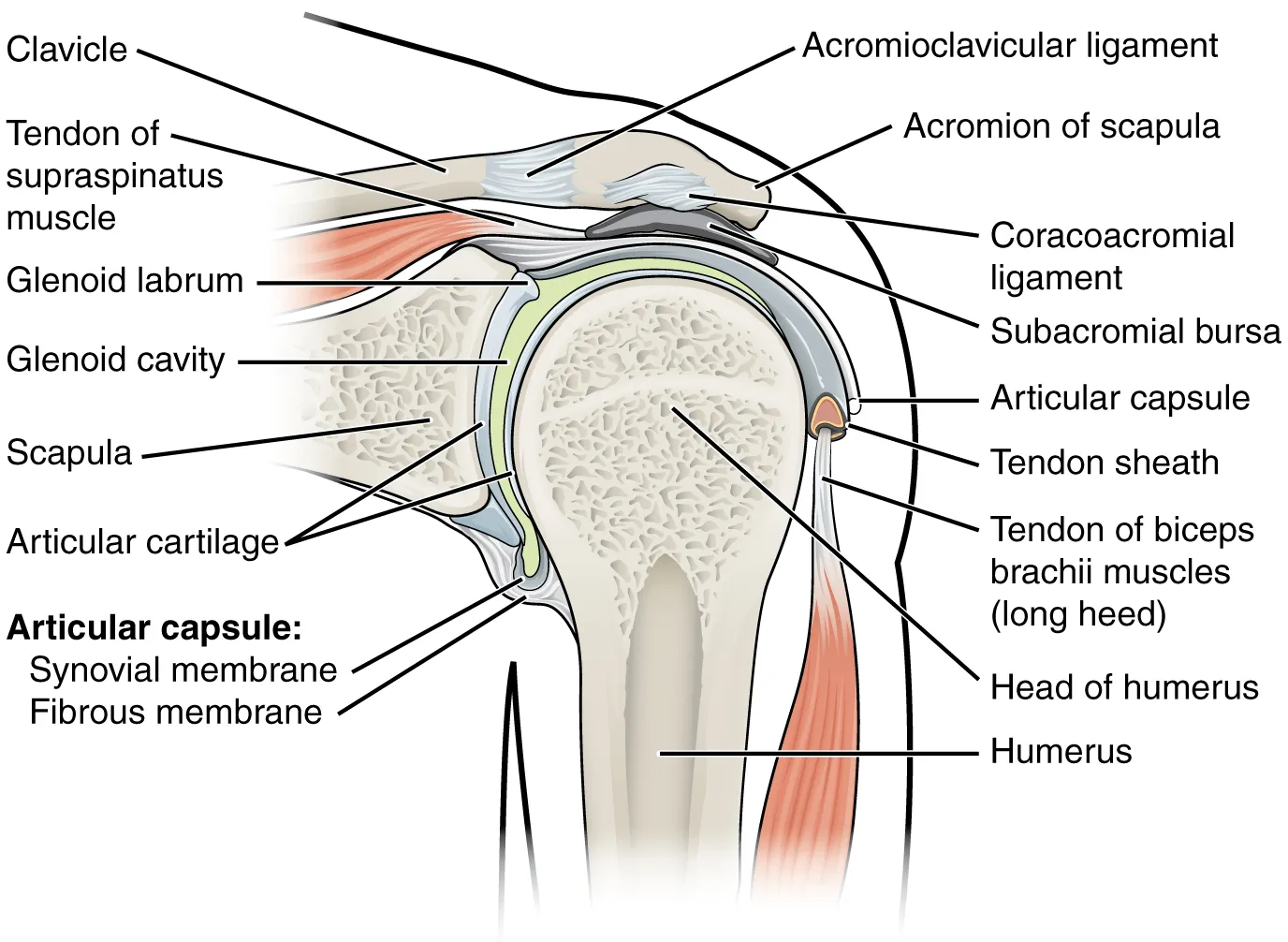
The acromion and that ligament are part of an arch that protects the shoulder joint from above8. A large bursa, a fluid-filled sac that cushions tissues, extends under them8. The shoulder joint page covers this anatomy.
What later reviews say about that account
A 2011 systematic review tested five hypotheses behind the impingement concept2. One was that contact with the coracoacromial arch causes common rotator cuff abnormalities2. The review found that high-level evidence did not support them2. The authors of a 2011 paper suggest it may be time to replace the non-specific label2.
The 2014 Dutch guideline states that Neer’s hypothesis cannot be substantiated with newer imaging and arthroscopic (keyhole camera) techniques1. It says more value is now placed on degeneration of the rotator cuff tendons1. A Dutch guideline published in 2014 judged that “impingement” of the rotator cuff does not explain the condition well enough anatomically1. It judged that the name “subacromial pain syndrome” describes the condition better1.
The authors of the 2013 paper propose that the evidence points to causes other than “impingement” as the main source of rotator cuff disease7. They write that tendinopathy (local pain in a tendon) linked with ageing may be a predominant factor in cuff degeneration7.
What measurements and scans found
A systematic review and meta-analysis of fifteen studies (775 participants) looked at the gap between the acromion and the upper arm bone11. A meta-analysis pools the results of several earlier studies. It found no difference in that gap between people with and without the syndrome, at three arm positions11. A second measure, the occupation ratio, was 5.14% greater in those with the syndrome with the shoulder in neutral11. The review found no consistent pattern in the correlation between the gap and pain or disability11.
A systematic review of 10 studies compared the orientation of the scapula (shoulder blade) in people with subacromial impingement syndrome and people without shoulder symptoms12. Some studies reported reduced upward rotation and increased anterior (forward) tilting, others the opposite, and some no difference from the symptom-free group12. The review found insufficient evidence for the clinical belief that the shoulder blade adopts a common, consistent posture in the syndrome12.
In 602 Finnish adults aged 41 to 76, MRI found a rotator cuff abnormality in 96% of shoulders without symptoms and 98% with symptoms3. Full-thickness tears were more prevalent in shoulders with symptoms, 14.6% against 6.5%, but the difference diminished after adjustment3.
Who it affects
How often it is recorded
| Where | What was recorded |
|---|---|
| 11 Dutch general practices, 35,150 registered patients, over a year | An estimated 11.2 shoulder complaints per 1,000 patients per year; rotator cuff tendinitis was the most recorded disorder (29%)13 |
| 766 patients referred to a hospital outpatient clinic in Oslo | Subacromial pain was the most common condition recorded (36%)14 |
In the Oslo clinic, subacromial pain was most frequent in people aged 40 to 60, with few differences between the sexes14. Among 80 elite swimmers aged 13 to 25, 91% reported shoulder pain and 84% had a positive impingement sign15.
What reviews found about work
The 2014 Dutch guideline reports work factors linked with the syndrome at its highest evidence level1. They include repetitive shoulder, hand and wrist movements, hand-arm vibration and a poor shoulder posture1.
A meta-analysis of seven studies found moderate evidence linking specific soft-tissue shoulder disorders with shoulder load and with raised-arm or raised-hand work16. On repetition, a systematic review and meta-analysis of work factors found low-quality evidence of no association with arm repetition16.
What studies found
How shoulder pain changes over time
The authors of a 2004 review state that only half of new shoulder disorder episodes reach complete recovery within 6 months17. Of 349 patients whose shoulder pain was a new episode, recruited by 11 Dutch general practitioners, 59% had recovered completely after one year18. A systematic review of 16 studies found strong evidence that more intense pain predicts a poorer outcome in primary care17. Its authors ask for caution because the conclusions rest on a small number of studies17.
Decompression surgery against placebo surgery and exercise
Reports at 2, 5 and 10 years each describe a randomised trial of 210 patients whose symptoms fitted shoulder impingement or subacromial pain syndrome4,19,20. The placebo (dummy) surgery was arthroscopy alone, keyhole surgery with a small camera19,20.
| Follow-up | Decompression against placebo surgery | Decompression against an exercise programme |
|---|---|---|
| 24 months | No clinically relevant difference in shoulder pain at rest or on activity19 | Pain statistically lower after surgery, but not beyond the pre-set minimal clinically important difference (the smallest change people notice as meaningful)19. The authors note this comparison was unblinded and likely biased towards surgery19 |
| 5 years | No benefit, in the 175 who completed follow-up20 | No benefit20 |
| 10 years | No benefit, in the 168 who completed follow-up4 | No benefit4 |
In a randomised trial in people with subacromial pain syndrome, pain on arm activity fell in each group over 10 years4. It fell by 57.0 points after decompression, 54.9 after placebo surgery and 48.8 after an exercise programme4.
A randomised, placebo-controlled trial of 313 patients at 32 UK hospitals had decompression, arthroscopy-only and no-intervention groups21. At 6 months, shoulder scores did not differ between decompression and arthroscopy only21. Both surgical groups did slightly better than the no-intervention group, by less than a clinically important amount21. Its six study-related complications were frozen shoulders, two in each group21. In a three-group trial of 313 patients, the authors note that some people got better while waiting for surgery and did not go ahead21.
A systematic review with meta-analysis covered adults with subacromial pain syndrome lasting more than 3 months22. It found high-certainty evidence that decompression adds no benefit over placebo surgery for pain at 1 year or physical function at 1 to 2 years22. It found moderate-certainty evidence of six serious harms per 1,000 patients having the surgery22.
What guidelines say about the surgery
- BMJ panel, 2019: a strong recommendation against decompression for adults with non-traumatic shoulder pain of more than 3 months identified as subacromial pain syndrome5. The panel noted substantial uncertainty about which alternative is best5.
- Dutch Orthopedic Association: advised caution with the surgery in 2013 and, in a 2021 update, strongly recommended against it23.
- Quebec guideline, 2022: does not recommend subacromial decompression for rotator cuff tendinopathy24.
- A systematic review of 26 shoulder guidelines published from 2008 onward: their surgical recommendations differed25. Six recommended, or said they may recommend, acromioplasty (surgery on the acromion) in chronic rotator cuff tendinopathy, and four did not recommend it25.
Exercise
Trials and reviews have compared exercise with other options26,27,28:
- A 2017 systematic review and meta-analysis of randomised trials in people with shoulder impingement found exercise superior to non-exercise controls for pain26. It called the evidence very low quality26.
- In a randomised trial of 708 UK adults with a new episode of a rotator cuff disorder, one group had a progressive exercise programme27. It was not superior to a single session of best-practice advice for shoulder pain and function over 12 months27.
- A network meta-analysis, which compares many options at once, covered 99 trials and 6,764 patients with subacromial shoulder conditions28. With studies at increased risk of bias excluded, the comparative effect of exercise alone stayed robust for pain and function, up to 3 months28. It rated certainty as low for most options, and moderate for the effect of exercise on function28.
A 2026 Dutch guideline update states that non-surgical care should include exercise, but that evidence is lacking on the form it should take23.
Injections
In the trial of 708 UK adults, some had a subacromial injection of corticosteroid, a drug that copies a hormone the body makes27. Pain and disability scores over 12 months showed no evidence of a difference with or without it27. The exception was a modest improvement in pain and function at 8 weeks27. A meta-analysis of 11 placebo-controlled trials (726 patients with rotator cuff tendinosis) found a small, transient reduction in pain at 4 to 8 weeks29. At 3 months pain was reduced no more than with a placebo injection29.
Work and sport afterwards
A secondary analysis of a randomised, placebo-surgery-controlled trial covered 184 patients with shoulder impingement syndrome30. By 24 months, 88% of the decompression group, 88% of the placebo group and 90% of the exercise group had returned to work30.
On sport, a 2026 review covered 42 observational studies of surgery for internal impingement in 1,420 overhead athletes31. Return to sport at the pre-injury level or higher ranged from 25% to 94% across procedures, and no pooled analysis was possible31.
Connections
The shoulder joint page covers the arch above the joint8. The rotator cuff tendons page covers tendon tears, which the 2016 wider term includes6. The 2019 BMJ panel noted that frozen shoulder may occur more often with surgery5.
Related exercise pages: push-up, pull-up and band external rotation32,33,34. From a study of 16 healthy participants, the authors suggest a raised-arm push-up may place the shoulder blade in a position of impingement32. From a study of 11 regular pull-up users, the authors suggest the reverse-grip pull-up potentially increases subacromial impingement risk in the hanging and starting phase33.
Related stretch pages: sleeper stretch and doorway pec stretch35,36. A meta-analysis of 10 randomised trials (628 people with subacromial impingement syndrome) linked modified posterior shoulder stretching with less pain at rest and during activity35. Its authors called for further high-quality research35. In a randomised trial of 80 adults with subacromial pain syndrome, adding pectoralis minor stretching to a 12-week exercise programme made no difference to pain36.
Subacromial shoulder pain (shoulder impingement) involves
Subacromial shoulder pain (shoulder impingement) has studies of the position of
Subacromial shoulder pain (shoulder impingement) has surgery trials that recorded cases of
Subacromial shoulder pain (shoulder impingement) has studies of muscle activity during
Subacromial shoulder pain (shoulder impingement) has authors' suggestions from a movement study of
Subacromial shoulder pain (shoulder impingement) has trials of modified versions of
Subacromial shoulder pain (shoulder impingement) has a trial of chest stretching related to
Sources
- Diercks R, Bron C, Dorrestijn O, Meskers C, Naber R, de Ruiter T, Willems J, Winters J, van der Woude HJ, Dutch Orthopaedic Association (2014). Guideline for diagnosis and treatment of subacromial pain syndrome. Acta orthopaedica. doi:10.3109/17453674.2014.920991 PMID 24847788
- Papadonikolakis A, McKenna M, Warme W, Martin BI, Matsen FA (2011). Published evidence relevant to the diagnosis of impingement syndrome of the shoulder.. The Journal of bone and joint surgery. American volume. doi:10.2106/JBJS.J.01748 PMID 22005869
- Ibounig T, Järvinen TLN, Raatikainen S, Härkänen T, Sillanpää N, Bensch F, Haapamäki V, Toivonen P, Björkenheim R, Ryösä A, Kanto K, Lepola V, Joukainen A, Paavola M, Koskinen S, Rämö L, Buchbinder R, Taimela S (2026). Incidental Rotator Cuff Abnormalities on Magnetic Resonance Imaging.. JAMA internal medicine. doi:10.1001/jamainternmed.2025.7903 PMID 41697693
- Kanto K, Bäck M, Ibounig T, Björkenheim R, Malmivaara A, Czuba T, Inkinen J, Kalske J, Savolainen V, Sinisaari I, Toivonen P, Taimela S, Järvinen TLN, Paavola M, Finnish Shoulder Impingement Arthroscopy Controlled Trial (FIMPACT) Investigators (2025). Arthroscopic subacromial decompression versus placebo surgery for subacromial pain syndrome: 10 year follow-up of the FIMPACT randomised, placebo surgery controlled trial.. BMJ (Clinical research ed.). doi:10.1136/bmj-2025-086201 PMID 41330610
- Vandvik PO, Lähdeoja T, Ardern C, Buchbinder R, Moro J, Brox JI, Burgers J, Hao Q, Karjalainen T, van den Bekerom M, Noorduyn J, Lytvyn L, Siemieniuk RAC, Albin A, Shunjie SC, Fisch F, Proulx L, Guyatt G, Agoritsas T, Poolman RW (2019). Subacromial decompression surgery for adults with shoulder pain: a clinical practice guideline.. BMJ (Clinical research ed.). doi:10.1136/bmj.l294 PMID 30728120
- Lewis J (2016). Rotator cuff related shoulder pain: Assessment, management and uncertainties.. Manual therapy. doi:10.1016/j.math.2016.03.009 PMID 27083390
- McFarland EG, Maffulli N, Del Buono A, Murrell GA, Garzon-Muvdi J, Petersen SA (2013). Impingement is not impingement: the case for calling it "Rotator Cuff Disease".. Muscles, ligaments and tendons journal. PMID 24367779
- Gray H; Lewis WH (editor) (1918). Anatomy of the Human Body. Lea & Febiger, Philadelphia (20th edition). Link
- Walch G, Boileau P, Noel E, Donell ST (1992). Impingement of the deep surface of the supraspinatus tendon on the posterosuperior glenoid rim: An arthroscopic study.. J Shoulder Elbow Surg. doi:10.1016/S1058-2746(09)80065-7 PMID 22959196
- Corpus KT, Camp CL, Dines DM, Altchek DW, Dines JS (2016). Evaluation and treatment of internal impingement of the shoulder in overhead athletes.. World Journal of Orthopedics. doi:10.5312/wjo.v7.i12.776 PMID 28032029
- Park SW, Chen YT, Thompson L, Kjoenoe A, Juul-Kristensen B, Cavalheri V, McKenna L (2020). No relationship between the acromiohumeral distance and pain in adults with subacromial pain syndrome: a systematic review and meta-analysis.. Scientific reports. doi:10.1038/s41598-020-76704-z PMID 33244115
- Ratcliffe E, Pickering S, McLean S, Lewis J (2014). Is there a relationship between subacromial impingement syndrome and scapular orientation? A systematic review.. British journal of sports medicine. doi:10.1136/bjsports-2013-092389 PMID 24174615
- van der Windt DA, Koes BW, de Jong BA, Bouter LM (1995). Shoulder disorders in general practice: incidence, patient characteristics, and management.. Annals of the rheumatic diseases. doi:10.1136/ard.54.12.959 PMID 8546527
- Juel NG, Natvig B (2014). Shoulder diagnoses in secondary care, a one year cohort.. BMC musculoskeletal disorders. doi:10.1186/1471-2474-15-89 PMID 24642168
- Sein ML, Walton J, Linklater J, Appleyard R, Kirkbride B, Kuah D, Murrell GA (2008). Shoulder pain in elite swimmers: primarily due to swim-volume-induced supraspinatus tendinopathy.. British journal of sports medicine. doi:10.1136/bjsm.2008.047282 PMID 18463295
- van der Molen HF, Foresti C, Daams JG, Frings-Dresen MHW, Kuijer PPFM (2017). Work-related risk factors for specific shoulder disorders: a systematic review and meta-analysis.. Occupational and environmental medicine. doi:10.1136/oemed-2017-104339 PMID 28756414
- Kuijpers T, van der Windt DAWM, van der Heijden GJMG, Bouter LM (2004). Systematic review of prognostic cohort studies on shoulder disorders.. Pain. doi:10.1016/j.pain.2004.02.017 PMID 15157703
- van der Windt DA, Koes BW, Boeke AJ, Devillé W, De Jong BA, Bouter LM (1996). Shoulder disorders in general practice: prognostic indicators of outcome.. The British journal of general practice : the journal of the Royal College of General Practitioners. PMID 8917870
- Paavola M, Malmivaara A, Taimela S, Kanto K, Inkinen J, Kalske J, Sinisaari I, Savolainen V, Ranstam J, Järvinen TLN, Finnish Subacromial Impingement Arthroscopy Controlled Trial (FIMPACT) Investigators (2018). Subacromial decompression versus diagnostic arthroscopy for shoulder impingement: randomised, placebo surgery controlled clinical trial.. BMJ (Clinical research ed.). doi:10.1136/bmj.k2860 PMID 30026230
- Paavola M, Kanto K, Ranstam J, Malmivaara A, Inkinen J, Kalske J, Savolainen V, Sinisaari I, Taimela S, Järvinen TL, Finnish Shoulder Impingement Arthroscopy Controlled Trial (FIMPACT) Investigators (2021). Subacromial decompression versus diagnostic arthroscopy for shoulder impingement: a 5-year follow-up of a randomised, placebo surgery controlled clinical trial.. British journal of sports medicine. doi:10.1136/bjsports-2020-102216 PMID 33020137
- Beard DJ, Rees JL, Cook JA, Rombach I, Cooper C, Merritt N, Shirkey BA, Donovan JL, Gwilym S, Savulescu J, Moser J, Gray A, Jepson M, Tracey I, Judge A, Wartolowska K, Carr AJ (2018). Arthroscopic subacromial decompression for subacromial shoulder pain (CSAW): a multicentre, pragmatic, parallel group, placebo-controlled, three-group, randomised surgical trial.. The Lancet. doi:10.1016/S0140-6736(17)32457-1 PMID 29169668
- Lähdeoja T, Karjalainen T, Jokihaara J, Salamh P, Kavaja L, Agarwal A, Winters M, Buchbinder R, Guyatt G, Vandvik PO, Ardern CL (2020). Subacromial decompression surgery for adults with shoulder pain: a systematic review with meta-analysis.. British journal of sports medicine. doi:10.1136/bjsports-2018-100486 PMID 30647053
- Lambers Heerspink FO, Veen EJD, Dorrestijn O, Visser CPJ, Leijs MJC, Van Poppel D, Stroomberg PA, Ottenheijm RPG, Kallewaard JW, De Ruiter TJW, Martens HA, Janssen FM, Geltink T, Ruiter MS, Van Raaij JJAM (2026). Update of guideline for diagnosis and treatment of subacromial pain syndrome: a multidisciplinary review by the Dutch Orthopedic Association Part 1: preventive measures, diagnostics, and non-surgical treatment of subacromial pain syndrome.. Acta Orthopaedica. doi:10.2340/17453674.2026.45365 PMID 41718640
- Lafrance S, Charron M, Roy JS, Dyer JO, Frémont P, Dionne CE, Macdermid JC, Tousignant M, Rochette A, Doiron-Cadrin P, Lowry V, Bureau N, Lamontagne M, Sandman E, Coutu MF, Lavigne P, Desmeules F (2022). Diagnosing, Managing, and Supporting Return to Work of Adults With Rotator Cuff Disorders: A Clinical Practice Guideline.. The Journal of orthopaedic and sports physical therapy. doi:10.2519/jospt.2022.11306 PMID 35881707
- Lowry V, Lavigne P, Zidarov D, Matifat E, Cormier AA, Desmeules F (2024). A Systematic Review of Clinical Practice Guidelines on the Diagnosis and Management of Various Shoulder Disorders.. Archives of physical medicine and rehabilitation. doi:10.1016/j.apmr.2023.09.022 PMID 37832814
- Steuri R, Sattelmayer M, Elsig S, Kolly C, Tal A, Taeymans J, Hilfiker R (2017). Effectiveness of conservative interventions including exercise, manual therapy and medical management in adults with shoulder impingement: a systematic review and meta-analysis of RCTs.. British journal of sports medicine. doi:10.1136/bjsports-2016-096515 PMID 28630217
- Hopewell S, Keene DJ, Marian IR, Dritsaki M, Heine P, Cureton L, Dutton SJ, Dakin H, Carr A, Hamilton W, Hansen Z, Jaggi A, Littlewood C, Barker KL, Gray A, Lamb SE, GRASP Trial Group (2021). Progressive exercise compared with best practice advice, with or without corticosteroid injection, for the treatment of patients with rotator cuff disorders (GRASP): a multicentre, pragmatic, 2 × 2 factorial, randomised controlled trial.. Lancet (London, England). doi:10.1016/S0140-6736(21)00846-1 PMID 34265255
- Babatunde OO, Ensor J, Littlewood C, Chesterton L, Jordan JL, Corp N, Wynne-Jones G, Roddy E, Foster NE, van der Windt DA (2021). Comparative effectiveness of treatment options for subacromial shoulder conditions: a systematic review and network meta-analysis.. Therapeutic advances in musculoskeletal disease. doi:10.1177/1759720X211037530 PMID 34527083
- Mohamadi A, Chan JJ, Claessen FM, Ring D, Chen NC (2017). Corticosteroid Injections Give Small and Transient Pain Relief in Rotator Cuff Tendinosis: A Meta-analysis.. Clinical orthopaedics and related research. doi:10.1007/s11999-016-5002-1 PMID 27469590
- Bäck M, Paavola M, Aronen P, Järvinen TLN, Taimela S, Finnish Shoulder Impingement Arthroscopy Controlled Trial (FIMPACT) Investigators (2021). Return to work after subacromial decompression, diagnostic arthroscopy, or exercise therapy for shoulder impingement: a randomised, placebo-surgery controlled FIMPACT clinical trial with five-year follow-up.. BMC musculoskeletal disorders. doi:10.1186/s12891-021-04768-7 PMID 34666734
- Challoumas D, Loh C, Ibekwe N, Leung TCC, Millar N (2026). Surgical management of internal impingement in overhead athletes: a systematic review.. Clinics in shoulder and elbow. doi:10.5397/cise.2025.01123 PMID 41680115
- Suprak DN, Bohannon J, Morales G, Stroschein J, San Juan JG (2013). Scapular kinematics and shoulder elevation in a traditional push-up.. Journal of athletic training. doi:10.4085/1062-6050-48.5.08 PMID 23952043
- Prinold JA, Bull AM (2016). Scapula kinematics of pull-up techniques: Avoiding impingement risk with training changes.. Journal of Science and Medicine in Sport. doi:10.1016/j.jsams.2015.08.002 PMID 26383875
- Clisby EF, Bitter NL, Sandow MJ, Jones MA, Magarey ME, Jaberzadeh S (2008). Relative contributions of the infraspinatus and deltoid during external rotation in patients with symptomatic subacromial impingement.. Journal of Shoulder and Elbow Surgery. doi:10.1016/j.jse.2007.05.019 PMID 18162415
- Guo R, Luo Y, Xu Y, Lan K, Zhao Y (2025). Efficacy of modified posterior shoulder stretching exercises on shoulder function in subacromial impingement syndrome: A comprehensive meta-analysis.. Medicine. doi:10.1097/MD.0000000000041117 PMID 39792722
- Gutiérrez-Espinoza H, Araya-Quintanilla F, Gutiérrez-Monclus R, Ríos-Riquelme M, Álvarez-Bueno C, Martínez-Vizcaino V, Cavero-Redondo I (2019). Does pectoralis minor stretching provide additional benefit over an exercise program in participants with subacromial pain syndrome? A randomized controlled trial.. Musculoskeletal science & practice. doi:10.1016/j.msksp.2019.102052 PMID 31472414
Changes
- Revised to report sources added after their published corrections were read