Pectoralis minor
Also called pec minor, pectoralis minor muscle
The thin chest muscle beneath the pectoralis major that runs from the ribs to the shoulder blade. Where it attaches and how that varies, how it tears, what studies of a short muscle found, and what it works with.
- Region
- Trunk
- Starts on
- the third, fourth and fifth ribs, near where each rib meets its cartilage1,2
- Ends on
- the inner border and upper surface of the coracoid process, a hooked bony point on the shoulder blade1,2,7
- Updated
- October 9, 2026
- Reviewed
- October 9, 2026 · how entries are checked
Function
Where it sits and attaches
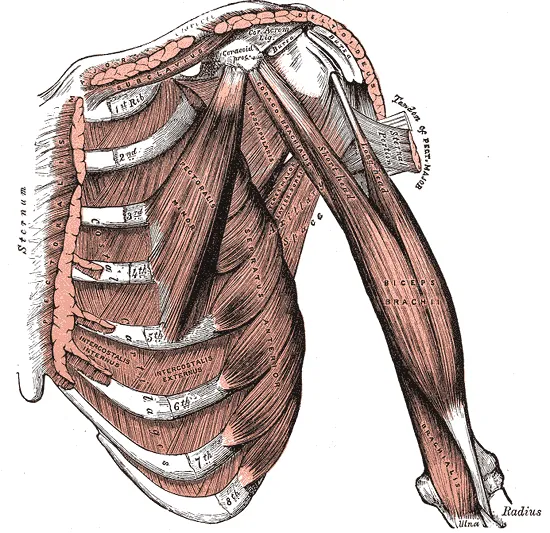
The pectoralis minor is a thin, triangular muscle at the upper part of the chest1. It lies beneath the pectoralis major, the large, fan-shaped muscle at the front of the chest1.
The muscle starts on the third, fourth and fifth ribs, near where each rib meets its cartilage, a firm, rubbery tissue1,2. The fibres run upward and outward and narrow into a flat tendon, a tough cord of tissue that connects a muscle to a bone1,2. The tendon attaches to the coracoid process, on its inner edge and top surface1,2. The coracoid process is a hooked bony point at the front of the scapula (shoulder blade).
How the attachments vary
Anatomy references give the rib origin as ribs 2 to 4 or ribs 3 to 51,7. A systematic review searches for the research on a question in a set, checkable way and sums it up. One such review of the muscle’s variations reports two patterns8. In some people the muscle starts on the second, third and fourth ribs, and in others on the third and fourth8.
The same systematic review says the main variations are at the other end, the insertion8. As a variation, the tendon may run on past the coracoid process to the greater tubercle1. The greater tubercle is a bump at the top of the upper arm bone.
A second systematic review included 25 studies and pooled results in a meta-analysis, which combines the results of several earlier studies9. Its pooled estimate was that 19.27% of tendons insert beyond the coracoid process9.
What it does
The pectoralis minor lowers the point of the shoulder1. It draws the shoulder blade downward and inward toward the chest wall, and tips its lower angle backward1. Its main job is described as steadying the shoulder blade by drawing it forward and down along the chest wall3,4.
The muscle also helps lift the ribs during deep breathing in3,4. When the arms are fixed, it acts on the ribs instead of the shoulder blade1. It draws them upward and expands the chest, which makes it one of the muscles of forced breathing in1.
Its nerve and blood supply
The medial pectoral nerve supplies the pectoralis minor1,10. Its fibres come from the eighth cervical (neck) and first thoracic (chest) nerves1,10. The nerve branches from the brachial plexus, the network of nerves, starting at the neck, that serves the arm11. It also supplies the lower half of the pectoralis major11.
The pectoral branch of the thoracoacromial artery runs down between the pectoralis major and the pectoralis minor1. It supplies both muscles1.
What runs behind it
A space lies behind the muscle2. The coracoid process bounds it above, the second to fourth ribs bound it behind, and the muscle bounds it in front2. The cords of the brachial plexus form in this space2. The axillary artery, the artery of the armpit, runs through it deep to the muscle2.
Breakdown
How it tears
Tears of the pectoralis minor alone are rare3. One case report (a report on a single patient) with a structured literature search found eleven earlier cases in English, published between 2004 and 20213. Most of the eleven happened in contact athletes or overhead athletes, whose sport uses repeated overhead arm actions3. Most of the tears were where the muscle meets its tendon, or at the attachment to the coracoid process3.
Another case report describes two ways the tendon tears12. One is a sudden impact, commonly in contact sport athletes12. The other is a fatigue rupture under eccentric loading, without a blow or fall12. Eccentric means muscle work done while the muscle lengthens. Three case reports describe how single tears happened3,4,13:
- A high school football player tore the tendon while tackling13.
- A 24-year-old woman felt a pop while holding a side plank with her full body weight on a straight arm4. MRI, a scan that shows soft tissue in detail, showed a complete tear where the muscle meets its tendon4.
- A 46-year-old man had sudden pain at the front of the chest after pulling a heavy hospital bed3. MRI showed a partial tear at the rib end, the first reported there3.
The report with the literature search says injuries to this muscle are frequently overlooked3. It gives two reasons: the muscle lies deep beneath the pectoralis major and adds little to large shoulder movements3. It says they are often mistaken for pectoralis major strains, or for injuries where the ribs meet their cartilage3.
A short muscle and the shoulder blade
Shortening or tightness of the pectoralis minor is described as one potential mechanism in people with shoulder complaints16. The mechanism is linked to a changed resting position of the shoulder blade, and to changed motion as the arm rises16. Two studies grouped people by the muscle’s resting length, and their findings differ5,6:
- In 50 volunteers without shoulder pain, the short group’s shoulder blade stayed tipped forward at higher angles of arm raising5. The authors concluded that this resembled motion reported in people with shoulder impingement5. They wrote that it supports the theory that a short muscle may influence shoulder blade motion5.
- In 30 healthy people grouped as short or typical, shoulder blade motion during arm raising did not differ between the groups6.
Whether a tight pectoralis minor causes abnormal shoulder blade movement or results from it is still debated2.
One study recorded muscle activity with EMG, which picks up a muscle’s electrical signals17. It compared 17 people with subacromial impingement syndrome and 20 healthy people17. Subacromial impingement is pinching of tissue in the space beneath the acromion, the bony point at the top of the shoulder. The pectoralis minor was significantly more active in the impingement group during three arm-raising exercises17. The shoulder impingement page covers that condition.
Length and shoulder pain
Cross-sectional studies, which look at a group once, have compared the muscle’s length or tightness with shoulder pain18,19. Their findings differ:
| Who was studied | What was found |
|---|---|
| 54 patients with subacromial pain syndrome on one side | Length did not differ between the painful shoulder, the other shoulder and the shoulders of people free of shoulder pain18 |
| 236 female competitive swimmers, aged 8 to 77 | A shorter muscle was among the findings in swimmers with shoulder pain and disability, but in single age groups rather than across two or more20 |
| Collegiate club volleyball players, 276 of whom were examined | Uneven tightness at the coracoid process with pectoral shortening was associated with shoulder pain19 |
Subacromial pain syndrome is shoulder pain around the acromion that did not start with an injury. A systematic review of 27 studies of clinical tests in swimmers also reported on the muscle21. It found moderate evidence that tightness is associated with developing shoulder pain in adolescent and adult swimmers21.
The nerves behind the muscle
One review describes how the space behind the muscle may shrink2. Progressive tightness, shortening and scarring of the muscle, with a coracoid process tilted forward, is described as reducing that space2. This is described as squeezing the cords of the brachial plexus there, most strongly during overhead activity2.
The same review also names a condition, pectoralis minor syndrome2. It describes the syndrome, when it occurs on its own, as frequently seen in teenagers and young adults who do repetitive arm activities2. This page does not cover that condition.
Recovery
After a tear
Across the eleven reported cases of a tear of this muscle alone, each was managed without surgery3. Return to full activity or sport typically took 2 to 12 weeks3. Two case reports, each of one person managed without surgery, give the detail3,4:
- The 24-year-old woman with a complete tear had resumed light workouts by 3 weeks4. At 3 months she reported no lasting disability and a full return to her sporting activities4.
- The 46-year-old man with a partial tear at the rib end had no symptoms left within six weeks3.
Whether stretching changes its length
In 50 people without shoulder disorders, the muscle was 2.24 cm longer during a one-arm self-stretch, more than two stretches given by another person22.
Studies of stretching over weeks differ on whether the resting length changes23,24. One study followed 25 people with shoulder pain and 25 healthy people with a tight pectoralis minor23. Six weeks of daily stretching did not change the muscle’s length in either group23. One pooled analysis of six randomised controlled trials in 263 adults concluded that static (held) stretching alone has no effect on pectoralis minor length25. A randomised controlled trial assigns people to groups by chance.
A third study followed 39 college women swimmers without symptoms24. Six weeks of a twice-weekly technique, a short stretch followed by a held contraction, increased resting length more than no intervention24. The doorway pec stretch page covers these studies in full.
Connections
The serratus anterior
The pectoralis minor is described as a synergist of the serratus anterior, which means it helps that muscle make the same movement26. The serratus anterior holds the shoulder blade against the chest wall26. One EMG study of 26 people compared the two muscles in three exercises26:
- Two were versions of the push-up plus, a push-up that ends by pushing the upper back higher26. In both, the activity of the two muscles was comparable26.
- The third was an exercise called the serratus punch26. In it, serratus anterior activity was significantly higher than pectoralis minor activity26.
Each of the three exercises worked the pectoralis minor at between 15% and 29% of its hardest effort with the joint held still26.
The push-up and the muscles that steady the shoulder blade
When the hands are fixed, as in a push-up, the serratus anterior acts in reverse27. It lifts the ribs and trunk toward the fixed shoulder blades27. For this, the shoulder blade is steadied by other muscles, such as the trapezius, the rhomboids, the pectoralis minor and the levator scapulae27. The trapezius is the large muscle across the upper back and neck, and the rhomboids lie between the shoulder blades and the spine. The levator scapulae runs from the neck to the top of the shoulder blade.
In 12 healthy adult men doing push-ups at three hand widths, pectoralis minor activity was greatest at the narrow width28. Related exercise and stretch pages: push-up and doorway pec stretch22,28.
Pectoralis minor lies beneath
Pectoralis minor attaches to
Pectoralis minor works with
Pectoralis minor works with to steady the shoulder blade in the push-up
Pectoralis minor is loaded by
Pectoralis minor is stretched by
Sources
- Gray H; Lewis WH (editor) (1918). Anatomy of the Human Body. Lea & Febiger, Philadelphia (20th edition). Link
- Ahmed AS, Graf AR, Karzon AL, Graulich BL, Egger AC, Taub SM, Gottschalk MB, Bowers RL, Wagner ER (2022). Pectoralis minor syndrome - review of pathoanatomy, diagnosis, and management of the primary cause of neurogenic thoracic outlet syndrome.. JSES reviews, reports, and techniques. doi:10.1016/j.xrrt.2022.05.008 PMID 37588453
- Ziroglu N, Koluman AC (2026). Isolated pectoralis minor tear at the costal origin: a case-based review of the literature.. BMC musculoskeletal disorders. doi:10.1186/s12891-025-09454-6 PMID 41582129
- Vance DD, Qayyum U, Jobin CM (2019). Rare Isolated Pectoralis Minor Tear from a Noncontact Injury: Case Report and Review of the Literature.. Case reports in orthopedics. doi:10.1155/2019/3605187 PMID 31559100
- Borstad JD, Ludewig PM (2005). The effect of long versus short pectoralis minor resting length on scapular kinematics in healthy individuals.. The Journal of orthopaedic and sports physical therapy. doi:10.2519/jospt.2005.35.4.227 PMID 15901124
- Ebaugh D, Pollen T, Mohring J, Gerrity K, Goodstadt N, Finley M (2018). Pectoralis minor muscle elongation and scapulothoracic motion do not differ in individuals with short versus typical resting pectoralis minor muscle length: a cross-sectional study.. Brazilian journal of physical therapy. doi:10.1016/j.bjpt.2018.05.003 PMID 29914856
- Betts JG, Young KA, Wise JA, Johnson E, Poe B, Kruse DH, Korol O, Johnson JE, Womble M, DeSaix P (2022). Anatomy and Physiology 2e. OpenStax. Link
- AlHarbi Y (2023). Anatomical Variations in the Pectoralis Minor Muscle Origin and Insertion: A Systematic Review.. Cureus. doi:10.7759/cureus.46329 PMID 37916251
- Asghar A, Narayan RK, Satyam A, Naaz S (2021). Prevalence of anomalous or ectopic insertion of pectoralis minor: a systematic review and meta-analysis of 4146 shoulders.. Surgical and radiologic anatomy : SRA. doi:10.1007/s00276-020-02610-8 PMID 33165647
- Porzionato A, Macchi V, Stecco C, Loukas M, Tubbs RS, De Caro R (2012). Surgical anatomy of the pectoral nerves and the pectoral musculature.. Clin Anat. doi:10.1002/ca.21301 PMID 22125052
- Maldonado KA, Tadi P (2023). Anatomy, Thorax, Medial Pectoral Nerves.. StatPearls. PMID 32310519
- Loske S, Taha ME, Carstens C, Dietrich KA, Frank C (2021). Isolated Pectoralis Minor Tendon Rupture with Subclavian Vein Thrombosis.. Case reports in orthopedics. doi:10.1155/2021/8865592 PMID 33575052
- Li X, Gorman MT, Dines JS, Limpisvasti O (2012). Isolated tear of the pectoralis minor tendon in a high school football player.. Orthopedics. doi:10.3928/01477447-20120725-33 PMID 22868619
- Rosa DP, Borstad JD, Pires ED, Camargo PR (2016). Reliability of measuring pectoralis minor muscle resting length in subjects with and without signs of shoulder impingement.. Brazilian journal of physical therapy. doi:10.1590/bjpt-rbf.2014.0146 PMID 26982455
- Rosa DP, Villa MAC, Habechian FAP, Ramirez PC (2026). Psychometric properties of pectoralis minor muscle length tests in individuals with and without rotator cuff-related shoulder pain: A COSMIN-based systematic review.. Journal of hand therapy : official journal of the American Society of Hand Therapists. doi:10.1016/j.jht.2025.05.011 PMID 40615308
- Morais N, Cruz J (2016). The pectoralis minor muscle and shoulder movement-related impairments and pain: Rationale, assessment and management.. Physical therapy in sport : official journal of the Association of Chartered Physiotherapists in Sports Medicine. doi:10.1016/j.ptsp.2015.10.003 PMID 26530726
- Castelein B, Cagnie B, Parlevliet T, Cools A (2016). Scapulothoracic muscle activity during elevation exercises measured with surface and fine wire EMG: A comparative study between patients with subacromial impingement syndrome and healthy controls.. Manual therapy. doi:10.1016/j.math.2016.03.007 PMID 27183834
- Navarro-Ledesma S, Fernandez-Sanchez M, Struyf F, Martinez-Calderon J, Miguel Morales-Asencio J, Luque-Suarez A (2019). Differences in scapular upward rotation, pectoralis minor and levator scapulae muscle length between the symptomatic, the contralateral asymptomatic shoulder and control subjects: a cross-sectional study in a Spanish primary care setting.. BMJ Open. doi:10.1136/bmjopen-2018-023020 PMID 31196895
- Reeser JC, Joy EA, Porucznik CA, Berg RL, Colliver EB, Willick SE (2010). Risk factors for volleyball-related shoulder pain and dysfunction.. PM & R : the journal of injury, function, and rehabilitation. doi:10.1016/j.pmrj.2009.11.010 PMID 20129510
- Tate A, Turner GN, Knab SE, Jorgensen C, Strittmatter A, Michener LA (2012). Risk factors associated with shoulder pain and disability across the lifespan of competitive swimmers.. Journal of athletic training. doi:10.4085/1062-6050-47.2.149 PMID 22488280
- Kennedy J, Otley T, Hendren S, Myers H, Tate A (2024). Sink or Swim? Clinical Objective Tests and Measures Associated with Shoulder Pain in Swimmers of Varied Age Levels of Competition: A Systematic Review.. International journal of sports physical therapy. doi:10.26603/001c.90282 PMID 38179580
- Borstad JD, Ludewig PM (2006). Comparison of three stretches for the pectoralis minor muscle.. Journal of shoulder and elbow surgery. doi:10.1016/j.jse.2005.08.011 PMID 16679233
- Rosa DP, Borstad JD, Pogetti LS, Camargo PR (2017). Effects of a stretching protocol for the pectoralis minor on muscle length, function, and scapular kinematics in individuals with and without shoulder pain.. Journal of hand therapy : official journal of the American Society of Hand Therapists. doi:10.1016/j.jht.2016.06.006 PMID 27769843
- Laudner KG, Wenig M, Selkow NM, Williams J, Post E (2015). Forward Shoulder Posture in Collegiate Swimmers: A Comparative Analysis of Muscle-Energy Techniques.. Journal of athletic training. doi:10.4085/1062-6050-50.11.07 PMID 26509682
- Lai CC, Chen SY, Yang JL, Lin JJ (2019). Effectiveness of stretching exercise versus kinesiotaping in improving length of the pectoralis minor: A systematic review and network meta-analysis.. Physical therapy in sport : official journal of the Association of Chartered Physiotherapists in Sports Medicine. doi:10.1016/j.ptsp.2019.08.003 PMID 31442850
- Castelein B, Cagnie B, Parlevliet T, Cools A (2016). Serratus anterior or pectoralis minor: Which muscle has the upper hand during protraction exercises?. Manual therapy. doi:10.1016/j.math.2015.12.002 PMID 26749459
- Neumann DA, Camargo PR (2019). Kinesiologic considerations for targeting activation of scapulothoracic muscles - part 1: serratus anterior.. Brazilian Journal of Physical Therapy. doi:10.1016/j.bjpt.2019.01.008 PMID 30737019
- Kim YS, Kim DY, Ha MS (2016). Effect of the push-up exercise at different palmar width on muscle activities.. Journal of physical therapy science. doi:10.1589/jpts.28.446 PMID 27064571
Changes
- First published.