Trapezius
The large muscle that runs from the back of the skull down the upper back and out to the shoulder blade. How it moves the shoulder blade, how it hurts and tires, how it grows with training, and what it works with.
- Region
- Neck
- Starts on
- the skull's back, the neck ligament, and the spine from the lowest neck vertebra (C7) to the lower thoracic vertebrae (Cervical vertebrae)1,9
- Ends on
- the collarbone, the acromion (the bony tip of the shoulder), and the ridge across the back of the shoulder blade1,8,9
- Updated
- September 29, 2026
- Reviewed
- September 29, 2026 · how entries are checked
Function
Where it sits and how it is built
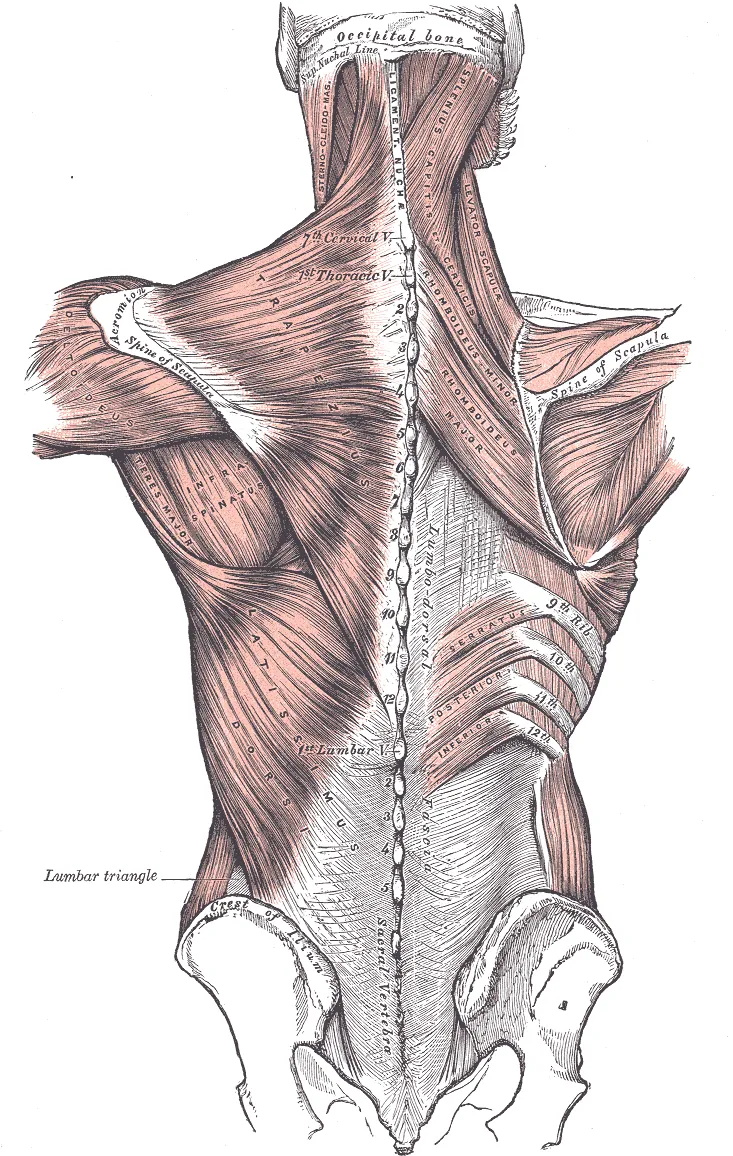
The trapezius is a large muscle near the surface of the back, shaped like a trapezoid1. It runs from the back of the skull down to the lower thoracic vertebrae1. From there it reaches out to the spine of the scapula, the ridge across the back of the shoulder blade1. Its starting point covers more ground than that of any other muscle, and its fibres run in different directions7. With the rhomboids, muscles between the shoulder blades and the spine, it holds the shoulder girdle (the shoulder blades and collarbones) in place from behind8.
The muscle is split into upper, middle and lower groups of fibres1,2. Dissection studies traced where each group ends9:
- Fibres from the back of the skull and the ligament of the neck run down but mainly across, to the clavicle (collarbone)9.
- Fibres from the C7 and T1 vertebrae run across to the spine of the scapula and the acromion, the bony point atop the shoulder9.
- Fibres from the thoracic spine gather onto one point of the shoulder blade, the deltoid tubercle9.
Volume studies found the biggest fibres were the ones arising at C7 and T1, and in the lower half of the neck’s ligament9.
What each part does
The trapezius steadies the shoulder blade and moves it1. Each group of fibres has its own actions:
| Part | What it does |
|---|---|
| Upper | Can raise the shoulder blade, turn it upward, and extend the neck1 |
| Middle | Draws the shoulder blade in toward the spine1 |
| Lower | Lowers the shoulder blade and helps the upper fibres turn it upward1 |
One dissection study disagrees that the upper fibres lift the shoulder blade directly, because they run mostly across9. In its account, the upper and middle fibres pull the shoulder blade and collarbone back9. Or they raise the shoulder blade by turning the collarbone where it meets the breastbone9. The same study found that the trapezius takes compression load off the neck’s spine by balancing turning forces9.
The trapezius and the serratus anterior, a muscle on the side of the chest, are considered the only muscles that turn the shoulder blade upward6. The levator scapulae is a muscle running from the neck to the top of the shoulder blade. The trapezius turns the shoulder blade against its pull and that of the rhomboids1. Together with the work of the deltoid, the rounded muscle that caps the shoulder, this turning is essential for throwing1.
Its nerves and fibres
The spinal accessory nerve makes the trapezius contract, and nerves from the C3 and C4 levels of the neck carry feeling from it1. In nerve tests during neck surgery in 18 patients, the accessory nerve reached all three parts of the muscle in every patient10. Seven also had an active branch from the cervical plexus, a network of neck nerves10. In another study, which included 25 neck operations, cervical plexus input that made the muscle contract appeared in only 32% of cases11.
In samples from five men, fibre types differed by region7. The middle and lower parts, and the lower part of the upper fibres, held mainly type 1 fibres, which contract slowly7. The very top of the upper part had more type 2 fibres, which contract fast7. Its fibres were much smaller than those in the rest of the muscle7. Women showed a similar pattern, but with much smaller fibres on average2.
Breakdown
Pain in the upper trapezius
Trapezius myalgia is a common complaint of pain, stiffness and tightness in the upper trapezius3. It is often linked to work, and put down to long spells of static or repetitive tasks3.
Studies of muscle samples disagree on whether the muscle itself changes3,12:
- In one study, 42 women office workers with trapezius myalgia had a higher share of “megafibres” than 20 matched healthy controls12. These are very large type 1 fibres with a poor supply of small blood vessels12.
- A systematic review, which sums up all the research on a question, compared healthy controls with people whose myalgia was linked to work3. It found no clear differences in muscle structure or function3. Its evidence for this was low to moderate3.
In that review, differences showed up mainly when the healthy group did a different job from the group with pain3. The authors suggest the tissue changes relate to workload rather than to pain3. In another study, 42 women with trapezius myalgia had lower peak force than 20 healthy controls across 100 maximal shoulder-raising efforts13.
Muscle activity in neck pain
A systematic review of 18 studies (756 people) compared muscle activity with and without neck pain14. Of these, 16 found differences, most often higher activity in muscles near the surface, such as the upper trapezius14. The authors suggest the changes may be adjustments to each task rather than one uniform fault14.
Another systematic review compared 485 people with shoulder or neck pain against 455 without15. In those with pain, the lower trapezius tended to be weaker and to show shorter times to switch on15. In a study of 60 people, maximal shrug strength was lower with chronic neck pain than in healthy controls16. It was also lower between bouts of recurrent neck pain16.
Trigger points
In one systematic review, five of seven studies found the upper trapezius consistently among the muscles with the most trigger points (tender knots)17. These studies were of people with neck or shoulder disorders17. But the review found only limited evidence that trigger points are highly common in these disorders, as all its studies were small17.
Injury to its nerve
The spinal accessory nerve runs close to the surface in part of the neck, which leaves it open to injury18. The authors of one eight-person case series write that injury during surgery is the most common reported cause18. They add that stretching or pulling injuries have also been reported18. In their own series, three injuries followed carrying and lifting18.
Neck dissection is an operation for head and neck cancer19. A systematic review of 75 studies found shoulder pain in 9 to 25% after the selective type19. After the radical and modified radical types, reported rates ranged up to 100%19. It concluded that sparing the accessory nerve lowers the risk of muscle and joint problems, but does not remove it19.
Recovery
How the muscle grows with training
In nine women, 10 weeks of strength training made upper trapezius fibres 36% larger in cross-sectional area, the size of a slice cut straight across20. Samples from ten elite power lifters showed larger fibres of every type than those from six control subjects21. Some small fibres in the lifters carried markers of early fibre formation21. The authors took this as a sign that new fibres had formed21.
Trials of strength training in people with pain
Randomised trials, which assign people to groups by chance, have tested strength training in employed women with trapezius myalgia5,22:
- In 48 women, 10 weeks of strength training for the painful muscle cut the worst neck pain score by about 79%5. General fitness training, as leg cycling, gave only a small, short-lived drop5.
- In 42 women, 10 weeks of neck and shoulder strength training raised the painful trapezius’s maximal electrical activity by 42 to 86%22. Pain fell by 42 to 49%22.
- In the 18 women who did the strength training, every measure of shoulder-raising force improved to levels comparable with healthy controls13.
A systematic review of eight randomised trials in office workers with non-specific neck pain favoured strengthening over no exercise for pain4. It did not for quality of life4.
One trial included 47 office workers with chronic neck and shoulder pain23. For ten weeks, they trained the lower trapezius and serratus anterior, keeping direct upper trapezius work to a minimum23. This lowered pain by 2.0 points against controls23.
In a trial of 447 office workers, the training groups did one hour a week of supervised strength training for 20 weeks24. They used five dumbbell exercises, including shrugs24. Among those with pain, neck pain fell compared with no training24.
After nerve injury
In the case series of eight people with accessory nerve injury, all were followed without surgery18. Six had significant improvement in shoulder pain and function18. The two whose injury followed a radical neck dissection improved moderately18.
Connections
The deltoid and serratus anterior
Muscles that hold the shoulder girdle, including the trapezius and serratus anterior, give the deltoid a steady base to move the arm from8. As the arm rises, the upper and lower trapezius and the serratus anterior work as a pair25. They turn the shoulder blade upward, and control it as the arm comes down25. One review says that when the deltoid is weakened, the arm may still rise past 90 degrees if first lifted that far with help26. That higher range comes from shoulder blade movement by the trapezius and serratus anterior26.
Whiplash
In the Quebec Task Force definition, a whiplash impact may cause injuries, which may in turn lead to whiplash-associated disorders27. One ultrasound study compared 36 people with chronic whiplash-associated disorders and 36 matched controls as they shrugged28. The outer layer of the upper trapezius changed shape less in the whiplash group, both lifting and lowering28. After a loaded arm-lifting task, this change of shape fell in both groups, but significantly only in the whiplash group28.
Exercises that load it
Related exercise pages: shrug, upper trapezius stretch, back extension and those in the table below6,29,30.
| Exercise | What studies found |
|---|---|
| Shrug | EMG (measuring muscle activity by its electrical signals) in 30 healthy people put the one-arm shrug top of 10 exercises for upper trapezius activity6 |
| Shrug | In 12 women workers with trapezius myalgia, trapezius activity in the shrug was about 102% of their hardest effort31 |
| Upper trapezius stretch | In 15 healthy men, the upper trapezius was stiffer, which the authors read as more stretched, with the neck bent forward and away29 |
| Bent-over row | A 2026 review describes it as mainly working the latissimus dorsi (the broad muscle across the middle and lower back), back deltoid and trapezius32 |
| Overhead press | A 2022 EMG study describes it as suited to working the upper trapezius, deltoids and triceps33 |
| Deadlift | In one study, upper trapezius activity was greater in parts of the lift with straighter knees, and middle trapezius activity where knees were more bent34 |
| Plank | In 21 healthy men, high planks drew more lower trapezius activity than low planks35 |
| Back extension | In 18 male amateur athletes without symptoms, hands behind the head drew more lower trapezius activity than crossed arms30 |
| Band external rotation | In 30 healthy people, turning the arm out lying face-down, arm raised to 90 degrees, drew the most lower trapezius activity of five exercises36 |
| Dead hang | In 17 recreational climbers hanging by the fingers, trapezius activity was lower with straight arms than with bent elbows37 |
Trapezius gives a steady base to
Trapezius is measured in studies of
Trapezius is loaded by
Trapezius is stretched by
Sources
- Ourieff J, Scheckel B, Agarwal A (2023). Anatomy, Back, Trapezius.. StatPearls. PMID 30085536
- Lindman R, Eriksson A, Thornell LE (1991). Fiber type composition of the human female trapezius muscle: enzyme-histochemical characteristics.. American Journal of Anatomy. doi:10.1002/aja.1001900406 PMID 1829322
- De Meulemeester K, Calders P, De Pauw R, Grymonpon I, Govaerts A, Cagnie B (2017). Morphological and physiological differences in the upper trapezius muscle in patients with work-related trapezius myalgia compared to healthy controls: A systematic review.. Musculoskeletal Science and Practice. doi:10.1016/j.msksp.2017.02.007 PMID 28315581
- Louw S, Makwela S, Manas L, Meyer L, Terblanche D, Brink Y (2017). Effectiveness of exercise in office workers with neck pain: A systematic review and meta-analysis.. South African Journal of Physiotherapy. doi:10.4102/sajp.v73i1.392 PMID 30135909
- Andersen LL, Kjaer M, Søgaard K, Hansen L, Kryger AI, Sjøgaard G (2008). Effect of two contrasting types of physical exercise on chronic neck muscle pain.. Arthritis and Rheumatism. doi:10.1002/art.23256 PMID 18163419
- Ekstrom RA, Donatelli RA, Soderberg GL (2003). Surface electromyographic analysis of exercises for the trapezius and serratus anterior muscles.. Journal of Orthopaedic and Sports Physical Therapy. doi:10.2519/jospt.2003.33.5.247 PMID 12774999
- Lindman R, Eriksson A, Thornell LE (1990). Fiber type composition of the human male trapezius muscle: enzyme-histochemical characteristics.. American Journal of Anatomy. doi:10.1002/aja.1001890306 PMID 2148051
- Betts JG, Young KA, Wise JA, Johnson E, Poe B, Kruse DH, Korol O, Johnson JE, Womble M, DeSaix P (2022). Anatomy and Physiology 2e. OpenStax. Link
- Johnson G, Bogduk N, Nowitzke A, House D (1994). Anatomy and actions of the trapezius muscle.. Clinical Biomechanics. doi:10.1016/0268-0033(94)90057-4 PMID 23916077
- Svenberg Lind C, Lundberg B, Hammarstedt Nordenvall L, Heiwe S, Persson JK, Hydman J (2015). Quantification of Trapezius Muscle Innervation During Neck Dissections. Annals of Otology, Rhinology and Laryngology. doi:10.1177/0003489415589365 PMID 26032955
- Gavid M, Mayaud A, Timochenko A, Asanau A, Prades JM (2016). Topographical and functional anatomy of trapezius muscle innervation by spinal accessory nerve and C2 to C4 nerves of cervical plexus.. Surgical and Radiologic Anatomy. doi:10.1007/s00276-016-1658-1 PMID 26957148
- Andersen LL, Suetta C, Andersen JL, Kjær M, Sjøgaard G (2008). Increased proportion of megafibers in chronically painful muscles.. Pain. doi:10.1016/j.pain.2008.06.013 PMID 18701218
- Andersen LL, Andersen CH, Skotte JH, Suetta C, Søgaard K, Saltin B, Sjøgaard G (2014). High-intensity strength training improves function of chronically painful muscles: case-control and RCT studies.. BioMed Research International. doi:10.1155/2014/187324 PMID 24707475
- Gascón-Jaén J, Poveda-Pagán EJ, Lozano-Quijada C, Pérez-Alenda S, Cruz-Montecinos C, Núñez-Cortes R (2026). Surface EMG activity during cervical and upper limb tasks in individuals with neck pain: a systematic review.. BMC Musculoskeletal Disorders. doi:10.1186/s12891-026-10183-7 PMID 42414991
- Wang DM, Li C, Hatchard N, Chang Chien GC, Alm J (2023). Lower trapezius muscle function in people with and without shoulder and neck pain: a systematic review.. Journal of Osteopathic Medicine. doi:10.1515/jom-2022-0056 PMID 36100364
- Yu CWG, Wongwitwichote K, Deane J, Devecchi V, Mansfield M, Falla D (2026). Physical and Psychological Features During Remission From Non-Specific Neck Pain.. European Journal of Pain. doi:10.1002/ejp.70365 PMID 42667170
- Ribeiro DC, Belgrave A, Naden A, Fang H, Matthews P, Parshottam S (2018). The prevalence of myofascial trigger points in neck and shoulder-related disorders: a systematic review of the literature.. BMC Musculoskeletal Disorders. doi:10.1186/s12891-018-2157-9 PMID 30045708
- Gun K, Uludag M, Delil S, Ozbayrak S, Sucuoglu H, Battal H, Adatepe NU, Karamehmetoglu SS (2014). Spinal accessory nerve injury: eight cases and review of the literature.. La Clinica Terapeutica. PMID 25203336
- Gane EM, Michaleff ZA, Cottrell MA, McPhail SM, Hatton AL, Panizza BJ, O'Leary SP (2017). Prevalence, incidence, and risk factors for shoulder and neck dysfunction after neck dissection: A systematic review.. European Journal of Surgical Oncology. doi:10.1016/j.ejso.2016.10.026 PMID 27956321
- Kadi F, Thornell LE (2000). Concomitant increases in myonuclear and satellite cell content in female trapezius muscle following strength training.. Histochemistry and Cell Biology. doi:10.1007/s004180050012 PMID 10766262
- Kadi F, Eriksson A, Holmner S, Butler-Browne GS, Thornell LE (1999). Cellular adaptation of the trapezius muscle in strength-trained athletes.. Histochemistry and Cell Biology. doi:10.1007/s004180050348 PMID 10094415
- Andersen LL, Andersen CH, Zebis MK, Nielsen PK, Søgaard K, Sjøgaard G (2008). Effect of physical training on function of chronically painful muscles: a randomized controlled trial.. Journal of Applied Physiology. doi:10.1152/japplphysiol.91057.2008 PMID 18948442
- Andersen CH, Andersen LL, Zebis MK, Sjøgaard G (2014). Effect of scapular function training on chronic pain in the neck/shoulder region: a randomized controlled trial.. Journal of Occupational Rehabilitation. doi:10.1007/s10926-013-9441-1 PMID 23832167
- Andersen CH, Andersen LL, Gram B, Pedersen MT, Mortensen OS, Zebis MK, Sjøgaard G (2012). Influence of frequency and duration of strength training for effective management of neck and shoulder pain: a randomised controlled trial.. British Journal of Sports Medicine. doi:10.1136/bjsports-2011-090813 PMID 22753863
- Elder A, Powers CM (2025). Scapular Stabilization for Shoulder Pain: Putting the Cart Before the Horse?. International Journal of Sports Physical Therapy. doi:10.26603/001c.128049 PMID 39906061
- Stokey PJ, Kaur S, Lee A, Behrens K, Ebraheim N (2024). Anatomy and Deficiency of the Deltoid Muscle: A Review of Literature.. Orthopedic Reviews. doi:10.52965/001c.115352 PMID 38562147
- Pastakia K, Kumar S (2011). Acute whiplash associated disorders (WAD).. Open access emergency medicine. doi:10.2147/OAEM.S17853 PMID 27147849
- Landén Ludvigsson M, Peterson G, Jull G, Trygg J, Peolsson A (2016). Mechanical properties of the trapezius during scapular elevation in people with chronic whiplash associated disorders--A case-control ultrasound speckle tracking analysis.. Manual Therapy. doi:10.1016/j.math.2015.07.009 PMID 26277485
- Yanase K, Ikezoe T, Nakamura M, Saeki J, Yagi M, Hirono T, Tamezawa T, Motomura Y, Ibuki S, Ichihashi N (2021). Effective muscle elongation positions for the neck extensor muscles: An ultrasonic shear wave elastography study.. Journal of Electromyography and Kinesiology. doi:10.1016/j.jelekin.2021.102569 PMID 34298283
- Park SY, Yoo WG (2014). Effects of hand and knee positions on muscular activity during trunk extension exercise with the Roman chair.. Journal of electromyography and kinesiology. doi:10.1016/j.jelekin.2014.08.012 PMID 25245250
- Andersen LL, Kjaer M, Andersen CH, Hansen PB, Zebis MK, Hansen K, Sjøgaard G (2008). Muscle activation during selected strength exercises in women with chronic neck muscle pain.. Physical Therapy. doi:10.2522/ptj.20070304 PMID 18339796
- Di Fonza D, Di Claudio G, Colantuono G, Persichini L, Cerulo N, Sangregorio B, Buonsenso A, Fiorilli G, Calcagno G, di Cagno A (2026). Electromyographic Analysis of Latissimus Dorsi Activation During Common Resistance Training Exercises: A Narrative Review.. Journal of Functional Morphology and Kinesiology. doi:10.3390/jfmk11030315 PMID 42647355
- Coratella G, Tornatore G, Longo S, Esposito F, Cè E (2022). Front vs Back and Barbell vs Machine Overhead Press: An Electromyographic Analysis and Implications For Resistance Training.. Frontiers in Physiology. doi:10.3389/fphys.2022.825880 PMID 35936912
- Escamilla RF, Francisco AC, Kayes AV, Speer KP, Moorman CT 3rd (2002). An electromyographic analysis of sumo and conventional style deadlifts.. Medicine and Science in Sports and Exercise. doi:10.1097/00005768-200204000-00019 PMID 11932579
- Can EN, Harput G, Turgut E (2024). Shoulder and Scapular Muscle Activity During Low and High Plank Variations With Different Body-Weight-Bearing Statuses.. Journal of Strength and Conditioning Research. doi:10.1519/JSC.0000000000004622 PMID 37815235
- Alizadehkhaiyat O, Hawkes DH, Kemp GJ, Frostick SP (2015). Electromyographic Analysis of the Shoulder Girdle Musculature During External Rotation Exercises.. Orthopaedic Journal of Sports Medicine. doi:10.1177/2325967115613988 PMID 26740950
- Exel J, Deimel D, Koller W, Werle C, Baca A, Maffiodo D, Sesana R, Colombo A, Kainz H (2023). Neuromechanics of finger hangs with arm lock-offs: analyzing joint moments and muscle activations to improve practice guidelines for climbing.. Frontiers in Sports and Active Living. doi:10.3389/fspor.2023.1251089 PMID 37927449
Changes
- First published.