Cervical vertebrae
Also called cervical spine, neck vertebrae, C1 to C7
The seven bones of the neck. How the atlas and axis nod and turn the head, how the lower bones are built and move, how they are injured in contact sport, and what changes studies found over years of play.
- Region
- Neck
- Muscles
- levator scapulae, deep neck flexors, trapezius, rhomboids, Scalenes, Neck extensors
- Updated
- October 22, 2026
- Reviewed
- October 22, 2026 · how entries are checked
Function
Seven bones, three of them unusual
The adult spine has 24 vertebrae: seven cervical ones in the neck, twelve thoracic ones below them and five lumbar ones in the lower back2. C3 to C6 are described as typical cervical vertebrae, and C1, C2 and C7 as atypical1. Their small bodies reflect that they carry the least body weight2. The cervical spine holds the upper spinal cord and the vertebral arteries, which help supply blood to the back of the brain7.
The parts of a typical neck vertebra
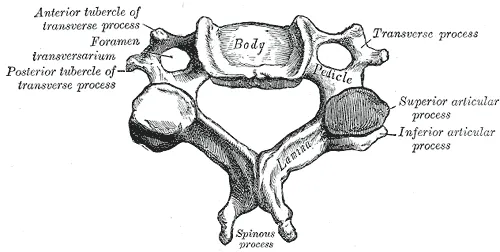
A typical neck vertebra has four notable features1,2:
- The spinous process (the bony point at the back) usually splits in two at its tip2. It is short on C3 to C6, but C7’s is much longer and forms the bump at the base of the neck2.
- The transverse processes (the spurs to each side) are sharply curved, in a U shape, so the cervical spinal nerves can pass2. Each holds an opening, the transverse foramen, through which an important artery supplying the brain rises up the neck2.
- The uncinate process is a raised lip of bone at the back edges of the top of the body, on C3 to C71. It meets the vertebra above to form the uncovertebral, or Luschka, joint1.
- The articular processes (the parts that form joints with the next vertebra) are flattened and face mostly up or down2. This gives the neck wide bending in each direction and wide rotation2.
In a cadaver study of 14 neck segments, the uncovertebral joints mainly controlled extension (bending backward) and side bending, then twisting8.
The atlas and the axis
The atlas, or C1, supports the skull2. It has no body and no spinous process, and is a ring made of a front arch and a back arch2.
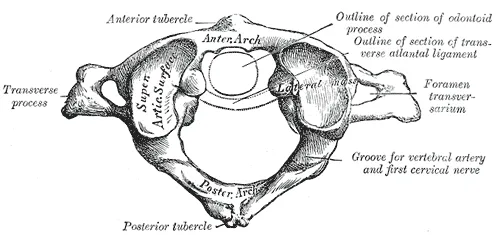
The axis, or C2, carries the dens (also called the odontoid process), a peg of bone rising from its body2. The dens meets the inside of the atlas’s front arch, and the transverse ligament holds it there2. The joint between the atlas and the skull lets the skull rock forward and back, as in nodding “yes”2. The joint between the atlas and the axis includes a pivot around the dens, letting the head turn right or left2.
In CT scans of 20 healthy volunteers turning the head fully, neck rotation averaged 69.7 degrees3. C1–C2 supplied 37.9 degrees of that3. In X-rays of 70 healthy people, forward and backward bending was largest at C4/C5 and C5/C69.
Breakdown
How the neck gives way under a head-first blow
A review of neck injury in sport reports calculated compressive load limits of 3,340 to 4,450 newtons (a unit of force)4. It describes axial loading (load pressing along the neck’s length) with the head bent forward about 30 degrees, as in a head-first tackle4. In that position the neck’s normal curve disappears, and with it the region’s energy-absorbing spring4. The review reports that in cadaver specimens hit along their length, the neck buckled and was injured within 2 to 31 milliseconds of impact4. The head had not yet visibly moved4.
Two rugby union reviews differ on the main mechanism10,11:
- Buckling. A systematic review (a set, checkable search of the research) concluded that most neck injuries more likely come from buckling10. It judged hyperflexion (bending forward past the normal limit) an unlikely cause of most of them10.
- Hyperflexion. A 2002 review reported hyperflexion as the most commonly reported mechanism11. It linked it to fracture-dislocation (a broken bone with the joint forced out of place) at C4–C5 or C5–C611.
In a facet dislocation, one of the small joints between vertebrae is forced out of place10. The systematic review found these most common, often on both sides, and mostly at C4/5 and C5/610. In computer simulations of a head-first tackle using a model of a rugby player, starting with the neck extended led to buckling12. Loads went beyond normal levels, typical of facet dislocations on both sides12. Starting with the neck flexed raised compression but stayed within normal limits12.
Football and the 1976 rule change
US college and high school football banned spearing and first contact with the top of the helmet in 19765. A national registry of head and neck injuries in tackle football has gathered data since 19715.
That registry then documented a dramatic fall in neck injuries and quadriplegia (paralysis of all four limbs) from 1976 to 19875. A 2004 position statement (an expert group’s agreed view), co-written by the registry papers’ lead author, says the rules dramatically cut catastrophic neck injuries5,6,13,14. But it says the rules on helmet contact are seldom enforced, and players still often lead with the head13. It names axial loading from head-down contact as the main cause of spinal cord injuries in tackle football13.
A 1993 paper on “spear tackler’s spine” shares a lead author with the registry findings above and draws on the same registry5,6,14. It found 15 cases from 1987 to 1990, using registry data and the senior author’s practice14. It named four features: a narrow spinal canal, a neck curve that stayed straight or reversed, X-ray signs of past injury, and past spear tackling14. Four of the 15 players had permanent nerve deficits14.
One study covered US high school and college football from 1989 to 200215:
- There were about 15 direct catastrophic neck injuries a year: 1.10 per 100,000 high school and 4.72 per 100,000 college players15.
- 76 players had quadriplegia, and spear tackling by defensive players remained the main cause15.
- 9 players had an injury at C1 or C2 alone, and 7 had one there plus another lower in the neck15.
Which sports
From 2005/06 to 2014/15, US high school athletes in 24 sports had these neck injury rates16. Each is per 100,000 athlete-exposures (one athlete in one practice or game)16:
| Group | Neck injuries per 100,000 athlete-exposures |
|---|---|
| Football | 10.1016 |
| Wrestling | 7.4216 |
| Girls’ gymnastics | 4.9516 |
| 24 sports overall | 3.0416 |
One case report (a report on a single patient) describes a C6 spinous process fracture in a 21-year-old cadet17. He had done several sets of overhead presses, resting the bar across his lower neck and shoulders17.
The size of the spinal canal
Two studies below compare the spinal canal (the channel holding the spinal cord) with the vertebral body, as a ratio, on side-view X-rays6,18. Of 124 professional and 100 rookie football players, 32% and 34% had a ratio below 0.80 somewhere from C3 to C618. Another study, with the same lead author as the registry papers, compared several groups of football players with a large control group5,6,14. A ratio at or under 0.80 had 93% sensitivity for short-lived cord neurapraxia6. Sensitivity is the share of cases a test flags.
But the ratio’s positive predictive value, the share of flagged people who have the condition, was 0.2%, too low for screening6. The same study concluded that, when the spine is stable, a canal narrow from development seems not to predispose to permanent catastrophic nerve injury6. The stinger page covers a related measure of canal width, the Torg ratio, in players with stingers19.
Wear over the years
In CT scans of 360 adults aged 21 to 79 at one Chinese hospital, uncovertebral joint wear began in the 20s and grew with age20. It was most marked at C5–6, then C4–5 and C6–720.
Studies of players found degenerative changes (gradual wear and breakdown) in the neck21,22:
- French rugby. In MRI scans (which show soft tissue in detail) of 206 elite male players without symptoms, the C2 to C7 findings were mainly disc changes21. They were seen most often in players over 2121.
- Front-row rugby. Blinded readers found significantly more wear on X-rays of 14 professional front-row players than of non-players22. The players did not report more symptoms22.
Recovery
What happened after cord injuries
A systematic review on return to play after spinal cord concussion found 16 studies23. Each was a case-control study, case series or case report23. Symptoms over 24 hours were more frequent in those with later recurrence or cord injury (36.36%) than in those without (11.11%)23. In the 1989 to 2002 football study, 43 players had cord neurapraxia15. Of those, 16 went back to football, and none of the 16 had permanent quadriplegia15.
After neck surgery
A systematic review of 9 observational series covered 175 athletes24. Of the professional athletes, 75% returned to their sport after neck surgery, mostly for a herniated disc (one whose soft centre pushes out)24. Of recreational athletes aged 10 to 42, 76% returned to play24. The review found little published research on this24. Outcomes were unclear except after single-level fusion (an operation fixing the bones of a joint together) for a herniated disc24.
A 2026 modified Delphi survey, a method that polls a panel of experts in rounds to work toward agreement, asked 34 sports spine surgeons25. The panel reached consensus to recommend return to high-impact, high-frequency sport after a healed C1 fracture25. That fracture had been fixed by open reduction and internal fixation, surgery that sets the bone and holds it with implants25. The panel reached the same consensus after one-level fusion or laminectomy, a surgery removing part of a vertebra’s back arch25. These are the panel’s agreed opinions, not measured outcomes25.
The muscles around the bones
One study put 22 active college students in three groups; its abstract does not say the groups were random26. Some added a head extension exercise to 12 weeks of lifting26. In them, total neck muscle cross-sectional area (slice size) on MRI rose from 19.5 to 22.0 square centimetres26. In students who lifted with no neck exercise, neck muscle area did not change, though quadriceps area rose 7%26.
Connections
Bones and discs
The seven cervical vertebrae form the neck region of the spine, above the thoracic and lumbar vertebrae2. Each intervertebral disc keeps neighbouring vertebral bodies from touching bone to bone27.
Nerves and nearby conditions
A 2024 study calls a stinger a short-lived injury of the brachial plexus or of cervical nerve roots (where nerves leave the spinal cord)28. The brachial plexus is the network of nerves, starting at the neck, that serves the arm. A 2022 European consensus says cervical ribs (extra ribs growing from a neck vertebra) occur in 0.5% to 2% of people29. It says 5% to 10% of people with one develop thoracic outlet syndrome29.
Exercise and stretch pages
Related exercise pages: neck isometric hold and overhead press. One professional rugby squad of 27 players was studied looking back over two seasons30. The season with isometric neck strengthening had fewer match injuries, but neck injuries did not differ significantly (6 against 8)30.
Related stretch pages: upper trapezius stretch and upper back stretch. In 15 healthy men, the levator scapulae measured stiffer, read by the authors as more lengthened, in neck positions bending away31. In a meta-analysis (pooled studies) of healthy people, four stretching studies of the upper back and neck showed no clear effect on posture32.
Cervical vertebrae forms part of
Cervical vertebrae lies next to
Cervical vertebrae is compared with
Cervical vertebrae is a form of
Cervical vertebrae is attached to by
Cervical vertebrae is related to
Sources
- Raveendranath V, Kavitha T, Umamageswari A (2019). Morphometry of the Uncinate Process, Vertebral Body, and Lamina of the C3-7 Vertebrae Relevant to Cervical Spine Surgery.. Neurospine. doi:10.14245/ns.1836272.136 PMID 31284340
- Betts JG, Young KA, Wise JA, Johnson E, Poe B, Kruse DH, Korol O, Johnson JE, Womble M, DeSaix P (2022). Anatomy and Physiology 2e. OpenStax. Link
- Kang J, Chen G, Zhai X, He X (2019). In vivo three-dimensional kinematics of the cervical spine during maximal active head rotation.. PloS one. doi:10.1371/journal.pone.0215357 PMID 30990826
- Swartz EE, Floyd RT, Cendoma M (2005). Cervical spine functional anatomy and the biomechanics of injury due to compressive loading.. Journal of athletic training. PMID 16284634
- Torg JS, Vegso JJ, O'Neill MJ, Sennett B (1990). The epidemiologic, pathologic, biomechanical, and cinematographic analysis of football-induced cervical spine trauma.. The American journal of sports medicine. doi:10.1177/036354659001800109 PMID 2301692
- Torg JS, Naranja RJ Jr, Pavlov H, Galinat BJ, Warren R, Stine RA (1996). The relationship of developmental narrowing of the cervical spinal canal to reversible and irreversible injury of the cervical spinal cord in football players.. The Journal of bone and joint surgery. American volume. doi:10.2106/00004623-199609000-00003 PMID 8816644
- Rahman S, Das JM (2023). Anatomy, Head and Neck: Cervical Spine.. StatPearls. PMID 32491448
- Kotani Y, McNulty PS, Abumi K, Cunningham BW, Kaneda K, McAfee PC (1998). The role of anteromedial foraminotomy and the uncovertebral joints in the stability of the cervical spine. A biomechanical study.. Spine. doi:10.1097/00007632-199807150-00011 PMID 9682312
- Lind B, Sihlbom H, Nordwall A, Malchau H (1989). Normal range of motion of the cervical spine.. Archives of physical medicine and rehabilitation. PMID 2774888
- Kuster D, Gibson A, Abboud R, Drew T (2012). Mechanisms of cervical spine injury in rugby union: a systematic review of the literature.. British journal of sports medicine. doi:10.1136/bjsports-2011-090360 PMID 22378840
- Quarrie KL, Cantu RC, Chalmers DJ (2002). Rugby union injuries to the cervical spine and spinal cord.. Sports medicine (Auckland, N.Z.). doi:10.2165/00007256-200232100-00003 PMID 12141883
- Silvestros P, Quarrington RD, Preatoni E, Gill HS, Jones CF, Cazzola D (2024). An Extended Neck Position is Likely to Produce Cervical Spine Injuries Through Buckling in Accidental Head-First Impacts During Rugby Tackling.. Annals of biomedical engineering. doi:10.1007/s10439-024-03576-z PMID 39004695
- Heck JF, Clarke KS, Peterson TR, Torg JS, Weis MP (2004). National Athletic Trainers' Association Position Statement: Head-Down Contact and Spearing in Tackle Football.. Journal of athletic training. PMID 15085218
- Torg JS, Sennett B, Pavlov H, Leventhal MR, Glasgow SG (1993). Spear tackler's spine. An entity precluding participation in tackle football and collision activities that expose the cervical spine to axial energy inputs.. The American journal of sports medicine. doi:10.1177/036354659302100502 PMID 8238702
- Boden BP, Tacchetti RL, Cantu RC, Knowles SB, Mueller FO (2006). Catastrophic cervical spine injuries in high school and college football players.. The American journal of sports medicine. doi:10.1177/0363546506288306 PMID 16816152
- Meron A, McMullen C, Laker SR, Currie D, Comstock RD (2018). Epidemiology of Cervical Spine Injuries in High School Athletes Over a Ten-Year Period.. PM & R : the journal of injury, function, and rehabilitation. doi:10.1016/j.pmrj.2017.09.003 PMID 28919185
- Watson DJ, Dolbeer JA (2017). C6 Spinous Process Fracture in a Young Adult.. Journal of Orthopaedic and Sports Physical Therapy. doi:10.2519/jospt.2017.7357 PMID 28859595
- Odor JM, Watkins RG, Dillin WH, Dennis S, Saberi M (1990). Incidence of cervical spinal stenosis in professional and rookie football players.. The American journal of sports medicine. doi:10.1177/036354659001800510 PMID 2252092
- Meyer SA, Schulte KR, Callaghan JJ, Albright JP, Powell JW, Crowley ET, et al. (1994). Cervical spinal stenosis and stingers in collegiate football players.. The American journal of sports medicine. doi:10.1177/036354659402200202 PMID 8198181
- Huang T, Qin J, Zhong W, Tang K, Quan Z (2021). The CT assessment of uncovertebral joints degeneration in a healthy population.. European journal of medical research. doi:10.1186/s40001-021-00619-2 PMID 34903291
- Castinel BH, Adam P, Milburn PD, Castinel A, Quarrie KL, Peyrin JC, et al. (2008). Epidemiology of cervical spine abnormalities in asymptomatic adult professional rugby union players using static and dynamic MRI protocols: 2002 to 2006.. British journal of sports medicine. doi:10.1136/bjsm.2007.045815 PMID 18385195
- Hogan BA, Hogan NA, Vos PM, Eustace SJ, Kenny PJ (2010). The cervical spine of professional front-row rugby players: correlation between degenerative changes and symptoms.. Irish journal of medical science. doi:10.1007/s11845-009-0432-3 PMID 19813050
- Nagoshi N, Tetreault L, Nakashima H, Nouri A, Fehlings MG (2017). Return to play in athletes with spinal cord concussion: a systematic literature review.. The spine journal : official journal of the North American Spine Society. doi:10.1016/j.spinee.2016.09.013 PMID 27836772
- Molinari RW, Pagarigan K, Dettori JR, Molinari R Jr, Dehaven KE (2016). Return to Play in Athletes Receiving Cervical Surgery: A Systematic Review.. Global spine journal. doi:10.1055/s-0035-1570460 PMID 26835207
- Zuckerman SL, White M, Rigney GH, Jo J, Bailes JE, Bonfield CM, et al. (2026). Return-to-Sport Recommendations in Athletes Requiring Cervical Spine Surgery: A Modified Delphi Consensus Survey of Expert Opinion.. Spine. doi:10.1097/BRS.0000000000005464 PMID 40838273
- Conley MS, Stone MH, Nimmons M, Dudley GA (1997). Specificity of resistance training responses in neck muscle size and strength.. European journal of applied physiology and occupational physiology. doi:10.1007/s004210050186 PMID 9189733
- Waxenbaum JA, Reddy V, Futterman B (2026). Anatomy, Back, Intervertebral Discs. StatPearls. PMID 29262063
- Lamplot JD, Petit C, Lee R, Mack CD, Herzog MM, Solomon GS, et al. (2024). Epidemiology of Stingers in the National Football League, 2015-2019.. Sports health. doi:10.1177/19417381231223413 PMID 38229225
- Dengler NF, Ferraresi S, Rochkind S, Denisova N, Garozzo D, Heinen C, Alimehmeti R, Capone C, Barone DG, Zdunczyk A, Pedro MT, Antoniadis G, Kaiser R, Dubuisson A, Kretschmer T, Rasulic L (2022). Thoracic Outlet Syndrome Part I: Systematic Review of the Literature and Consensus on Anatomy, Diagnosis, and Classification of Thoracic Outlet Syndrome by the European Association of Neurosurgical Societies' Section of Peripheral Nerve Surgery.. Neurosurgery. doi:10.1227/neu.0000000000001908 PMID 35319532
- Naish R, Burnett A, Burrows S, Andrews W, Appleby B (2013). Can a Specific Neck Strengthening Program Decrease Cervical Spine Injuries in a Men's Professional Rugby Union Team? A Retrospective Analysis.. Journal of sports science & medicine. PMID 24149163
- Yanase K, Ikezoe T, Nakamura M, Saeki J, Yagi M, Hirono T, Tamezawa T, Motomura Y, Ibuki S, Ichihashi N (2021). Effective muscle elongation positions for the neck extensor muscles: An ultrasonic shear wave elastography study.. Journal of Electromyography and Kinesiology. doi:10.1016/j.jelekin.2021.102569 PMID 34298283
- Warneke K, Lohmann LH, Wilke J (2024). Effects of Stretching or Strengthening Exercise on Spinal and Lumbopelvic Posture: A Systematic Review with Meta-Analysis.. Sports medicine - open. doi:10.1186/s40798-024-00733-5 PMID 38834878
Changes
- First published.