Levator scapulae
The muscle that runs from the upper neck to the top inner corner of the shoulder blade. How it lifts the shoulder blade and moves the neck, what studies of neck and shoulder pain found in it, how it changes, and what it works with.
- Region
- Neck
- Starts on
- the side spurs (transverse processes) of the first four neck vertebrae, by tendon slips1,2
- Ends on
- the shoulder blade's inner border, between its upper inner angle and the base of the ridge across its back1,30
- Updated
- October 9, 2026
- Reviewed
- October 9, 2026 · how entries are checked
Function
Where it sits and what it joins
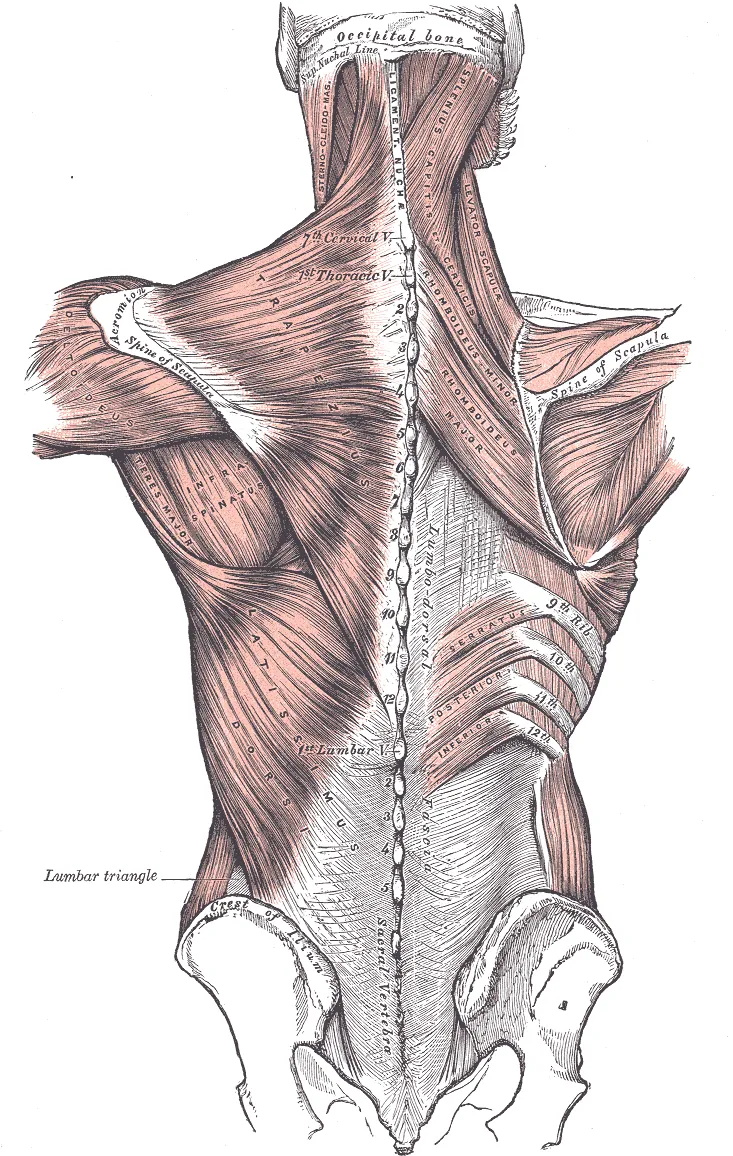
The levator scapulae sits at the side and back of the neck1. Gray’s Anatomy groups it with the trapezius, latissimus dorsi and two rhomboids as the muscles that connect the upper limb to the spine1.
The muscle starts as slips of tendon on the transverse processes of the first four neck vertebrae1,2. A transverse process is a small spur of bone that sticks out to each side of a vertebra.
The muscle ends on the inner border of the scapula (shoulder blade)1. The attachment runs from the upper inner angle of the bone down to a smooth triangular surface at the root of its spine1. The spine of the scapula is the ridge that runs across the back of the shoulder blade. The muscle reaches the upper inner angle next to where the rhomboid minor ends2.
What it does
The primary function of the two levator scapulae muscles is to raise the shoulder blades3. With the head fixed, the muscle raises the upper inner angle of the shoulder blade1. With the shoulder fixed, it bends the neck to its own side and turns it the same way1.
Working with other muscles that join the trunk to the upper limb, it can turn the socket of the shoulder blade downward2,3. With them, it can also bend the neck backward and to the side2,3.
What recordings show when the arm moves
Electromyography (EMG) measures a muscle’s activity by picking up its electrical signals. One study used EMG and x-rays to follow the muscle as the arm rose out to the side7. The muscle contracted while shortening through the first 90 degrees, and while lengthening through the second 907. The authors suggest that its action may be what applies force to the neck part of the spine in this movement7.
A second study recorded the right levator scapulae and upper trapezius of six adults with fine-wire electrodes (very thin wire sensors)8. All six recruited the levator scapulae alone when moving the arm backward8. The author concluded that, as the arm moves backward, the muscle puts a torque (a turning force) on the neck that has to be counteracted8.
Which nerves supply it
Sources report its nerve supply differently1,9,10. The dorsal scapular nerve is the nerve that supplies the rhomboid muscles. The cervical plexus is a network of nerves in the neck. A cadaver is a body donated for study.
| Source | What it reports |
|---|---|
| Gray’s Anatomy | The third and fourth neck nerves, and frequently a branch of the dorsal scapular nerve too1 |
| A dissection study of 37 cadaver necks | About two cervical plexus nerves on average ran to the muscle, with a range of one to four9. The dorsal scapular nerve entered the muscle or gave it branches in 11 of 35 specimens9 |
| 70 adult Japanese cadavers | The dorsal scapular nerve supplied the levator scapulae and both rhomboids in each case10 |
How much its shape varies
The number of vertebrae the muscle attaches to varies1. In an MRI study of 37 people aged 18 to 36, 16 had extra attachments at the lower end4. These went to the serratus anterior (a muscle on the side of the chest), the serratus posterior superior, or the first or second rib4. A narrative review, a summary written without a set search method, reports additional slips in 13.1% of an anatomical series of 30011. In a dissection of 30 cadaver shoulders, where the muscle ended varied greatly12.
Breakdown
The authors of one study call the levator scapulae a key structure in how neck and shoulder pain arises2. The neck pain page covers the condition itself.
Whether it is stiffer in people with neck pain
Three studies compared the muscle’s stiffness in people with and without chronic neck pain2,5,13. Two used shear wave elastography, an ultrasound method that estimates how stiff a tissue is2,5.
| Who was measured | What was found |
|---|---|
| 35 patients with chronic neck pain and 35 people of matching age without it | Shear wave velocity, a measure of stiffness, was higher in the patients5 |
| 34 people with chronic neck pain and 33 without | No significant differences in elasticity between the groups, between sides, or between men and women2 |
| People with chronic mechanical neck pain and controls without symptoms | Stiffness did not differ between the groups13 |
In the 35 patients, shear wave velocity was measured in several neck muscles, the levator scapulae among them5. It did not correlate with pain intensity or neck disability scores5. In the third study’s comparison of clinical and psychological measures, stiffness had a positive association with three things: disability, anxiety and fear of movement13.
Its size, and tender knots
Two studies of women measured the muscle’s size14,15. Cross-sectional area is the size of a slice cut straight across a muscle.
- An MRI study had 117 women: 37 with chronic whiplash-associated disorder, 45 with chronic neck pain of no known cause, and 35 healthy controls14. The levator scapulae was among the muscles with a significantly larger cross-sectional area in the controls than in one or both pain groups14.
- An ultrasound study had 66 women in three groups of 22: two groups with neck pain and one of controls15. Levator scapulae thickness did not differ between the groups, at rest or with the arm raised holding 1 kg15.
A trigger point is a tender knot in a muscle. Three sources report them in this muscle16,17,18:
- Workers. A review reports one study of manual and office workers with nonspecific neck or shoulder pain16. In both groups, the levator scapulae was among the four muscles where active trigger points were most prevalent16.
- People with chronic whiplash-associated disorder. An exploratory study compared 32 such people with 32 matched healthy controls17. The patients’ active trigger points were mostly found in the levator scapulae and suboccipital muscles17.
- College overhead athletes, whose sports use repeated overhead arm actions. Among 345 with neck and shoulder pain, 14% had trigger points in the levator scapulae, against 73% in the trapezius18.
Levator scapulae syndrome
One report describes 22 patients with levator scapulae syndrome, all of them young women12. Their shared picture was pain over the upper inner angle of the shoulder blade, most often on the dominant side12. Movements that stretched the muscle on the painful side made symptoms worse12. Radiographs (X-ray images) and bone scans of their shoulders and the neck part of the spine were negative12.
The same group dissected 30 cadaver shoulders12. In more than half, a bursa (a small fluid-filled sac) lay between the shoulder blade, the serratus and the levator12. They suggested the syndrome may be caused by variations in where the levator scapulae ends and the serratus anterior starts12. In their account, these lead to bursitis (a swollen bursa) and pain12.
The author of a 1989 review of 66 patients’ records wrote that the syndrome is frequent and well documented, yet often goes unrecognised19. The author likened it to a tendinitis (pain and swelling of a tendon) and wrote that recurrence is likely19.
Recovery
A larger muscle on the side of neck surgery, and a stretching study
A CT scan builds detailed pictures of the inside of the body from X-rays. One CT report covers five patients with a lump at the back of the neck that could be felt20. Unequal levator scapulae muscles caused the lump20. Three of the five had had a radical neck dissection on one side, surgery that removes lymph nodes and other tissue from the neck20. Those three showed hypertrophy (growth in the size of a muscle) of the levator scapulae on that side20.
A stretching study compared two positions in 24 university students with a shortened levator scapulae21. Stretching while sitting increased the muscle’s measured length and neck range of motion more than stretching on hands and knees21.
When surgeons move it to stand in for the trapezius
A tendon transfer is surgery that moves a tendon so that it can do the job of another. A review describes one such operation, the Eden-Lange procedure, used when the trapezius stays paralysed6. It moves the ends of the levator scapulae and rhomboids outward along the shoulder blade6. Their redirected pull then steadies the shoulder blade and supports the shoulder girdle (the shoulder blades and collarbones) in the trapezius’s place6.
Two series followed patients after such transfers22,23:
| Patients | Follow-up | Rated result |
|---|---|---|
| 22 with trapezius paralysis after injury to the spinal accessory nerve (the nerve that supplies the trapezius) | Seven and a half years, on average | Excellent in 13, satisfactory in 6, unsatisfactory in 322 |
| 12 with chronic trapezius paralysis | 32 years, on average | Excellent in 9, fair in 2, poor in 123 |
In the series of 12, overhead function was restored in nine23. Its authors concluded that the operation restores shoulder function less well when the serratus anterior is also paralysed or the rhomboids are weak23.
Connections
The rhomboids, serratus anterior and trapezius
In a dissection study of body donors, the levator scapulae and the rhomboid minor were found joined and wrapped in connective tissue24. Both end on the inner border of the scapula1,6. The pair formed a unit separate from the rhomboid major, the other of the two rhomboids24.
A study of 10 healthy men used shear wave elastography as they moved into a levator scapulae stretching position25. Stiffness rose in the serratus anterior as well as the levator scapulae, but not in the rhomboid minor25. The authors read this as force passing between the two muscles through their connective tissue25.
The trapezius rotates the shoulder blade against the levator scapulae and rhomboids26.
Exercises and stretches that load it
Related exercise pages: the shrug and the upper trapezius stretch27,28. Maximum voluntary contraction is the hardest effort a person can make with a muscle.
| Exercise or stretch | Who was measured | What was found |
|---|---|---|
| Shrug, arms overhead | 26 people, surface and fine-wire EMG | Levator scapulae activity was significantly lower than in a weighted shrug with the arms at the sides27 |
| Robbery exercise | 23 healthy men, electrodes in the muscle | The muscle worked at 58% of maximum voluntary contraction, significantly more than the 27% to 36% in the inferior glide and low row29 |
| Neck positions used in stretching | 15 healthy men, shear wave elastography | The muscle was stiffer in each position that included bending away than at rest or bending forward alone; the authors read this as more lengthened28 |
Levator scapulae ends on
Levator scapulae was found joined, in one dissection study, to the rhomboid minor of the
Levator scapulae is opposed in rotating the shoulder blade by the
Levator scapulae stiffened in one stretch study together with the
Levator scapulae is measured in studies of
Levator scapulae is loaded by
Levator scapulae is stretched by
Sources
- Gray H; Lewis WH (editor) (1918). Anatomy of the Human Body. Lea & Febiger, Philadelphia (20th edition). Link
- Varol U, Valera-Calero JA, Sánchez-Jiménez E, Fernández-de-Las-Peñas C, Ortega-Santiago R, Kobylarz MD, Navarro-Santana MJ (2024). Levator Scapulae Stiffness Measurement Reliability in Individuals with and without Chronic Neck Pain by Experienced and Novel Examiners.. Sensors (Basel, Switzerland). doi:10.3390/s24010277 PMID 38203140
- Henry JP, Munakomi S (2023). Anatomy, Head and Neck, Levator Scapulae Muscles.. StatPearls. PMID 31971759
- Au J, Webb AL, Buirski G, Smith PN, Pickering MR, Perriman DM (2017). Anatomic variations of levator scapulae in a normal cohort: an MRI study.. Surgical and Radiologic Anatomy. doi:10.1007/s00276-016-1727-5 PMID 27515303
- Taş S, Korkusuz F, Erden Z (2018). Neck Muscle Stiffness in Participants With and Without Chronic Neck Pain: A Shear-Wave Elastography Study.. Journal of Manipulative and Physiological Therapeutics. doi:10.1016/j.jmpt.2018.01.007 PMID 30442356
- Martin RM, Fish DE (2008). Scapular winging: anatomical review, diagnosis, and treatments.. Current Reviews in Musculoskeletal Medicine. doi:10.1007/s12178-007-9000-5 PMID 19468892
- Behrsin JF, Maguire K (1986). Levator Scapulae Action during Shoulder Movement: A Possible Mechanism for Shoulder Pain of Cervical Origin.. The Australian Journal of Physiotherapy. doi:10.1016/S0004-9514(14)60646-2 PMID 25026444
- Eliot DJ (1996). Electromyography of levator scapulae: new findings allow tests of a head stabilization model.. Journal of Manipulative and Physiological Therapeutics. PMID 8903697
- Frank DK, Wenk E, Stern JC, Gottlieb RD, Moscatello AL (1997). A cadaveric study of the motor nerves to the levator scapulae muscle.. Otolaryngology--Head and Neck Surgery. doi:10.1016/S0194-59989770051-2 PMID 9419097
- Tetsu S, Terayama H, Qu N, Yamazaki H, Sakamoto R, Tanaka O, Suyama K, Takenaka M, Suzuki T, Sakabe K (2018). Anatomical variants of dorsal scapular nerve in relation to the middle scalene muscle in Japanese population.. Medicine. doi:10.1097/MD.0000000000013349 PMID 30461656
- Szostak Z, Piech P, Bronikowska A, Węgłowski R, Gągała J, Staśkiewicz G (2026). Levator scapulae muscle variability: pathology or anatomical variant? A narrative review with pragmatic classification and imaging relevance.. Folia Morphologica. doi:10.5603/fm.110979 PMID 42345217
- Menachem A, Kaplan O, Dekel S (1993). Levator scapulae syndrome: an anatomic-clinical study.. Bulletin (Hospital for Joint Diseases (New York, N.Y.)). PMID 8374486
- Valera-Calero JA, Varol U, López-Redondo M, Díaz-Arribas MJ, Navarro-Santana MJ, Plaza-Manzano G (2025). Association among clinical severity indicators, psychological health status and elastic properties of neck muscles in patients with chronic mechanical neck pain.. European Spine Journal. doi:10.1007/s00586-025-08721-3 PMID 39951148
- Van Looveren E, Cagnie B, Coppieters I, Meeus M, De Pauw R (2021). Changes in Muscle Morphology in Female Chronic Neck Pain Patients Using Magnetic Resonance Imaging.. Spine. doi:10.1097/BRS.0000000000003856 PMID 33290364
- Aramsaengthien R, Sriburee S, Sremakaew M, Uthaikhup S (2025). Investigation of axioscapular muscle thickness in individuals with neck pain with and without scapular dysfunction.. Musculoskeletal Science & Practice. doi:10.1016/j.msksp.2025.103292 PMID 40020272
- Ribeiro DC, Belgrave A, Naden A, Fang H, Matthews P, Parshottam S (2018). The prevalence of myofascial trigger points in neck and shoulder-related disorders: a systematic review of the literature.. BMC Musculoskeletal Disorders. doi:10.1186/s12891-018-2157-9 PMID 30045708
- Ríos-León M, Barriga-Martín A, Taylor J (2026). The Role of Muscle Trigger Points in Chronic Whiplash-Associated Disorders with Neuropathic Pain Components: An Exploratory Cross-Sectional Study.. Journal of Clinical Medicine. doi:10.3390/jcm15093361 PMID 42123096
- Pagilla V, George BM, Maiya GA, Venkatesan P, Apte S, P R K, Kumar R, K G MR (2026). Prevalence of Myofascial Pain Syndrome Among Overhead Athletes With Neck and Shoulder Pain: A Cross-Sectional Study.. Musculoskeletal Care. doi:10.1002/msc.70229 PMID 42178597
- Estwanik JJ (1989). Levator Scapulae Syndrome.. The Physician and Sportsmedicine. doi:10.1080/00913847.1989.11709889 PMID 27448128
- Shpizner BA, Holliday RA (1993). Levator scapulae muscle asymmetry presenting as a palpable neck mass: CT evaluation.. AJNR. American Journal of Neuroradiology. PMID 8456729
- Jeong HJ, Cynn HS, Yi CH, Yoon JW, Lee JH, Yoon TL, Kim BB (2017). Stretching position can affect levator scapular muscle activity, length, and cervical range of motion in people with a shortened levator scapulae.. Physical Therapy in Sport. doi:10.1016/j.ptsp.2017.04.001 PMID 28578252
- Bigliani LU, Compito CA, Duralde XA, Wolfe IN (1996). Transfer of the levator scapulae, rhomboid major, and rhomboid minor for paralysis of the trapezius.. The Journal of Bone and Joint Surgery. American volume. doi:10.2106/00004623-199610000-00011 PMID 8876581
- Romero J, Gerber C (2003). Levator scapulae and rhomboid transfer for paralysis of trapezius.. The Journal of Bone and Joint Surgery. British volume. doi:10.1302/0301-620x.85b8.14179 PMID 14653596
- Kulow C, Theopold JD, Ehrlich A, Hobusch C, Steinke H (2022). Levator scapulae and rhomboid minor are united.. Annals of anatomy = Anatomischer Anzeiger : official organ of the Anatomische Gesellschaft. doi:10.1016/j.aanat.2022.151938 PMID 35367623
- Kawabuchi K, Yamane K, Maniwa S, Inoue K, Nakamura M (2024). Epimuscular myofascial force transmission between the levator scapulae muscle and the upper fiber of the serratus anterior or rhomboid minor muscles.. Clinical Biomechanics (Bristol, Avon). doi:10.1016/j.clinbiomech.2024.106194 PMID 38335837
- Ourieff J, Scheckel B, Agarwal A (2023). Anatomy, Back, Trapezius.. StatPearls. PMID 30085536
- Castelein B, Cools A, Parlevliet T, Cagnie B (2016). Modifying the shoulder joint position during shrugging and retraction exercises alters the activation of the medial scapular muscles.. Manual Therapy. doi:10.1016/j.math.2015.09.005 PMID 26409441
- Yanase K, Ikezoe T, Nakamura M, Saeki J, Yagi M, Hirono T, Tamezawa T, Motomura Y, Ibuki S, Ichihashi N (2021). Effective muscle elongation positions for the neck extensor muscles: An ultrasonic shear wave elastography study.. Journal of Electromyography and Kinesiology. doi:10.1016/j.jelekin.2021.102569 PMID 34298283
- Berckmans K, Castelein B, Borms D, Palmans T, Parlevliet T, Cools A (2020). Analysis of Scapular Kinematics and Muscle Activity by Use of Fine-Wire Electrodes During Shoulder Exercises.. The American journal of sports medicine. doi:10.1177/0363546520908604 PMID 32176519
- Betts JG, Young KA, Wise JA, Johnson E, Poe B, Kruse DH, Korol O, Johnson JE, Womble M, DeSaix P (2022). Anatomy and Physiology 2e. OpenStax. Link
Changes
- First published.