Whiplash
Also called whiplash-associated disorders, neck sprain, neck strain
How research defines whiplash and whiplash-associated disorders, who they affect, how symptoms change over time, and what trials of different approaches found.
- Region
- Neck
- Muscles
- trapezius, multifidus
- Updated
- September 29, 2026
- Reviewed
- September 29, 2026 · how entries are checked
What it is
How the term is defined
The Quebec Task Force defined whiplash as a transfer of energy to the neck through acceleration and deceleration1. It may come from a rear-end or side-impact car crash, or from diving or other mishaps1. The same definition says the impact may injure bone or soft tissue1. Those injuries may then lead to a range of clinical effects, called whiplash-associated disorders1.
A 2018 narrative review (a summary written without a set, checkable search method) uses “whiplash-associated disorder” for the clinical picture, not the mechanism9. That review lists sports, falls, car crashes and other physical trauma as causes of whiplash injury9. It calls neck pain the leading symptom, and notes that almost all published studies of these disorders address it9.
Where the symptoms may come from
The 2018 narrative review states that the symptoms likely come from a sprain of the neck’s ligaments or a strain of its muscles9. Ligaments are tough bands of tissue that hold bones together at a joint. A sprain is a stretched or torn ligament, and a strain is an overstretched or torn muscle.
One study looked at 68 people referred in a row with chronic neck pain after whiplash10. Numbing injections, some checked against a placebo (a dummy version with no active part), traced the pain to the neck’s facet joints in 60%10. Facet joints are the small joints between neighbouring vertebrae, the bones stacked on top of each other to form the spine.
How it is graded
These disorders can be graded by severity, from grade 0, with no complaints and no signs, to grade 47. The Quebec Task Force describes grades I to IV11:
| Grade | Description |
|---|---|
| 0 | No complaints and no physical signs7 |
| I | A neck complaint of pain, stiffness or tenderness, with no physical signs11 |
| II | A neck complaint plus signs in the muscles and joints, such as less movement and tender spots11 |
| III | Adds signs in the nerves, such as weaker or absent reflexes, muscle weakness and changes in feeling11 |
| IV | A neck complaint with a broken bone or a dislocated joint11 |
The introduction of a 2015 systematic review states that about 93% of people after whiplash can be classed as grade II8. The 2018 narrative review describes people who still have symptoms more than 3 months after the injury as having chronic whiplash-associated disorder9.
Who it affects
How often it is recorded
A review of 32 studies found that the yearly rate of new whiplash-associated disorders after traffic crashes differed a great deal between countries12. In one area of northern Sweden, 3297 acute whiplash injuries from road crashes were recorded between 2000 and 200913. That came to 235 injuries per 100,000 people per year13. Of those injured, 51.9% were women, 86.4% were car occupants and 6.1% were riding bicycles13.
A population-based cohort study tracked claims in Saskatchewan, Canada, which switched to a no-fault system with no payments for pain and suffering14. Afterwards, whiplash claims over six months fell from 417 per 100,000 people to 302 and then 29614.
Who is more often counted
A review found that younger age and being female were both linked with filing claims or seeking care for whiplash12. The evidence for this was not consistent12. The same review found that seat position and the direction of impact were linked with these disorders in one study12.
That review also found preliminary evidence on seats and head restraints built to limit how far the head tips back in rear-end crashes12. These went with fewer reports of these disorders, especially in women12.
Neck pain in general
These figures are for neck pain in the general population, not for whiplash15,16:
- Across 195 countries in 2017, age-standardised Global Burden of Disease estimates put about 3551 per 100,000 people with neck pain at any one time15.
- A review found that 30% to 50% of people typically had neck pain over 12 months16.
- In that review, 1.7% to 11.5% had neck pain that limited their activity16.
The sources differ on age15,16. In the 2017 global estimates, neck pain rose with age up to 70 to 74 years and then fell15. The review found that it peaked in middle age, and was more common in women16. The global estimates also put it higher in women than men, but not significantly15.
What studies found
How symptoms change over time
A review of 47 studies on the course of whiplash suggests that about half of people report neck pain a year after the injury2. A meta-analysis (a study that pools the results of earlier studies) of studies outside the general population gave a lower figure3. Its studies differed considerably3:
| Symptom and time after injury | Share of people |
|---|---|
| Neck pain, within 7 days | 84%3 |
| Headache, within 7 days | 60%3 |
| Neck pain, at 12 months | 38%3 |
| Headache, at 12 months | 38%3 |
Reviews suggest that recovery after acute whiplash happens for a large share of people in the first 3 months4,5. After that, recovery rates level off, and pain and disability change little4,5. In a study that followed 155 people with whiplash for 12 months, three paths appeared17:
- 45% had mild or almost no pain and disability throughout17.
- 39% started at moderate levels and fell to mild levels by 3 months17.
- 16% started with severe pain and disability that stayed moderate to severe for 12 months17.
Of 170 people followed up after a UK emergency department visit with whiplash, two thirds had some disability 4 to 6 weeks after the injury18. A 2016 guideline on grades I to III neck pain and associated disorders describes their typical course as benign and self-limited19.
What went with slower recovery
A review found that greater pain, more symptoms and greater disability at the start predicted slower recovery2. In that review, few factors about the crash itself, such as its direction or the type of headrest, predicted recovery2. Passive coping, depressed mood and fear of movement after the injury went with slower or less complete recovery2.
A systematic review and meta-analysis found that high pain intensity, and headache at the start, predicted a poor outcome20. So did female sex, less than post-secondary education, a high Neck Disability Index score and grade 2 or 3 whiplash20. In the same review, a rear-end crash, older age and the severity of the crash showed no significant value in predicting a poor outcome20.
Return to work
A Danish study followed people on sick leave for more than eight weeks21. After 6 months, return to work was significantly lower in 104 people off with whiplash than in 3204 off with other muscle and joint disorders21. When the numbers settled after two years, 44% of the whiplash group had returned to work, against 58% of the other group21.
What trials of different approaches found
Reviews of many trials found7,8:
- A review of 23 randomised trials (2344 people) with grade 1 or 2 whiplash found the evidence neither supported nor refuted passive or active approaches7.
- Only eight of those trials met one of the reviewers’ marks of high quality, so quality was poor overall7.
- A meta-analysis pooled 15 trials in acute grade II whiplash8. Active approaches lowered pain more than passive ones at 6 months and at 1 to 3 years8.
- All 15 of those trials were at high risk of bias, and the evidence was rated low or very low8.
- In the same meta-analysis, behavioural approaches lowered pain more than standard or control care at 6 months, on very low evidence8. These included acting as usual, education and self-care8.
A pooled analysis of six trials in grade I–II whiplash compared wearing a non-rigid collar for 1 to 2 weeks with no collar22. The collar did not improve pain scores or range of motion (how far a joint moves)22. A review of four trials (409 people) found an active or act-as-usual approach lowered pain more than a soft collar, pooling two trials23. It rated the evidence low to very low23.
- A systematic review of 27 randomised studies (2127 people) found short-term effects of exercise on neck pain and medium-term effects on disability6. It judged the evidence weak6.
- One review looked at persistent neck pain and grade I/II whiplash25. Supervised qigong, and combined strength, range-of-motion and flexibility programmes, did better than a wait list25.
- Most studies in that review reported small effects25. It found supervised high-dose strength work was not superior to home exercise or advice25.
- A randomised trial of 172 people with chronic grade 1 or 2 whiplash compared a 20-session exercise programme with advice24. The programme lowered pain no more than advice at 14 weeks, 6 months or 12 months24.
In a randomised trial of 216 people with chronic whiplash, two groups did clinician-led neck-specific exercise26. At 3 months, 29% to 48% of them had at least halved how much pain bothered them, against 5% of a general activity group26. At 6 months, the figures were 39% to 44%, against 28%26. Adding a behavioural approach to the neck exercise made no significant difference to any outcome26.
A systematic review of 13 trials (2427 people) in chronic whiplash compared neck-specific exercise with and without a behavioural approach27. Its meta-analysis found no difference in pain or disability27.
A cluster-randomised trial, which assigns whole groups by chance, took in 3851 people with acute grade I–III whiplash at UK emergency departments28. At 12 months, Neck Disability Index scores showed no difference between active management and usual consultations28.
Connections
The neck muscles
A meta-analysis of MRI studies found inconsistent evidence that neck muscle size or fat content changes after whiplash29. MRI is a scan that shows soft tissue such as muscle in detail. In chronic whiplash, the multifidus, a deep muscle along the spine, had a larger cross-sectional area at the C5 and C6 levels of the neck29. But in that pooled result, the studies varied unacceptably29. Cross-sectional area is the size of a slice cut straight across a muscle.
The trapezius is a large back muscle near the skin that runs from the skull down to the lower thoracic (chest-level) vertebrae30. Its upper fibres can raise the shoulder blade, rotate it upward and extend the neck30.
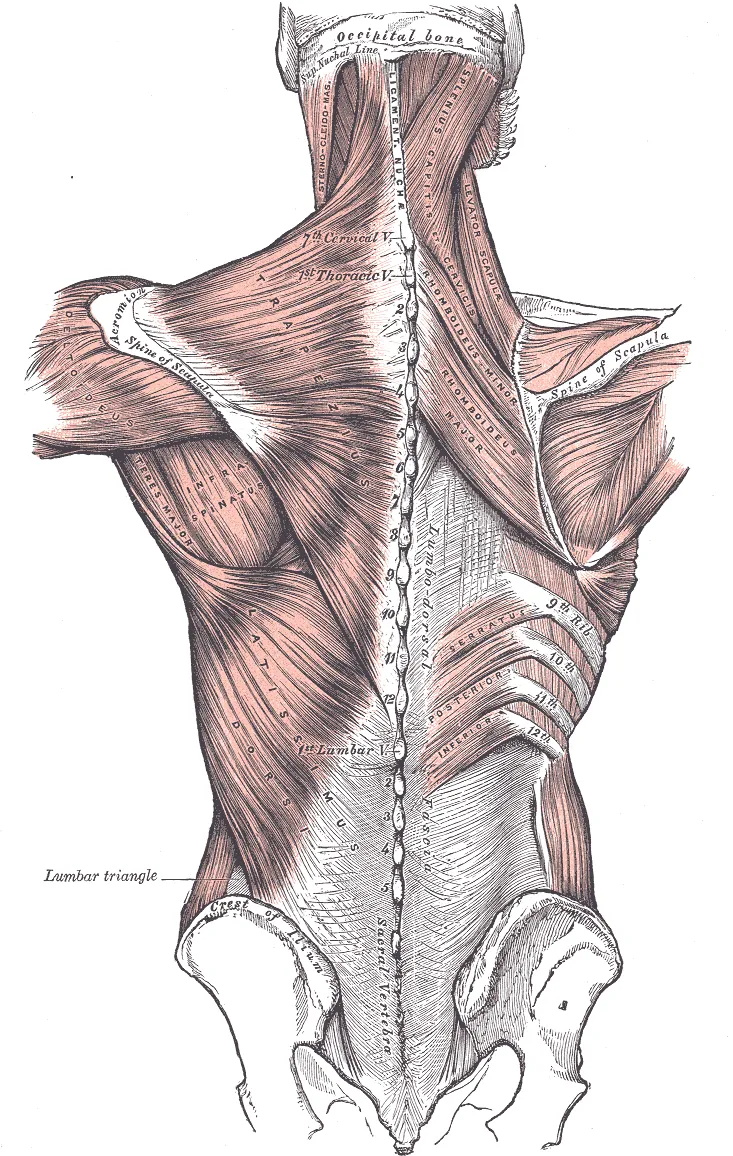
An ultrasound study compared 36 people with chronic whiplash-associated disorders and 36 matched controls31. During a shoulder shrug, the outer layer of the upper trapezius changed shape less in the whiplash group, both lifting and lowering31. After a task of lifting a loaded arm out to the side, this change fell in both groups, but significantly only in the whiplash group31. The authors suggest the muscle’s layers may be used in a different pattern, and call for more research31.
Related exercise pages
See also the shrug, the movement measured in that trapezius study31, and the neck isometric hold.
A randomised pilot trial took in 33 people with subacute whiplash-associated disorders32. A 6-week device-guided craniocervical (head-on-neck) exercise programme delivered online went with greater drops in disability and pain32. It was compared with standard neck exercise and usual care; the authors call the findings preliminary32. In the trial, 16 mild, short-lived adverse events were reported (27%)32.
Whiplash was studied in
Whiplash was studied with
Whiplash is discussed on
Sources
- Pastakia K, Kumar S (2011). Acute whiplash associated disorders (WAD).. Open access emergency medicine. doi:10.2147/OAEM.S17853 PMID 27147849
- Carroll LJ, Holm LW, Hogg-Johnson S, Côté P, Cassidy JD, Haldeman S, et al. (2008). Course and prognostic factors for neck pain in whiplash-associated disorders (WAD). Spine. doi:10.1097/BRS.0b013e3181643eb8 PMID 18204405
- Al-Khazali HM, Ashina H, Iljazi A, Lipton RB, Ashina M, Ashina S, Schytz HW (2020). Neck pain and headache after whiplash injury: a systematic review and meta-analysis.. Pain. doi:10.1097/j.pain.0000000000001805 PMID 31977938
- Kamper SJ, Rebbeck TJ, Maher CG, McAuley JH, Sterling M (2008). Course and prognostic factors of whiplash: a systematic review and meta-analysis.. Pain. doi:10.1016/j.pain.2008.02.019 PMID 18407412
- Ritchie C, Sterling M (2016). Recovery Pathways and Prognosis After Whiplash Injury.. The Journal of orthopaedic and sports physical therapy. doi:10.2519/jospt.2016.6918 PMID 27594661
- Chrcanovic B, Larsson J, Malmström EM, Westergren H, Häggman-Henrikson B (2022). Exercise therapy for whiplash-associated disorders: a systematic review and meta-analysis.. Scandinavian journal of pain. doi:10.1515/sjpain-2021-0064 PMID 34561976
- Verhagen AP, Scholten-Peeters GG, van Wijngaarden S, de Bie RA, Bierma-Zeinstra SM (2007). Conservative treatments for whiplash.. The Cochrane database of systematic reviews. doi:10.1002/14651858.CD003338.pub3 PMID 17443525
- Wiangkham T, Duda J, Haque S, Madi M, Rushton A (2015). The Effectiveness of Conservative Management for Acute Whiplash Associated Disorder (WAD) II: A Systematic Review and Meta-Analysis of Randomised Controlled Trials.. PloS one. doi:10.1371/journal.pone.0133415 PMID 26196127
- Anderson C, Yeung E, Toong T, Tong T, Reed N (2018). A narrative review on cervical interventions in adults with chronic whiplash-associated disorder.. BMJ open sport & exercise medicine. doi:10.1136/bmjsem-2017-000299 PMID 29719724
- Lord SM, Barnsley L, Wallis BJ, Bogduk N (1996). Chronic cervical zygapophysial joint pain after whiplash. Spine. doi:10.1097/00007632-199608010-00005 PMID 8855458
- Al-Wardat M, Al Rjoub T, Alrawashdeh A, Etoom M, Kanaan S, Hawamdeh Z, et al. (2026). The effectiveness of psychological interventions on pain, disability, and psychological symptoms in whiplash-associated disorders: a systematic review and meta-analysis.. BMC psychology. doi:10.1186/s40359-026-04955-y PMID 42298620
- Holm LW, Carroll LJ, Cassidy JD, Hogg-Johnson S, Côté P, Guzman J, et al. (2008). The burden and determinants of neck pain in whiplash-associated disorders after traffic collisions. Spine. doi:10.1097/BRS.0b013e3181643ece PMID 18204401
- Styrke J, Stålnacke BM, Bylund PO, Sojka P, Björnstig U (2012). A 10-year incidence of acute whiplash injuries after road traffic crashes in a defined population in northern Sweden.. PM & R. doi:10.1016/j.pmrj.2012.05.010 PMID 22819305
- Cassidy JD, Carroll LJ, Côté P, Lemstra M, Berglund A, Nygren A (2000). Effect of eliminating compensation for pain and suffering on the outcome of insurance claims for whiplash injury.. The New England journal of medicine. doi:10.1056/NEJM200004203421606 PMID 10770984
- Safiri S, Kolahi AA, Hoy D, Buchbinder R, Mansournia MA, Bettampadi D, et al. (2020). Global, regional, and national burden of neck pain in the general population, 1990-2017: systematic analysis of the Global Burden of Disease Study 2017.. BMJ (Clinical research ed.). doi:10.1136/bmj.m791 PMID 32217608
- Hogg-Johnson S, van der Velde G, Carroll LJ, Holm LW, Cassidy JD, Guzman J, et al. (2008). The burden and determinants of neck pain in the general population. Spine. doi:10.1097/BRS.0b013e31816454c8 PMID 18204398
- Sterling M, Hendrikz J, Kenardy J (2010). Compensation claim lodgement and health outcome developmental trajectories following whiplash injury: A prospective study.. Pain. doi:10.1016/j.pain.2010.02.013 PMID 20307934
- Crouch R, Whitewick R, Clancy M, Wright P, Thomas P (2006). Whiplash associated disorder: incidence and natural history over the first month for patients presenting to a UK emergency department.. Emergency medicine journal. doi:10.1136/emj.2004.022145 PMID 16439739
- Côté P, Wong JJ, Sutton D, Shearer HM, Mior S, Randhawa K, et al. (2016). Management of neck pain and associated disorders: A clinical practice guideline from the Ontario Protocol for Traffic Injury Management (OPTIMa) Collaboration.. European spine journal. doi:10.1007/s00586-016-4467-7 PMID 26984876
- Walton DM, Macdermid JC, Giorgianni AA, Mascarenhas JC, West SC, Zammit CA (2013). Risk factors for persistent problems following acute whiplash injury: update of a systematic review and meta-analysis.. The Journal of orthopaedic and sports physical therapy. doi:10.2519/jospt.2013.4507 PMID 23322093
- Biering-Sørensen S, Møller A, Stoltenberg CD, Holm JW, Skov PG (2014). The return-to-work process of individuals sick-listed because of whiplash-associated disorder: a three-year follow-up study in a Danish cohort of long-term sickness absentees.. BMC public health. doi:10.1186/1471-2458-14-113 PMID 24495801
- Ricciardi L, Stifano V, D'Arrigo S, Polli FM, Olivi A, Sturiale CL (2019). The role of non-rigid cervical collar in pain relief and functional restoration after whiplash injury: a systematic review and a pooled analysis of randomized controlled trials.. European spine journal. doi:10.1007/s00586-019-06035-9 PMID 31214856
- Christensen SWM, Rasmussen MB, Jespersen CL, Sterling M, Skou ST (2021). Soft-collar use in rehabilitation of whiplash-associated disorders - A systematic review and meta-analysis.. Musculoskeletal science & practice. doi:10.1016/j.msksp.2021.102426 PMID 34271416
- Michaleff ZA, Maher CG, Lin CW, Rebbeck T, Jull G, Latimer J, Connelly L, Sterling M (2014). Comprehensive physiotherapy exercise programme or advice for chronic whiplash (PROMISE): a pragmatic randomised controlled trial.. Lancet (London, England). doi:10.1016/S0140-6736(14)60457-8 PMID 24703832
- Southerst D, Nordin MC, Côté P, Shearer HM, Varatharajan S, Yu H, et al. (2016). Is exercise effective for the management of neck pain and associated disorders or whiplash-associated disorders? A systematic review by the Ontario Protocol for Traffic Injury Management (OPTIMa) Collaboration.. The spine journal. doi:10.1016/j.spinee.2014.02.014 PMID 24534390
- Ludvigsson ML, Peterson G, O'Leary S, Dedering Å, Peolsson A (2015). The effect of neck-specific exercise with, or without a behavioral approach, on pain, disability, and self-efficacy in chronic whiplash-associated disorders: a randomized clinical trial.. The Clinical journal of pain. doi:10.1097/AJP.0000000000000123 PMID 24918474
- Correia L, Carvalho P, Amaral L, Esteves M, Vilarinho R, Cervaens M (2025). The Effect of Neck-Specific Exercise with or Without a Behavioral Approach in Chronic Whiplash-Associated Disorders: A Systematic Review and Meta-Analysis.. Muscles (Basel, Switzerland). doi:10.3390/muscles4040049 PMID 41283437
- Lamb SE, Gates S, Williams MA, Williamson EM, Mt-Isa S, Withers EJ, et al. (2013). Emergency department treatments and physiotherapy for acute whiplash: a pragmatic, two-step, randomised controlled trial.. Lancet (London, England). doi:10.1016/S0140-6736(12)61304-X PMID 23260167
- Owers DS, Perriman DM, Smith PN, Neeman T, Webb AL (2018). Evidence for cervical muscle morphometric changes on magnetic resonance images after whiplash: A systematic review and meta-analysis.. Injury. doi:10.1016/j.injury.2017.12.001 PMID 29269107
- Ourieff J, Scheckel B, Agarwal A (2023). Anatomy, Back, Trapezius.. StatPearls. PMID 30085536
- Landén Ludvigsson M, Peterson G, Jull G, Trygg J, Peolsson A (2016). Mechanical properties of the trapezius during scapular elevation in people with chronic whiplash associated disorders--A case-control ultrasound speckle tracking analysis.. Manual Therapy. doi:10.1016/j.math.2015.07.009 PMID 26277485
- Muñoz-Bustos M, Neira-Torres H, Ceballos-Laita L, Muñoz-Bustos GA, Portela A, Carrasco-Uribarren A (2026). Effects of device-guided craniocervical muscle training in subacute whiplash: a preliminary randomized controlled trial.. The Journal of manual & manipulative therapy. doi:10.1080/10669817.2026.2720771 PMID 42667605
Changes
- First published.