Serratus anterior
The fan-shaped muscle on the side of the chest that holds the shoulder blade to the ribs and turns it upward. How it moves the shoulder blade, what happens when its nerve fails, how that tends to recover, and what it works with.
- Region
- Trunk
- Starts on
- the sides of the first nine ribs, in a saw-toothed row1,2
- Ends on
- the front of the shoulder blade's inner border, from its upper angle to its lower angle1,2
- Updated
- September 30, 2026
- Reviewed
- September 30, 2026 · how entries are checked
Function
Where it sits and what it attaches to
The muscle runs from the side wall of the chest to the scapula (shoulder blade)1. It starts on the sides of the first nine ribs2. These rib attachments look like the teeth of a saw, which gives the muscle its name2. On the fifth to ninth ribs, it interlocks with the start of the external oblique, the outermost flat muscle of the abdomen5.
From the ribs, it passes backward in front of the shoulder blade2. It attaches along the whole inner edge of the bone’s front surface2. There it lies close to the subscapularis (a muscle on the front of the shoulder blade, next to the ribs), and often links with it2.
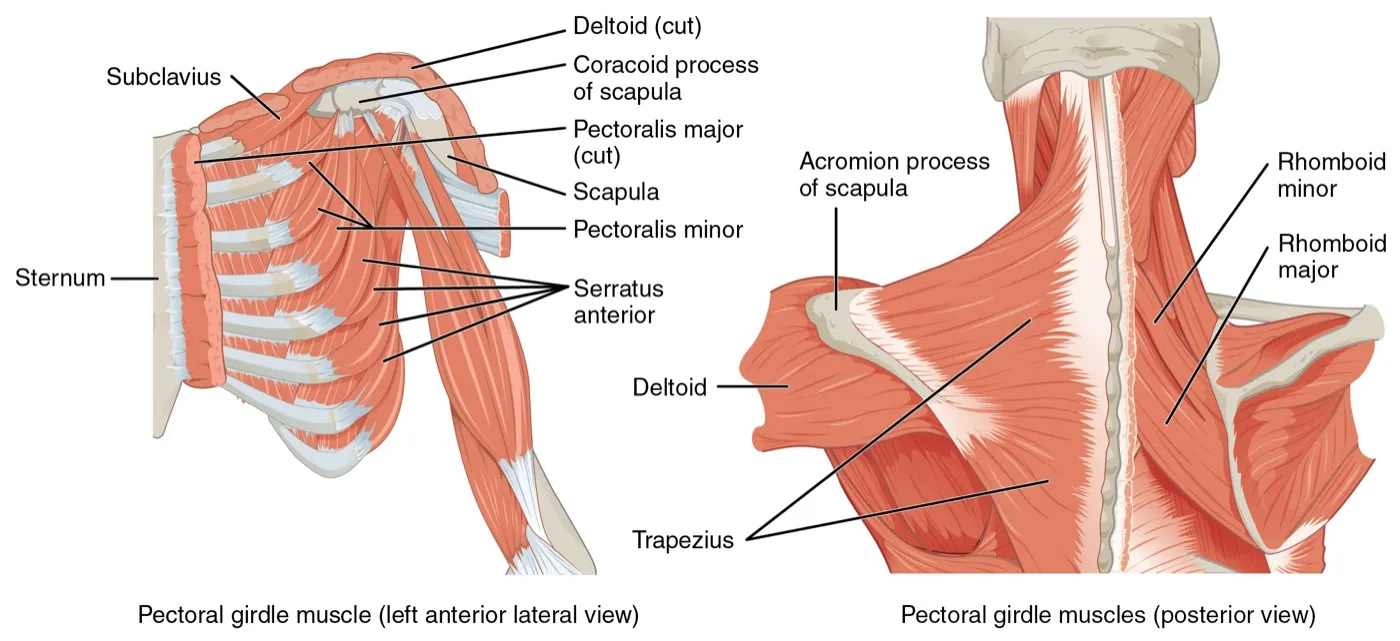
Most of it lies beneath the shoulder blade and chest muscles1. It can be felt between the pectoralis major (the large, fan-shaped muscle at the front of the chest) and the latissimus dorsi (the lats)1.
Three parts
Sources usually split the muscle into three parts, by where each one lands on the shoulder blade1. The bone’s inner border ends in a superior angle at the top and an inferior angle at the bottom6. One review gives each part’s rib levels3:
| Part | Starts on | Attaches to |
|---|---|---|
| Upper | Ribs one and two | The upper inner corner3 |
| Middle | Ribs three to five | The inner border3 |
| Lower | Ribs six to nine | The lower corner3 |
What it does to the shoulder blade
The muscle’s primary actions are protraction and turning the shoulder blade upward on the chest wall2. Protraction happens when reaching forward or pushing things away2. It protracts strongly because its line of pull is close to level and it has a long moment arm, meaning good leverage2. One review of scapular winging adds that it keeps the shoulder blade close against the chest wall3. That review says this places the shoulder socket for arm movement3.
Sources give each part a different job, and their wording differs3,7,8:
- One review describes the upper part as the anchor that lets the shoulder blade turn as the arm goes overhead3.
- From 70 dissections of cadavers (bodies donated for study), one team suggests the middle part moves the shoulder blade away from the body’s midline7.
- The same team suggests the lower part helps turn the shoulder blade upward, move it away from the midline and tilt it backward7.
- A review of shoulder muscle studies says the middle and lower parts turn the shoulder blade upward, tilt it back and turn it outward8.
That review describes these two parts as the only muscles between shoulder blade and chest able to both turn it upward and tilt it back8.
EMG (electromyography) measures a muscle’s activity by picking up its electrical signals. In an EMG study of 29 healthy people, the lower part was more active than the upper part9. This held in tests that mainly turned the shoulder blade upward9. The two parts did not differ significantly in tests of full protraction9.
When the hands are fixed, as in a push-up, the muscle works in reverse2. It lifts the ribs and trunk toward the shoulder blades2. In a full push-up, one review says its forward pull drives the late phase, lifting the chest highest from the floor2.
Its nerve
One review says the long thoracic nerve is the muscle’s only nerve, and that it averages 24 cm long3. It runs down the chest wall on the muscle’s outer surface10. Another source says it comes from the brachial plexus (the network of nerves, starting at the neck, that serves the arm)10. That source says it typically gets fibres from the C5, C6 and C7 nerve roots10.
A study of 70 dissections of 35 cadavers looked at the supply to each part7. There, the C5 nerve root gave most of the upper part’s supply7. The long thoracic nerve, formed from the C6 and C7 roots, supplied the middle and lower parts7.
Breakdown
When the muscle is weak: winging
Scapular winging is rare3. When the serratus anterior is paralysed, the shoulder blade’s inner edge sticks out3. The trapezius is the large muscle across the upper back and neck that moves the shoulder blade. When it or the rhomboids (muscles between the shoulder blades and the spine) are paralysed, the outer edge sticks out instead3.
When a weak muscle works against resistance to draw the shoulder blade forward, the inner border lifts away from the ribs2. The worse the weakness, the worse the winging tends to be2.
With the muscle weak, the arm-lifting muscles can turn the shoulder blade downward during attempts to raise the arm2. One review says winging can affect lifting, pushing and pulling heavy objects and daily tasks3. It can reduce power, limit raising the arm, and cause considerable pain3.
How often it happens
Paralysis of the serratus anterior is uncommon3. One review gives two figures. One EMG laboratory reported 15 cases in 7,000 patients, and the Mayo Clinic found one case in 38,500 patients3. It has been recorded in athletes in many sports, such as weightlifting, tennis, baseball and gymnastics3. It has also been seen in manual workers, such as mechanics, welders and carpenters3.
What damages the nerve
The nerve’s long, winding path is thought to make it easy to injure3. Most injuries from trauma follow blunt trauma, such as the shoulder being forced suddenly downward3. Injury can also follow repeated movements in sport, or in tasks such as digging and hedge-clipping3.
How trauma injures the nerve is not settled3. In one cadaver study, tilting and turning the head away while raising the arm doubled the nerve’s length3. That supports the idea that stretch does the damage, though at least one pair of authors was not convinced3.
One study of 92 people with this paralysis recorded what came first11:
| What came before it | Share of cases |
|---|---|
| Exertion | 40%11 |
| Trauma | 24%11 |
| Infection | 15%11 |
| Surgery or anaesthesia | 11%11 |
| No clear cause | 10%11 |
Fatigue and shoulder pain
In one study of 30 people, tiring the serratus anterior changed how the shoulder blade moved as the arm rose13. It tilted back less and turned inward more, but its upward turn did not change13.
A systematic review looked at 12 EMG studies that compared people with shoulder problems against control groups14. Shoulder impingement syndrome is a pinching of tissue in the space beneath the bony point at the top of the shoulder. In 3 of 5 studies of it, serratus activity was lower than in the controls14. Results in unstable shoulder joints were contradictory14.
Recovery
How paralysis tends to recover
A systematic review looked at six studies of 234 shoulders with this paralysis managed without surgery4. Across these studies, winging recovered on its own in 21% to 78%, with a median follow-up of 72 months4. It concluded that a substantial share of people with nerve-related winging managed without surgery seem to have lasting complaints4.
A different review, of scapular winging, states that most cases of serratus anterior paralysis clear up on their own within 24 months3. One long-term study of 37 people with this paralysis found a mixed picture15:
- Over 2 to 31 years of observation alone, winging lasted 16 months on average and went away in 78%15.
- Raising the arm forward returned to normal in 82%, and raising it to the side in 89%15.
- Symptoms mostly recovered within 2 years, but at least a quarter had lasting symptoms, mainly pain15.
- 30% of that group were free of pain15.
What the cause changes
In 92 people with this paralysis, followed for 18 years on average, recovery differed by cause11. Paralysis after infection recovered better, and paralysis after surgery or anaesthesia recovered worse11. Cases after trauma and after overuse or exertion followed the same course11.
A Mayo Clinic study followed 106 people for about four years16. Of these, 50 had damage to this nerve and 56 had damage to the spinal accessory nerve, which works the trapezius16,17. Across the whole group, good recovery of function was generally seen, whatever their nerve tests showed16. Injuries from trauma generally did worse than those from other causes16. This result is about function, while the systematic review above looked at winging and lasting complaints4,16.
Connections
The trapezius
The serratus anterior and the trapezius are the primary force couple that turns the shoulder blade upward as the arm rises2. A force couple is two muscles pulling in different directions that together turn a bone. The serratus anterior’s leading role comes from its good leverage and its many fibres meeting at the lower corner2.
The middle trapezius holds back the serratus anterior’s strong forward pull2. Without enough of it, the shoulder blade usually drifts far forward as the arm rises2.
Other shoulder-blade muscles
The levator scapulae runs from the neck to the top of the shoulder blade. The pectoralis minor is a smaller chest muscle beneath the pectoralis major. When the trunk rises in a push-up, both help the trapezius and rhomboids steady the shoulder blade2. As the arm rises, the rhomboids and levator scapulae are less active, and are thought to help resist the serratus anterior’s sideways pull8.
The deltoid and rotator cuff
Muscles that position the shoulder girdle, including this one, give the deltoid a steady base to move the arm from6. The shoulder girdle is the shoulder blades and collarbones, and the deltoid is the rounded muscle that caps the shoulder. As the arm rises, the middle deltoid and the supraspinatus, a muscle along the top of the shoulder blade, pull it toward a downward turn2. The upward turning force from the serratus anterior and trapezius must be greater2.
The rotator cuff is a group of four muscles that cross the shoulder joint and help hold it steady. A shoulder blade out of place can change their line of pull2.
Exercises that load it
Related exercise pages: plank, shrug, overhead press and band external rotation19,20,21,22.
| Exercise or study | What was found |
|---|---|
| 10 exercises, 30 healthy people | Activity was highest in exercises that turned the shoulder blade far upward23 |
| Push-up plus, 30 people, healthy or with mild shoulder problems | The standard version drew the most activity of the versions tested, up to 123% of maximum24 |
| Floor and suspended planks, 21 people | Activity peaked in the normal floor plank and the feet-suspended plank19 |
| Shrug, 20 people whose shoulder blades turn downward | Activity was greatest with the arms raised 150 degrees to the side20 |
| Overhead press, 12 men lifting half their maximum | An unsteady bar with kettlebells hung from bands raised activity above a steady barbell21 |
| Band external rotation, 13 healthy men | Activity rose with the arm held 90 degrees out to the side22 |
Serratus anterior moves
Serratus anterior works with to turn the shoulder blade upward
Serratus anterior gives a steady base to
Serratus anterior interlocks on the ribs with
Serratus anterior lies next to
Serratus anterior is loaded by
Sources
- Lung K, St Lucia K, Lui F (2024). Anatomy, Thorax, Serratus Anterior Muscles.. StatPearls. PMID 30285352
- Neumann DA, Camargo PR (2019). Kinesiologic considerations for targeting activation of scapulothoracic muscles - part 1: serratus anterior.. Brazilian Journal of Physical Therapy. doi:10.1016/j.bjpt.2019.01.008 PMID 30737019
- Martin RM, Fish DE (2008). Scapular winging: anatomical review, diagnosis, and treatments.. Current Reviews in Musculoskeletal Medicine. doi:10.1007/s12178-007-9000-5 PMID 19468892
- Geurkink TH, Gacaferi H, Marang-van de Mheen PJ, Schoones JW, de Groot JH, Nagels J, Nelissen RGHH (2023). Treatment of neurogenic scapular winging: a systematic review on outcomes after nonsurgical management and tendon transfer surgery.. Journal of Shoulder and Elbow Surgery. doi:10.1016/j.jse.2022.09.009 PMID 36252782
- Hosea TM, Hannafin JA (2012). Rowing injuries.. Sports Health. doi:10.1177/1941738112442484 PMID 23016093
- Betts JG, Young KA, Wise JA, Johnson E, Poe B, Kruse DH, Korol O, Johnson JE, Womble M, DeSaix P (2022). Anatomy and Physiology 2e. OpenStax. Link
- Hamada J, Igarashi E, Akita K, Mochizuki T (2008). A cadaveric study of the serratus anterior muscle and the long thoracic nerve.. Journal of Shoulder and Elbow Surgery. doi:10.1016/j.jse.2008.02.009 PMID 18586531
- Phadke V, Camargo P, Ludewig P (2009). Scapular and rotator cuff muscle activity during arm elevation: A review of normal function and alterations with shoulder impingement.. Revista Brasileira de Fisioterapia. doi:10.1590/S1413-35552009005000012 PMID 20411160
- Ekstrom RA, Bifulco KM, Lopau CJ, Andersen CF, Gough JR (2004). Comparing the function of the upper and lower parts of the serratus anterior muscle using surface electromyography.. Journal of Orthopaedic and Sports Physical Therapy. doi:10.2519/jospt.2004.34.5.235 PMID 15189015
- Lung K, Lui F (2023). Anatomy, Thorax, Long Thoracic Nerve.. StatPearls. PMID 30571017
- Vastamäki M, Ristolainen L, Vastamäki H, Pikkarainen V (2017). Isolated serratus palsy etiology influences its long-term outcome.. Journal of Shoulder and Elbow Surgery. doi:10.1016/j.jse.2017.04.007 PMID 28606639
- Güzel Ş, Ozen S, Sözay S (2023). Scapula winging secondary to prone plank exercise: a case report.. International Journal of Neuroscience. doi:10.1080/00207454.2021.1924710 PMID 33930995
- Harrison N, Garrett WZ, Timmons MK (2021). Serratus Anterior Fatigue Reduces Scapular Posterior Tilt and External Rotation During Arm Elevation.. Journal of Sport Rehabilitation. doi:10.1123/jsr.2021-0010 PMID 34294607
- Struyf F, Cagnie B, Cools A, Baert I, Brempt JV, Struyf P, Meeus M (2014). Scapulothoracic muscle activity and recruitment timing in patients with shoulder impingement symptoms and glenohumeral instability.. Journal of Electromyography and Kinesiology. doi:10.1016/j.jelekin.2013.12.002 PMID 24389333
- Pikkarainen V, Kettunen J, Vastamäki M (2013). The natural course of serratus palsy at 2 to 31 years.. Clinical Orthopaedics and Related Research. doi:10.1007/s11999-012-2723-7 PMID 23208124
- Friedenberg SM, Zimprich T, Harper CM (2002). The natural history of long thoracic and spinal accessory neuropathies.. Muscle and Nerve. doi:10.1002/mus.10068 PMID 11932971
- Ourieff J, Scheckel B, Agarwal A (2023). Anatomy, Back, Trapezius.. StatPearls. PMID 30085536
- Vastamäki M, Pikkarainen V, Vastamäki H, Ristolainen L (2015). Scapular Bracing is Effective in Some Patients but Symptoms Persist in Many Despite Bracing.. Clinical Orthopaedics and Related Research. doi:10.1007/s11999-015-4310-1 PMID 25910775
- Byrne JM, Bishop NS, Caines AM, Crane KA, Feaver AM, Pearcey GE (2014). Effect of using a suspension training system on muscle activation during the performance of a front plank exercise.. Journal of Strength and Conditioning Research. doi:10.1519/JSC.0000000000000510 PMID 24796979
- Choi WJ, Cynn HS, Lee CH, Jeon HS, Lee JH, Jeong HJ, Yoon TL (2015). Shrug exercises combined with shoulder abduction improve scapular upward rotator activity and scapular alignment in subjects with scapular downward rotation impairment.. Journal of Electromyography and Kinesiology. doi:10.1016/j.jelekin.2014.12.001 PMID 25553964
- Williams MR Jr, Hendricks DS, Dannen MJ, Arnold AM, Lawrence MA (2020). Activity of Shoulder Stabilizers and Prime Movers During an Unstable Overhead Press.. Journal of Strength and Conditioning Research. doi:10.1519/JSC.0000000000002660 PMID 29889776
- Sung JH, Kim GT, Shin H, Lee D, Wang J (2026). The effects of shoulder abduction angle and elastic band resistance on shoulder muscle activity during external rotation exercises.. Scientific Reports. doi:10.1038/s41598-025-34767-w PMID 41559205
- Ekstrom RA, Donatelli RA, Soderberg GL (2003). Surface electromyographic analysis of exercises for the trapezius and serratus anterior muscles.. Journal of Orthopaedic and Sports Physical Therapy. doi:10.2519/jospt.2003.33.5.247 PMID 12774999
- Ludewig PM, Hoff MS, Osowski EE, Meschke SA, Rundquist PJ (2004). Relative balance of serratus anterior and upper trapezius muscle activity during push-up exercises.. American Journal of Sports Medicine. doi:10.1177/0363546503258911 PMID 14977678
Changes
- First published.