Long thoracic nerve
The nerve that runs down the side of the chest to the serratus anterior. Where it runs, how it is injured, and what series of people with a palsy of it report about recovery and surgery.
- Region
- Trunk
- Updated
- October 8, 2026
- Reviewed
- October 8, 2026 · how entries are checked
Function
Where it starts and where it runs
One review of long thoracic nerve palsy describes the nerve as a motor nerve whose anatomy varies1. In most people it arises from the nerve roots labelled C5, C6 and C71. A nerve root is the part of a nerve where it leaves the spinal cord.
In 15 fresh cadavers, the branches from C5 and C6 met under the middle scalene, a muscle at the side of the neck7. They formed an upper division, which met the C7 branch lower down, in the armpit region7. One review describes the nerve then running down the side of the chest wall as far as the ninth rib1. There it lies on the surface of the serratus anterior, a muscle on the side of the chest that attaches to the upper ribs1. The 1918 plate below labels that muscle by its older name, serratus magnus.
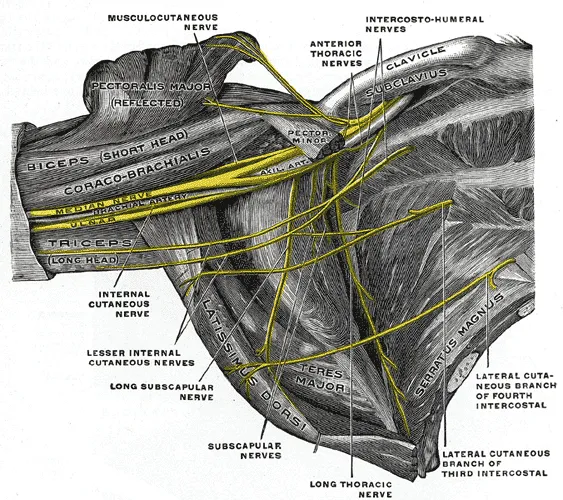
In 40 dissections of 21 adult cadavers, the nerve’s course differed markedly from person to person8. The author suggested this may explain why some people develop paralysis and others do not8.
What it does
Protraction is drawing the shoulder blade forward around the rib cage. In 15 fresh cadavers, two branches from the nerve’s upper division consistently reached the upper part of the serratus anterior7. When those branches were stimulated electrically during surgery in six patients, the shoulder moved forward, into protraction7. The serratus anterior page describes how the muscle moves the scapula (shoulder blade)9.
Breakdown
What a palsy of this nerve looks like
A review of long thoracic nerve injury describes the winging seen in serratus palsy6. The shoulder blade shifts toward the spine, its lower tip turns toward the midline, and its inner border stands out6.
What series report as the cause
Four series counted causes, and each counted a different kind of patient2,3,4,10. Electromyography measures a muscle’s activity by picking up its electrical signals. A lesion is an area of damaged tissue.
| Who was counted | Causes reported |
|---|---|
| 197 cases of isolated serratus anterior paralysis | Exertion came before 35% and trauma caused 26%. No cause was known in 15%3 |
| 96 patients in a row with serratus anterior dysfunction confirmed on needle electromyography | 84 had a long thoracic nerve lesion: neuralgic amyotrophy in 47, trauma in 33, surgery-related injury in 2 and neck pathology in 2. A muscle disorder accounted for the other 124 |
| 128 patients with a one-sided winged shoulder blade | Long thoracic nerve palsy in 70, ahead of spinal accessory nerve palsy in 39. Of the 70, 61 were related to neuralgic amyotrophy2 |
| 47 patients who had surgery on the nerve for winging | Heavy weight-lifting in 31 and repetitive throwing in 5. No cause was identified in 910 |
Injury or inflammation: the accounts differ
In 246 cases of neuralgic amyotrophy, an attack typically began with severe, continuous pain that lasted about four weeks on average5. Weakness followed5. In a retrospective series of 355 patients with the condition, the long thoracic nerve was the one most often involved11. A retrospective study is one that looks back at past cases or records.
The authors who analysed the 197 cases judged the nerve lesion to be mechanical in origin in most of them3. Another group re-read the nerve tests and MRI scans (detailed soft-tissue scans) of seven patients labelled with a non-traumatic, isolated palsy of this nerve12. All seven showed wider muscle or nerve involvement, and none showed MRI signs of nerve compression12. Those authors took this as strong support for an inflammatory cause12. One review notes that the line between injury and nerve inflammation is probably blurred1.
Where the nerve may be stretched or squeezed
One review states that where the nerve gets constricted remains controversial1. It names two places thought prone to compression: where the nerve pierces the middle scalene, and where it crosses the second rib1. Three reports reach different conclusions8,13,14:
- A review of 14 patients with traumatic winging found that each injury had suddenly forced the shoulder girdle (the shoulder blades and collarbones) downward13. Its anatomical studies suggested the nerve is compressed against the second rib, not trapped by the middle scalene13.
- In 40 dissections of 21 adult cadavers, the nerve was open to compression and stretching in front of the lower shoulder blade8.
- Authors who saw ten young athletes with isolated, complete serratus anterior paralysis concluded that it results from a traction injury (a pull along the length)14.
Loads, sport and medical procedures
One study covered nerve compression after carrying a load on the shoulders among 152,095 military conscripts15. The long thoracic nerve was affected most often, in 19 patients, against 13 for the axillary nerve15. One case report (a report on a single patient) attributed a nerve injury with winging to overhead weight-lifting exercises16. Another described one-sided winging from an injury to this nerve after plank exercises, possibly done incorrectly17.
One review says sharp injury to the nerve normally happens during operations, such as radical mastectomy (breast removal) and removal of the first rib1. In the larger published series, such injuries were 2% to 11% of cases1.
Recovery
Without surgery: what reviews say
Three reviews describe the outlook in different terms1,6,18:
- One review states that most patients regain serratus anterior function without surgery, though it may take as long as two years6.
- A second review states that, despite the traditionally positive outlook, newer evidence suggests the course is less clear-cut1. It reports residual winging, muscle weakness and fatigue in 25% to 57% of patients1.
- A 2025 review states that recovery can happen on its own, but many patients are left with lasting weakness of varying severity18.
A review of long thoracic nerve palsy states that no clinical measure currently identifies the people who may not recover1.
Without surgery: what series report
| Who was followed | What was reported |
|---|---|
| Ten young athletes with isolated, complete serratus anterior paralysis | The authors stated that full recovery is usual and takes nine months on average14 |
| 90 patients with isolated serratus palsy, managed with a brace or observation alone | Winging lasted 15.1 months on average in the 42 who felt they had recovered19 |
| 47 patients whose nerve lesion was put down to neuralgic amyotrophy | Winging resolved on its own within three years in 22, after 16 months on average4 |
| 26 patients whose paralysis followed a medical procedure, surveyed on average six years after onset | All but one still had symptoms and limits in using the arm20 |
A review of long thoracic nerve injury states that a brace is often tolerated poorly6. In one study, 55 people with isolated serratus palsy wore a shoulder blade brace for a mean 10 months21. After at least 10 years, winging had disappeared in 64%, and 67% still had pain at rest at least occasionally21.
Operations that free the nerve
Neurolysis is an operation that frees a nerve from the tissue around it. Decompression is surgery that takes pressure off a nerve. Three series report results after such operations10,22,23. Distal means farther from the centre of the body.
| Series | Where the nerve was freed | What was reported |
|---|---|---|
| 50 operations in 47 patients, followed for an average of 25.7 months | Above the collarbone | Winging improved in 49 (98%). The result was rated good or excellent in 46 (92%)10 |
| 52 cases in a row of isolated serratus anterior paralysis, studied retrospectively | Distal segment | Improvement was rated excellent or good in 45. Winging was completely corrected in 32 (61.5%)22 |
| 73 patients in a retrospective series, assessed up to 24 months after surgery | Distal segment | Improvement was excellent in 52% and good in 30%. Winging was gone in 63%, minimal in 31.5% and unchanged in 5.5%23 |
Among the 73, the best outcomes were in patients operated on within 12 months of the paralysis who had no pain in the compensating muscles23. Among the 52, the best outcomes were in patients operated on within 18 months who had no pain beforehand22.
Nerve transfer
A nerve transfer is surgery that reroutes a working nerve to a muscle that has lost its own nerve supply. Authors reporting in 2026 noted that published literature on nerve transfer for this palsy is scarce24. They wrote that the transfer usually takes a branch of the thoracodorsal nerve24. That nerve supplies the latissimus dorsi, the broad muscle across the middle and lower back25,26.
In a retrospective review of 19 patients operated on for an isolated palsy of this nerve, three had a nerve transfer27. In those three, full forward raising of the arm returned at an average of 2.5 months27. In a single-centre retrospective case series of 17 patients with long-standing palsy, 11 had the nerve freed and 6 also had a transfer24. Across the whole group, serratus anterior strength went from a median (middle value) grade of 0 to 3 at a median 12 months24. The first sign of contraction came at 3 weeks after decompression alone and at 7 months after transfer24.
Muscle transfer
A tendon transfer is surgery that moves a tendon so that it can do the job of another. Two series moved the pectoralis major, the large, fan-shaped muscle at the front of the chest28,29.
Sixteen patients with an isolated injury of this nerve had the tendon transferred28. After four years and three months on average, the result was excellent in eight, good in five and fair in one28. Two failed, both after a traumatic event28. In an observational cohort of 15 patients, forward raising of the arm improved from 86 degrees before surgery to 140 at one year29. It averaged 121 degrees after a median 17 years29.
Connections
One review names the serratus anterior as the one muscle this nerve supplies1.
One review describes a second, less common pattern, lateral winging, in which the shoulder droops and the shoulder blade sits lower1. It attributes this to dysfunction of the trapezius, mostly from spinal accessory nerve palsy, or to paralysis of the rhomboids1. The trapezius is the large muscle across the upper back and neck that moves the shoulder blade. The rhomboids are muscles between the shoulder blades and the spine.
In a full prone (face-down) push-up, protraction force from the serratus anterior dominates the late phase9. A single case report described one-sided winging from an injury to this nerve after prone plank exercises17. Related exercise pages: push-up, plank9,17.
Long thoracic nerve supplies
Long thoracic nerve supplies the muscle that moves
Long thoracic nerve gives a different winging, when it fails, from a palsy of the nerve to
Long thoracic nerve gives a different winging, when it fails, from paralysis of
Long thoracic nerve was affected, in one study of load carriage, more often than
Long thoracic nerve has been operated on, in series of its palsy, by transferring
Long thoracic nerve usually receives, when a nerve transfer is done, a branch of the nerve to
Long thoracic nerve was injured, in one case report, after
Long thoracic nerve supplies a muscle that works in
Sources
- Wu F, Ng CY (2023). Long Thoracic Nerve Palsy: When Is Decompression Indicated.. Journal of hand surgery global online. doi:10.1016/j.jhsg.2022.11.006 PMID 37521538
- Seror P, Lenglet T, Nguyen C, Ouaknine M, Lefevre-Colau MM (2018). Unilateral winged scapula: Clinical and electrodiagnostic experience with 128 cases, with special attention to long thoracic nerve palsy.. Muscle & nerve. doi:10.1002/mus.26059 PMID 29314072
- Vastamäki M, Kauppila LI (1993). Etiologic factors in isolated paralysis of the serratus anterior muscle: A report of 197 cases.. Journal of shoulder and elbow surgery. doi:10.1016/S1058-2746(09)80082-7 PMID 22959502
- Ng CY, Wu F (2021). Scapular winging secondary to serratus anterior dysfunction: analysis of clinical presentations and etiology in a consecutive series of 96 patients.. Journal of shoulder and elbow surgery. doi:10.1016/j.jse.2021.02.012 PMID 33675974
- van Alfen N, van Engelen BG (2006). The clinical spectrum of neuralgic amyotrophy in 246 cases.. Brain : a journal of neurology. doi:10.1093/brain/awh722 PMID 16371410
- Wiater JM, Flatow EL (1999). Long thoracic nerve injury.. Clinical orthopaedics and related research. PMID 10613149
- Bertelli JA, Ghizoni MF (2005). Long Thoracic Nerve. The Journal of bone and joint surgery. American volume. doi:10.2106/JBJS.D.02383 PMID 15866961
- Kauppila LI (1993). The long thoracic nerve: Possible mechanisms of injury based on autopsy study.. Journal of shoulder and elbow surgery. doi:10.1016/S1058-2746(09)80083-9 PMID 22959503
- Neumann DA, Camargo PR (2019). Kinesiologic considerations for targeting activation of scapulothoracic muscles - part 1: serratus anterior.. Brazilian Journal of Physical Therapy. doi:10.1016/j.bjpt.2019.01.008 PMID 30737019
- Nath RK, Lyons AB, Bietz G (2007). Microneurolysis and decompression of long thoracic nerve injury are effective in reversing scapular winging: long-term results in 50 cases.. BMC musculoskeletal disorders. doi:10.1186/1471-2474-8-25 PMID 17343759
- Seror P (2025). Neuralgic amyotrophy of Parsonage and Turner. Which nerves are most frequently involved in daily practice? Data from 355 patients.. Joint bone spine. doi:10.1016/j.jbspin.2024.105777 PMID 39303939
- Maldonado AA, Zuckerman SL, Howe BM, Mauermann ML, Spinner RJ (2017). "Isolated long thoracic nerve palsy": More than meets the eye.. Journal of plastic, reconstructive & aesthetic surgery : JPRAS. doi:10.1016/j.bjps.2017.06.020 PMID 28716694
- Gozna ER, Harris WR (1979). Traumatic winging of the scapula.. The Journal of bone and joint surgery. American volume. PMID 511883
- Gregg JR, Labosky D, Harty M, Lotke P, Ecker M, DiStefano V, Das M (1979). Serratus anterior paralysis in the young athlete.. The Journal of bone and joint surgery. American volume. PMID 479228
- Mäkelä JP, Ramstad R, Mattila V, Pihlajamäki H (2006). Brachial plexus lesions after backpack carriage in young adults.. Clinical orthopaedics and related research. doi:10.1097/01.blo.0000229338.29277.29 PMID 16906084
- Berthold JB, Burg TM, Nussbaum RP (2017). Long Thoracic Nerve Injury Caused by Overhead Weight Lifting Leading to Scapular Dyskinesis and Medial Scapular Winging.. The Journal of the American Osteopathic Association. doi:10.7556/jaoa.2017.025 PMID 28134956
- Güzel Ş, Ozen S, Sözay S (2023). Scapula winging secondary to prone plank exercise: a case report.. International Journal of Neuroscience. doi:10.1080/00207454.2021.1924710 PMID 33930995
- Sanchez-Urgelles P, Diez Sánchez B, Sanchez-Sotelo J (2025). Serratus anterior palsy secondary to long thoracic nerve dysfunction.. JSES reviews, reports, and techniques. doi:10.1016/j.xrrt.2025.01.011 PMID 40321868
- Vastamäki M, Vastamäki H, Pikkarainen V, Ristolainen L (2018). Initial Electromyography Fails to Predict Long-Term Outcome of Isolated Serratus Palsy.. Scandinavian journal of surgery : SJS : official organ for the Finnish Surgical Society and the Scandinavian Surgical Society. doi:10.1177/1457496918766716 PMID 29628010
- Kauppila LI, Vastamäki M (1996). Iatrogenic Serratus Anterior Paralysis. Chest. doi:10.1378/chest.109.1.31 PMID 8549212
- Vastamäki M, Pikkarainen V, Vastamäki H, Ristolainen L (2015). Scapular Bracing is Effective in Some Patients but Symptoms Persist in Many Despite Bracing.. Clinical Orthopaedics and Related Research. doi:10.1007/s11999-015-4310-1 PMID 25910775
- Le Nail LR, Bacle G, Marteau E, Corcia P, Favard L, Laulan J (2014). Isolated paralysis of the serratus anterior muscle: surgical release of the distal segment of the long thoracic nerve in 52 patients.. Orthopaedics & traumatology, surgery & research : OTSR. doi:10.1016/j.otsr.2014.03.004 PMID 24703793
- Roulet S, Bernier D, Le Nail LR, Tranier M, Corcia P, Laulan J, Bacle G (2022). Neurolysis of the distal segment of the long thoracic nerve for the treatment of scapular winging due to serratus anterior palsy: a continuous series of 73 cases.. Journal of shoulder and elbow surgery. doi:10.1016/j.jse.2022.02.039 PMID 35429634
- Li M, Parekh JN, Jimulia D, Duraku LS, Chaudhry T, Power DM (2026). Long Thoracic Nerve Decompression and Transfer: Single-Center Case Series of Clinical and Electromyographic Outcomes.. Hand (New York, N.Y.). doi:10.1177/15589447251343240 PMID 40667637
- Recker AJ, Gehrman MD, Diaz C, Bullock GS, Trasolini NA, Waterman BR (2023). Baseball Pitchers who Suffer Latissimus Dorsi and Teres Major Tendon Injuries Have a High Return to Play Rate After Either Operative or Nonoperative Treatment.. Arthroscopy, Sports Medicine, and Rehabilitation. doi:10.1016/j.asmr.2023.100787 PMID 37720893
- Lehane KM, Faust T, Romeo AA, Erickson BJ (2025). Approach to diagnosing and treating tears of the latissimus dorsi and teres major.. JSES Reviews, Reports, and Techniques. doi:10.1016/j.xrrt.2025.05.015 PMID 41179423
- Noland SS, Krauss EM, Felder JM, Mackinnon SE (2018). Surgical and Clinical Decision Making in Isolated Long Thoracic Nerve Palsy.. Hand (New York, N.Y.). doi:10.1177/1558944717733306 PMID 28975819
- Perlmutter GS, Leffert RD (1999). Results of transfer of the pectoralis major tendon to treat paralysis of the serratus anterior muscle.. The Journal of bone and joint surgery. American volume. PMID 10199276
- Geurkink TH, Marang-van de Mheen PJ, Robbers T, Nagels J, Nelissen RGHH (2024). Long-term outcomes of pectoralis major transfer for scapular winging due to long thoracic nerve palsy: results after a median follow-up of 17 years.. JSES international. doi:10.1016/j.jseint.2024.04.002 PMID 39035646
Changes
- Revised to report sources added after their published corrections were read