Latissimus dorsi
Also called lats, latissimus
The broad back muscle that runs from the lower spine and pelvis to the upper arm bone. What it moves, how and in whom it tears, how it adapts to training, and what it works with.
- Region
- Trunk
- Starts on
- the lower six thoracic vertebrae, lumbar spine, thoracolumbar fascia, lowest ribs, iliac crest and shoulder blade's lower tip (Pelvis)1,2,8
- Ends on
- the floor of the bicipital groove, at the top of the upper arm bone1,2
- Updated
- September 29, 2026
- Reviewed
- September 29, 2026 · how entries are checked
Function
Where the muscle sits
The latissimus dorsi is a broad, triangular muscle on the lower part of the back8. No other muscle of the upper trunk is larger1. Many muscles cross the shoulder and move the humerus (upper arm bone)8. Two of them are axial muscles, meaning muscles based on the trunk rather than on the limbs or shoulder blade8. They are this muscle and the pectoralis major, the large chest muscle8.
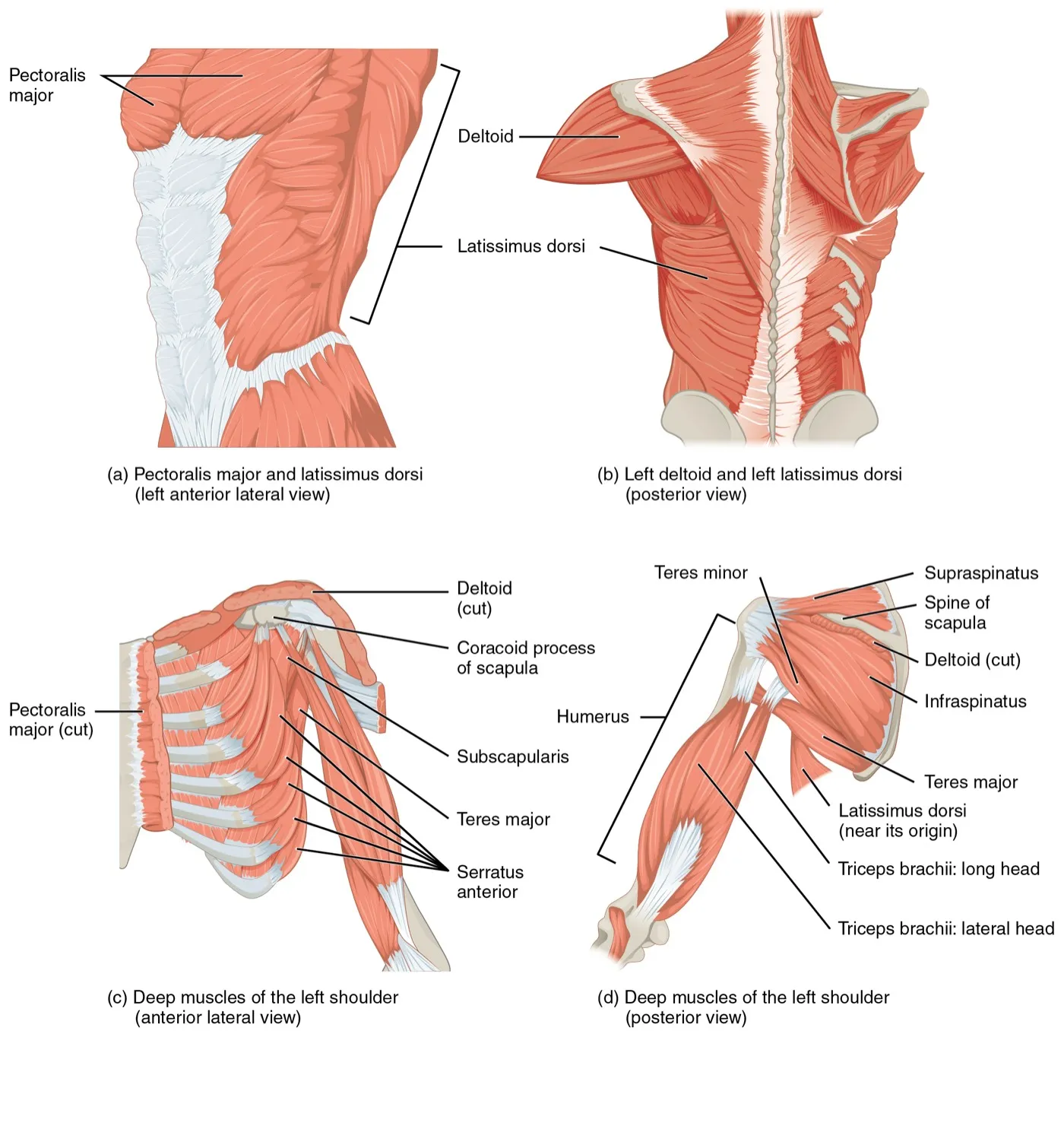
The muscle starts from a wide area1,2:
- the spiny bumps on the backs of the lower six thoracic (chest-level) vertebrae (spine bones)1,2;
- the lumbar (lower back) spine1,2;
- the thoracolumbar fascia, a sheet of tough tissue over the lower back1,2;
- the lowest three to four ribs1,2;
- the iliac crest, the top rim of the pelvis1,2;
- the lower tip of the scapula (shoulder blade)1,2.
The muscle ends in a tendon (a tough cord joining muscle to bone) on the upper arm bone1,2. The tendon attaches in the floor of a groove there, called the intertubercular or bicipital groove1,2. The thoracodorsal nerve supplies the muscle2,4.
What it moves
At the shoulder, the muscle does three things1,2,3:
| Action | What the arm does |
|---|---|
| Extension | Moves the arm backward1,2,3 |
| Adduction | Moves down and in, toward the body1,2,3 |
| Internal rotation | Turns inward1,2,3 |
It adds little to abduction, which means lifting the arm out to the side1. Its activity is also out of step with the main muscles that lift the arm this way1. The teres major, a thick shoulder muscle from the shoulder blade to the upper arm bone, works with it to make the same three movements4.
How it works in a throw
The first muscle-activity study of pitching showed the muscle working in two ways4. In these pitchers, the muscle first works while lengthening to slow the arm as it moves back, then shortens to pull the arm forward4. Working while lengthening is called an eccentric contraction; working while shortening is a concentric one4. The switch happens as the throw moves from late cocking, with the arm drawn back, into acceleration4.
Whether it turns the trunk
Whether the muscle helps twist the spine is disputed6. One group argued that it is built to move the arm6. In their view, its part in bracing the joints between spine and pelvis through the thoracolumbar fascia is trivial6. The background of a separate trunk-rotation study describes it as acting on the same side as the turn9. In 24 young men twisting against a machine, the external oblique, a side abdominal muscle, was more active than this muscle10.
Breakdown
Who tears the muscle
Injuries to this muscle and the teres major are uncommon4. They happen in high-level athletes who throw overhead again and again4. Most reported cases are in professional baseball pitchers2. Cases have also been reported in these groups2:
- weight lifters and CrossFit athletes2;
- water skiers and steer wrestlers2;
- rock climbers and track athletes2.
In people who do not pitch, two kinds of event are the typical cause2. One is pulling the arm down and forward hard against resistance2. The other is the arm being forced suddenly back, or too far out to the side2.
When in the throw it happens
In pitching, injury most often happens as late cocking turns into acceleration4. That is the moment the muscle switches from lengthening to shortening4. How much a pitcher throws is also linked to tears11. In most periods studied, games with more innings and more batters faced went with more tears later11. Being a starting pitcher was also linked to a higher risk11.
What kinds of tear there are
Four main types of rupture, or tear, have been described2:
- A tear or avulsion of the tendon alone, where avulsion means the tendon pulls off the bone2.
- Combined injuries, with the pectoralis major, teres major or rotator cuff (four muscles that steady the shoulder joint) also hurt2.
- A strain where muscle meets tendon2.
- A strain within the muscle itself, the least common type2.
A review of injured professional players says tears are most often reported in two places4. One is where muscle turns into tendon, and the other is where the tendon meets bone4.
Recovery
How the muscle adapts to training
In two studies, the muscle or its fibres grew over a period of training5,12. In one study, 18 healthy young adults did eight weeks of resistance training that got harder over time5. They had not trained with weights regularly for at least two years before, and each ate either a normal or a high protein diet5. Across both diet groups, strength rose, and so did cross-sectional area (the size of a slice cut across) for the whole muscle and single fibres5. These are changes measured before and after training, and everyone in the study trained5.
In the same study, the mix of fibre types also changed5. Myosin is the protein in muscle fibres that makes them contract; its forms are used to sort fibres into types. Fibres shifted from making type 2X myosin toward type 2A myosin (both fast types)5. In a separate study, nine people did hard canoeing training for nine weeks12. Afterwards, the average size of their type II fibres in this muscle was 82% greater12.
How players return after a tear
Most of the studies of return after a tear below are in professional baseball players4,13,14. In 120 pitchers with a tear of this muscle or the teres major, 75% returned to play13. The rate was the same with or without surgery13. On average, the time back to the same level was much longer with surgery than without13:
| Group | Average days to return to the same level |
|---|---|
| Without surgery | About 170, with wide variation13 |
| With surgery | About 406, with wide variation13 |
The two groups may not be directly comparable4. In one review, the pitchers who had surgery had first tried non-surgical care without success4. A systematic review of 159 players found similar return rates with and without surgery4. It judged the evidence too mixed and too weak to compare the two approaches4.
Smaller studies show the range of outcomes14:
- A later study summarises 16 players managed without surgery: 15 returned to the same or a higher level, after about 82 days on average14.
- In the same group, 9 injuries ended the season, and 5 of those were full avulsions14.
- In 20 men with a tear, 80% of them baseball pitchers, each professional baseball player in the group returned, after 8.7 months on average14.
- In that group, some needed surgery after non-surgical care failed14.
Connections
The teres major beside it
The teres major works with the latissimus dorsi to pull the arm in, back and inward4. In a study of cadavers (bodies donated for study), some teres major fibres attached straight into this tendon in 15 of 18 bodies4. Three patterns of attachment are described, from fully separate to fully combined1,15. How common each pattern is differs between reports1,15.
The back sheet and the opposite hip
The muscle helps form the thoracolumbar fascia6. The outer part of the fascia’s back layer is mostly made of flat tendon sheets from two muscles6. These are this muscle and the serratus posterior inferior, a muscle of the back6. In nine cadavers, the muscle merged with the external oblique at about the level of the 9th to 11th ribs16. In some cadavers and scans, the external oblique’s covering joined the covering of this muscle first17.
The muscle may also tense the thoracolumbar fascia, and that tension may reach across to the opposite side of the pelvis6,18. In 10 donor bodies, a simulated muscle pull moved the fascia’s back layer, suggesting this muscle, among others, would tense its outer part in life18. Below about the fourth lumbar vertebra, tension in this layer crossed to the other side18. It has been proposed that this muscle and the opposite gluteus maximus, the main buttock muscle, both tense the fascia6. That would give a route for force between the pelvis and the trunk6.
In 54 runners and inactive people, tensing this muscle stiffened the lower back19. It also changed the resting position and stiffness of the opposite hip19. A systematic review found moderate evidence for force passing at one of two links in this back chain7. The chain runs from this muscle to the opposite gluteus maximus, then to the vastus lateralis on the outer thigh7. The review noted that differing methods made the studies hard to compare7.
A chain down the back of the arm
A review of dissection studies places the muscle in a chain of connected tissue down the back of the arm20. The chain runs to the triceps behind the upper arm, the anconeus at the elbow, and a wrist muscle, the extensor carpi ulnaris20. Whether this chain matters for moving force is not yet known20.
Exercises that work the muscle
Studies of muscle activity show this muscle at work in several exercises3,21,22:
| Exercise | What studies found for this muscle |
|---|---|
| Bent-over row | A review names it one of the row’s main targets3 |
| Bent-over row | One unrepeated study of 20 men found more activity with a wide grip than a narrow one3 |
| Inverted row | In 7 men, highest of three rows tested, including the standing bent-over row23 |
| Bench press | In 28 men, activity was similar across grip widths24 |
| Dead hang | In 17 climbers, less active with straight arms than with bent elbows22 |
| Farmer’s carry | In one study, more active than in the yoke walk21 |
| Plank | In 18 adults, face-down (prone) exercises such as the plank: about 110–160% more active than the crunch25 |
| Overhead press | In 12 men, more active with an unstable “Earthquake” bar carrying kettlebells hung from elastic bands than a stable barbell26 |
For the bent-over row, a 2026 review found two studies on how technique changes muscle activity3. A review of bench press studies notes an earlier suggestion that this muscle may be a main mover in the lift27. In the farmer’s carry study, activity averaged well above the level of a maximal test contraction, at 152% and 169% on the two sides21. In the same 18 adults, face-down and side-lying exercises on the toes, rather than the knees, raised the activity of several muscles, including this one25.
Latissimus dorsi works with to move the arm
Latissimus dorsi merges with
Latissimus dorsi proposed to tense the back fascia with
Latissimus dorsi is loaded by
Sources
- Hovsepian JM, Cartaya MA, Glaser J, Oehler N, Solovyov I, Abi Mansour C, Avila JC, Vogt S (2026). Surgical anatomy, biomechanics and clinical outcomes of latissimus dorsi transfer for irreparable rotator cuff tears: a review.. Journal of Orthopaedic Surgery and Research. doi:10.1186/s13018-026-07200-9 PMID 42661214
- Lehane KM, Faust T, Romeo AA, Erickson BJ (2025). Approach to diagnosing and treating tears of the latissimus dorsi and teres major.. JSES Reviews, Reports, and Techniques. doi:10.1016/j.xrrt.2025.05.015 PMID 41179423
- Di Fonza D, Di Claudio G, Colantuono G, Persichini L, Cerulo N, Sangregorio B, Buonsenso A, Fiorilli G, Calcagno G, di Cagno A (2026). Electromyographic Analysis of Latissimus Dorsi Activation During Common Resistance Training Exercises: A Narrative Review.. Journal of Functional Morphology and Kinesiology. doi:10.3390/jfmk11030315 PMID 42647355
- Recker AJ, Gehrman MD, Diaz C, Bullock GS, Trasolini NA, Waterman BR (2023). Baseball Pitchers who Suffer Latissimus Dorsi and Teres Major Tendon Injuries Have a High Return to Play Rate After Either Operative or Nonoperative Treatment.. Arthroscopy, Sports Medicine, and Rehabilitation. doi:10.1016/j.asmr.2023.100787 PMID 37720893
- Paoli A, Pacelli QF, Cancellara P, Toniolo L, Moro T, Canato M, Miotti D, Neri M, Morra A, Quadrelli M, Reggiani C (2016). Protein Supplementation Does Not Further Increase Latissimus Dorsi Muscle Fiber Hypertrophy after Eight Weeks of Resistance Training in Novice Subjects, but Partially Counteracts the Fast-to-Slow Muscle Fiber Transition.. Nutrients. doi:10.3390/nu8060331 PMID 27258300
- Willard FH, Vleeming A, Schuenke MD, Danneels L, Schleip R (2012). The thoracolumbar fascia: anatomy, function and clinical considerations.. Journal of Anatomy. doi:10.1111/j.1469-7580.2012.01511.x PMID 22630613
- Krause F, Wilke J, Vogt L, Banzer W (2016). Intermuscular force transmission along myofascial chains: a systematic review.. Journal of Anatomy. doi:10.1111/joa.12464 PMID 27001027
- Betts JG, Young KA, Wise JA, Johnson E, Poe B, Kruse DH, Korol O, Johnson JE, Womble M, DeSaix P (2022). Anatomy and Physiology 2e. OpenStax. Link
- Sugaya T, Sakamoto M, Nakazawa R, Wada N (2016). Relationship between spinal range of motion and trunk muscle activity during trunk rotation.. Journal of Physical Therapy Science. doi:10.1589/jpts.28.589 PMID 27065549
- Fan JZ, Liu X, Ni GX (2014). Angular velocity affects trunk muscle strength and EMG activation during isokinetic axial rotation.. BioMed Research International. doi:10.1155/2014/623191 PMID 24804227
- Chalmers PN, McElheny K, D'Angelo J, Ma K, Rowe D, Romeo AA, Erickson BJ (2022). Is workload associated with latissimus dorsi and teres major tears in professional baseball pitchers? An analysis of days of rest, innings pitched, and batters faced.. Journal of Shoulder and Elbow Surgery. doi:10.1016/j.jse.2021.10.035 PMID 34861404
- Baker SJ, Hardy L (1989). Effects of high intensity canoeing training on fibre area and fibre type in the latissimus dorsi muscle.. British Journal of Sports Medicine. doi:10.1136/bjsm.23.1.23 PMID 2730995
- Erickson BJ, Chalmers PN, D'Angelo J, Ma K, Romeo AA (2019). Performance and Return to Sport After Latissimus Dorsi and Teres Major Tears Among Professional Baseball Pitchers.. The American Journal of Sports Medicine. doi:10.1177/0363546519829086 PMID 30897340
- Erickson BJ, Chalmers PN, Potter HG, Altchek DW, Romeo AA (2019). Magnetic Resonance Imaging Grading System for Tears of the Latissimus Dorsi and Teres Major.. Orthopaedic Journal of Sports Medicine. doi:10.1177/2325967119826548 PMID 31457064
- Kwon S, Choi CH, Kim H, Hur MS (2026). Morphological Analysis of the Latissimus Dorsi Tendon Insertion: Implications for Optimizing Tendon Transfer Surgeries in Rotator Cuff Repair.. Clinical Anatomy. doi:10.1002/ca.24285 PMID 40366331
- Oh S, Kim H, Lee JH, Son D (2022). Anatomical Study of the Close Association between Latissimus Dorsi and Surrounding Muscles. How to Safely Harvest the Muscle?. Archives of Plastic Surgery. doi:10.1055/s-0042-1756293 PMID 36159379
- Fan C, Fede C, Gaudreault N, Porzionato A, Macchi V, DE Caro R, Stecco C (2018). Anatomical and functional relationships between external abdominal oblique muscle and posterior layer of thoracolumbar fascia.. Clinical Anatomy. doi:10.1002/ca.23248 PMID 30113090
- Vleeming A, Pool-Goudzwaard AL, Stoeckart R, van Wingerden JP, Snijders CJ (1995). The posterior layer of the thoracolumbar fascia. Its function in load transfer from spine to legs.. Spine. PMID 7701385
- Caldeira PF, Resende RA, Murta BJ, Schleip R, Procópio PRS, Araújo PA, Fonseca ST, Ocarino JM (2024). Myofascial force transmission between latissimus dorsi and contralateral gluteus maximus in runners: a cross-sectional study.. Journal of Biomechanics. doi:10.1016/j.jbiomech.2024.112431 PMID 39556920
- Wilke J, Krause F (2019). Myofascial chains of the upper limb: A systematic review of anatomical studies.. Clinical Anatomy. doi:10.1002/ca.23424 PMID 31226229
- Hindle BR, Lorimer A, Winwood P, Keogh JWL (2019). The Biomechanics and Applications of Strongman Exercises: a Systematic Review.. Sports Medicine - Open. doi:10.1186/s40798-019-0222-z PMID 31820223
- Exel J, Deimel D, Koller W, Werle C, Baca A, Maffiodo D, Sesana R, Colombo A, Kainz H (2023). Neuromechanics of finger hangs with arm lock-offs: analyzing joint moments and muscle activations to improve practice guidelines for climbing.. Frontiers in Sports and Active Living. doi:10.3389/fspor.2023.1251089 PMID 37927449
- Fenwick CM, Brown SH, McGill SM (2009). Comparison of different rowing exercises: trunk muscle activation and lumbar spine motion, load, and stiffness.. Journal of Strength and Conditioning Research. doi:10.1519/JSC.0b013e3181942019 PMID 19197209
- Saeterbakken AH, Stien N, Pedersen H, Solstad TEJ, Cumming KT, Andersen V (2021). The Effect of Grip Width on Muscle Strength and Electromyographic Activity in Bench Press among Novice- and Resistance-Trained Men.. International Journal of Environmental Research and Public Health. doi:10.3390/ijerph18126444 PMID 34198674
- Escamilla RF, Lewis C, Pecson A, Imamura R, Andrews JR (2016). Muscle Activation Among Supine, Prone, and Side Position Exercises With and Without a Swiss Ball.. Sports Health. doi:10.1177/1941738116653931 PMID 27302152
- Williams MR Jr, Hendricks DS, Dannen MJ, Arnold AM, Lawrence MA (2020). Activity of Shoulder Stabilizers and Prime Movers During an Unstable Overhead Press.. Journal of Strength and Conditioning Research. doi:10.1519/JSC.0000000000002660 PMID 29889776
- Stastny P, Gołaś A, Blazek D, Maszczyk A, Wilk M, Pietraszewski P, Petr M, Uhlir P, Zając A (2017). A systematic review of surface electromyography analyses of the bench press movement task.. PLoS One. doi:10.1371/journal.pone.0171632 PMID 28170449
Changes
- Tidy pass: minor review findings fixed, glosses aligned with the reviewed glossary.
- Added a figure showing where it sits, links to the exercise pages that load it, and tighter wording in a few places.
- First published.