External oblique
Also called external abdominal oblique, obliquus externus abdominis
The outermost flat muscle on the side of the abdomen. How it twists and bends the trunk, what side strains mean for it, how it adapts, and what it works with.
- Region
- Trunk
- Starts on
- the lower eight ribs3,37
- Ends on
- the front half of the hip bone's top rim (iliac crest), and the linea alba down the belly's centre (Pelvis)1,3,8
- Updated
- September 29, 2026
- Reviewed
- September 29, 2026 · how entries are checked
Function
Where it lies and what it attaches to
On the flanks, the wall of the abdomen has three layers of muscle1. The external oblique is the outer layer, the internal oblique is the middle one, and the transversus abdominis is the deepest1. The external oblique’s fibres run down and toward the midline, like fingers slid into trouser pockets1. The internal oblique’s fibres run at right angles to them, up and toward the midline1.
The muscle starts on the lower eight ribs3. Below, it attaches to the front half of the outer edge of the iliac crest, the top rim of the hip bone3. Toward the midline, it ends in the linea alba, a band of tissue running down the centre of the abdomen3.
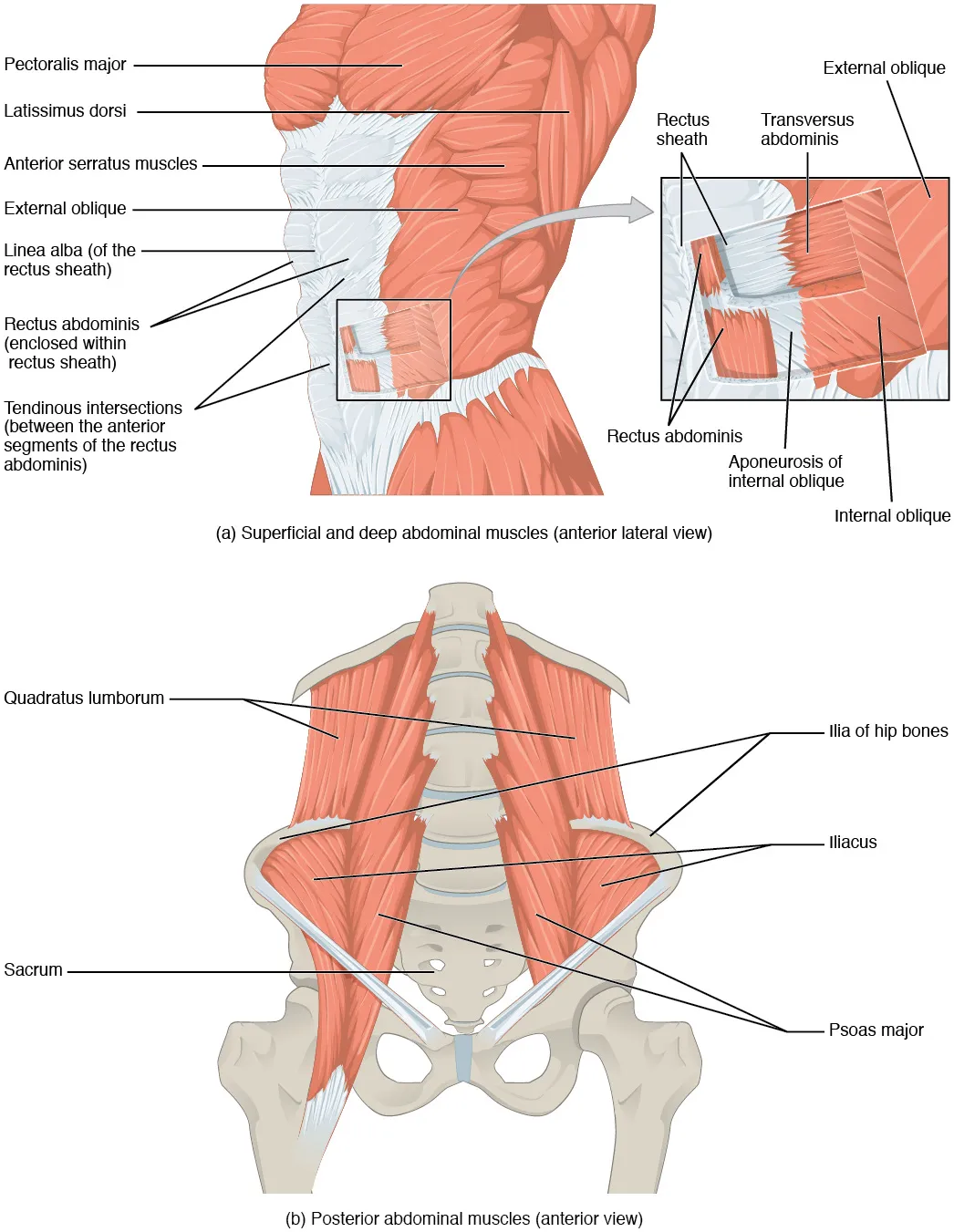
It reaches the linea alba through an aponeurosis, a broad flat sheet of tendon8. This sheet passes in front of the rectus abdominis, the long muscle down the front of the abdomen9. In the upper abdomen, it is the main part of the front wall of the rectus sheath, the casing around that muscle8. Some centimetres below the navel, the internal oblique’s sheet also passes in front of the rectus abdominis9. The transversus abdominis’s sheet does the same from a level that varies9.
The intercostal nerves, which run between the ribs, supply the external oblique and the other abdominal wall muscles10. These nerves also carry feeling from the matching strips of skin10. In 40 dissected half-walls of the abdomen, the tenth intercostal nerve sent a median (middle value) of nine branches to this muscle11.
How it twists and bends the trunk
OpenStax, an anatomy textbook, names both obliques as main movers for twisting at the waist1. It also names them for lateral flexion, bending the spine to the side1. In 24 healthy young men turning the trunk at set speeds on a machine, the external oblique opposite the turn was a main driver12. The external oblique on the same side as the turn acted as an antagonist, working against the movement12. Of the three turning muscles recorded, the external oblique showed the most electrical activity12.
How held positions and lifts load it
Several exercise studies have recorded external oblique activity16,17. In one small study of 13 people with low back pain, a braced front plank reached a median of 77% of the muscle’s session peak15. In 17 healthy people, a side plank with the upper body raised reached about 78% of maximum13. In 25 people, the rotational side-bridge reached 62.8% of maximum, the most of four side-bridge exercises tested14. The authors of a 30-person study concluded that the side bridge could be used to strengthen this muscle18.
Each row below compares two versions of a task within one study19,20:
| Task | External oblique activity |
|---|---|
| Prone exercises, including the plank on the toes, against a crunch | About 10 to 100% more in the prone exercises16 |
| Long-lever plank with pelvis tucked, against a plain plank | Higher19 |
| Plank with feet raised, against feet on the ground | Higher21 |
| Plank with belly drawn in, against a plain plank | Higher22 |
| Side plank, weight-bearing side against the other side | Higher on the weight-bearing side, in one study of 25 people14 |
| Farmer’s carry, against holding the same weights still | Higher on both sides17 |
| One-hand suitcase carry, against holding it still | Higher on the loaded side, not on the other17 |
| One-arm rows, against two-arm rows | Higher20 |
| Seated two-arm dumbbell press, against standing | About 58% lower when seated23 |
| Deadlift with a lifting belt, against without | Lower with the belt24 |
In a held bridge, rectus abdominis activity was lower than oblique activity25. Squeezing the knees together during a bridge raised external oblique activity26. In 30 adults, no difference in external oblique activity was found between a held V-sit and a plank27.
Breakdown
What a side strain is
A side strain is damage to one of three flat side muscles: the external oblique, the internal oblique or the transversus abdominis3,4,5. It commonly occurs where these muscles attach to the lower four ribs3,4,5. The authors of a report on four cricketers describe it as rare where the muscles attach to the pelvis3. A narrative review, a summary without a set search method, linked side strain mostly with cricket and baseball5. It usually came on suddenly, mostly on the side opposite the dominant arm5.
The side-strain counts and scans below do not separate the external oblique from the internal oblique2,3,4,5. The narrative review above does name one muscle: it found that scans typically show the internal oblique torn away from the lower ribs5. In ten cricket fast bowlers, 70% of MRI scans, a type of detailed body scan, fitted injury to any of the three flat muscles4. The baseball counts group the two obliques with the muscles between the ribs2.
How common it is in baseball
Across the 1991 to 2010 Major League Baseball seasons, 393 abdominal muscle strains made up 5% of injuries2. At least 92% of these were oblique or intercostal strains2. A later study counted 996 oblique injuries that cost playing time in the major and minor leagues from 2011 to 201528. Most happened while batting (46%) or pitching (35%)28. Its authors describe sudden sharp pain on the side of the abdomen after a forceful twist28.
Which side it affects
In these studies, the strains tended to fall on one side2,4,28. The 1991 to 2010 baseball rows cover abdominal muscle strains in general2:
| Group | Side most affected |
|---|---|
| Baseball pitchers, 1991 to 2010 | Opposite the throwing arm, in 78.1%2 |
| Baseball position players, 1991 to 2010 | Opposite the batting side, in 70.3%2 |
| Baseball players, 2011 to 2015 | The leading side, in 77%28 |
| Cricket fast bowlers, one report of ten | The side of the non-bowling arm, the authors state4 |
In those ten bowlers, the most consistent signs were a tender spot and pain when bending against resistance toward the sore side4. For six of the ten, it was a repeat injury4.
Recovery
How long players are out
In these studies, average time away from sport after these strains ranged from about 22 to 39 days28,29. Like the injury counts, these figures cover abdominal strains in general, not the external oblique alone2,3,4,5,28,29. The 1991 to 2010 baseball figures also include strains of the muscles between the ribs2.
| Group | Average days out |
|---|---|
| Baseball players, 2011 to 2015 | 22.2 days28 |
| Baseball position players, 1991 to 2010 | 26.7 days2 |
| Baseball pitchers, 1991 to 2010 | 35.4 days2 |
| Cricket fast bowlers | 39 days29 |
In the later baseball study, pitchers lost five more days per injury than batters28. Leading-side injuries took five days longer than trailing-side ones28. Among 57 cricket fast bowlers, 44% needed more than six weeks29. Bowlers whose MRI showed a muscle tear were eight times as likely to need that long29. Repeat injury rates were 12.1% in the earlier baseball study and 8.15% in the later one2,28.
How it adapts to training
In a randomised trial, 40 people did four weeks of rotation exercises6. Their external oblique grew thicker on ultrasound, a scan made with sound waves, compared with their own first scan6. The published summary gives no comparison with the untrained group6. In a small one-time comparison, 16 female rugby players had a thicker right external oblique than 16 women who did not play sport30.
In one study, a one-sided sport went with more muscle on one side31. On MRI, professional tennis players had 18% more oblique and transversus abdominis muscle on the non-dominant side31. In soccer players and inactive people, the two sides did not differ significantly31. In people with long-lasting low back pain, a meta-analysis found no difference in resting external oblique thickness between motor control training and other approaches32.
What happens when load is taken away
Five astronauts spent six months on the International Space Station across seven missions7. The combined thickness of their side and front abdominal muscles, including the external oblique, fell by 16.2%7. It rose again during a 15-day reconditioning programme back on Earth7.
Connections
Muscles that share its work
In trunk rotation, the external oblique is described as working on the side opposite the turn33. The rectus abdominis and the lumbar multifidus, a deep lower-spine muscle, are described as doing the same33. The latissimus dorsi, the broad muscle of the back, is described as working on the same side33. So are the internal oblique and transversus abdominis33. Whether the latissimus dorsi helps rotate the spine is disputed34.
In ten healthy people, the muscles that bend the trunk forward and those that straighten it worked at the same time around an upright spine35. The external oblique was one of six right-side muscles recorded, and this shared work rose with 32 kg added to the torso35. A model explained it as keeping the lower spine mechanically stable35.
Where it meets other structures
The external oblique joins or overlaps several nearby structures36,37:
- Latissimus dorsi: in nine dissected bodies, it merged with the external oblique at an average level of about the 9th to 11th rib36.
- Serratus anterior: this side-of-chest muscle interlocks with the external oblique’s start on the 5th to 9th ribs37.
- Pectoralis major: part of this chest muscle arises from the external oblique’s aponeurosis38.
- Thoracolumbar fascia: the external oblique’s covering ran straight into this sheet over the lower back in most bodies and scans studied39.
In the rest, the external oblique’s covering first joined the latissimus dorsi’s covering: two of ten bodies and four of 27 scans39.
Exercises that load it
Studies have recorded the muscle working in the plank, side plank, farmer’s carry and suitcase carry13,16,17. They also recorded it in one-arm rows, standing presses, the deadlift and the held bridge20,23,24,26. Exercise pages that load it: barbell row, deadlift, farmer’s carry, glute bridge hold, hollow hold, overhead press, plank, side plank.
External oblique forms part of the sheath of
External oblique merges with
External oblique gives origin to part of
External oblique is loaded by
Sources
- Betts JG, Young KA, Wise JA, Johnson E, Poe B, Kruse DH, Korol O, Johnson JE, Womble M, DeSaix P (2022). Anatomy and Physiology 2e. OpenStax. Link
- Conte SA, Thompson MM, Marks MA, Dines JS (2012). Abdominal muscle strains in professional baseball: 1991-2010.. American Journal of Sports Medicine. doi:10.1177/0363546511433030 PMID 22268233
- Mehta CP, Daftary A, Lawande M (2021). Side Strain and Impact Injuries at the Iliac Crest Attachment of Lateral Abdominal Wall Musculature in Cricketers: An Uncommon Injury Pattern.. Indian Journal of Radiology and Imaging. doi:10.1055/s-0041-1734345 PMID 34556921
- Humphries D, Jamison M (2004). Clinical and magnetic resonance imaging features of cricket bowler's side strain.. British Journal of Sports Medicine. doi:10.1136/bjsm.2003.005272 PMID 15388565
- Nealon AR, Kountouris A, Cook JL (2017). Side strain in sport: a narrative review of pathomechanics, diagnosis, imaging and management for the clinician.. Journal of Science and Medicine in Sport. doi:10.1016/j.jsams.2016.08.016 PMID 27616432
- Niewiadomy P, Szuścik-Niewiadomy K, Kuszewski M, Kurpas A, Kochan M (2021). The influence of rotational movement exercise on the abdominal muscle thickness and trunk mobility - Randomized control trial.. Journal of Bodywork and Movement Therapies. doi:10.1016/j.jbmt.2021.05.008 PMID 34391272
- Hides JA, Lambrecht G, Sexton CT, Pruett C, Petersen N, Jaekel P, Rosenberger A, Weerts G (2021). The effects of exposure to microgravity and reconditioning of the lumbar multifidus and anterolateral abdominal muscles: implications for people with LBP.. The Spine Journal. doi:10.1016/j.spinee.2020.09.006 PMID 32966906
- Medina Pedrique M, Robin Valle de Lersundi Á, Avilés Oliveros A, Ruiz SM, López-Monclús J, Munoz-Rodriguez J, Blázquez Hernando LA, Martinez Caballero J, García-Urena MÁ (2023). Incisions in Hepatobiliopancreatic Surgery: Surgical Anatomy and its Influence to Open and Close the Abdomen.. Journal of Abdominal Wall Surgery. doi:10.3389/jaws.2023.11123 PMID 38312419
- Cavalli M, Aiolfi A, Bruni PG, Manfredini L, Lombardo F, Bonfanti MT, Bona D, Campanelli G (2021). Prevalence and risk factors for diastasis recti abdominis: a review and proposal of a new anatomical variation.. Hernia. doi:10.1007/s10029-021-02468-8 PMID 34363190
- Kei N, Takahiko T (2025). Pseudohernia Following Herpes Zoster Presenting With Transient Abdominal Wall Bulging: A Case Report.. Cureus. doi:10.7759/cureus.91076 PMID 41018410
- Solé Cruz E, Rabattu PY, Todesco A, Bellier A, Chaffanjon PC, Faguet R, Piolat C, Robert Y (2020). Study of abdominal wall muscle innervation applied to large-defect closure in congenital diaphragmatic hernia.. Clinical Anatomy. doi:10.1002/ca.23503 PMID 31625184
- Fan JZ, Liu X, Ni GX (2014). Angular velocity affects trunk muscle strength and EMG activation during isokinetic axial rotation.. BioMed Research International. doi:10.1155/2014/623191 PMID 24804227
- Devorski L, Bazett-Jones DM, Mangum LC, Glaviano NR (2022). Muscle Activation in the Shoulder Girdle and Lumbopelvic-Hip Complex During Common Therapeutic Exercises.. Journal of Sport Rehabilitation. doi:10.1123/jsr.2020-0485 PMID 34525451
- Youdas JW, Boor MM, Darfler AL, Koenig MK, Mills KM, Hollman JH (2014). Surface electromyographic analysis of core trunk and hip muscles during selected rehabilitation exercises in the side-bridge to neutral spine position.. Sports Health. doi:10.1177/1941738114539266 PMID 25177418
- Calatayud J, Escriche-Escuder A, Cruz-Montecinos C, Andersen LL, Pérez-Alenda S, Aiguadé R, Casaña J (2019). Tolerability and Muscle Activity of Core Muscle Exercises in Chronic Low-back Pain.. International Journal of Environmental Research and Public Health. doi:10.3390/ijerph16193509 PMID 31547140
- Escamilla RF, Lewis C, Pecson A, Imamura R, Andrews JR (2016). Muscle Activation Among Supine, Prone, and Side Position Exercises With and Without a Swiss Ball.. Sports Health. doi:10.1177/1941738116653931 PMID 27302152
- Ellestad SH, Holcomb TP, Swiergol AM, Holmstrup ME, Dicus JR (2024). The Quantification of Muscle Activation During the Loaded Carry Movement Pattern.. International Journal of Exercise Science. doi:10.70252/NWUE9985 PMID 38665162
- Ekstrom RA, Donatelli RA, Carp KC (2007). Electromyographic analysis of core trunk, hip, and thigh muscles during 9 rehabilitation exercises.. Journal of Orthopaedic and Sports Physical Therapy. doi:10.2519/jospt.2007.2471 PMID 18560185
- Schoenfeld BJ, Contreras B, Tiryaki-Sonmez G, Willardson JM, Fontana F (2014). An electromyographic comparison of a modified version of the plank with a long lever and posterior tilt versus the traditional plank exercise.. Sports Biomechanics. doi:10.1080/14763141.2014.942355 PMID 25325773
- Saeterbakken A, Andersen V, Brudeseth A, Lund H, Fimland MS (2015). The Effect of Performing Bi- and Unilateral Row Exercises on Core Muscle Activation.. International Journal of Sports Medicine. doi:10.1055/s-0034-1398646 PMID 26134664
- Moreno-Navarro P, Sabido R, Barbado D, Prat-Luri A, Vera-Garcia FJ (2024). Trunk muscle activation in prone plank exercises with different body tilts.. Journal of Back and Musculoskeletal Rehabilitation. doi:10.3233/BMR-230209 PMID 38217576
- García-Jaén M, Cortell-Tormo JM, Hernández-Sánchez S, Tortosa-Martínez J (2020). Influence of Abdominal Hollowing Maneuver on the Core Musculature Activation during the Prone Plank Exercise.. International Journal of Environmental Research and Public Health. doi:10.3390/ijerph17207410 PMID 33053717
- Saeterbakken AH, Fimland MS (2012). Muscle activity of the core during bilateral, unilateral, seated and standing resistance exercise.. European Journal of Applied Physiology. doi:10.1007/s00421-011-2141-7 PMID 21877146
- Escamilla RF, Francisco AC, Kayes AV, Speer KP, Moorman CT 3rd (2002). An electromyographic analysis of sumo and conventional style deadlifts.. Medicine and Science in Sports and Exercise. doi:10.1097/00005768-200204000-00019 PMID 11932579
- Stevens VK, Bouche KG, Mahieu NN, Coorevits PL, Vanderstraeten GG, Danneels LA (2006). Trunk muscle activity in healthy subjects during bridging stabilization exercises.. BMC Musculoskeletal Disorders. doi:10.1186/1471-2474-7-75 PMID 16987410
- Jang EM, Kim MH, Oh JS (2013). Effects of a Bridging Exercise with Hip Adduction on the EMG Activities of the Abdominal and Hip Extensor Muscles in Females.. Journal of Physical Therapy Science. doi:10.1589/jpts.25.1147 PMID 24259933
- Musalem LL, Stankovic T, Glisic D, Cook GE, Beach TA (2015). Biomechanical and Electromyographic Comparisons of Isometric Trunk Flexor Endurance Test Postures: Prone Plank Versus V-Sit.. Journal of Applied Biomechanics. doi:10.1123/jab.2014-0197 PMID 26252077
- Camp CL, Conte S, Cohen SB, Thompson M, D' Angelo J, Nguyen JT, Dines JS (2017). Epidemiology and Impact of Abdominal Oblique Injuries in Major and Minor League Baseball.. Orthopaedic Journal of Sports Medicine. doi:10.1177/2325967117694025 PMID 28451598
- Nealon AR, Docking SI, Lucas PE, Connell DA, Koh ES, Cook JL (2019). MRI findings are associated with time to return to play in first class cricket fast bowlers with side strain in Australia and England.. Journal of Science and Medicine in Sport. doi:10.1016/j.jsams.2019.05.020 PMID 31239202
- Abuín-Porras V, de la Cueva-Reguera M, Benavides-Morales P, Ávila-Pérez R, Cruz-Torres B, Pareja-Galeano H, Blanco-Morales M, Romero-Morales C (2019). Comparison of the Abdominal Wall Muscle Thickness in Female Rugby Players Versus Non-Athletic Women: A Cross-Sectional Study.. Medicina (Kaunas). doi:10.3390/medicina56010008 PMID 31881780
- Sanchis-Moysi J, Idoate F, Izquierdo M, Calbet JA, Dorado C (2013). The hypertrophy of the lateral abdominal wall and quadratus lumborum is sport-specific: an MRI segmental study in professional tennis and soccer players.. Sports Biomechanics. doi:10.1080/14763141.2012.725087 PMID 23724609
- Shanbehzadeh S, ShahAli S, Hides J, Ebrahimi-Takamjani I, Rasouli O (2022). Effect of Motor Control Training on Trunk Muscle Morphometry, Pain, and Disability in People With Chronic Low Back Pain: A Systematic Review and Meta-Analysis.. Journal of Manipulative and Physiological Therapeutics. doi:10.1016/j.jmpt.2022.06.003 PMID 35879124
- Sugaya T, Sakamoto M, Nakazawa R, Wada N (2016). Relationship between spinal range of motion and trunk muscle activity during trunk rotation.. Journal of Physical Therapy Science. doi:10.1589/jpts.28.589 PMID 27065549
- Willard FH, Vleeming A, Schuenke MD, Danneels L, Schleip R (2012). The thoracolumbar fascia: anatomy, function and clinical considerations.. Journal of Anatomy. doi:10.1111/j.1469-7580.2012.01511.x PMID 22630613
- Cholewicki J, Panjabi MM, Khachatryan A (1997). Stabilizing function of trunk flexor-extensor muscles around a neutral spine posture.. Spine. doi:10.1097/00007632-199710010-00003 PMID 9346140
- Oh S, Kim H, Lee JH, Son D (2022). Anatomical Study of the Close Association between Latissimus Dorsi and Surrounding Muscles. How to Safely Harvest the Muscle?. Archives of Plastic Surgery. doi:10.1055/s-0042-1756293 PMID 36159379
- Hosea TM, Hannafin JA (2012). Rowing injuries.. Sports Health. doi:10.1177/1941738112442484 PMID 23016093
- Solari F, Burns B (2023). Anatomy, Thorax, Pectoralis Major Major.. StatPearls. PMID 30252247
- Fan C, Fede C, Gaudreault N, Porzionato A, Macchi V, DE Caro R, Stecco C (2018). Anatomical and functional relationships between external abdominal oblique muscle and posterior layer of thoracolumbar fascia.. Clinical Anatomy. doi:10.1002/ca.23248 PMID 30113090
Changes
- Added a figure showing where it sits, links to the exercise pages that load it, and tighter wording in a few places.
- First published.