Transversus abdominis
Also called transversalis
The deepest flat muscle of the abdominal wall, wrapping the belly like a belt. How it squeezes the abdomen, the debate over its early switch-on in low back pain, how it changes with training, and what it works with.
- Region
- Trunk
- Starts on
- the inner surface of the last six rib cartilages (costal cartilages)35; the lumbar vertebrae's side spurs (transverse processes), by way of the thoracolumbar fascia35; the deep side of the front part of the iliac crest (the top rim of the hip bone) (Pelvis)1,35; the outer half of the groin (inguinal) ligament35
- Ends on
- the linea alba, the tough band down the centre of the belly, through a broad sheet of tendon35; the pubic crest and pectineal line, shared with the internal oblique as the conjoint tendon (Pelvis)1,10,35
- Updated
- September 30, 2026
- Reviewed
- September 30, 2026 · how entries are checked
Function
A belt around the belly
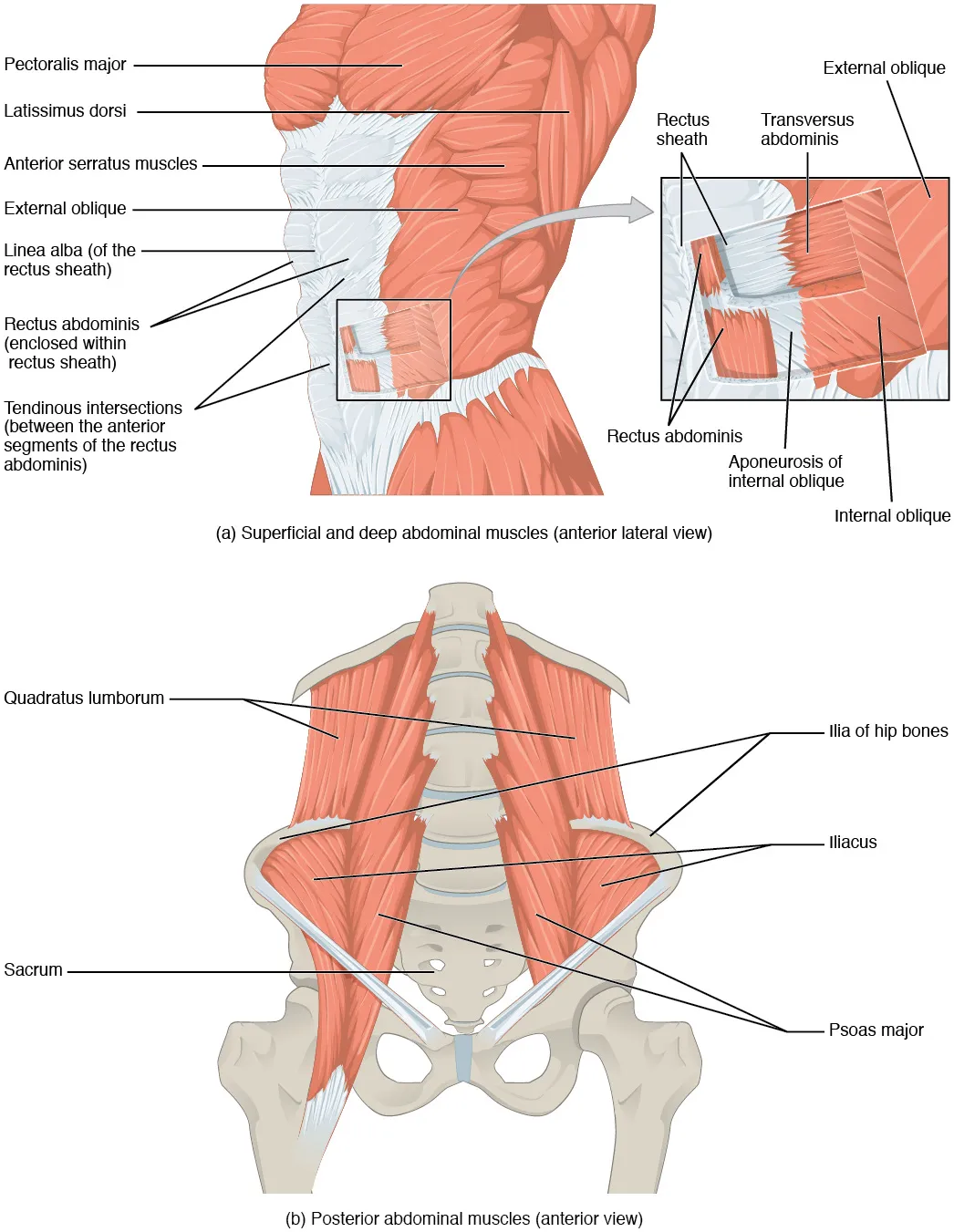
The side wall of the abdomen has three layers of muscle1. The external oblique is the outer layer, the internal oblique the middle one, and the transversus abdominis the deepest1. Its fibres run across the abdomen, like the front of a belt1.
In a dissection of 26 cadavers (bodies donated for study), the fascicles (bundles of muscle fibres) ran level in the upper part7. Lower down, they angled more and more downward and toward the midline7. Thin partitions inside the muscle split it into regions, and the authors suggest each region may work differently7.
Where it attaches
At the back, the muscle reaches the lumbar spine (the lower back) through the thoracolumbar fascia, a sheet of tough connective tissue over the back7. In another dissection of 18 cadavers, it reached the tips of the lumbar transverse processes (small bony spurs on each side of a vertebra)8. It did so through a middle fascia layer, thicker at those tips8.
At the front, it helps build the rectus sheath, the casing of flat tendon sheets around the rectus abdominis9. An expert consensus describes the sheath’s back layer as the transversus aponeurosis (a flat sheet of tendon) fused with part of the internal oblique’s9. In the upper abdomen, the transversus reaches the sheath as muscle9. Lower down it reaches it as aponeurosis instead, because its muscular edge, the linea semilunaris, shifts outward and downward9.
At the top, its fibres interlock with the diaphragm (the main breathing muscle) under the lower edge of the rib cage9. At the bottom, it attaches to the ilium (the wide upper part of the hip bone) and to the pubis, part of the pelvis1. With the internal oblique it forms the conjoined tendon, one tendon shared by two muscles, which inserts on the crest of the pubis10.
Its nerves
The 7th to 11th intercostal nerves, which run between the ribs, supply the side-wall muscles level by level9. So does the subcostal nerve, beneath the lowest rib9.
Squeezing, breathing and twisting
The transversus abdominis squeezes the abdomen1. It does this when breathing out forcefully, passing stool or urine, and giving birth1. In six seated adults, breathing recruited it in preference to the outer abdominal muscles11. With extra carbon dioxide in the air, it became active before either outer muscle could be recorded11. During deliberate efforts, such as speaking or pulling the belly in, it generally worked together with those outer muscles11.
In six men, the authors concluded it appeared to be the abdominal muscle most consistently linked to changes in pressure inside the belly12. In three people, the diaphragm was stimulated to raise belly pressure with no abdominal or back muscle activity13. Spine stiffness rose by 8% to 31% of resting levels, and it rose more when the pressure rose more13.
Another study looked at the sacroiliac joint, where the base of the spine meets the pelvis14. In 13 healthy people lying face-down, tightening the transversus alone reduced joint looseness more than a general abdominal exercise pattern14. Both reduced it14.
In six people without spinal pain, it was active during seated trunk rotation15. Its upper fibres worked in the opposite pattern to its middle and lower fibres15.
Breakdown
Strains, hernias and bone pulled loose
A side strain is an injury of the internal or external oblique or the transversus abdominis, commonly where they attach to the lower four ribs16,17,18. In 10 first-class cricket fast bowlers with such an injury, 70% of MRI scans (detailed soft-tissue scans) fitted injury to these muscles near those ribs17.
An expert consensus calls one part of the transversus aponeurosis the Spigelian fascia9. It names defects there as the cause of a Spigelian hernia9. The conjoined tendon forms most of the inner back wall of the inguinal canal, a passage through the belly wall at the groin10.
In three of 18 cadavers, tension on the fascia that carries its attachment broke a lumbar transverse process8. The authors suggest the attachment fits a role in controlling single lumbar levels, or in avulsion (pulling-away) fractures of these spurs8.
Losing size
In five astronauts across seven six-month missions on the International Space Station, transversus thickness fell by 34.1%19. It increased again during a 15-day reconditioning programme on Earth19.
The debate over early activity in low back pain
Feedforward activity is a muscle switching on ahead of a movement, before the movement disturbs the body. Studies disagree on what its feedforward timing means, including in low back pain3,4.
Studies that describe an early, direction-free stiffener. In 15 people without back pain making fast arm movements while standing, the transversus was always the first trunk muscle to switch on3. Its timing did not depend on the direction of movement, which the authors took to support a role in stiffening the spine3. In another study of 15 people, the transversus switched on before the shoulder muscle whatever the direction of movement20. Timing of the obliques, rectus abdominis and multifidus (a deep muscle running along the spine) varied with direction20.
In 15 people with low back pain and 15 matched controls, the transversus switched on significantly later in those with pain, for every arm direction3. With leg movements, it was delayed in every direction, while delays in other trunk muscles appeared only in some directions21. The authors read the delay as a sign of a problem in controlling the muscles3. They suggested it makes the muscles less efficient at steadying the spine3. A systematic review of 27 studies, pooling results where they could be combined, found delayed muscle onsets in chronic (long-lasting) low back pain2.
Studies that describe a side-specific, direction-specific muscle. In six healthy people making eight kinds of arm movement, feedforward transversus activity was not equal on the two sides22. It varied with the direction of the disturbance, tracking the twisting force the arm put on the trunk22. A laboratory study with a repeated case study also found its early activity depended on arm direction and differed between sides4. The authors said its role as a two-sided stabiliser needs revising4.
In another laboratory study, the transversus did not usually contract on both sides at once; one of six people did5. The authors said this does not fit the idea of a unique two-sided stiffening role5. The same review that found delays calls their functional relevance unknown2. It found no conclusive differences in movement, or in centre of pressure, where body weight is centred under the feet2. For acute (recent) low back pain, it found only two studies, with conflicting results2.
Recovery
How the muscle changes with exercise
A systematic review of 14 studies covered 395 healthy people24. The greatest gains in side-wall muscle thickness on ultrasound came with local abdominal exercises24. They also came with programmes of four weeks or more, three sessions a week, and sessions of 30 minutes or longer24.
Hollowing and bracing
A scoping review, which maps the research on a topic, describes hollowing as gently drawing in the lower belly below the navel25. The upper belly, back and pelvis stay still25.
It describes bracing as tightening all four abdominal muscles and pushing the waist out, without drawing in25. Covering 22 randomised controlled trials, it reports that hollowing is often linked to selective transversus activity25. Bracing works the trunk muscles together more broadly25. Few trials compared the two directly, leaving open whether they work equally well25.
Studies in people with chronic low back pain
Motor control training is exercise that trains how the deep trunk muscles are switched on and coordinated. A Cochrane review of 29 trials covered 2,431 people with chronic non-specific low back pain26. Low to high quality evidence showed motor control exercise was not clinically more effective than other exercise26. Against minimal intervention, low to moderate quality evidence showed it improved pain, with medium effect sizes (a standard measure of how large a difference is)26.
In chronic low back pain, a meta-analysis found a greater transversus contraction ratio after motor control training than other approaches27. The standardised mean difference, the gap on a common scale, was 0.93 (95% confidence interval −0.0 to 1.85)27. It found no difference in resting thickness in programmes shorter than 12 weeks27.
In a randomised trial of 109 people with chronic low back pain, deep abdominal muscle timing in fast arm raises barely changed, if at all28. This held after 8 weeks of low-load core stability, high-load sling or general exercise28. Changes in timing were not linked to changes in pain28.
A review of 15 studies looked at non-surgical programmes6. It found strong evidence that changes in contraction thickness or feedforward activity were unrelated to changes in pain or disability6. A review included five cohort studies, which follow a group over time29. It found limited evidence that transversus contraction thickness and early switch-on at the start were unrelated to later pain after exercise programmes29.
Connections
The other abdominal muscles
During trunk rotation, the internal oblique, transversus and latissimus dorsi are described as acting on the same side30. The external oblique, rectus abdominis and multifidus act on the opposite side30. During repeated arm raises, the transversus and internal oblique opposite the moving arm switched on earlier than on the other side4.
The back muscles and the legs
Along the edge of the sheath around the back muscles, such as the erector spinae, a seam forms where it meets the transversus aponeurosis31. A review describes it as placed to spread tension from nearby muscles into the thoracolumbar fascia31.
One laboratory study recorded six pairs of trunk and leg muscles during arm movements5. With one-sided arm movements, early activity, transversus included, usually followed a diagonal pattern that depended on direction5. It included a twisting motion that passed energy up from the ground5.
Exercises that load it
Studies of the bird dog report these findings32,33,34:
- A systematic review reports that the bird dog produced greater transversus activity than internal oblique or multifidus activity32.
- In 15 healthy men, bracing and hollowing each raised shear modulus (a measure of tissue stiffness from ultrasound) significantly in the transversus alone33.
- In 44 healthy young adults, the bird dog and side plank with hollowing gave the most relative thickening of the transversus, internal oblique and multifidus34.
Related exercise pages: bird dog and side plank34.
Transversus abdominis lies beneath
Transversus abdominis forms part of the sheath of
Transversus abdominis joins the fascia of
Transversus abdominis is studied with
Transversus abdominis attaches to
Transversus abdominis is loaded by
Sources
- Betts JG, Young KA, Wise JA, Johnson E, Poe B, Kruse DH, Korol O, Johnson JE, Womble M, DeSaix P (2022). Anatomy and Physiology 2e. OpenStax. Link
- Knox MF, Chipchase LS, Schabrun SM, Romero RJ, Marshall PWM (2018). Anticipatory and compensatory postural adjustments in people with low back pain: a systematic review and meta-analysis.. The Spine Journal. doi:10.1016/j.spinee.2018.06.008 PMID 29906616
- Hodges PW, Richardson CA (1996). Inefficient muscular stabilization of the lumbar spine associated with low back pain.. Spine. doi:10.1097/00007632-199611150-00014 PMID 8961451
- Allison GT, Morris SL, Lay B (2008). Feedforward responses of transversus abdominis are directionally specific and act asymmetrically: implications for core stability theories.. Journal of Orthopaedic & Sports Physical Therapy. doi:10.2519/jospt.2008.2703 PMID 18448877
- Morris SL, Lay B, Allison GT (2013). Transversus abdominis is part of a global not local muscle synergy during arm movement.. Human Movement Science. doi:10.1016/j.humov.2012.12.011 PMID 23482302
- Wong AY, Parent EC, Funabashi M, Kawchuk GN (2014). Do changes in transversus abdominis and lumbar multifidus during conservative treatment explain changes in clinical outcomes related to nonspecific low back pain? A systematic review.. The Journal of Pain. doi:10.1016/j.jpain.2013.10.008 PMID 24184573
- Urquhart DM, Barker PJ, Hodges PW, Story IH, Briggs CA (2005). Regional morphology of the transversus abdominis and obliquus internus and externus abdominis muscles.. Clinical Biomechanics. doi:10.1016/j.clinbiomech.2004.11.007 PMID 15698694
- Barker PJ, Urquhart DM, Story IH, Fahrer M, Briggs CA (2007). The middle layer of lumbar fascia and attachments to lumbar transverse processes: implications for segmental control and fracture.. European Spine Journal. doi:10.1007/s00586-007-0502-z PMID 17924150
- Nip L, Parker SG, Scala A, Halligan S, Rockall TA, Thomas R, Giordano P, Simpson G, Chitsabesan P, Boermeester M, Zhao S, Windsor ACJ, Garcia-Urena MA (2025). Essential Anatomy for the Abdominal Wall Surgeon: Expert Consensus of Anatomical Concepts and Operative Steps for Posterior Component Separation.. World Journal of Surgery. doi:10.1002/wjs.70155 PMID 41266107
- Jiang J, Koay J (2023). Anatomy, Abdomen and Pelvis: Conjoint Tendon (Inguinal Aponeurotic Falx).. StatPearls. PMID 31747179
- De Troyer A, Estenne M, Ninane V, Van Gansbeke D, Gorini M (1990). Transversus abdominis muscle function in humans.. Journal of Applied Physiology. doi:10.1152/jappl.1990.68.3.1010 PMID 2140344
- Cresswell AG, Grundström H, Thorstensson A (1992). Observations on intra-abdominal pressure and patterns of abdominal intra-muscular activity in man.. Acta Physiologica Scandinavica. doi:10.1111/j.1748-1716.1992.tb09314.x PMID 1534959
- Hodges PW, Eriksson AE, Shirley D, Gandevia SC (2005). Intra-abdominal pressure increases stiffness of the lumbar spine.. Journal of Biomechanics. doi:10.1016/j.jbiomech.2004.08.016 PMID 16023475
- Richardson CA, Snijders CJ, Hides JA, Damen L, Pas MS, Storm J (2002). The relation between the transversus abdominis muscles, sacroiliac joint mechanics, and low back pain.. Spine. doi:10.1097/00007632-200202150-00015 PMID 11840107
- Urquhart DM, Hodges PW (2005). Differential activity of regions of transversus abdominis during trunk rotation.. European Spine Journal. doi:10.1007/s00586-004-0799-9 PMID 15940481
- Mehta CP, Daftary A, Lawande M (2021). Side Strain and Impact Injuries at the Iliac Crest Attachment of Lateral Abdominal Wall Musculature in Cricketers: An Uncommon Injury Pattern.. Indian Journal of Radiology and Imaging. doi:10.1055/s-0041-1734345 PMID 34556921
- Humphries D, Jamison M (2004). Clinical and magnetic resonance imaging features of cricket bowler's side strain.. British Journal of Sports Medicine. doi:10.1136/bjsm.2003.005272 PMID 15388565
- Nealon AR, Kountouris A, Cook JL (2017). Side strain in sport: a narrative review of pathomechanics, diagnosis, imaging and management for the clinician.. Journal of Science and Medicine in Sport. doi:10.1016/j.jsams.2016.08.016 PMID 27616432
- Hides JA, Lambrecht G, Sexton CT, Pruett C, Petersen N, Jaekel P, Rosenberger A, Weerts G (2021). The effects of exposure to microgravity and reconditioning of the lumbar multifidus and anterolateral abdominal muscles: implications for people with LBP.. The Spine Journal. doi:10.1016/j.spinee.2020.09.006 PMID 32966906
- Hodges PW, Richardson CA (1997). Feedforward contraction of transversus abdominis is not influenced by the direction of arm movement.. Experimental Brain Research. doi:10.1007/pl00005644 PMID 9166925
- Hodges PW, Richardson CA (1998). Delayed postural contraction of transversus abdominis in low back pain associated with movement of the lower limb.. Journal of Spinal Disorders. PMID 9493770
- Morris SL, Lay B, Allison GT (2012). Corset hypothesis rebutted--transversus abdominis does not co-contract in unison prior to rapid arm movements.. Clinical Biomechanics. doi:10.1016/j.clinbiomech.2011.09.007 PMID 22000066
- Grenier SG, McGill SM (2007). Quantification of lumbar stability by using 2 different abdominal activation strategies.. Archives of Physical Medicine and Rehabilitation. doi:10.1016/j.apmr.2006.10.014 PMID 17207676
- Prentice CLS, Milanese S, Flavell CA, Massy-Westropp N (2024). A dose response analysis of exercise prescription variables for lateral abdominal muscle thickness and activation: A systematic review.. Journal of Bodywork and Movement Therapies. doi:10.1016/j.jbmt.2024.01.016 PMID 38763566
- Golob I, Opara Zupančič M, Kozinc Ž (2024). Abdominal Hollowing vs. Abdominal Bracing: A Scoping Review of Clinical Trials on Effectiveness for Trunk Stability and Rehabilitation.. Journal of Functional Morphology and Kinesiology. doi:10.3390/jfmk9040193 PMID 39449487
- Saragiotto BT, Maher CG, Yamato TP, Costa LO, Menezes Costa LC, Ostelo RW, Macedo LG (2016). Motor control exercise for chronic non-specific low-back pain.. Cochrane Database of Systematic Reviews. doi:10.1002/14651858.CD012004 PMID 26742533
- Shanbehzadeh S, ShahAli S, Hides J, Ebrahimi-Takamjani I, Rasouli O (2022). Effect of Motor Control Training on Trunk Muscle Morphometry, Pain, and Disability in People With Chronic Low Back Pain: A Systematic Review and Meta-Analysis.. Journal of Manipulative and Physiological Therapeutics. doi:10.1016/j.jmpt.2022.06.003 PMID 35879124
- Vasseljen O, Unsgaard-Tøndel M, Westad C, Mork PJ (2012). Effect of core stability exercises on feed-forward activation of deep abdominal muscles in chronic low back pain: a randomized controlled trial.. Spine. doi:10.1097/BRS.0b013e318241377c PMID 22146280
- Wong AYL, Parent EC, Funabashi M, Stanton TR, Kawchuk GN (2013). Do various baseline characteristics of transversus abdominis and lumbar multifidus predict clinical outcomes in nonspecific low back pain? A systematic review.. Pain. doi:10.1016/j.pain.2013.07.010 PMID 23867731
- Sugaya T, Sakamoto M, Nakazawa R, Wada N (2016). Relationship between spinal range of motion and trunk muscle activity during trunk rotation.. Journal of Physical Therapy Science. doi:10.1589/jpts.28.589 PMID 27065549
- Willard FH, Vleeming A, Schuenke MD, Danneels L, Schleip R (2012). The thoracolumbar fascia: anatomy, function and clinical considerations.. Journal of Anatomy. doi:10.1111/j.1469-7580.2012.01511.x PMID 22630613
- Oliva-Lozano JM, Muyor JM (2020). Core Muscle Activity During Physical Fitness Exercises: A Systematic Review.. International Journal of Environmental Research and Public Health. doi:10.3390/ijerph17124306 PMID 32560185
- Motomura Y, Tateuchi H, Ota M, Miyakoshi K, Asayama A, Nojiri S, Nakao S, Yagi M, Ichihashi N (2024). Effects of abdominal hollowing and bracing on each intervertebral angle during quadruped upper and lower extremity lift: Three-dimensional motion analysis of the spine.. Journal of Biomechanics. doi:10.1016/j.jbiomech.2024.112128 PMID 38797083
- Tsartsapakis I, Bagioka I, Fountoukidou F, Kellis E (2024). A Comparison between Core Stability Exercises and Muscle Thickness Using Two Different Activation Maneuvers.. Journal of Functional Morphology and Kinesiology. doi:10.3390/jfmk9020070 PMID 38651428
- Picasso R, Pistoia F, Zaottini F, Airaldi S, Perez MM, Pansecchi M, Tovt L, Sanguinetti S, Möller I, Bruns A, Martinoli C (2021). High-resolution ultrasound of spigelian and groin hernias: a closer look at fascial architecture and aponeurotic passageways.. Journal of Ultrasonography. doi:10.15557/JoU.2021.0008 PMID 33791116
Changes
- First published.