Muscle strain
Also called muscle strains, muscle strain injury, muscle tear, indirect muscle injury, traumatic muscle injury
An overstretched or torn muscle, the general case behind hamstring, calf and hip flexor strains. How reviews define and grade it, who it affects, how long elite players were out, and what reviews of injections found.
- Region
- Across the body
- Muscles
- hamstrings, adductors, quadriceps, gastrocnemius, soleus
- Updated
- October 15, 2026
- Reviewed
- October 15, 2026 · how entries are checked
What it is
What the name covers
A 2023 review defines traumatic muscle injury as damage to muscle tissue that can cause a loss of function1. It splits these injuries in two1. Indirect, non-contact injuries are strains or ruptures, often from a muscle being activated as it lengthens1. Direct injuries come from an outside impact, as a contusion (a bruise) or a cut1.
The 2013 Munich consensus statement, a report of what an expert panel agreed, calls “strain” one of the most used terms for these injuries9. It adds that the term still has no clear definition and is used in very different ways9. Its authors do not recommend the word and propose “tear” for injuries with torn muscle fibres9.
Where it tends to happen
A 2020 statement paper says lower-limb muscle injuries are frequent in sports built on sprinting, jumping, sudden turns and kicking10. It says non-contact strains are typically thought to happen where muscle joins tendon, when force exceeds what the tissue can bear10. The Munich statement lists features of muscles that are often injured9:
- they often cross two joints, or have a more complex build9;
- they do eccentric work, meaning they work while lengthening9;
- they hold mostly type 2 fibres, the fast-contracting kind9.
The same statement reports that up to 96% of muscle injuries in football happen without contact9. Contusions are more common in contact sports such as rugby, American football and ice hockey9.
How injuries are graded
A scoping review of sudden non-contact muscle injuries in adults who play sport found 24 classifications in 37 studies from 2010 to 20223. Most were made for hamstring or other lower-limb injuries3. Six systems, among them Munich, BAMIC and MLG-R, made up 70% of the reports3. The review concluded that no classification or set of terms is agreed, so outcomes by grade differ between studies3.
Three of the six sort injuries in different ways9,11,12:
| System | How it sorts an injury |
|---|---|
| Munich (2013) | Functional disorders with no visible tear, against structural tears, from partial to total, and avulsions, where a tendon pulls off its bone9 |
| British Athletics (BAMIC, 2014) | A grade from 0 to 4 on MRI, plus a site letter: a at the fascia, b where muscle meets tendon, c inside the tendon11 |
| MLG-R (2017) | Four letters: how it happened, where it is, how severe it is, and how many times that muscle was re-injured12 |
Who it affects
A 2023 review states that traumatic muscle injury can affect people at any stage of life1. The counts below come from elite sport:
| Who was studied | What was found |
|---|---|
| 2,299 male professional footballers, 2001 to 2009 | Muscle injuries were 31% of all injuries2. A player had 0.6 a season on average, about 15 a season for a squad of 252 |
| 89 European professional men’s teams, 2001 to 2013 | Muscle injuries were 32% of 17,371 injuries13 |
| 44 studies of professional men’s football, pooled | Muscle and tendon injuries were the most common type, 4.6 per 1,000 hours against 8.1 for all injuries14 |
| 596 players in 15 elite European women’s teams | Thigh muscle injuries were the most frequent; hamstrings were 12% and quadriceps 11% of 1,527 injuries15 |
| 13 international athletics championships, 2009 to 2019 | 344 lower-limb muscle injuries, 36% of injuries in competition16 |
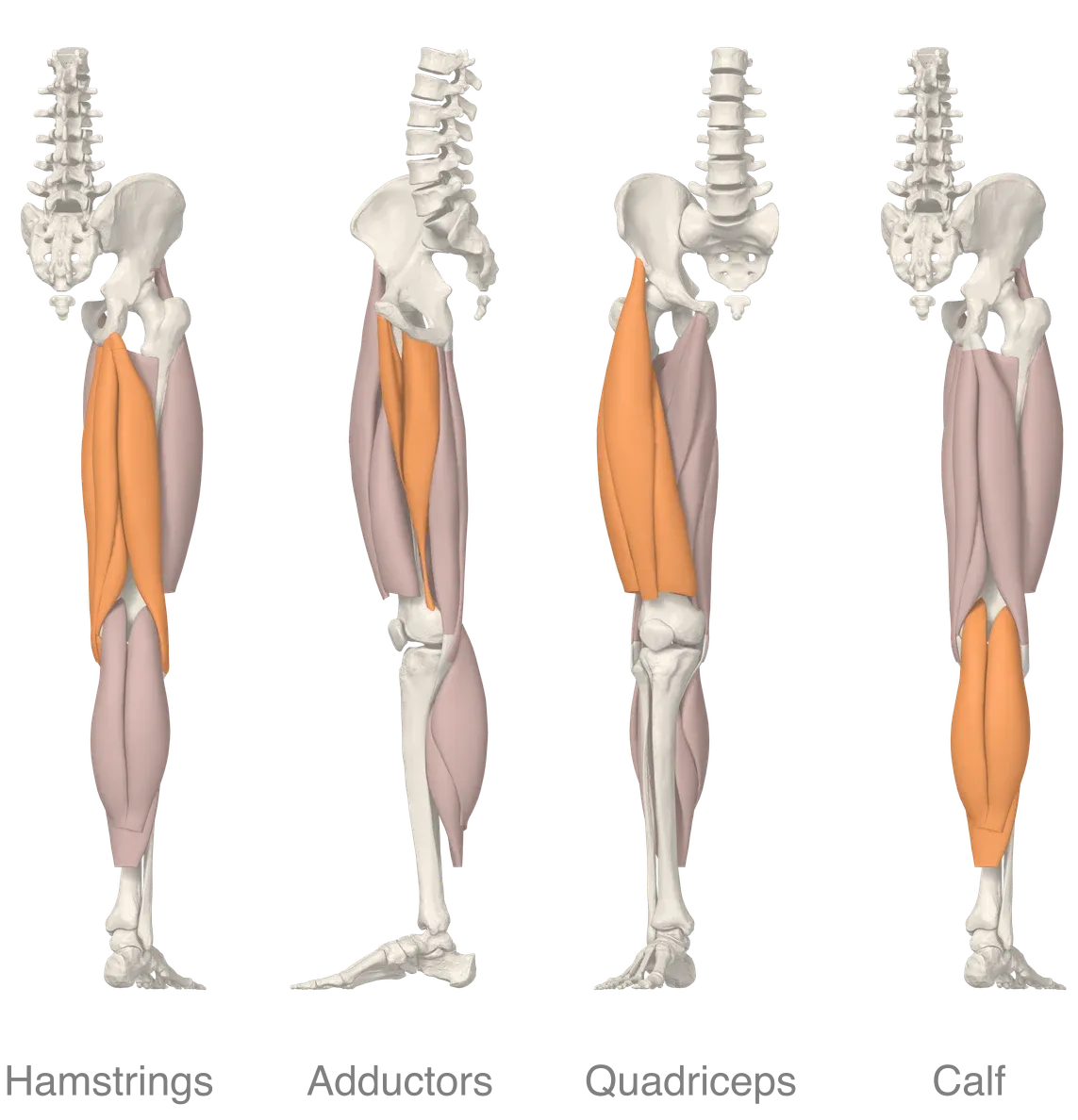
In the cohort of 2,299 footballers, 92% of muscle injuries were in the hamstrings, adductors, quadriceps and calf2.
A 2020 statement paper says strain rates have held steady for decades in football and Australian football10. Hamstring and calf strains rose slightly over that time10.
What goes with a higher rate
In a cohort of 1,401 male professional footballers, previous injury, older age and the kicking leg went with higher muscle injury rates17. The same injury in the previous season went with higher rates in all four main groups17. In Australian Football League data from 1992 to 2014, a recent injury of the same kind was the strongest risk factor for each main strain18.
How often it comes back
In the cohort of 2,299 footballers, 16% of muscle injuries were re-injuries, which kept players out significantly longer than first injuries2. The Australian Football League data covered 3,647 muscle strains18. The risk of a recurrence in the first match back differed by muscle; for all strains combined, it fell gradually after that18:
| Strain | Recurrence risk in the first match back (%) |
|---|---|
| Hamstring | 918 |
| Groin | 618 |
| Quadriceps | 518 |
| Calf | 218 |
What studies found
How long elite players were out
One study tested the Munich system on 393 thigh muscle injuries4. They came from 31 European men’s professional football teams in 2011/124. Two-thirds were structural, and these kept players out longer than functional disorders, whose median was 5 to 8 days4. Among the tears, median time out rose with size4:
| Tear, Munich class | Median days out |
|---|---|
| Minor partial tear | 134 |
| Moderate partial tear | 324 |
| Subtotal or complete tear, or tendon avulsion | 604 |
In the same study, time out did not differ significantly between the front and back of the thigh4. Of the injuries, 12% were re-injuries, and the injury class showed no significant link with re-injury4. Of injuries assessed both by examination and on imaging, 77% were judged tears on examination, but MRI showed a tear in only 29%4.
In the UEFA Elite Club Injury Study of professional football, structural calf, hamstring and quadriceps injuries each had a median of 13 days out19. Its authors suggest muscle tissue may need a certain time to heal before return to play, whichever group is hurt19. A systematic review covered 11 cohort studies of 468 athletes with 574 muscle injuries graded with BAMIC20. Every study linked grade or site with return to play20. Fewer linked them with re-injury: 2 of 4 studies by grade and 3 of 4 by site20.
What MRI adds
In the 89 European men’s teams, time out tracked the MRI grade of thigh injuries13. A 2026 systematic review of 961 injuries in male professional soccer players found that the MRI signs linked to longer return differed by muscle group21. In hamstrings, involvement of the tendon or its junction with muscle went with longer return, while oedema (fluid swelling) predicted poorly21. The same review concluded that MRI is an important but not stand-alone part of return decisions21.
Between 50% and 90% of athletes back at play 29 to 49 days after a muscle injury still showed an abnormal MRI signal22. That figure comes from a 2019 Italian consensus statement on football22. The same statement reports that MRI and ultrasound signals returned to normal after about 6 months on average22.
How the tissue heals, and early loading
The muscle page covers the three phases of repair that a review describes23. A review states that minor injuries such as strains heal on their own, while severe ones form scar tissue that impairs function23.
A 2023 review states that care for muscle injury had moved within 5 years from rest and protection to early activity and gradual loading1. One randomised trial, which assigns people to groups by chance, compared an early with a delayed start to an exercise programme24. It enrolled 50 recreational athletes with a severe acute thigh or calf strain24. PubMed’s record of its 2018 paper lists seven funders, among them the Novo Nordisk Foundation, Denmark’s Ministry of Culture and Bispebjerg Hospital24.
In the same trial, the authors reported that the early start sped up recovery24. Strength was similar in both groups at 5 weeks, 3 months and 6 months, and one re-injury was recorded24. The authors said their imaging and strength measures did not explain the faster recovery, as both groups recovered structure and function alike24. In both groups, MRI still showed higher blood flow in the injured muscle than in an uninjured one after 6 months24.
A 2005 review said that, though these injuries are common, few clinical studies had looked at managing them25. A 2020 statement paper rated most outcomes very low to moderate in quality10. The same paper found the research mainly on hamstrings, with little on quadriceps, adductor and calf injuries10.
Injections and medicines
A 2014 systematic review states that injections are widely used for muscle injuries but have only limited evidence that they work26. A 2023 review agrees, describing very limited evidence for the many medicines and injections used1. The 2014 review found strong to moderate evidence that numbing drugs and NSAIDs (anti-inflammatory painkillers) are toxic to muscle when injected into it26.
Reviews of platelet-rich plasma injections (made from a person’s own blood) for acute muscle injuries differ on how firm the gain in return time is5,6,7,8:
- Grassi 2018, six randomised trials, 374 patients. Return came about 7 days sooner overall, but not significantly sooner in the two double-blind trials5. Double-blind means neither participants nor assessors knew the groups. Patients were not blinded in four of the six trials5.
- Sheth 2018, five randomised trials, 268 patients with grade I or II injuries. Return came about 5.6 days earlier, with no significant difference in re-injury6. With hamstring strains alone, return time did not differ6.
- Bensa 2026, nine randomised trials, 474 patients. Return came a mean 7.5 days sooner, including in the double-blind and hamstring trials, with no difference in re-injury7. It judged five trials at high risk of bias and urged caution7.
- Kobayashi 2026, an umbrella review of eight systematic reviews in athletes. Re-injury risk was lower with platelet-rich plasma, a risk ratio of 0.84, with high certainty of evidence, meaning reviewers were sure of it8. Return came 4.4 days sooner, but not significantly so, with low certainty8.
Deciding when to return
The Italian consensus came from a Delphi study of 66 experts, a method that polls experts in rounds22. It separates two stages22. Return to training is partial rejoining of the team; return to play is full, unrestricted training and matches22. It said return decisions rested on expert opinion, and rated its own advice as level IV evidence, a low rung, grade D22.
A 2026 systematic review of football studies also found that the decisions rest on expert opinion, not validated outcomes27. Across its ten studies, the most common criteria were no pain, at least 90% strength symmetry and functional tests, and re-injury was rarely reported27.
Connections
Three published pages each cover strains of one muscle group19,28,29:
- Hamstring strain: the most frequent injury in Australian Football League data from 1992 to 201228.
- Calf strain: 818 first-time structural calf injuries in elite football kept players out a median of 13 days19.
- Hip flexor strain: in 33 male athletes with an acute hip flexor injury on MRI, 16 were in the rectus femoris29.
The four groups named in the football cohort have their own entries: hamstrings, hip adductors, quadriceps, and the calf’s gastrocnemius and soleus2.
The fascia page covers the BAMIC site letters11. A 2023 meta-analysis found moderate evidence of a better outlook for “b” injuries than “c” ones30. The same review found no strong evidence that tendon involvement inside the muscle changed return time30. It rated eight of its nine studies at high risk of bias30.
Muscle strain is one kind of injury to
Muscle strain is the general case of
Muscle strain involves
Muscle strain is graded in one system by whether it involves
Sources
- Edouard P, Reurink G, Mackey AL, Lieber RL, Pizzari T, Järvinen TAH, Gronwald T, Hollander K (2023). Traumatic muscle injury.. Nature reviews. Disease primers. doi:10.1038/s41572-023-00469-8 PMID 37857686
- Ekstrand J, Hägglund M, Waldén M (2011). Epidemiology of muscle injuries in professional football (soccer).. The American Journal of Sports Medicine. doi:10.1177/0363546510395879 PMID 21335353
- Fontanier V, Bruchard A, Tremblay M, Mohammed R, da Silva-Oolup S, Suri-Chilana M, Pasquier M, Hachem S, Meyer AL, Honoré M, Vigne G, Bermon S, Murnaghan K, Lemeunier N (2025). Classification of myo-connective tissue injuries for severity grading and return to play prediction: A scoping review.. Journal of science and medicine in sport. doi:10.1016/j.jsams.2024.07.016 PMID 39232948
- Ekstrand J, Askling C, Magnusson H, Mithoefer K (2013). Return to play after thigh muscle injury in elite football players: implementation and validation of the Munich muscle injury classification.. British journal of sports medicine. doi:10.1136/bjsports-2012-092092 PMID 23645834
- Grassi A, Napoli F, Romandini I, Samuelsson K, Zaffagnini S, Candrian C, Filardo G (2018). Is Platelet-Rich Plasma (PRP) Effective in the Treatment of Acute Muscle Injuries? A Systematic Review and Meta-Analysis.. Sports medicine (Auckland, N.Z.). doi:10.1007/s40279-018-0860-1 PMID 29363053
- Sheth U, Dwyer T, Smith I, Wasserstein D, Theodoropoulos J, Takhar S, Chahal J (2018). Does Platelet-Rich Plasma Lead to Earlier Return to Sport When Compared With Conservative Treatment in Acute Muscle Injuries? A Systematic Review and Meta-analysis.. Arthroscopy : the journal of arthroscopic & related surgery. doi:10.1016/j.arthro.2017.06.039 PMID 28800920
- Bensa A, Fattini Fellini G, Boffa A, Grassi A, Samuelsson K, Filardo G (2026). Platelet-Rich Plasma Accelerates the Return to Sport in Athletes with Acute Muscle Injuries: A Systematic Review and Statistical Fragility Index-Based Meta-Analysis of Randomized Controlled Trials.. Sports medicine - open. doi:10.1186/s40798-026-01017-w PMID 42120624
- Kobayashi EN, Sprey JWC, Jorge PB (2026). Platelet-Rich Plasma in Acute Muscle Injuries: An Umbrella Review and Meta-analysis of Return to Sport and Reinjury Outcomes.. Orthopaedic journal of sports medicine. doi:10.1177/23259671251399907 PMID 41798097
- Mueller-Wohlfahrt HW, Haensel L, Mithoefer K, Ekstrand J, English B, McNally S, Orchard J, van Dijk CN, Kerkhoffs GM, Schamasch P, Blottner D, Swaerd L, Goedhart E, Ueblacker P (2013). Terminology and classification of muscle injuries in sport: the Munich consensus statement.. British Journal of Sports Medicine. doi:10.1136/bjsports-2012-091448 PMID 23080315
- Ishøi L, Krommes K, Husted RS, Juhl CB, Thorborg K (2020). Diagnosis, prevention and treatment of common lower extremity muscle injuries in sport - grading the evidence: a statement paper commissioned by the Danish Society of Sports Physical Therapy (DSSF).. British journal of sports medicine. doi:10.1136/bjsports-2019-101228 PMID 31937579
- Pollock N, James SL, Lee JC, Chakraverty R (2014). British athletics muscle injury classification: a new grading system.. British Journal of Sports Medicine. doi:10.1136/bjsports-2013-093302 PMID 25031367
- Valle X, Alentorn-Geli E, Tol JL, Hamilton B, Garrett WE Jr, Pruna R, Til L, Gutierrez JA, Alomar X, Balius R, Malliaropoulos N, Monllau JC, Whiteley R, Witvrouw E, Samuelsson K, Rodas G (2017). Muscle Injuries in Sports: A New Evidence-Informed and Expert Consensus-Based Classification with Clinical Application.. Sports medicine (Auckland, N.Z.). doi:10.1007/s40279-016-0647-1 PMID 27878524
- Hallén A, Ekstrand J (2014). Return to play following muscle injuries in professional footballers.. Journal of sports sciences. doi:10.1080/02640414.2014.905695 PMID 24784885
- López-Valenciano A, Ruiz-Pérez I, Garcia-Gómez A, Vera-Garcia FJ, De Ste Croix M, Myer GD, Ayala F (2020). Epidemiology of injuries in professional football: a systematic review and meta-analysis.. British journal of sports medicine. doi:10.1136/bjsports-2018-099577 PMID 31171515
- Hallén A, Tomás R, Ekstrand J, Bengtsson H, Van den Steen E, Hägglund M, Waldén M (2024). UEFA Women's Elite Club Injury Study: a prospective study on 1527 injuries over four consecutive seasons 2018/2019 to 2021/2022 reveals thigh muscle injuries to be most common and ACL injuries most burdensome.. British journal of sports medicine. doi:10.1136/bjsports-2023-107133 PMID 38182274
- Edouard P, Hollander K, Navarro L, Lacourpaille L, Morales-Artacho AJ, Hanon C, Morin JB, Le Garrec S, Branco P, Junge A, Guilhem G (2021). Lower limb muscle injury location shift from posterior lower leg to hamstring muscles with increasing discipline-related running velocity in international athletics championships.. Journal of science and medicine in sport. doi:10.1016/j.jsams.2021.02.006 PMID 33632663
- Hägglund M, Waldén M, Ekstrand J (2013). Risk Factors for Lower Extremity Muscle Injury in Professional Soccer. The American journal of sports medicine. doi:10.1177/0363546512470634 PMID 23263293
- Orchard JW, Chaker Jomaa M, Orchard JJ, Rae K, Hoffman DT, Reddin T, Driscoll T (2020). Fifteen-week window for recurrent muscle strains in football: a prospective cohort of 3600 muscle strains over 23 years in professional Australian rules football.. British journal of sports medicine. doi:10.1136/bjsports-2019-100755 PMID 32024646
- Ekstrand J, Krutsch W, Spreco A, van Zoest W, Roberts C, Meyer T, Bengtsson H (2020). Time before return to play for the most common injuries in professional football: a 16-year follow-up of the UEFA Elite Club Injury Study.. British Journal of Sports Medicine. doi:10.1136/bjsports-2019-100666 PMID 31182429
- Hollabaugh WL, Sin A, Walden RL, Weaver JS, Porras LP, LeClere LE, Karpinos AR, Coronado RA, Gregory AJ, Sullivan JP (2024). Outcomes of Activity-Related Lower Extremity Muscle Tears After Application of the British Athletics Muscle Injury Classification: A Systematic Review.. Sports Health. doi:10.1177/19417381231195529 PMID 37681683
- Faiella E, Pileri M, D'Andrea V, Redi A, Lamja S, Santucci D, Stellato L, Formiconi F, Zobel BB, Grasso RF, Longo UG, Ahlbäumer G, Schaeffeler C (2026). MRI Features of Acute Muscle Injuries in Professional Soccer Players: A Systematic Review of Prognostic Associations With Return to Play.. AJR. American journal of roentgenology. doi:10.2214/AJR.25.33710 PMID 41222245
- Bisciotti GN, Volpi P, Alberti G, Aprato A, Artina M, Auci A, Bait C, Belli A, Bellistri G, Bettinsoli P, et al. (2019). Italian consensus statement (2020) on return to play after lower limb muscle injury in football (soccer).. BMJ open sport & exercise medicine. doi:10.1136/bmjsem-2018-000505 PMID 31673400
- Laumonier T, Menetrey J (2016). Muscle injuries and strategies for improving their repair.. Journal of Experimental Orthopaedics. doi:10.1186/s40634-016-0051-7 PMID 27447481
- Bayer ML, Hoegberget-Kalisz M, Jensen MH, Olesen JL, Svensson RB, Couppé C, Boesen M, Nybing JD, Kurt EY, Magnusson SP, Kjaer M (2018). Role of tissue perfusion, muscle strength recovery, and pain in rehabilitation after acute muscle strain injury: A randomized controlled trial comparing early and delayed rehabilitation.. Scandinavian journal of medicine & science in sports. doi:10.1111/sms.13269 PMID 30043997
- Järvinen TA, Järvinen TL, Kääriäinen M, Kalimo H, Järvinen M (2005). Muscle injuries: biology and treatment.. The American journal of sports medicine. doi:10.1177/0363546505274714 PMID 15851777
- Reurink G, Goudswaard GJ, Moen MH, Weir A, Verhaar JA, Tol JL (2014). Myotoxicity of injections for acute muscle injuries: a systematic review.. Sports medicine (Auckland, N.Z.). doi:10.1007/s40279-014-0186-6 PMID 24723211
- Vicente Ó, Velasco-Roldan O, Pedret C (2026). The Criteria and Design for Return-to-Play Following Muscle Injury in Football are Not Standardized: A Systematic Review Including Descriptive Analysis of RTP Criteria Distribution and Study Design Heterogeneity.. Sports medicine (Auckland, N.Z.). doi:10.1007/s40279-026-02523-3 PMID 42570051
- Orchard JW, Seward H, Orchard JJ (2013). Results of 2 decades of injury surveillance and public release of data in the Australian Football League.. The American journal of sports medicine. doi:10.1177/0363546513476270 PMID 23460329
- Serner A, Weir A, Tol JL, Thorborg K, Roemer F, Guermazi A, Yamashiro E, Hölmich P (2018). Characteristics of acute groin injuries in the hip flexor muscles - a detailed MRI study in athletes.. Scandinavian journal of medicine & science in sports. doi:10.1111/sms.12939 PMID 28649793
- Beattie CE, Barnett RJ, Williams J, Sim J, Pullinger SA (2023). Are return-to-play times longer in lower-limb muscle injuries involving the intramuscular tendon? A systematic review.. Journal of science and medicine in sport. doi:10.1016/j.jsams.2023.10.002 PMID 37884432
Changes
- First published.