Calf strain
Also called calf muscle strain, calf muscle injury, calf muscle tear, calf tear, tennis leg
An overstretched or torn calf muscle. How consensus statements and reviews describe it, which muscle is injured, who it affects, how long it kept athletes out, and how little has been compared in trials.
- Region
- Lower leg
- Muscles
- gastrocnemius, soleus
- Updated
- October 5, 2026
- Reviewed
- October 5, 2026 · how entries are checked
What it is
How consensus statements and reviews describe it
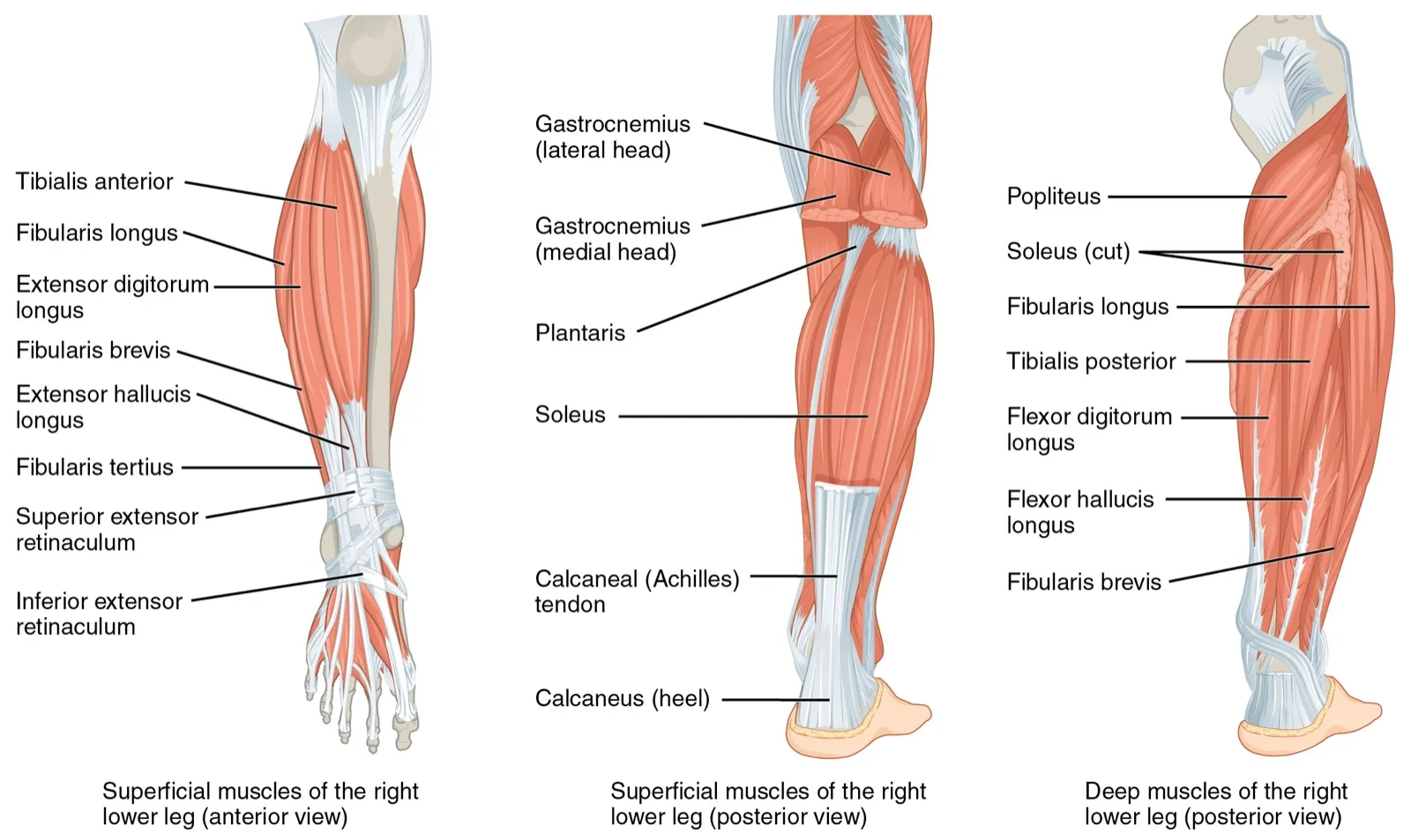
As an injury, a strain is an overstretched or torn muscle. A calf strain is one in the calf muscles. They include the gastrocnemius, the large two-headed muscle nearest the skin, and the soleus, the flat muscle underneath it. A 2026 narrative review of 82 articles says calf muscle injuries are too often grouped under one label1. It points to important differences between injuries of the gastrocnemius, the soleus and, less commonly, the plantaris, a small calf muscle1.
The word itself is disputed5. The 2013 Munich consensus statement, a report of what a panel of experts agrees on, covers muscle injuries in sport5. A survey behind it found that team doctors and scientists used injury terms in very different ways, most obviously “strain”5. Its authors call “strain” a biomechanical term and do not recommend it5. They propose “tear” for structural injuries of muscle fibres or bundles5.
How injuries are graded
Two general schemes appear in calf studies6:
- The Munich consensus statement separates functional disorders with no visible tear (types 1 and 2) from structural injuries with a visible fibre tear5. Type 3 is a partial tear, and type 4 is a subtotal or total tear or a tendon pulled from its attachment5.
- The British Athletics Muscle Injury Classification grades injuries 0 to 4 on MRI, a scan that shows soft tissue such as muscle in detail7. A letter marks the site: “a” at the fascia (a sheet of tissue around muscle), “b” where muscle meets tendon, and “c” within the tendon7.
A systematic review of 11 studies that used the British Athletics scheme found two that reported calf injuries8. The 2026 narrative review concludes that general schemes improve the terms used, but incompletely capture injuries in the lower part of the calf1.
Tennis leg
A historical review describes tennis leg as an injury of the gastrocnemius muscle and tendon, tied to the sport of tennis since 18839. A 2026 imaging review calls it a common cause of sudden pain at the back and inner side of the calf10. That review says it was first described as a rupture of the plantaris tendon10. Its most frequent cause, the review says, is injury to the inner (medial) head of the gastrocnemius, where muscle meets tendon low in the calf10.
In one series, 141 patients were referred for ultrasound, a scan made with sound waves, as tennis leg11. The scan showed a rupture of the medial head in 94 and a plantaris tendon rupture in two11.
Which muscle is injured
The muscle injured most often differed from study to study14,15.
| Who was studied | What was found |
|---|---|
| 184 calf strains in elite Australian Football players, 2014 to 2017 | 84.6% were soleus injuries14 |
| 27 acute calf injuries on one National Football League team, 2003 to 2015 | 74% involved the gastrocnemius alone, 15% the soleus alone and 11% both15 |
| 59 MRI examinations of calf muscle injuries, 39 of them single-muscle strains | Of the 39, the gastrocnemius in 19, the soleus in 18 and the plantaris in 216 |
| 82 gastrocnemius injuries in elite male Australian football players | 78% involved the medial head17 |
A 2022 study interviewed 20 expert clinicians working in elite sport4. They described gastrocnemius injuries as most common in acceleration, jumping and sprinting, and almost always apparent at once4. Soleus injuries were most common in steady running, or came on gradually4.
Who it affects
How often it is recorded
| Who was studied | What was found |
|---|---|
| The US National Football League, 2015 to 2019 | 728 of 5,780 lower-limb muscle strains (12.6%) were calf strains18 |
| 1,401 male professional soccer players at 26 European clubs, nine seasons | 306 of 2,123 muscle injuries in the main lower-limb groups were calf injuries19 |
| 41 professional football players on one team, two seasons | 16 calf strains: 3.1 per 1,000 hours of match play and 0.5 per 1,000 hours of training20 |
| Runners other than ultramarathoners, in a systematic review | Calf strain was 1.0% of injuries in studies of prevalence (existing cases) and 4.2% in studies of incidence (new cases)21 |
Age and earlier strains
A systematic review of ten studies covered 5,397 athletes and 518 calf or lower-leg muscle injuries2. It found older age and a previous calf strain were the strongest risk factors2. The same review found little evidence overall, with a trend for studies at high risk of bias2.
Single studies report the same two factors19,22:
- Australian Football League, 1992 to 2014: a calf strain in the previous 8 weeks was the strongest risk factor for another22. The odds ratio, how many times higher the odds were, was 13.322.
- European professional soccer, 1,401 players: players above the mean age had almost twice the rate of calf injury19. No link with age was found for the other muscle groups19.
- Relay runners, a survey of 2,886: calf, Achilles and hamstring soft-tissue injuries were more prevalent at age 40 or over than in younger runners23.
On body size, the sources differ2,20. The systematic review found no evidence that height, weight, gender or side dominance are linked with calf strain2. In a pilot (small first) study of 41 professional football players from one team, the injured players were older, heavier and taller20.
Running load
In that pilot study, the week before a calf strain carried higher training volume and running distances than the players’ previous six-week average20. Its authors conclude such a week might raise the risk20. The 20 expert clinicians described recent breaks in running, or sudden rises in running load, as a common factor, particularly for soleus injuries4.
What studies found
How long athletes were out
| Who was studied | Time to return |
|---|---|
| 818 first-time structural calf injuries in professional football | Median 13 days, mean 17.4; 80% of absences were between 4 and 35 days3 |
| 27 acute calf injuries on one National Football League team | Mean 17.4 days, range 3 to 6215 |
| 184 calf strains in elite Australian Football players | Mean 19.1 days for the gastrocnemius and 25.4 for the soleus, a gap that was not statistically significant14 |
| 44 soleus injuries in high-level or professional athletes | 29.1 days, reported as the median24 |
| 100 patients in a row with calf muscle injury on MRI, graded 0 to 3 by damage to muscle and connective tissue | Means of 8, 17, 25 and 48 days25 |
What scans add
The 2026 narrative review concludes that damage to connective tissue appears to matter more for the outlook than oedema, swelling from fluid, alone1. It names the aponeurosis, a broad, flat sheet of tendon, and the tendon inside the muscle1. In 149 Australian Football League calf strains, severe disruption of the aponeurosis went with a mean of 31.3 days out, against 19.4 without26.
The 2026 review states that the precise value of MRI findings for predicting the outlook remains uncertain1. It adds that studies define return to play inconsistently1.
How often it came back
- Professional football: the re-injury rate recorded for structural calf muscle injuries was 14.4%3. Mean absence after 118 repeat injuries was 3.3 days longer than after first injuries3.
- Elite male Australian football, 563 injuries over a decade: 13% to 21.3% recurred within two years, depending on the definition used27.
- Soleus injuries in 44 high-level or professional athletes: 3 (6.8%) had been reinjured when phoned a year later24.
- Australian Football League, 149 strains: older age and a history of calf strain raised the risk of a repeat within two seasons26. MRI findings of the first injury were not linked with it26.
The 20 clinicians interviewed did not find that simply taking longer before return to play was an effective safeguard against a repeat4.
What has been compared
The authors of the 2022 interview study wrote that research on calf strains was scarce4. They wrote that practitioners had relied on commentaries and book chapters4. The 2026 narrative review lists comparative trials of calf-specific programmes among its priorities for research1.
Studies have compared the following28,29,30:
- Starting exercise early or late: a randomised trial (groups assigned by chance) covered 50 recreational athletes with a severe thigh or calf strain28. It measured muscle strength at 5 weeks, 3 months and 6 months28. Strength was similar in the two groups each time28. Its authors reported that an early start sped up recovery, but that their scans and strength measures did not explain why28.
- Ice: a pilot randomised trial assigned 19 patients with an acute gastrocnemius tear to repeated crushed ice or a control group29. It found no significant difference in functional capacity, recovery time, absence from work or pain29. Its authors calculated that a full trial would need 396 participants29.
- Platelet-rich plasma: this is a part of a person’s own blood, prepared for injection. One study compared medical records of people with medial gastrocnemius injuries where muscle meets tendon30. The 31 given three injections returned to sport after a mean of 53 days, against 119 days in 30 others30.
A meta-analysis, which pools earlier studies, covered six randomised trials of these injections for acute muscle injuries in general31. Return to sport was about 7 days sooner overall, with no significant difference in the two double-blind trials31. It rated the quality of evidence as low or very low31.
A 2022 article on calf strain in athletes states that most calf strains are managed effectively without surgery32. The interview study concluded that a universal programme for avoiding calf strains may not exist4.
Connections
A calf strain involves the gastrocnemius, the soleus or, less often, the plantaris1.
In public records of NBA players from 1958 to 2024, a previous calf strain went with higher odds of a rupture of the Achilles tendon33.
A 2016 article on calf injuries in runners states that calf pain is common among runners young and old, but most frequent in masters athletes34.
Calf strain involves
Calf strain has been linked in one study with later rupture of
Calf strain has been counted in studies of
Calf strain is one kind of injury to
Sources
- Balius R, Pedret C, Pujol-Marzo M, Valle X, de la Fuente J (2026). Triceps surae muscle injuries-a clinical challenge more complex than you think.. British medical bulletin. doi:10.1093/bmb/ldag021 PMID 42476539
- Green B, Pizzari T (2017). Calf muscle strain injuries in sport: a systematic review of risk factors for injury.. British Journal of Sports Medicine. doi:10.1136/bjsports-2016-097177 PMID 28259848
- Ekstrand J, Krutsch W, Spreco A, van Zoest W, Roberts C, Meyer T, Bengtsson H (2020). Time before return to play for the most common injuries in professional football: a 16-year follow-up of the UEFA Elite Club Injury Study.. British Journal of Sports Medicine. doi:10.1136/bjsports-2019-100666 PMID 31182429
- Green B, McClelland JA, Semciw AI, Schache AG, McCall A, Pizzari T (2022). The Assessment, Management and Prevention of Calf Muscle Strain Injuries: A Qualitative Study of the Practices and Perspectives of 20 Expert Sports Clinicians.. Sports medicine - open. doi:10.1186/s40798-021-00364-0 PMID 35032233
- Mueller-Wohlfahrt HW, Haensel L, Mithoefer K, Ekstrand J, English B, McNally S, Orchard J, van Dijk CN, Kerkhoffs GM, Schamasch P, Blottner D, Swaerd L, Goedhart E, Ueblacker P (2013). Terminology and classification of muscle injuries in sport: the Munich consensus statement.. British Journal of Sports Medicine. doi:10.1136/bjsports-2012-091448 PMID 23080315
- Pezzotta G, Querques G, Pecorelli A, Nani R, Sironi S (2017). MRI detection of soleus muscle injuries in professional football players.. Skeletal radiology. doi:10.1007/s00256-017-2729-z PMID 28770309
- Pollock N, James SL, Lee JC, Chakraverty R (2014). British athletics muscle injury classification: a new grading system.. British Journal of Sports Medicine. doi:10.1136/bjsports-2013-093302 PMID 25031367
- Hollabaugh WL, Sin A, Walden RL, Weaver JS, Porras LP, LeClere LE, Karpinos AR, Coronado RA, Gregory AJ, Sullivan JP (2024). Outcomes of Activity-Related Lower Extremity Muscle Tears After Application of the British Athletics Muscle Injury Classification: A Systematic Review.. Sports Health. doi:10.1177/19417381231195529 PMID 37681683
- Domeracki SJ (2021). "Tennis Leg": A State-of-the-Science Review.. Workplace health & safety. doi:10.1177/2165079920961966 PMID 33514295
- Godoy IRB, Cantarelli Rodrigues T, Alharfi M, Flores DV (2026). Imaging in the diagnosis and characterization of tennis leg.. Skeletal radiology. doi:10.1007/s00256-026-05212-4 PMID 41981329
- Delgado GJ, Chung CB, Lektrakul N, Azocar P, Botte MJ, Coria D, Bosch E, Resnick D (2002). Tennis leg: clinical US study of 141 patients and anatomic investigation of four cadavers with MR imaging and US.. Radiology. doi:10.1148/radiol.2241011067 PMID 12091669
- Parellada AJ, Morrison WB, Reiter SB, Carrino JA, Glickman PL, Kloss LA, Patel P (2006). Unsuspected lower extremity deep venous thrombosis simulating musculoskeletal pathology.. Skeletal radiology. doi:10.1007/s00256-006-0128-y PMID 16724202
- Slawski DP (1994). Deep venous thrombosis complicating rupture of the medial head of the gastrocnemius muscle.. Journal of orthopaedic trauma. doi:10.1097/00005131-199406000-00016 PMID 8027900
- Green B, Lin M, Schache AG, McClelland JA, Semciw AI, Rotstein A, Cook J, Pizzari T (2020). Calf muscle strain injuries in elite Australian Football players: A descriptive epidemiological evaluation.. Scandinavian Journal of Medicine & Science in Sports. doi:10.1111/sms.13552 PMID 31494970
- Werner BC, Belkin NS, Kennelly S, Weiss L, Barnes RP, Potter HG, Warren RF, Rodeo SA (2017). Acute Gastrocnemius-Soleus Complex Injuries in National Football League Athletes.. Orthopaedic journal of sports medicine. doi:10.1177/2325967116680344 PMID 28203595
- Koulouris G, Ting AY, Jhamb A, Connell D, Kavanagh EC (2007). Magnetic resonance imaging findings of injuries to the calf muscle complex.. Skeletal radiology. doi:10.1007/s00256-007-0306-6 PMID 17483942
- Gray C, Pizzari T, Murphy MC, Schache AG, Breidahl WH, Klinken S, Bell T, Green B (2025). Gastrocnemius Muscle Strain Injury Characteristics in Elite Male Australian Football Players: A 10-Year Longitudinal Cohort Study.. The Journal of orthopaedic and sports physical therapy. doi:10.2519/jospt.2025.13526 PMID 40985375
- Herzog MM, Weiss L, Lee RY, Williams T, Ramsden S, Sills AK, Mack CD (2023). Lower Extremity Strains in the US National Football League, 2015-2019.. The American journal of sports medicine. doi:10.1177/03635465231175479 PMID 37259957
- Hägglund M, Waldén M, Ekstrand J (2013). Risk Factors for Lower Extremity Muscle Injury in Professional Soccer. The American journal of sports medicine. doi:10.1177/0363546512470634 PMID 23263293
- Soler A, Agulló F, Hernández-Davó J, Raya-González J, Del Coso J, González-Ródenas J, Moreno-Pérez V (2025). Influence of the External Workload on Calf Muscle Strain Injuries in Professional Football Players: A Pilot Study.. Sports health. doi:10.1177/19417381241247754 PMID 38708680
- Kakouris N, Yener N, Fong DTP (2021). A systematic review of running-related musculoskeletal injuries in runners.. Journal of sport and health science. doi:10.1016/j.jshs.2021.04.001 PMID 33862272
- Orchard JW, Chaker Jomaa M, Orchard JJ, Rae K, Hoffman DT, Reddin T, Driscoll T (2020). Fifteen-week window for recurrent muscle strains in football: a prospective cohort of 3600 muscle strains over 23 years in professional Australian rules football.. British journal of sports medicine. doi:10.1136/bjsports-2019-100755 PMID 32024646
- McKean KA, Manson NA, Stanish WD (2006). Musculoskeletal injury in the masters runners.. Clinical journal of sport medicine : official journal of the Canadian Academy of Sport Medicine. doi:10.1097/00042752-200603000-00011 PMID 16603885
- Pedret C, Rodas G, Balius R, Capdevila L, Bossy M, Vernooij RW, Alomar X (2015). Return to Play After Soleus Muscle Injuries.. Orthopaedic journal of sports medicine. doi:10.1177/2325967115595802 PMID 26674181
- Prakash A, Entwisle T, Schneider M, Brukner P, Connell D (2018). Connective tissue injury in calf muscle tears and return to play: MRI correlation.. British journal of sports medicine. doi:10.1136/bjsports-2017-098362 PMID 29074478
- Green B, Lin M, McClelland JA, Semciw AI, Schache AG, Rotstein AH, Cook J, Pizzari T (2020). Return to Play and Recurrence After Calf Muscle Strain Injuries in Elite Australian Football Players.. The American Journal of Sports Medicine. doi:10.1177/0363546520959327 PMID 33030961
- Green B, Schache AG, Pizzari T (2025). What is a recurrence? The onset, frequency and time loss impact of recurrent calf muscle strain injuries in elite male Australian football players over a decade.. BMJ Open Sport & Exercise Medicine. doi:10.1136/bmjsem-2025-002865 PMID 40919406
- Bayer ML, Hoegberget-Kalisz M, Jensen MH, Olesen JL, Svensson RB, Couppé C, Boesen M, Nybing JD, Kurt EY, Magnusson SP, Kjaer M (2018). Role of tissue perfusion, muscle strength recovery, and pain in rehabilitation after acute muscle strain injury: A randomized controlled trial comparing early and delayed rehabilitation.. Scandinavian journal of medicine & science in sports. doi:10.1111/sms.13269 PMID 30043997
- Prins JC, Stubbe JH, van Meeteren NL, Scheffers FA, van Dongen MC (2011). Feasibility and preliminary effectiveness of ice therapy in patients with an acute tear in the gastrocnemius muscle: a pilot randomized controlled trial.. Clinical rehabilitation. doi:10.1177/0269215510388312 PMID 21059665
- Borrione P, Fossati C, Pereira MT, Giannini S, Davico M, Minganti C, Pigozzi F (2018). The use of platelet-rich plasma (PRP) in the treatment of gastrocnemius strains: a retrospective observational study.. Platelets. doi:10.1080/09537104.2017.1349307 PMID 28895770
- Grassi A, Napoli F, Romandini I, Samuelsson K, Zaffagnini S, Candrian C, Filardo G (2018). Is Platelet-Rich Plasma (PRP) Effective in the Treatment of Acute Muscle Injuries? A Systematic Review and Meta-Analysis.. Sports medicine (Auckland, N.Z.). doi:10.1007/s40279-018-0860-1 PMID 29363053
- Meek WM, Kucharik MP, Eberlin CT, Naessig SA, Rudisill SS, Martin SD (2022). Calf Strain in Athletes.. JBJS reviews. doi:10.2106/JBJS.RVW.21.00183 PMID 35316243
- Elsabbagh Z, Le Y, Bcharah G, Ryu D, Badin D, Hsu NN, Thompson JM, Aiyer A (2026). Prior Calf Strain as a Risk Factor for Achilles Tendon Rupture in National Basketball Association Players: A Retrospective Analysis.. Orthopaedic journal of sports medicine. doi:10.1177/23259671261449170 PMID 42293040
- Fields KB, Rigby MD (2016). Muscular Calf Injuries in Runners.. Current sports medicine reports. doi:10.1249/JSR.0000000000000292 PMID 27618240
Changes
- First published.