Muscle
Also called skeletal muscle, muscles, muscle tissue
Skeletal muscle, the tissue that moves the body. What it is made of, how it responds to load, how it gets injured and heals, what training studies found, and how it changes from childhood to old age.
- Region
- Across the body
- Updated
- September 30, 2026
- Reviewed
- September 30, 2026 · how entries are checked
What it is
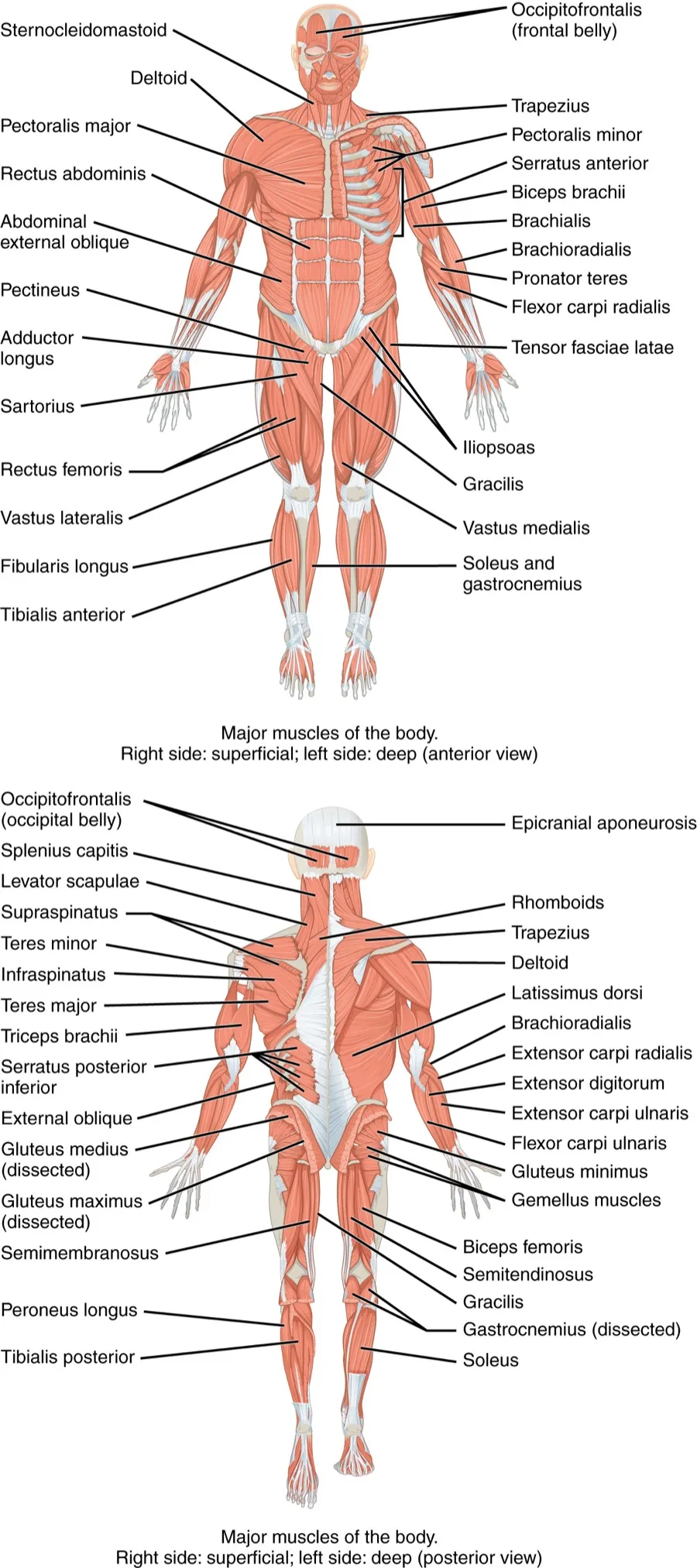
The body has three kinds of muscle tissue: skeletal, cardiac and smooth1. This page covers skeletal muscle, which depends completely on signals from the nervous system1. Skeletal muscles make movement and also stop it1. They hold posture against gravity, keep joints stable and make heat1.
Fibres and their wrappings
Skeletal muscle cells are called muscle fibres1. Each is a long cylinder with many nuclei, formed when young cells fuse before birth1. Three layers of connective tissue (tissue packed with collagen, a strong, rope-like protein) wrap each muscle1. One surrounds the whole muscle, one each fascicle (bundle of fibres) and one each single fibre1.
In muscles that pull on bone through a tendon (a tough cord joining muscle to bone), the layers’ collagen weaves into the tendon’s collagen1. So the pull the fibres make passes through the layers to the tendon, then on to the bone1.
Slow and fast fibres
Fibres fall into three main types, sorted by how fast they contract and how they make energy1. The three are slow oxidative, fast oxidative and fast glycolytic, and most human muscles hold all three1. Slow oxidative fibres are thin, resist fatigue and make little tension1. Fast glycolytic fibres are thick, make high tension for quick moves, and tire quickly1. A muscle’s main job sets its main fibre type; posture muscles, for example, hold many slow fibres1.
A motor unit is one nerve cell and the fibres it switches on1. Small units fire first, and larger ones join as more force is needed1.
How it responds to load
Bigger fibres, and the debate over new ones
A meta-analysis (a study that pools the results of several earlier studies) looked at fibre number5. It states that resistance exercise grows human muscle mainly by hypertrophy, the enlarging of fibres5. It notes some debate over whether hyperplasia (new fibres) also occurs5. Pooling 11 human studies, it found no significant change in fibre number after training of up to 6 months5. The authors add that a change may be hard to detect, as trials were short and fibre number is hard to estimate5.
On the other side, a 1996 meta-analysis of 17 animal studies found that overload raised fibre number by about 15% on average6. A 2020 review states that whether new fibres can form in adult muscle is debated, with no firm conclusion yet7.
A review names faster protein building as the key route, though not the only one, by which resistance exercise makes muscle grow8. Satellite cells (muscle stem cells) sit just outside the fibre’s membrane and join it under some kinds of stress, mainly to repair damage1.
Progressive overload
In a trial in 55 untrained young women, each arm was randomly given rising loads, the same load throughout, or no exercise9. After 8 weeks of elbow extension, the triceps thickened in both trained arms9. The rising-load arms grew about twice as much, about 23% against 12%9. The authors note that the same load still grew these women’s muscle, and that whether it keeps working longer is an open question9.
In 39 untrained young men and women, legs were randomly set to add either load or repetitions for 10 weeks10. Both legs gained strength and muscle size, with no difference between the two10. In 43 people with at least a year of lower-body training, the two ways gave similar changes over 8 weeks11.
Damage and soreness
A review states that eccentric (lengthening) exercise damages muscle unused to it more than other exercise does12. A 2019 review states that such damage is probably not essential for growth, and that whether it adds to growth is still unclear8.
A review states that delayed-onset muscle soreness (soreness that starts hours to days after exercise) usually appears 12 to 24 hours after unaccustomed eccentric exercise12. It peaks between 24 and 72 hours and is gone within 5 to 7 days12. How sore a muscle feels matches other damage markers poorly, so soreness seems a weak gauge of damage12.
How it gets injured
Naming muscle injuries
A survey behind the 2013 Munich consensus found wide variation in muscle injury terms, especially for “strain”13. The consensus sorts injuries into functional disorders with no visible tear, and structural injuries with a tear13.
How common and where
In one cohort study of 2,299 male professional footballers, muscle injuries were 31% of all injuries and 27% of time lost3. Of these, 92% hit four leg muscle groups: hamstrings, adductors, quadriceps and calf3. In the same players, 16% were reinjuries, which kept players out significantly longer than first injuries3.
A review of 21 video studies covered 728 non-contact and indirect muscle injuries in sport14. Most happened while running or in sport moves that change muscle length while it is contracting14. Studies of athletes found older age and a previous strain the strongest risk factors for hamstring and calf strains15,16.
Training load and injury
A systematic review of 22 studies found evidence linking the acute:chronic workload ratio (recent training load compared with longer-term load) with non-contact injuries17. A 2020 critique argues that no study has properly estimated whether the ratio causes injury18. It finds no evidence for using it to lower injury risk18. The ratio evidence covers non-contact injuries in general, not muscle injuries alone17.
How muscle heals
A review describes three phases of repair19. First comes breakdown with inflammation, then satellite cells wake and multiply, then the new fibres mature19. The same review says regeneration usually starts within 4 to 5 days, peaks at about 2 weeks and fades by 3 to 4 weeks19.
By the same review’s account, early scarring helps, steadying the tissue as a scaffold for new fibres19. Too much collagen after injury, though, often enlarges the scar and can stop the muscle working normally19. A 2020 review states that muscle can regenerate fully after minor injuries20. After severe ones, scar tissue keeps it from recovering to a functional level20.
How training builds it
Size and strength
In one network meta-analysis of trials in healthy adults, every resistance training plan tested beat no exercise for muscle growth2. Every plan also beat no exercise for strength; loads over 80% of the one-repetition maximum (heaviest single lift) gave the most2. The resistance training page covers doses in detail.
A review of heavy strength training finds the main structural change is a larger cross-section of the whole muscle and of each fibre21. It says this comes from more and larger myofibrils (contracting strands inside a muscle fibre), and that satellite cells switch on very early21. A 2020 review states that whether fibres grow through larger myofibrils, more of them, or both is still unresolved7.
The first weeks
A review concludes that strength gains come from both nerve and structural changes21. Nerve changes may count most early on, but growth starts at the outset too21. A meta-analysis of 30 trials found subtle training changes in the nervous system, in and below the brain’s outer layer, that likely add to strength22. A review puts forward that size gains in the first sessions are mostly swelling, with true growth not seen until about 18 sessions23.
How much, and who gains most
An analysis of 67 studies in mostly young men found size and strength gains rose with training volume, with diminishing returns, more so for strength24. Across 28 studies in 747 healthy adults, light, moderate and heavy loads taken to failure did not differ in growth25. Strength gains were greater with heavy and moderate loads than light ones25. After 12 weeks of one-arm training in 585 adults, biceps size changes ranged from −2% to +59%26.
Endurance training changes muscle in other ways. A review pooled training studies in 5,973 people27. Continuous endurance training raised mitochondria (the small parts inside a cell that release energy from food) by about 23%27. Capillaries (tiny, thin-walled blood vessels) per fibre rose about 15%, mostly in the first 4 weeks and only in untrained to moderately trained people27. The review concludes that less fit people change more, and that the ability to adapt lasts throughout life27.
Across the lifespan
Children and teenagers
A pooled analysis of trials in healthy under-18s found resistance training raised strength28. The capacity to gain strength seemed to grow with age and maturity, with no clear jump at puberty28.
A 2008 Canadian position paper states that children’s strength gains have been put down mainly to nerve changes, though scans suggest growth may occur too29. A 2023 systematic review of 22 studies in 604 prepubertal children (before puberty) found strength rose in every case30. In its authors’ view, gains over 8 to 12 weeks come mainly from nerve changes, and small structural changes probably matter little for strength30. A 2021 review found that a few such studies reported trivial to moderate changes in muscle size and motor unit activation31.
A meta-analysis of 23 studies in 1,443 under-18s found a small rise in muscle size against inactive controls32. A literature review states there is no evidence that resistance training harms growth in height33.
Adults and older age
A review drew on studies following people aged 75 over time4. Muscle mass fell 0.64–0.70% a year in women and 0.80–0.98% in men4. Strength fell faster: about 3–4% a year in men and 2.5–3% in women4. The same review finds that losing strength is more consistently linked to disability and death than losing mass4.
A review states that nerve studies confirm fewer motor units with age, and some remaining units grow larger4. Another review states that, fibre by fibre, age-related loss is mainly shrinking of type II fibres34. A meta-analysis of 55 studies of master athletes, training for 20 years or more with mean ages over 59, looked at long-term training35. It suggests such training keeps strength and physical function at levels like those of young, healthy people, in ways that depend on the type of exercise35.
A 2019 European consensus describes sarcopenia as a muscle disease built up from harmful muscle changes over a lifetime36. It is common in older adults but can start earlier, and counts low strength as a key feature36. Across 151 studies of people with a mean age of 68.5, sarcopenia affected 10% to 27%, depending on how it was defined37.
A Cochrane review (a systematic review to Cochrane’s published standards) pooled 121 trials in 6,700 older people38. Progressive resistance training had a large effect on strength38. In 25 trials of healthy adults with a mean age of 65 or over, strength rose substantially; in the nine that measured it, muscle size rose little39. A review of 14 studies in 528 older adults with sarcopenia found that supervised resistance training gave a small but significant gain in muscle mass40.
Connections
In one cohort of male professional footballers, 92% of muscle injuries hit the hamstrings, adductors, quadriceps and calf3. The library has entries on the hamstrings, hip adductors, quadriceps, gastrocnemius and soleus. Other entries cover the gluteus maximus, gluteus medius, gluteus minimus, rectus abdominis, external oblique, internal oblique and transversus abdominis.
Postural muscles tend to hold many slow fibres1. Back and upper-body entries cover the erector spinae, multifidus, deltoid, pectoralis major, latissimus dorsi, trapezius and serratus anterior. Arm entries cover the biceps brachii and triceps brachii.
Where muscles pull on bone, they do it through a tendon, and skeletal muscle depends on nerve signals to work1. Training methods have their own pages: resistance training, eccentric training, isometric training and blood flow restriction training.
Muscle pulls on
Muscle is switched on by
Muscle is wrapped by
Muscle is loaded by
Muscle has an entry on
- MuscleBiceps brachii
- MuscleDeltoid
- MuscleErector spinae
- MuscleExternal oblique
- MuscleGastrocnemius
- MuscleGluteus maximus
- MuscleGluteus medius
- MuscleGluteus minimus
- MuscleHamstrings
- MuscleHip adductors
- MuscleInternal oblique
- MuscleLatissimus dorsi
- MuscleMultifidus
- MusclePectoralis major
- MuscleQuadriceps
- MuscleRectus abdominis
- MuscleSerratus anterior
- MuscleSoleus
- MuscleTransversus abdominis
- MuscleTrapezius
- MuscleTriceps brachii
Sources
- Betts JG, Young KA, Wise JA, Johnson E, Poe B, Kruse DH, Korol O, Johnson JE, Womble M, DeSaix P (2022). Anatomy and Physiology 2e. OpenStax. Link
- Currier BS, Mcleod JC, Banfield L, Beyene J, Welton NJ, D'Souza AC, Keogh JAJ, Lin L, Coletta G, Yang A, Colenso-Semple L, Lau KJ, Verboom A, Phillips SM (2023). Resistance training prescription for muscle strength and hypertrophy in healthy adults: a systematic review and Bayesian network meta-analysis.. British Journal of Sports Medicine. doi:10.1136/bjsports-2023-106807 PMID 37414459
- Ekstrand J, Hägglund M, Waldén M (2011). Epidemiology of muscle injuries in professional football (soccer).. The American Journal of Sports Medicine. doi:10.1177/0363546510395879 PMID 21335353
- Mitchell WK, Williams J, Atherton P, Larvin M, Lund J, Narici M (2012). Sarcopenia, dynapenia, and the impact of advancing age on human skeletal muscle size and strength; a quantitative review.. Frontiers in Physiology. doi:10.3389/fphys.2012.00260 PMID 22934016
- Barton NV, Gowda HN, Dankel SJ (2026). A systematic review and meta-analysis examining if hyperplasia occurs in humans in response to resistance exercise.. The Journal of sports medicine and physical fitness. doi:10.23736/S0022-4707.25.17206-X PMID 41307564
- Kelley G (1996). Mechanical overload and skeletal muscle fiber hyperplasia: a meta-analysis.. Journal of applied physiology (Bethesda, Md. : 1985). doi:10.1152/jappl.1996.81.4.1584 PMID 8904572
- Jorgenson KW, Phillips SM, Hornberger TA (2020). Identifying the Structural Adaptations that Drive the Mechanical Load-Induced Growth of Skeletal Muscle: A Scoping Review.. Cells. doi:10.3390/cells9071658 PMID 32660165
- Wackerhage H, Schoenfeld BJ, Hamilton DL, Lehti M, Hulmi JJ (2019). Stimuli and sensors that initiate skeletal muscle hypertrophy following resistance exercise.. Journal of Applied Physiology. doi:10.1152/japplphysiol.00685.2018 PMID 30335577
- Kassiano W, Santos-Melo V, Manske I, Lisboa F, Miguel A, Gomes F, Prado A, et al (2026). Progressive Overload Affects the Magnitude of Muscle Hypertrophy.. Medicine and science in sports and exercise. doi:10.1249/MSS.0000000000003968 PMID 41718594
- Chaves TS, Scarpelli MC, Bergamasco JGA, Silva DGD, Medalha Junior RA, Dias NF, Bittencourt D, et al (2024). Effects of Resistance Training Overload Progression Protocols on Strength and Muscle Mass.. International journal of sports medicine. doi:10.1055/a-2256-5857 PMID 38286426
- Plotkin D, Coleman M, Van Every D, Maldonado J, Oberlin D, Israetel M, et al (2022). Progressive overload without progressing load? The effects of load or repetition progression on muscular adaptations.. PeerJ. doi:10.7717/peerj.14142 PMID 36199287
- Hody S, Croisier JL, Bury T, Rogister B, Leprince P (2019). Eccentric Muscle Contractions: Risks and Benefits.. Frontiers in Physiology. doi:10.3389/fphys.2019.00536 PMID 31130877
- Mueller-Wohlfahrt HW, Haensel L, Mithoefer K, Ekstrand J, English B, McNally S, Orchard J, van Dijk CN, Kerkhoffs GM, Schamasch P, Blottner D, Swaerd L, Goedhart E, Ueblacker P (2013). Terminology and classification of muscle injuries in sport: the Munich consensus statement.. British Journal of Sports Medicine. doi:10.1136/bjsports-2012-091448 PMID 23080315
- Finnern LS, Wilke J, Willwacher S, Pasanen K, Hollander K, Dalos D, Welsch GH, Krosshaug T, Edouard P, Gronwald T, Hoenig T (2026). Qualitative and quantitative situational characteristics of muscle strains in sports: a systematic review and meta-analysis.. British Journal of Sports Medicine. doi:10.1136/bjsports-2025-110327 PMID 41558842
- Green B, Bourne MN, van Dyk N, Pizzari T (2020). Recalibrating the risk of hamstring strain injury (HSI): A 2020 systematic review and meta-analysis of risk factors for index and recurrent hamstring strain injury in sport.. British Journal of Sports Medicine. doi:10.1136/bjsports-2019-100983 PMID 32299793
- Green B, Pizzari T (2017). Calf muscle strain injuries in sport: a systematic review of risk factors for injury.. British Journal of Sports Medicine. doi:10.1136/bjsports-2016-097177 PMID 28259848
- Griffin A, Kenny IC, Comyns TM, Lyons M (2020). The Association Between the Acute:Chronic Workload Ratio and Injury and its Application in Team Sports: A Systematic Review.. Sports Medicine. doi:10.1007/s40279-019-01218-2 PMID 31691167
- Impellizzeri FM, Tenan MS, Kempton T, Novak A, Coutts AJ (2020). Acute:Chronic Workload Ratio: Conceptual Issues and Fundamental Pitfalls.. International Journal of Sports Physiology and Performance. doi:10.1123/ijspp.2019-0864 PMID 32502973
- Laumonier T, Menetrey J (2016). Muscle injuries and strategies for improving their repair.. Journal of Experimental Orthopaedics. doi:10.1186/s40634-016-0051-7 PMID 27447481
- Gardner T, Kenter K, Li Y (2020). Fibrosis following Acute Skeletal Muscle Injury: Mitigation and Reversal Potential in the Clinic.. Journal of sports medicine (Hindawi Publishing Corporation). doi:10.1155/2020/7059057 PMID 33376749
- Folland JP, Williams AG (2007). The Adaptations to Strength Training. Sports Medicine. doi:10.2165/00007256-200737020-00004 PMID 17241104
- Siddique U, Rahman S, Frazer AK, Pearce AJ, Howatson G, Kidgell DJ (2020). Determining the Sites of Neural Adaptations to Resistance Training: A Systematic Review and Meta-analysis.. Sports medicine (Auckland, N.Z.). doi:10.1007/s40279-020-01258-z PMID 31993949
- Damas F, Libardi CA, Ugrinowitsch C (2018). The development of skeletal muscle hypertrophy through resistance training: the role of muscle damage and muscle protein synthesis.. European Journal of Applied Physiology. doi:10.1007/s00421-017-3792-9 PMID 29282529
- Pelland JC, Remmert JF, Robinson ZP, Hinson SR, Zourdos MC (2026). The Resistance Training Dose Response: Meta-Regressions Exploring the Effects of Weekly Volume and Frequency on Muscle Hypertrophy and Strength Gains.. Sports medicine (Auckland, N.Z.). doi:10.1007/s40279-025-02344-w PMID 41343037
- Lopez P, Radaelli R, Taaffe DR, Newton RU, Galvão DA, Trajano GS, et al (2021). Resistance Training Load Effects on Muscle Hypertrophy and Strength Gain: Systematic Review and Network Meta-analysis.. Medicine and science in sports and exercise. doi:10.1249/mss.0000000000002585 PMID 33433148
- Hubal MJ, Gordish-Dressman H, Thompson PD, Price TB, Hoffman EP, Angelopoulos TJ, Gordon PM, Moyna NM, Pescatello LS, Visich PS, Zoeller RF, Seip RL, Clarkson PM (2005). Variability in muscle size and strength gain after unilateral resistance training.. Medicine and science in sports and exercise. PMID 15947721
- Mølmen KS, Almquist NW, Skattebo Ø (2025). Effects of Exercise Training on Mitochondrial and Capillary Growth in Human Skeletal Muscle: A Systematic Review and Meta-Regression.. Sports medicine (Auckland, N.Z.). doi:10.1007/s40279-024-02120-2 PMID 39390310
- Behringer M, Vom Heede A, Yue Z, Mester J (2010). Effects of resistance training in children and adolescents: a meta-analysis.. Pediatrics. doi:10.1542/peds.2010-0445 PMID 20974785
- Behm DG, Faigenbaum AD, Falk B, Klentrou P (2008). Canadian Society for Exercise Physiology position paper: resistance training in children and adolescents.. Applied physiology, nutrition, and metabolism = Physiologie appliquee, nutrition et metabolisme. doi:10.1139/h08-020 PMID 18461111
- Sánchez Pastor A, García-Sánchez C, Marquina Nieto M, de la Rubia A (2023). Influence of Strength Training Variables on Neuromuscular and Morphological Adaptations in Prepubertal Children: A Systematic Review.. International journal of environmental research and public health. doi:10.3390/ijerph20064833 PMID 36981742
- Tumkur Anil Kumar N, Oliver JL, Lloyd RS, Pedley JS, Radnor JM (2021). The Influence of Growth, Maturation and Resistance Training on Muscle-Tendon and Neuromuscular Adaptations: A Narrative Review.. Sports (Basel, Switzerland). doi:10.3390/sports9050059 PMID 34066778
- Komm Y, Zeiler L, Held S, Comfort P, Faigenbaum A, Geisler S, Augste C (2026). Effects of Resistance Training on Muscle Hypertrophy in Children and Adolescents: A Systematic Review and Meta-Analysis.. Sports Medicine. doi:10.1007/s40279-026-02499-0 PMID 42752819
- Faigenbaum AD, Myer GD (2010). Resistance training among young athletes: safety, efficacy and injury prevention effects.. British journal of sports medicine. doi:10.1136/bjsm.2009.068098 PMID 19945973
- Snijders T, Nederveen JP, McKay BR, Joanisse S, Verdijk LB, van Loon LJ, Parise G (2015). Satellite cells in human skeletal muscle plasticity.. Frontiers in Physiology. doi:10.3389/fphys.2015.00283 PMID 26557092
- Mckendry J, Breen L, Shad BJ, Greig CA (2018). Muscle morphology and performance in master athletes: A systematic review and meta-analyses.. Ageing research reviews. doi:10.1016/j.arr.2018.04.007 PMID 29715523
- Cruz-Jentoft AJ, Bahat G, Bauer J, Boirie Y, Bruyère O, Cederholm T, Cooper C, Landi F, Rolland Y, Sayer AA, Schneider SM, Sieber CC, Topinkova E, Vandewoude M, Visser M, Zamboni M (2019). Sarcopenia: revised European consensus on definition and diagnosis.. Age and Ageing. doi:10.1093/ageing/afy169 PMID 30312372
- Petermann-Rocha F, Balntzi V, Gray SR, Lara J, Ho FK, Pell JP, Celis-Morales C (2022). Global prevalence of sarcopenia and severe sarcopenia: a systematic review and meta-analysis.. Journal of Cachexia, Sarcopenia and Muscle. doi:10.1002/jcsm.12783 PMID 34816624
- Liu CJ, Latham NK (2009). Progressive resistance strength training for improving physical function in older adults.. The Cochrane database of systematic reviews. doi:10.1002/14651858.cd002759.pub2 PMID 19588334
- Borde R, Hortobágyi T, Granacher U (2015). Dose-Response Relationships of Resistance Training in Healthy Old Adults: A Systematic Review and Meta-Analysis.. Sports medicine (Auckland, N.Z.). doi:10.1007/s40279-015-0385-9 PMID 26420238
- Delaire L, Courtay-Breuil A, Humblot J, Vidal H, Bonnefoy M, Meugnier E (2025). Influence of Resistance Training Variables to Improve Muscle Mass Outcomes in Sarcopenia: A Systematic Review With Meta-Regressions.. Journal of Cachexia, Sarcopenia and Muscle. doi:10.1002/jcsm.70162 PMID 41365305
Changes
- First published.