Hamstring strain
Also called hamstring strain injury, hamstring injury, hamstring muscle injury
How research defines and grades a hamstring strain, how often it happens in the sports that have counted it, how long athletes were out, and what trials of exercise, injections and surgery found.
- Region
- Thigh
- Muscles
- biceps femoris, semitendinosus, semimembranosus
- Updated
- October 8, 2026
- Reviewed
- October 8, 2026 · how entries are checked
What it is
What the term covers
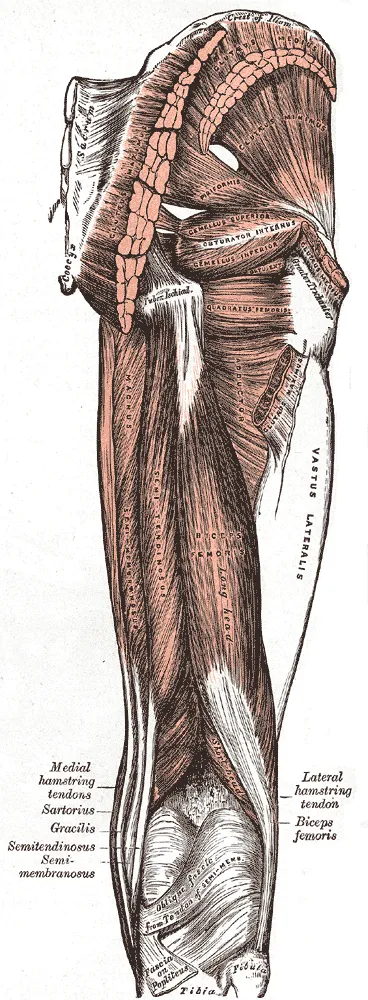
A 2022 clinical practice guideline on hamstring strain injury in athletes sets out what it covers1. A clinical practice guideline is a document of graded recommendations for clinicians, built from a review of the evidence. Its scope is sports-related injuries from overloading and overstretching1. These injuries affect myofascial structures (muscle and its wrapping) or musculotendinous structures (muscle and its tendon)1. They can be in any combination of the three hamstring muscles1.
The three are the biceps femoris, the semitendinosus and the semimembranosus, described on the hamstrings page7. A review reports that most hamstring injuries in athletes are strains where muscle joins tendon, most often at the upper junction8.
Two types, by how the injury happens
A case series of professional dancers describes two types of hamstring strain, with different mechanisms9. A case series is a report on a group of patients with the same condition. One happens in high-speed running, the other in stretching exercises9. A systematic review of 26 studies looked at how each one happens10:
- Running type. The vast majority of studies on running injuries proposed that they occur in the late swing phase of the running stride10. The swing phase is when the foot is off the ground. Some studies reported the stance phase, when the foot is on the ground10.
- Stretching type. Each study that reported this mechanism concluded that injury occurs with extensive hip flexion (bending at the hip) and a hyperextended knee10. Hyperextension is straightening a joint past its normal limit.
The same review reports that the running type typically involves the biceps femoris long head and has a shorter recovery time10. The stretching type commonly affects the semimembranosus10. The review reports that the running type is the most frequent10. In Australian football, it reports 81% of hamstring injuries during sprinting and 19% during kicking, a stretching-type injury10.
How injuries are graded
An international Delphi study asked hamstring injury experts which classification system they used11. A Delphi study is a method that polls a panel of experts in rounds to work toward agreement. The British Athletics Muscle Injury Classification was the most commonly used, at 58%11. The same Delphi study states that such systems lack data on their reliability and validity, and are not specific to single hamstring muscles11.
Who it affects
How often it happens, sport by sport
The rates below come from separate studies, each of one sport or one setting2,12,13. A cohort study follows a group of people over time, and an athlete-exposure is one athlete taking part in one practice or game.
| Who was studied | In matches or competition | In training or practice |
|---|---|---|
| 36 European men’s professional football clubs, 2001 to 2014 | 4.77 per 1000 hours | 0.51 per 1000 hours2 |
| Professional rugby union, one cohort study | 5.6 per 1000 player match hours | 0.27 per 1000 player training hours12 |
| 25 NCAA college sports, 2009-2010 to 2013-2014 | 5.24 per 10,000 athlete-exposures | 2.56 per 10,000 athlete-exposures13 |
In the football cohort, 22% of players had one or more hamstring injuries in a season2. In Australian Football League injury data from 1992 to 2012, hamstring strain was the most frequent and prevalent injury14.
The running page covers 13 international athletics championships15. In them, the hamstrings were the most frequently injured muscle group in sprints, hurdles, jumps, combined events and men’s middle distances15.
In NCAA college sports from 2009-2010 to 2013-2014, men had a higher hamstring strain rate than women in soccer, baseball or softball, and indoor track13.
Six field team sports, pooled
A systematic review pooled cohort studies from six field-based team sports: soccer, Australian football, rugby union, Gaelic football, hurling and field hockey3. Its 63 articles covered 5952 hamstring injuries and about 7.26 million hours of exposure3. It put the hamstring injury rate at 0.81 per 1000 hours3.
The same review compared rates across those articles3:
- Matches and training. The rate was 9.4 times higher in matches than in training3.
- Sport. The rate was not significantly different between the six sports3.
- Playing surface. The rate was 1.5 times higher on grass than on artificial turf3.
- Age. The rate was 6.4% higher for each added year in the average age of the group studied3. The groups’ average body mass and height made no significant difference to it3.
A published correction to the review gives hamstring injuries as 12% of all injuries3. It gives hamstring strain injuries as 10% of all injuries3. The correction says the error it fixed did not affect the rate results3.
Two sources report on change over time2,3. The pooled review found that the rate had not changed significantly over the last 30 years3. Its authors conclude that more work is needed to reduce it3.
In men’s professional football clubs followed from 2001 to 2014, the training hamstring injury rate rose by 4.0% a year2. The total rate rose by 2.3% a year2. The authors of that study report that match rates remained stable2.
What goes with a higher risk
A meta-analysis (a study that pools the results of several earlier studies) of 78 prospective studies covered 71,324 athletes16. A prospective study follows people forward in time. Older age and an earlier hamstring strain were the strongest risk factors, as the hamstrings page sets out16. In the same analysis, a past anterior cruciate ligament injury and a past calf strain were also significant risk factors16. The anterior cruciate ligament is the front one of two ligaments that cross inside the knee.
Three studies of elite and professional players set muscle measures against hamstring strain injury17,18,19:
- 152 elite soccer players. Biceps femoris long head fascicles under 10.56 cm at the start of preseason went with a relative risk of 4.1 for later injury17. Fascicles are bundles of muscle fibres.
- 210 elite Australian footballers. Eccentric hamstring strength in the Nordic exercise below 256 N at the start of preseason was associated with a 2.7-fold risk of later injury18. Eccentric work is muscle work done while the muscle lengthens.
- 614 professional soccer players. Differences in isokinetic strength between injured and uninjured players were small19. Isokinetic describes a strength test on a machine that holds a limb to a fixed speed. The authors concluded that strength deficits were weak risk factors that did not identify individual players at risk19.
What studies found
How long athletes were out
In 23 European professional football teams followed from 2007 to 2011, time out rose with the MRI grade4:
| MRI grade | Mean days out |
|---|---|
| Grade 0 | 84 |
| Grade 1 | 174 |
| Grade 2 | 224 |
| Grade 3 | 734 |
In the same teams, 70% of hamstring injuries were grade 0 or 1, with no sign of fibre disruption on MRI4. Those two grades accounted for 56% of the total days out4.
Two studies measured something different: the time to return to the level before the injury9,20. In 18 elite sprinters with a first acute hamstring strain, the median (middle value) was 16 weeks, with a range of 6 to 5020. In 15 professional dancers with a first acute strain from stretching, it was 50 weeks, with a range of 30 to 769.
What scans and examination could tell
A prospective cohort of 180 male athletes with acute hamstring injuries tested how well examination and MRI findings explained return time21. A model built from history and clinical examination explained 29% of the variation in time to return to sport21. Adding MRI findings explained a further 2.8%21. The authors concluded that clinicians cannot give an accurate return time just after the injury21.
Two systematic reviews looked at what predicts return time5,22. One, of 12 studies, found no strong evidence that any MRI finding gives a prognosis for time to return to play5. The other, of 16 studies, found no strong evidence for a valuable prognosis from any clinical finding at the start22.
Two studies took scans at the time of return23,24. In 53 athletes cleared to return to play after a hamstring injury, 89% still showed increased signal within the muscle on MRI23. A randomised trial compared two exercise programmes after acute hamstring strain injury, and 29 people began a programme24. No participant showed complete resolution of the injury on MRI at return to sport, although pain had nearly resolved and strength had returned24.
When the injury came back
Two sports reported how often the injury was a repeat12,14:
- Professional rugby union. In one cohort study, 23% of hamstring muscle injuries were recurrent, and they cost more days (25) than new injuries (14)12.
- Australian Football League, 1992 to 2012. The recurrence rate was 26%14.
A case series followed 19 athletes with a hamstring reinjury confirmed on MRI25. In it, 79% of reinjuries were at the same spot in the muscle as the first injury25. More than half happened within 25 days of return to sport25. A systematic review of 11 studies found no strong evidence that any MRI finding predicts reinjury risk26. It found moderate evidence that injuries within the tendon and biceps femoris injuries were associated with a higher risk26.
Trials of exercise programmes after a strain
Four randomised trials compared exercise programmes in athletes with an acute hamstring injury6,27,28,29:
| Who was studied | What was compared | Time to return | Repeat injuries |
|---|---|---|---|
| 75 Swedish elite football players | A protocol emphasising lengthening exercises against conventional exercises | Mean 28 against 51 days to full team training | One, in the conventional group6 |
| 56 Swedish elite sprinters and jumpers | A protocol emphasising lengthening exercises against conventional exercises | Mean 49 against 86 days to full training | Two, both in the conventional group27 |
| 90 male athletes, injury confirmed on MRI | Lengthening exercises from day 1 against after running at 70% of maximal speed | Median 23 against 33 days; no significant difference | No significant difference in rates over 12 months28 |
| 24 athletes | Stretching and isolated hamstring strengthening against progressive agility and trunk stabilisation | Mean 37.4 against 22.2 days; no significant difference | 7 of 10 against 1 of 13 within a year of return29 |
The authors of the 90-athlete trial reported a greater than expected loss to follow-up, at 19%28. They said the trial was potentially underpowered for a firm conclusion28.
Two reviews pooled trials like these30,31. A Cochrane review (a systematic review done to Cochrane’s published standards) found two randomised trials with 104 participants30. It concluded that current practice and widely published protocols could be neither supported nor refuted30. A meta-analysis of 10 randomised trials pooled two studies of lengthening exercises31. It found a significantly shorter time to return to play but no difference in the risk of re-injury31.
Trials of platelet-rich plasma injections
Platelet-rich plasma is a part of a person’s own blood with extra platelets, prepared for injection. Trials and pooled analyses of it disagree31,32,33,34:
- A randomised trial with placebo injections, in 80 competitive and recreational athletes. The plasma injections showed no benefit over the placebo (dummy) ones in time to return to play or re-injury rate at 1 year32.
- A randomised three-arm trial of 90 professional athletes. Return to sport came 5.7 days sooner after one platelet-rich injection than after a platelet-poor one33. Against no injection, the 2.9-day gap was not significant33.
- A meta-analysis of three studies. It found no effect on time to return to play compared with control31.
- A 2026 meta-analysis of six randomised trials with 277 participants. Return to play came a mean 8.6 days sooner with the injections, with high heterogeneity, meaning the trials’ results varied widely34. Reinjury did not differ, and the certainty of evidence was rated low to moderate34.
Programmes in athletes without an injury
Reviews of programmes meant to lower the rate of hamstring injury do not agree35,36,37. Two of the three below concern the Nordic hamstring exercise, set out on the Nordic hamstring curl page36,37.
- A Cochrane review of seven randomised trials, with searches to December 2008. It concluded there was insufficient evidence from randomised trials to draw conclusions for football and other high-risk activities35.
- A meta-analysis of 15 studies of athletes across sports. Programmes that included the Nordic hamstring exercise had a pooled hamstring injury risk ratio of 0.49, against programmes or usual training without it36. A risk ratio is how many times more often something happens in one group than in another.
- A reanalysis that kept randomised trials alone. Its pooled risk ratio was 0.59, with a 95% confidence interval of 0.27 to 1.2937. A confidence interval is a range around a result that shows how precise it is. The authors judged the protective effect inconclusive and mostly based on trials at high risk of bias37.
Surgery when the tendon pulls off the bone
An avulsion is a tear in which a tendon pulls away from the bone it attaches to. The proximal hamstring tendon page cites a systematic review on how common this is38. It reports that avulsion of the hamstring origin from the ischial tuberosity (the “sitting bone”) makes up 3% to 11% of hamstring injuries38.
A randomised trial enrolled 119 patients aged 30 to 70 with a proximal hamstring avulsion39. Function scores at 2 years were similar after surgical reinsertion of the tendons and without surgery, 79.9 against 78.5 out of 10039. The approach without surgery was noninferior, meaning not meaningfully worse beyond a margin set in advance39.
Connections
The injury sits in the hamstrings, and one of the three muscles carries most of it in football40. In male professional footballers, 80% of hamstring injuries placed in one muscle from 2011/12 onward were in the biceps femoris40. Avulsions of the upper tendon are covered on the proximal hamstring tendon page38.
The sciatic nerve is the large nerve that runs from the lower back down the back of the thigh. One study read the MRI scans of 96 hamstring strain injuries in US college American football players41. Swelling touched or surrounded the sciatic nerve in 75 of them, or 78.1%41.
Related exercise and stretch pages: Nordic hamstring curl, running and hamstring stretch15,36,42. A four-season study followed elite soccer teams from Iceland and Norway, which chose whether to use the programmes on offer42. The incidence of hamstring strains did not differ between teams that used a flexibility training programme and teams that did not42.
Hamstring strain involves
Hamstring strain can involve
Hamstring strain has been studied alongside
Hamstring strain has been studied in athletes at risk of
Hamstring strain has been studied in people who do
Sources
- Martin RL, Cibulka MT, Bolgla LA, Koc TA, Loudon JK, Manske RC, Weiss L, Christoforetti JJ, Heiderscheit BC (2022). Hamstring Strain Injury in Athletes.. The Journal of orthopaedic and sports physical therapy. doi:10.2519/jospt.2022.0301 PMID 35164536
- Ekstrand J, Waldén M, Hägglund M (2016). Hamstring injuries have increased by 4% annually in men's professional football, since 2001: a 13-year longitudinal analysis of the UEFA Elite Club injury study.. British journal of sports medicine. doi:10.1136/bjsports-2015-095359 PMID 26746908
- Maniar N, Carmichael DS, Hickey JT, Timmins RG, San Jose AJ, Dickson J, Opar D (2023). Incidence and prevalence of hamstring injuries in field-based team sports: a systematic review and meta-analysis of 5952 injuries from over 7 million exposure hours.. British journal of sports medicine. doi:10.1136/bjsports-2021-104936 PMID 36455927
- Ekstrand J, Healy JC, Waldén M, Lee JC, English B, Hägglund M (2012). Hamstring muscle injuries in professional football: the correlation of MRI findings with return to play.. British journal of sports medicine. doi:10.1136/bjsports-2011-090155 PMID 22144005
- Reurink G, Brilman EG, de Vos RJ, Maas M, Moen MH, Weir A, Goudswaard GJ, Tol JL (2015). Magnetic resonance imaging in acute hamstring injury: can we provide a return to play prognosis?. Sports medicine (Auckland, N.Z.). doi:10.1007/s40279-014-0243-1 PMID 25119158
- Askling CM, Tengvar M, Thorstensson A (2013). Acute hamstring injuries in Swedish elite football: a prospective randomised controlled clinical trial comparing two rehabilitation protocols.. British journal of sports medicine. doi:10.1136/bjsports-2013-092165 PMID 23536466
- Betts JG, Young KA, Wise JA, Johnson E, Poe B, Kruse DH, Korol O, Johnson JE, Womble M, DeSaix P (2022). Anatomy and Physiology 2e. OpenStax. Link
- Koolmees DS, Klott JD, Poppe TR, Bernholt DL (2025). Distal Hamstring Injuries and Disorders.. Journal of the American Academy of Orthopaedic Surgeons: Global Research & Reviews. doi:10.5435/JAAOSGlobal-D-25-00248 PMID 40972536
- Askling CM, Tengvar M, Saartok T, Thorstensson A (2007). Acute First-Time Hamstring Strains during Slow-Speed Stretching. The American journal of sports medicine. doi:10.1177/0363546507303563 PMID 17567821
- Danielsson A, Horvath A, Senorski C, Alentorn-Geli E, Garrett WE, Cugat R, Samuelsson K, Hamrin Senorski E (2020). The mechanism of hamstring injuries - a systematic review.. BMC musculoskeletal disorders. doi:10.1186/s12891-020-03658-8 PMID 32993700
- Paton BM, Court N, Giakoumis M, Head P, Kayani B, Kelly S, Kerkhoffs GMMJ, Moore J, Moriarty P, Murphy S, Plastow R, Pollock N, Read P, Stirling B, Tulloch L, van Dyk N, Wilson MG, Wood D, Haddad F (2023). London International Consensus and Delphi study on hamstring injuries part 1: classification.. British journal of sports medicine. doi:10.1136/bjsports-2021-105371 PMID 36650035
- Brooks JH, Fuller CW, Kemp SP, Reddin DB (2006). Incidence, risk, and prevention of hamstring muscle injuries in professional rugby union.. The American journal of sports medicine. doi:10.1177/0363546505286022 PMID 16493170
- Dalton SL, Kerr ZY, Dompier TP (2015). Epidemiology of Hamstring Strains in 25 NCAA Sports in the 2009-2010 to 2013-2014 Academic Years.. The American journal of sports medicine. doi:10.1177/0363546515599631 PMID 26330571
- Orchard JW, Seward H, Orchard JJ (2013). Results of 2 decades of injury surveillance and public release of data in the Australian Football League.. The American journal of sports medicine. doi:10.1177/0363546513476270 PMID 23460329
- Edouard P, Hollander K, Navarro L, Lacourpaille L, Morales-Artacho AJ, Hanon C, Morin JB, Le Garrec S, Branco P, Junge A, Guilhem G (2021). Lower limb muscle injury location shift from posterior lower leg to hamstring muscles with increasing discipline-related running velocity in international athletics championships.. Journal of science and medicine in sport. doi:10.1016/j.jsams.2021.02.006 PMID 33632663
- Green B, Bourne MN, van Dyk N, Pizzari T (2020). Recalibrating the risk of hamstring strain injury (HSI): A 2020 systematic review and meta-analysis of risk factors for index and recurrent hamstring strain injury in sport.. British Journal of Sports Medicine. doi:10.1136/bjsports-2019-100983 PMID 32299793
- Timmins RG, Bourne MN, Shield AJ, Williams MD, Lorenzen C, Opar DA (2016). Short biceps femoris fascicles and eccentric knee flexor weakness increase the risk of hamstring injury in elite football (soccer): a prospective cohort study.. British journal of sports medicine. doi:10.1136/bjsports-2015-095362 PMID 26675089
- Opar DA, Williams MD, Timmins RG, Hickey J, Duhig SJ, Shield AJ (2015). Eccentric hamstring strength and hamstring injury risk in Australian footballers.. Medicine and science in sports and exercise. doi:10.1249/MSS.0000000000000465 PMID 25137368
- van Dyk N, Bahr R, Whiteley R, Tol JL, Kumar BD, Hamilton B, Farooq A, Witvrouw E (2016). Hamstring and Quadriceps Isokinetic Strength Deficits Are Weak Risk Factors for Hamstring Strain Injuries. The American journal of sports medicine. doi:10.1177/0363546516632526 PMID 27002102
- Askling CM, Tengvar M, Saartok T, Thorstensson A (2007). Acute First-Time Hamstring Strains during High-Speed Running. The American journal of sports medicine. doi:10.1177/0363546506294679 PMID 17170160
- Wangensteen A, Almusa E, Boukarroum S, Farooq A, Hamilton B, Whiteley R, Bahr R, Tol JL (2015). MRI does not add value over and above patient history and clinical examination in predicting time to return to sport after acute hamstring injuries: a prospective cohort of 180 male athletes.. British journal of sports medicine. doi:10.1136/bjsports-2015-094892 PMID 26305004
- Schut L, Wangensteen A, Maaskant J, Tol JL, Bahr R, Moen M (2017). Can Clinical Evaluation Predict Return to Sport after Acute Hamstring Injuries? A Systematic Review.. Sports medicine (Auckland, N.Z.). doi:10.1007/s40279-016-0639-1 PMID 27757818
- Reurink G, Goudswaard GJ, Tol JL, Almusa E, Moen MH, Weir A, Verhaar JA, Hamilton B, Maas M (2014). MRI observations at return to play of clinically recovered hamstring injuries.. British journal of sports medicine. doi:10.1136/bjsports-2013-092450 PMID 24255767
- Silder A, Sherry MA, Sanfilippo J, Tuite MJ, Hetzel SJ, Heiderscheit BC (2013). Clinical and morphological changes following 2 rehabilitation programs for acute hamstring strain injuries: a randomized clinical trial.. The Journal of orthopaedic and sports physical therapy. doi:10.2519/jospt.2013.4452 PMID 23485730
- Wangensteen A, Tol JL, Witvrouw E, Van Linschoten R, Almusa E, Hamilton B, Bahr R (2016). Hamstring Reinjuries Occur at the Same Location and Early After Return to Sport. The American journal of sports medicine. doi:10.1177/0363546516646086 PMID 27184543
- van Heumen M, Tol JL, de Vos RJ, Moen MH, Weir A, Orchard J, Reurink G (2017). The prognostic value of MRI in determining reinjury risk following acute hamstring injury: a systematic review.. British journal of sports medicine. doi:10.1136/bjsports-2016-096790 PMID 28259847
- Askling CM, Tengvar M, Tarassova O, Thorstensson A (2014). Acute hamstring injuries in Swedish elite sprinters and jumpers: a prospective randomised controlled clinical trial comparing two rehabilitation protocols.. British journal of sports medicine. doi:10.1136/bjsports-2013-093214 PMID 24620041
- Vermeulen R, Whiteley R, van der Made AD, van Dyk N, Almusa E, Geertsema C, Targett S, Farooq A, Bahr R, Tol JL, Wangensteen A (2022). Early versus delayed lengthening exercises for acute hamstring injury in male athletes: a randomised controlled clinical trial.. British journal of sports medicine. doi:10.1136/bjsports-2020-103405 PMID 35338036
- Sherry MA, Best TM (2004). A comparison of 2 rehabilitation programs in the treatment of acute hamstring strains.. The Journal of orthopaedic and sports physical therapy. doi:10.2519/jospt.2004.34.3.116 PMID 15089024
- Mason DL, Dickens VA, Vail A (2012). Rehabilitation for hamstring injuries.. The Cochrane database of systematic reviews. doi:10.1002/14651858.CD004575.pub3 PMID 23235611
- Pas HI, Reurink G, Tol JL, Weir A, Winters M, Moen MH (2015). Efficacy of rehabilitation (lengthening) exercises, platelet-rich plasma injections, and other conservative interventions in acute hamstring injuries: an updated systematic review and meta-analysis.. British journal of sports medicine. doi:10.1136/bjsports-2015-094879 PMID 26198389
- Reurink G, Goudswaard GJ, Moen MH, Weir A, Verhaar JA, Bierma-Zeinstra SM, Maas M, Tol JL (2015). Rationale, secondary outcome scores and 1-year follow-up of a randomised trial of platelet-rich plasma injections in acute hamstring muscle injury: the Dutch Hamstring Injection Therapy study.. British journal of sports medicine. doi:10.1136/bjsports-2014-094250 PMID 25940636
- Hamilton B, Tol JL, Almusa E, Boukarroum S, Eirale C, Farooq A, Whiteley R, Chalabi H (2015). Platelet-rich plasma does not enhance return to play in hamstring injuries: a randomised controlled trial.. British journal of sports medicine. doi:10.1136/bjsports-2015-094603 PMID 26136179
- Nakagawa H, Krochmal P, Thomas I, Rabinowitz JB, Kruse RC, Bowers R, Sussman WI (2026). Effects of percutaneous platelet-rich plasma injection on return-to-play after acute hamstring muscle injury: a systematic review and meta-analysis.. British journal of sports medicine. doi:10.1136/bjsports-2025-110683 PMID 41708276
- Goldman EF, Jones DE (2010). Interventions for preventing hamstring injuries.. The Cochrane database of systematic reviews. doi:10.1002/14651858.CD006782.pub2 PMID 20091605
- van Dyk N, Behan FP, Whiteley R (2019). Including the Nordic hamstring exercise in injury prevention programmes halves the rate of hamstring injuries: a systematic review and meta-analysis of 8459 athletes.. British Journal of Sports Medicine. doi:10.1136/bjsports-2018-100045 PMID 30808663
- Impellizzeri FM, McCall A, van Smeden M (2021). Why methods matter in a meta-analysis: a reappraisal showed inconclusive injury preventive effect of Nordic hamstring exercise.. Journal of clinical epidemiology. doi:10.1016/j.jclinepi.2021.09.007 PMID 34520846
- Hillier-Smith R, Paton B (2022). Outcomes following surgical management of proximal hamstring tendon avulsions. Bone & Joint Open. doi:10.1302/2633-1462.35.BJO-2021-0196.R1 PMID 35549447
- Pihl E, Laszlo S, Rosenlund AM, Kristoffersen MH, Schilcher J, Hedbeck CJ, Skorpil M, Micoli C, Eklund M, Sköldenberg O, Frihagen F, Jonsson KB (2024). Operative versus Nonoperative Treatment of Proximal Hamstring Avulsions.. NEJM evidence. doi:10.1056/EVIDoa2400056 PMID 39023393
- Ekstrand J, Bengtsson H, Waldén M, Davison M, Khan KM, Hägglund M (2023). Hamstring injury rates have increased during recent seasons and now constitute 24% of all injuries in men's professional football: the UEFA Elite Club Injury Study from 2001/02 to 2021/22.. British Journal of Sports Medicine. doi:10.1136/bjsports-2021-105407 PMID 36588400
- Lee KS, Miller A, Mosiman S, Joachim MR, Heiderscheit B (2026). Sciatic nerve involvement is associated with longer return to sport in collegiate American football players with acute hamstring injuries.. British journal of sports medicine. doi:10.1136/bjsports-2026-111940 PMID 42785966
- Arnason A, Andersen TE, Holme I, Engebretsen L, Bahr R (2008). Prevention of hamstring strains in elite soccer: an intervention study.. Scandinavian journal of medicine & science in sports. doi:10.1111/j.1600-0838.2006.00634.x PMID 17355322
Changes
- Revised to report sources added after their published corrections were read
- First published.