Disc herniation
Also called herniated disc, slipped disc, prolapsed disc
Disc material pushed out past the edge of a disc in the spine. How a guideline and reviews define it, who it affects, how it changes on scans, and what trials of surgery and non-surgical care found.
- Region
- Spine
- Updated
- October 9, 2026
- Reviewed
- October 9, 2026 · how entries are checked
What it is
How a guideline and a review define it
A 2011 BMJ Clinical Evidence chapter describes a herniated lumbar (lower back) disc as displaced disc material1. The material comes from the nucleus pulposus or the annulus fibrosus, and it lies beyond the intervertebral disc space1. Each intervertebral disc has an inner nucleus pulposus, an outer annulus fibrosus and cartilage endplates6. The endplates anchor the disc to the vertebrae (spinal bones) above and below6.
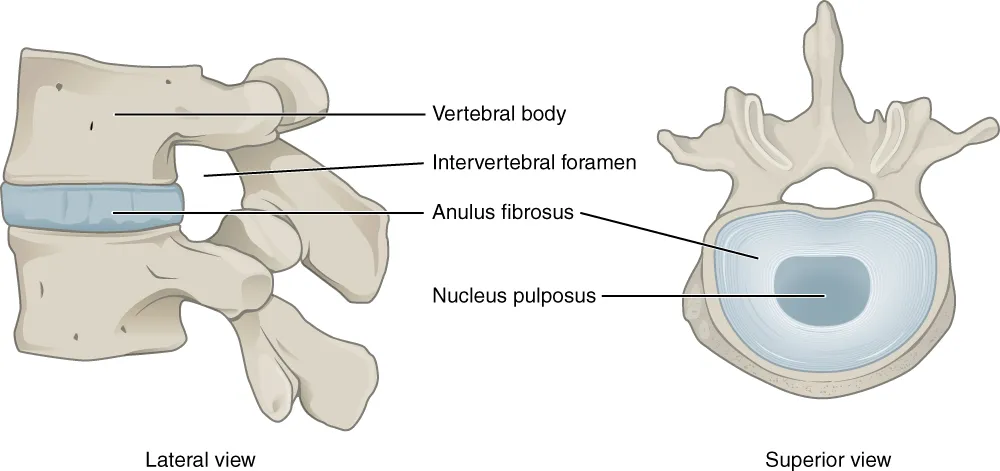
A 2012 North American Spine Society guideline defines lumbar disc herniation with radiculopathy (a nerve root problem that brings numbness, weakness or weaker reflexes)7. In its definition, disc material is displaced in one place beyond the normal margins of the disc space7. The result is numbness, weakness or pain that follows a myotomal or dermatomal pattern7. A myotome is the group of muscles one nerve root serves, and a dermatome is the matching area of skin.
A review describes a herniated or prolapsed disc as one that bulges or ruptures backward, or backward and to one side8. It presses on nerve roots inside the spinal canal, the channel in the spine that holds the spinal cord8. Herniation of the L4/L5 or L5/S1 disc, the two lowest lumbar discs, can cause sciatica9,10. Sciatica is pain felt along the path of the sciatic nerve, in the buttock and down the leg.
Four names for what a scan shows
A 2020 study of lumbar disc herniation took its definitions from the North American Spine Society task-force nomenclature3:
- Bulge: soft tissue reaches beyond the ring apophyses around the whole circumference of the disc3. Ring apophyses are the growth rims around the top and bottom edges of a vertebral body.
- Protrusion: a herniation whose displaced material is narrower than its base3.
- Extrusion: a herniation in which any part of the material beyond the disc space is wider than its base3.
- Sequestration: a herniation whose displaced material has lost continuity with the disc space3.
A herniation on a scan is not always felt
The BMJ Clinical Evidence chapter states that a disc herniation shows on imaging in 19% to 27% of people who have no symptoms1. It adds that herniation on imaging does not reliably predict future low back pain or correlate with symptoms1.
A 1994 MRI study looked at 98 people without back pain and found a disc bulge in 52%2. A protrusion was found in 27% and an extrusion in 1%2. Its authors concluded that a bulge or protrusion on MRI may often be a coincidence when found in someone with low back pain2. A systematic review of imaging in 3,110 people without back pain found disc bulges in 30% at age 20 and 84% at age 8011.
Who it affects
How common it is
- Prevalence (the share of people with a condition at a given time). The BMJ Clinical Evidence chapter puts symptomatic herniated lumbar disc at roughly 1% to 3% in Italy and Finland, depending on age and sex1.
- Incidence (new cases in a group over a set time). A systematic review of 87 studies looked at lumbar disc herniation with nerve-root symptoms10. It gave the limits of 95% confidence intervals (ranges that show how precise a result is) around yearly estimates10. Those limits ran from 0.3 to 2.7 per 1,000 people when cases were defined by surgery10. When cases were defined by clinical signs, they spread far more widely, between 0.1 and 298.3 per 1,00010.
- Age and sex. The BMJ Clinical Evidence chapter reports that herniated lumbar disc is most prevalent at ages 30 to 50 and gives two males for each female1.
- Level. In its background, the systematic review puts 95% of symptomatic herniated discs in people aged 25 to 55 at L4/L5 and L5/S110.
- The neck. In a records survey of 561 people with cervical (neck) radiculopathy in Rochester, Minnesota, a confirmed disc protrusion was responsible in 21.9%12.
What goes with it
The systematic review of 87 studies found several factors associated with developing lumbar disc herniation with nerve-root symptoms10:
- middle age, 30 to 50 years10;
- smoking10;
- higher body mass index, a measure of weight for height10;
- cardiovascular (heart and blood vessel) risk factors in women10;
- greater cumulative lumbar load at work from forward-bent postures and manual handling10.
Lifting and sport
The BMJ Clinical Evidence chapter lists weight-bearing sports, such as weight lifting and hammer throw, among the risk factors for disc herniation1.
A 1993 case-control study covered 287 people with lumbar and 63 with cervical disc herniation13. A case-control study compares people who have a condition with similar people who do not. Most of the sports it examined showed no association with a higher herniation risk, and may be protective13. Using weight lifting equipment showed no association with herniation at either level13. The study noted a possible association between free weights and cervical herniation, with a confidence interval that ran from lower to higher risk13.
Another 1993 case-control report, on lifting outside work, covered 287 people with signs and symptoms of a herniated lumbar disc14. Frequent lifting outside work of loads of 25 pounds or more, with straight knees and a bent back, was linked to a higher risk14.
What studies found
How it goes without surgery
The 2012 North American Spine Society guideline could not establish the natural history of lumbar disc herniation that comes with radiculopathy7. None of the studies its work group identified reported results for control patients who received no care beyond pain medication7. In the absence of reliable evidence, the work group gave its opinion that most such people will improve whatever care they receive7.
The BMJ Clinical Evidence chapter states that clinical improvement is usual in most people1. By its account, only about 10% still have enough pain after 6 weeks to consider surgery1.
One study followed 199 people whose leg pain had resolved during usual non-surgical care for a symptomatic lumbar disc herniation15. The cumulative risk of leg pain recurring was 23% at 1 year and 51% at 3 years15. The authors note that these estimates depend on the definitions used15.
How the herniation changes on scans
In a 2024 meta-analysis of 2,233 people who had non-surgical care for lumbar disc herniation, pooled incidence of disc resorption was 70.39%4. It and two systematic reviews counted how often each type regressed (shrank) or was resorbed without surgery4,16,17:
| Type | 2015 review, nine studies | 2023 review, 360 cases | 2024 meta-analysis, 2,233 people |
|---|---|---|---|
| Bulge | 13%16 | 13.3%17 | 13.33%4 |
| Protrusion | 41%16 | 52.5%17 | 37.53%4 |
| Extrusion | 70%16 | 70.4%17 | 66.91%4 |
| Sequestration | 96%16 | 93.0%17 | 87.77%4 |
The 2024 meta-analysis concluded that resorption mainly occurred within 6 months4.
The US trial of surgery, and its follow-ups
The US Spine Patient Outcomes Research Trial randomised 501 surgical candidates, assigning them to groups by chance5. Each had a lumbar disc herniation on imaging and at least 6 weeks of radiculopathy5. Its reports found5,18:
- At 2 years. The group assigned open discectomy (surgery that removes disc material) and the group assigned non-surgical care both improved substantially5. Differences favoured surgery, but for the primary outcomes they were small and not statistically significant5.
- Changing groups. Half of those assigned to surgery had it within 3 months, and 30% of those assigned to non-surgical care had surgery in that time5. The authors said this meant the as-randomised analysis did not warrant conclusions about which approach was better5.
- Those who declined randomisation. Of 743 such candidates, 528 had surgery and 191 had usual non-surgical care19. Both groups improved, and those who chose surgery reported greater improvement19. The authors caution that such non-randomised comparisons of self-reported outcomes are subject to confounding, where another factor could explain a link19.
- At 4 years. One analysis combined the randomised group with those who declined randomisation, and grouped people by the care they actually received18,19. It found greater improvement in bodily pain, physical function and disability after open discectomy than after usual non-surgical care18.
Other trials and pooled results
A single-centre randomised trial studied 128 people whose sciatica from a lumbar disc herniation had lasted 4 to 12 months20. Leg pain at 6 months averaged 2.8 out of 10 in the surgery group and 5.2 with standardised non-surgical care20. Scores at the start were 7.7 and 8.020.
A 2023 meta-analysis pooled randomised trials in people with sciatica from a lumbar disc herniation21. It found very low to low certainty evidence that discectomy reduced leg pain more than non-surgical care21. The gap was about 12 points out of 100 up to three months and a negligible 2.3 points at 12 months21. Effects on disability were small, negligible or absent, and the risk of any adverse event was similar in the two groups21.
Exercise and sport
The 2012 guideline looked at structured exercise programmes used on their own for lumbar disc herniation with radiculopathy7. It found there was not enough evidence to recommend for or against them7.
A 2021 systematic review and meta-analysis covered 20 studies of elite athletes with a symptomatic lumbar disc herniation22. Of 799 who had surgery, 83.0% returned to play, as did 81.5% of 308 who had non-surgical care22. The difference was not statistically significant22.
A separate systematic review of 14 studies of athletes who had lumbar discectomy found a pooled return-to-sport rate of 81%23. Only 59% returned at the same level23. It concluded that rates of return to sport cannot be determined accurately, because the studies were varied and of low quality23.
Connections
The intervertebral disc page covers the tissue, and the spine page the joints around it6. In laboratory tests, a healthy disc herniates only under forces larger than those normally met8.
The sciatica page covers the leg pain a herniation can cause9. A 2007 BMJ review states that in many people with the clinical symptoms of sciatica, scans show no lumbar disc herniation24. The sciatic nerve arises from the spinal nerves numbered L4 to S325.
Disc herniation involves
Disc herniation can cause
Disc herniation can cause pain along
Disc herniation occurs in
Disc herniation is studied on scans alongside
Sources
- Jordan J, Konstantinou K, O'Dowd J (2011). Herniated lumbar disc.. BMJ clinical evidence. PMID 21711958
- Jensen MC, Brant-Zawadzki MN, Obuchowski N, Modic MT, Malkasian D, Ross JS (1994). Magnetic resonance imaging of the lumbar spine in people without back pain.. The New England journal of medicine. doi:10.1056/NEJM199407143310201 PMID 8208267
- Divi SN, Makanji HS, Kepler CK, Anderson DG, Goyal DKC, Warner ED, Galetta MS, Hilibrand AS, Kaye ID, Kurd MF, Radcliff KE, Rihn JA, Woods BI, Vaccaro AR, Schroeder GD (2020). Does the Size or Location of Lumbar Disc Herniation Predict the Need for Operative Treatment?. Global spine journal. doi:10.1177/2192568220948519 PMID 32935569
- Zou T, Liu XY, Wang PC, Chen H, Wu PG, Feng XM, Sun HH (2024). Incidence of Spontaneous Resorption of Lumbar Disc Herniation: A Meta-analysis.. Clinical spine surgery. doi:10.1097/BSD.0000000000001490 PMID 37559207
- Weinstein JN, Tosteson TD, Lurie JD, Tosteson AN, Hanscom B, Skinner JS, Abdu WA, Hilibrand AS, Boden SD, Deyo RA (2006). Surgical vs Nonoperative Treatment for Lumbar Disk Herniation. JAMA. doi:10.1001/jama.296.20.2441 PMID 17119140
- Waxenbaum JA, Reddy V, Futterman B (2026). Anatomy, Back, Intervertebral Discs. StatPearls. PMID 29262063
- North American Spine Society Evidence-Based Clinical Guidelines Committee (Kreiner DS, Hwang S, Easa J, Resnick DK, and the Lumbar Disc Herniation with Radiculopathy Work Group) (2012). Diagnosis and Treatment of Lumbar Disc Herniation with Radiculopathy (Evidence-Based Clinical Guidelines for Multidisciplinary Spine Care). North American Spine Society. Link
- Urban JP, Roberts S (2003). Degeneration of the intervertebral disc.. Arthritis research & therapy. PMID 12723977
- Betts JG, Young KA, Wise JA, Johnson E, Poe B, Kruse DH, Korol O, Johnson JE, Womble M, DeSaix P (2022). Anatomy and Physiology 2e. OpenStax. Link
- Hincapié CA, Kroismayr D, Hofstetter L, Kurmann A, Cancelliere C, Raja Rampersaud Y, Boyle E, Tomlinson GA, Jadad AR, Hartvigsen J, Côté P, Cassidy JD (2025). Incidence of and risk factors for lumbar disc herniation with radiculopathy in adults: a systematic review.. European spine journal. doi:10.1007/s00586-024-08528-8 PMID 39453541
- Brinjikji W, Luetmer PH, Comstock B, Bresnahan BW, Chen LE, Deyo RA, Halabi S, Turner JA, Avins AL, James K, Wald JT, Kallmes DF, Jarvik JG (2015). Systematic literature review of imaging features of spinal degeneration in asymptomatic populations.. AJNR American Journal of Neuroradiology. doi:10.3174/ajnr.A4173 PMID 25430861
- Radhakrishnan K, Litchy WJ, O'Fallon WM, Kurland LT (1994). Epidemiology of cervical radiculopathy. Brain : a journal of neurology. doi:10.1093/brain/117.2.325 PMID 8186959
- Mundt DJ, Kelsey JL, Golden AL, Panjabi MM, Pastides H, Berg AT, Sklar J, Hosea T (1993). An epidemiologic study of sports and weight lifting as possible risk factors for herniated lumbar and cervical discs. The American journal of sports medicine. doi:10.1177/036354659302100617 PMID 8291639
- Mundt DJ, Kelsey JL, Golden AL, Pastides H, Berg AT, Sklar J, Hosea T, Panjabi MM (1993). An Epidemiologic Study of Non-Occupational Lifting as a Risk Factor for Herniated Lumbar Intervertebral Disc. Spine. doi:10.1097/00007632-199304000-00012 PMID 8484151
- Suri P, Pearson AM, Scherer EA, Zhao W, Lurie JD, Morgan TS, Weinstein JN (2016). Recurrence of Pain After Usual Nonoperative Care for Symptomatic Lumbar Disk Herniation: Analysis of Data From the Spine Patient Outcomes Research Trial.. PM & R : the journal of injury, function, and rehabilitation. doi:10.1016/j.pmrj.2015.10.016 PMID 26548963
- Chiu CC, Chuang TY, Chang KH, Wu CH, Lin PW, Hsu WY (2015). The probability of spontaneous regression of lumbar herniated disc: a systematic review.. Clinical rehabilitation. doi:10.1177/0269215514540919 PMID 25009200
- Rashed S, Vassiliou A, Starup-Hansen J, Tsang K (2023). Systematic review and meta-analysis of predictive factors for spontaneous regression in lumbar disc herniation.. Journal of neurosurgery. Spine. doi:10.3171/2023.6.SPINE23367 PMID 37486886
- Weinstein JN, Lurie JD, Tosteson TD, Tosteson AN, Blood EA, Abdu WA, Herkowitz H, Hilibrand A, Albert T, Fischgrund J (2008). Surgical Versus Nonoperative Treatment for Lumbar Disc Herniation. Spine. doi:10.1097/BRS.0b013e31818ed8f4 PMID 19018250
- Weinstein JN, Lurie JD, Tosteson TD, Skinner JS, Hanscom B, Tosteson AN, Herkowitz H, Fischgrund J, Cammisa FP, Albert T, Deyo RA (2006). Surgical vs Nonoperative Treatment for Lumbar Disk Herniation. JAMA. doi:10.1001/jama.296.20.2451 PMID 17119141
- Bailey CS, Rasoulinejad P, Taylor D, Sequeira K, Miller T, Watson J, Rosedale R, Bailey SI, Gurr KR, Siddiqi F, Glennie A, Urquhart JC (2020). Surgery versus Conservative Care for Persistent Sciatica Lasting 4 to 12 Months.. The New England journal of medicine. doi:10.1056/NEJMoa1912658 PMID 32187469
- Liu C, Ferreira GE, Abdel Shaheed C, Chen Q, Harris IA, Bailey CS, Peul WC, Koes B, Lin CC (2023). Surgical versus non-surgical treatment for sciatica: systematic review and meta-analysis of randomised controlled trials.. BMJ (Clinical research ed.). doi:10.1136/bmj-2022-070730 PMID 37076169
- Sedrak P, Shahbaz M, Gohal C, Madden K, Aleem I, Khan M (2021). Return to Play After Symptomatic Lumbar Disc Herniation in Elite Athletes: A Systematic Review and Meta-analysis of Operative Versus Nonoperative Treatment.. Sports health. doi:10.1177/1941738121991782 PMID 33563131
- Reiman MP, Sylvain J, Loudon JK, Goode A (2016). Return to sport after open and microdiscectomy surgery versus conservative treatment for lumbar disc herniation: a systematic review with meta-analysis.. British journal of sports medicine. doi:10.1136/bjsports-2015-094691 PMID 26491033
- Koes BW, van Tulder MW, Peul WC (2007). Diagnosis and treatment of sciatica.. BMJ (Clinical research ed.). doi:10.1136/bmj.39223.428495.BE PMID 17585160
- Giuffre BA, Black AC, Jeanmonod R (2023). Anatomy, Sciatic Nerve. StatPearls. PMID 29494038
Changes
- First published.