Sciatica
Also called lumbosacral radicular syndrome, lumbosacral radicular pain, lumbar radicular pain, nerve root pain, ischias
How guidelines and reviews define sciatica, leg pain that starts at a nerve root in the lower back, how common it is, how it tends to go, and what trials of rest, exercise, medicines, injections and surgery found.
- Region
- Spine
- Updated
- October 9, 2026
- Reviewed
- October 9, 2026 · how entries are checked
What it is
How guidelines and reviews define it
A NICE guideline uses the word for leg pain secondary to a problem at a lumbosacral nerve root1. It notes that two other terms are more accurate1. They are radicular pain (pain that comes from a nerve root) and radiculopathy (a problem at a nerve root). A 2010 review states that sciatica is a symptom, not a specific condition4.
Reviews describe it in these ways2,5,6:
- A radiating leg pain. A 2020 Cochrane review describes lumbosacral radicular pain, commonly called sciatica, as a syndrome in which people report radiating leg pain5. A Cochrane review is a systematic review done to the Cochrane Collaboration’s published standards.
- A pattern in the leg. A 2014 systematic review (a checkable search of the research on a question) describes the pain as radiating in a dermatomal pattern6. The pattern lies in the territory of the sciatic nerve6. A dermatome is the area of skin that one spinal nerve supplies.
- Leg pain worse than back pain. A 2007 BMJ review states that low back pain may come with sciatica, but the leg pain is usually the more severe2.
Where the pain starts
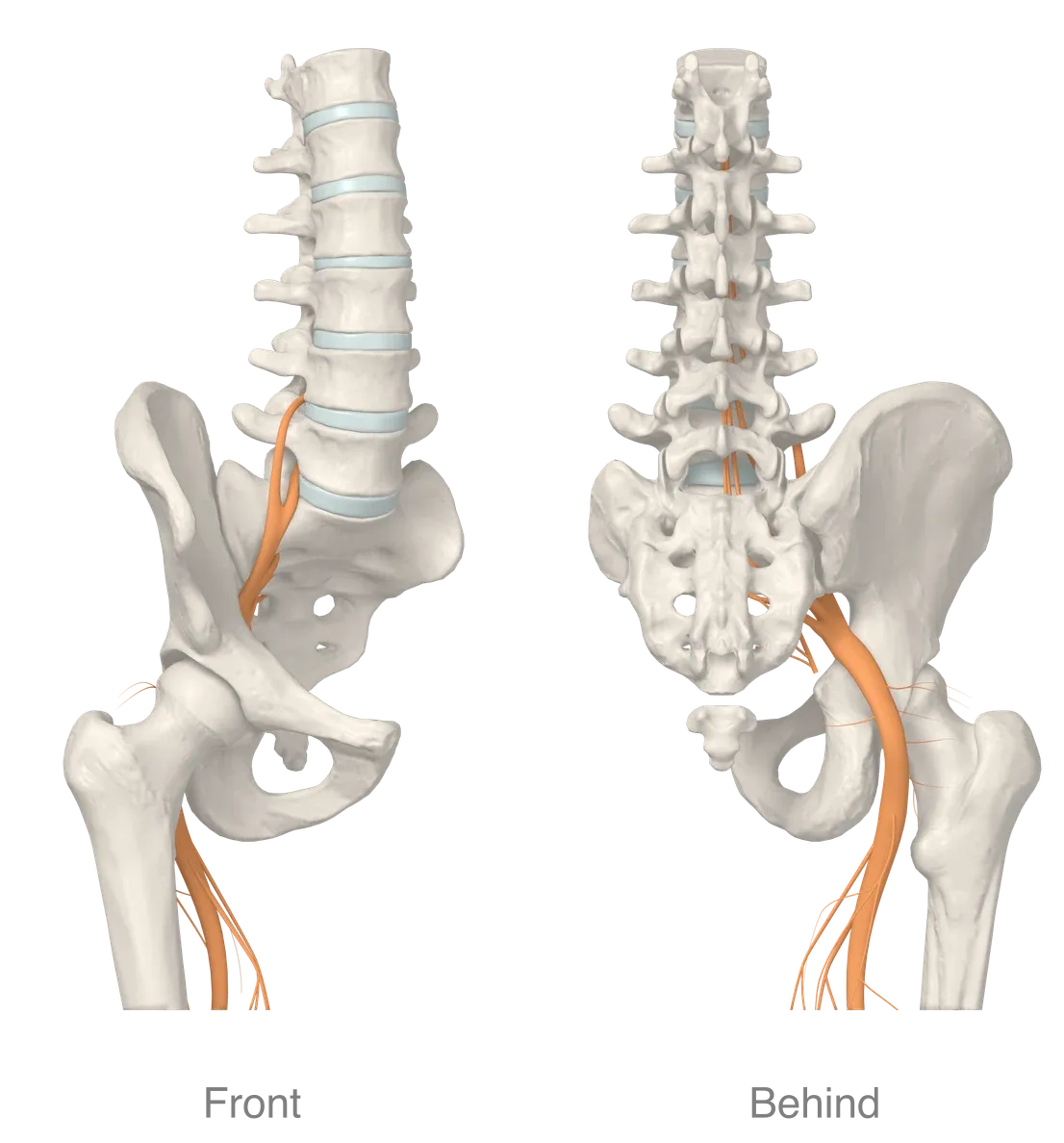
The sciatic nerve, the body’s largest, starts in the lower back and runs down the back of the leg as far as the heel7. It arises from the spinal nerves labelled L4 to S37.
A 2007 BMJ article states that in about 90% of cases, a herniated disc compressing a nerve root causes sciatica2. It names spinal narrowing and, less often, tumours as other possible causes2. In a herniated disc, the disc bulges or ruptures backward, or backward and to one side, and presses on nerve roots in the spinal canal8. Herniation of the L4/L5 or L5/S1 disc, both in the lower back, can cause sciatica9.
A 2007 BMJ review states that scans show no lumbar (lower back) disc herniation in many people who have the symptoms of sciatica2.
Who it affects
How common it is
A 2007 BMJ review states that exact figures for how often sciatica occurs are lacking2. Reviews give these estimates2,10,11:
| What was estimated | Estimate | Source |
|---|---|---|
| Share of people with low back pain who have sciatica | 5% to 10% | A 2007 BMJ review2 |
| Annual prevalence of disc-related sciatica in the general population | 2.2% | The same review2 |
| Lifetime share with radicular pain from a herniated lumbar disc, in the sciatic nerve’s territory | 13% to 40% | A second 2007 review10 |
| How common sciatica is, across 23 studies | 1.2% to 43% | A 2008 review11 |
Prevalence is the share of people in a group who have a condition at a given time. The 2008 review found that 2 of its 23 studies used a clinical assessment to identify sciatica11. Its authors suggest that differences in definitions, data collection and perhaps populations may explain the wide range11.
What goes with it
A systematic review of studies of first-time sciatica identified smoking, obesity, occupational factors and health status as modifiable risk factors6. It identified age, gender and social class as non-modifiable ones6.
Three meta-analyses (studies that pool the results of several earlier studies) put numbers on some of these links, as odds ratios12,13,14. An odds ratio is how many times higher the odds of an outcome are in one group than in another.
- Smoking. Across 28 studies, current smokers were more likely to have lumbar radicular pain, or sciatica verified clinically, with a pooled odds ratio of 1.4612.
- Body weight. Across 26 studies, overweight (1.23) and obesity (1.40) were both associated with lumbar radicular pain13.
- Work. Across 24 studies of workers, heavy physically demanding work was associated with clinician-identified lumbosacral radiculopathy syndrome (2.03)14. Of those studies, 19 were rated at high risk of bias, a rating of how likely flaws are to have skewed a result14.
- Driving and sitting. The same analysis of studies of workers found no significant association with professional driving or with sitting at work14.
What studies found
How it tends to go
A 2007 BMJ review states that the course of acute sciatica is in general favourable, with most pain and related disability resolving within two weeks2. It reports on people with acute sciatica in the placebo (dummy) groups of randomised trials of non-surgical approaches2. About 50% said they had improved within 10 days, and after four weeks the figure was about 75%2. The same review states that up to 30% go on having pain for a year or more2.
Studies that followed people for longer report15,16,17:
| Who was followed | What was found |
|---|---|
| 183 people with a lumbosacral radicular syndrome, in a randomised trial of two weeks of bed rest or watchful waiting | 87% of both groups reported improvement after 12 weeks15 |
| 609 UK adults seen by a family doctor for back-related leg pain, in a cohort (a group followed over time) | 55% had improved at 12 months, in the whole sample and in the sciatica group alike16 |
| 466 people with sciatica and lumbar disc herniation referred to secondary care (hospital and specialist services), about a third of whom had surgery | 44% at 1 year and 39% at 2 years had not reached the study’s threshold for success on its main back questionnaire17 |
Another cohort followed 79 people whose radicular pain from a lumbar disc herniation had resolved without surgery18. In 25%, the pain came back within a year of resolving18.
Rest, exercise and therapist-led programmes
- Bed rest. In a 2010 Cochrane review, bed-rest advice and stay-active advice differed little or not at all in pain or function, on moderate-quality evidence19.
- Exercise against advice. A meta-analysis of five randomised trials compared supervised structured exercise with advice to stay active20. Low-quality evidence showed a small short-term effect on leg pain favouring exercise, with no difference in disability20. In the long term, the same review found moderate-quality evidence of no difference in leg pain or disability20.
- Therapist-delivered programmes. A 2023 meta-analysis of 18 randomised trials (2,699 participants) found no difference in pain or disability between such programmes and control approaches21. The review concluded that the evidence was inadequate to say how well such programmes work21.
Medicines and injections
In a 2012 meta-analysis of randomised trials of pain medicines for sciatica, most pooled estimates did not favour the active medicine over placebo22. The review called the evidence low quality22.
A randomised trial gave 209 people with sciatica the medicine pregabalin or a placebo for up to 8 weeks23. Pregabalin did not significantly reduce leg pain compared with placebo at week 8 or week 5223. More adverse events (unwanted effects seen during a trial) were reported in the pregabalin group, 227 against 12423.
A 2020 Cochrane review covered 25 trials of epidural corticosteroid injections against placebo in people with lumbosacral radicular pain5. An epidural injection goes into the space around the nerves inside the spine. A corticosteroid is a drug that copies a type of hormone the body makes. At short-term follow-up, the injections were probably slightly more effective than placebo for leg pain, by about 5 points on a 0 to 100 scale5. The review concluded that the effects were small, and that patients and clinicians may not see them as clinically important5.
A UK randomised trial enrolled 163 people with sciatica from a herniated lumbar disc lasting 6 weeks to 12 months24. One group was assigned an epidural steroid injection, and the other microdiscectomy, surgery that removes disc material through a small cut24. Disability scores at 18 weeks did not differ significantly between the groups24. Four serious adverse events were associated with surgery and none with the injection24.
Surgery compared with non-surgical care
Three randomised trials compared surgery with non-surgical care3,25,26:
| Who was studied | What was found |
|---|---|
| 501 surgical candidates in the US with a lumbar disc herniation on imaging and at least 6 weeks of radiculopathy | Both groups improved substantially over 2 years; differences favoured surgery, and for the primary outcomes they were small and not statistically significant25 |
| 283 people with 6 to 12 weeks of severe sciatica | Leg pain eased faster with early surgery, and after 1 year the probability of perceived recovery was 95% in both groups3 |
| 128 people at a single centre whose sciatica from a lumbar disc herniation had lasted 4 to 12 months | Leg pain at 6 months averaged 2.8 out of 10 with microdiscectomy and 5.2 with non-operative care, from 7.7 and 8.026 |
At two years in the 283-person trial, disability scores did not differ significantly between the groups, and 20% of patients reported an unsatisfactory outcome27. At five years, the groups did not differ significantly on the main outcome scores, and 46% of those assigned to non-surgical care had had surgery28.
A 2023 systematic review and meta-analysis pooled randomised trials in people with sciatica from a lumbar disc herniation29. It found very low to low certainty evidence that discectomy (surgery that removes disc material) reduced leg pain more than non-surgical care29. On a 0 to 100 scale, the gap was about 12 points up to three months and a negligible 2.3 points at 12 months29. For disability, it found small, negligible or no effects29. The risk of any adverse event was similar in the two groups29.
Connections
The sciatic nerve page covers the nerve, including the two ways a 2010 review found the word sciatica used4. The disc herniation and intervertebral disc pages cover the disc, including how a herniated disc presses on nerve roots8.
A systematic review of nine studies concluded that low back pain with leg pain appears linked to more pain and disability than back pain alone30.
A 2010 systematic review described piriformis syndrome as sciatica caused by the piriformis muscle compressing the sciatic nerve, and noted that it remained controversial31.
In one randomised trial of flexion-based or extension-based exercise for chronic axial low back pain, the flexion programme included the knee-to-chest stretch32. The one group with transient sciatica was the flexion group, in 3 of 27 patients32. The trial’s authors wrote that the mechanism is unknown32.
Sciatica is described as leg pain in the territory of the
Sciatica is attributed in about 90% of cases, by a 2007 BMJ article, to
Sciatica can follow herniation of a lower lumbar
Sciatica is estimated to affect 5% to 10% of people with
Sciatica is the leg pain named in one definition of
Sciatica was reported in 3 of 27 people in one trial of a flexion programme that included the
Sources
- National Institute for Health and Care Excellence (2016). Low back pain and sciatica in over 16s: assessment and management. National Institute for Health and Care Excellence (NICE guideline NG59). Link
- Koes BW, van Tulder MW, Peul WC (2007). Diagnosis and treatment of sciatica.. BMJ (Clinical research ed.). doi:10.1136/bmj.39223.428495.BE PMID 17585160
- Peul WC, van Houwelingen HC, van den Hout WB, Brand R, Eekhof JA, Tans JT, Thomeer RT, Koes BW, Leiden-The Hague Spine Intervention Prognostic Study Group (2007). Surgery versus prolonged conservative treatment for sciatica.. The New England journal of medicine. doi:10.1056/NEJMoa064039 PMID 17538084
- Valat JP, Genevay S, Marty M, Rozenberg S, Koes B (2010). Sciatica.. Best practice & research. Clinical rheumatology. doi:10.1016/j.berh.2009.11.005 PMID 20227645
- Oliveira CB, Maher CG, Ferreira ML, Hancock MJ, Oliveira VC, McLachlan AJ, Koes BW, Ferreira PH, Cohen SP, Pinto RZ (2020). Epidural corticosteroid injections for lumbosacral radicular pain.. The Cochrane database of systematic reviews. doi:10.1002/14651858.CD013577 PMID 32271952
- Cook CE, Taylor J, Wright A, Milosavljevic S, Goode A, Whitford M (2014). Risk factors for first time incidence sciatica: a systematic review.. Physiotherapy research international : the journal for researchers and clinicians in physical therapy. doi:10.1002/pri.1572 PMID 24327326
- Giuffre BA, Black AC, Jeanmonod R (2023). Anatomy, Sciatic Nerve. StatPearls. PMID 29494038
- Urban JP, Roberts S (2003). Degeneration of the intervertebral disc.. Arthritis research & therapy. PMID 12723977
- Betts JG, Young KA, Wise JA, Johnson E, Poe B, Kruse DH, Korol O, Johnson JE, Womble M, DeSaix P (2022). Anatomy and Physiology 2e. OpenStax. Link
- Stafford MA, Peng P, Hill DA (2007). Sciatica: a review of history, epidemiology, pathogenesis, and the role of epidural steroid injection in management.. British journal of anaesthesia. doi:10.1093/bja/aem238 PMID 17704089
- Konstantinou K, Dunn KM (2008). Sciatica. Spine. doi:10.1097/BRS.0b013e318183a4a2 PMID 18923325
- Shiri R, Falah-Hassani K (2016). The Effect of Smoking on the Risk of Sciatica: A Meta-analysis.. The American journal of medicine. doi:10.1016/j.amjmed.2015.07.041 PMID 26403480
- Shiri R, Lallukka T, Karppinen J, Viikari-Juntura E (2014). Obesity as a risk factor for sciatica: a meta-analysis.. American journal of epidemiology. doi:10.1093/aje/kwu007 PMID 24569641
- Kuijer PPFM, Verbeek JH, Seidler A, Ellegast R, Hulshof CTJ, Frings-Dresen MHW, Van der Molen HF (2018). Work-relatedness of lumbosacral radiculopathy syndrome. Neurology. doi:10.1212/01.wnl.0000544322.26939.09 PMID 30120136
- Vroomen PC, de Krom MC, Wilmink JT, Kester AD, Knottnerus JA (1999). Lack of effectiveness of bed rest for sciatica.. The New England journal of medicine. doi:10.1056/NEJM199902113400602 PMID 9971865
- Konstantinou K, Dunn KM, Ogollah R, Lewis M, van der Windt D, Hay EM, ATLAS Study Team (2018). Prognosis of sciatica and back-related leg pain in primary care: the ATLAS cohort.. The spine journal : official journal of the North American Spine Society. doi:10.1016/j.spinee.2017.10.071 PMID 29174459
- Haugen AJ, Brox JI, Grøvle L, Keller A, Natvig B, Soldal D, Grotle M (2012). Prognostic factors for non-success in patients with sciatica and disc herniation.. BMC musculoskeletal disorders. doi:10.1186/1471-2474-13-183 PMID 22999108
- Suri P, Rainville J, Hunter DJ, Li L, Katz JN (2012). Recurrence of radicular pain or back pain after nonsurgical treatment of symptomatic lumbar disk herniation.. Archives of physical medicine and rehabilitation. doi:10.1016/j.apmr.2011.11.028 PMID 22464091
- Dahm KT, Brurberg KG, Jamtvedt G, Hagen KB (2010). Advice to rest in bed versus advice to stay active for acute low-back pain and sciatica.. Cochrane Database of Systematic Reviews. doi:10.1002/14651858.CD007612.pub2 PMID 20556780
- Fernandez M, Hartvigsen J, Ferreira ML, Refshauge KM, Machado AF, Lemes ÍR, Maher CG, Ferreira PH (2015). Advice to Stay Active or Structured Exercise in the Management of Sciatica. Spine. doi:10.1097/BRS.0000000000001036 PMID 26165218
- Dove L, Jones G, Kelsey LA, Cairns MC, Schmid AB (2023). How effective are physiotherapy interventions in treating people with sciatica? A systematic review and meta-analysis.. European spine journal : official publication of the European Spine Society, the European Spinal Deformity Society, and the European Section of the Cervical Spine Research Society. doi:10.1007/s00586-022-07356-y PMID 36580149
- Pinto RZ, Maher CG, Ferreira ML, Ferreira PH, Hancock M, Oliveira VC, McLachlan AJ, Koes B (2012). Drugs for relief of pain in patients with sciatica: systematic review and meta-analysis.. BMJ (Clinical research ed.). doi:10.1136/bmj.e497 PMID 22331277
- Mathieson S, Maher CG, McLachlan AJ, Latimer J, Koes BW, Hancock MJ, Harris I, Day RO, Billot L, Pik J, Jan S, Lin CC (2017). Trial of Pregabalin for Acute and Chronic Sciatica.. The New England journal of medicine. doi:10.1056/NEJMoa1614292 PMID 28328324
- Wilby MJ, Best A, Wood E, Burnside G, Bedson E, Short H, Wheatley D, Hill-McManus D, Sharma M, Clark S, Baranidharan G, Price C, Mannion R, Hutchinson PJ, Hughes DA, Marson A, Williamson PR (2021). Surgical microdiscectomy versus transforaminal epidural steroid injection in patients with sciatica secondary to herniated lumbar disc (NERVES): a phase 3, multicentre, open-label, randomised controlled trial and economic evaluation.. The Lancet. Rheumatology. doi:10.1016/S2665-9913(21)00036-9 PMID 33969319
- Weinstein JN, Tosteson TD, Lurie JD, Tosteson AN, Hanscom B, Skinner JS, Abdu WA, Hilibrand AS, Boden SD, Deyo RA (2006). Surgical vs Nonoperative Treatment for Lumbar Disk Herniation. JAMA. doi:10.1001/jama.296.20.2441 PMID 17119140
- Bailey CS, Rasoulinejad P, Taylor D, Sequeira K, Miller T, Watson J, Rosedale R, Bailey SI, Gurr KR, Siddiqi F, Glennie A, Urquhart JC (2020). Surgery versus Conservative Care for Persistent Sciatica Lasting 4 to 12 Months.. The New England journal of medicine. doi:10.1056/NEJMoa1912658 PMID 32187469
- Peul WC, van den Hout WB, Brand R, Thomeer RT, Koes BW, Leiden-The Hague Spine Intervention Prognostic Study Group (2008). Prolonged conservative care versus early surgery in patients with sciatica caused by lumbar disc herniation: two year results of a randomised controlled trial.. BMJ (Clinical research ed.). doi:10.1136/bmj.a143 PMID 18502911
- Lequin MB, Verbaan D, Jacobs WC, Brand R, Bouma GJ, Vandertop WP, Peul WC, Leiden-The Hague Spine Intervention Prognostic Study Group, Wilco C Peul, Bart W Koes, Ralph T W M Thomeer, Wilbert B van den Hout, Ronald Brand (2013). Surgery versus prolonged conservative treatment for sciatica: 5-year results of a randomised controlled trial.. BMJ open. doi:10.1136/bmjopen-2012-002534 PMID 23793663
- Liu C, Ferreira GE, Abdel Shaheed C, Chen Q, Harris IA, Bailey CS, Peul WC, Koes B, Lin CC (2023). Surgical versus non-surgical treatment for sciatica: systematic review and meta-analysis of randomised controlled trials.. BMJ (Clinical research ed.). doi:10.1136/bmj-2022-070730 PMID 37076169
- Konstantinou K, Hider SL, Jordan JL, Lewis M, Dunn KM, Hay EM (2013). The impact of low back-related leg pain on outcomes as compared with low back pain alone: a systematic review of the literature.. The Clinical journal of pain. doi:10.1097/AJP.0b013e31826f9a52 PMID 23328336
- Hopayian K, Song F, Riera R, Sambandan S (2010). The clinical features of the piriformis syndrome: a systematic review.. European spine journal : official publication of the European Spine Society, the European Spinal Deformity Society, and the European Section of the Cervical Spine Research Society. doi:10.1007/s00586-010-1504-9 PMID 20596735
- Park CH, Beom J, Chung CK, Kim CH, Lee MY, Park MW, Kim K, Chung SG (2024). Long-term effects of lumbar flexion versus extension exercises for chronic axial low back pain: a randomized controlled trial.. Scientific reports. doi:10.1038/s41598-024-51769-2 PMID 38302483
Changes
- First published.