Piriformis syndrome
Also called piriformis muscle syndrome
A disputed label for buttock and leg pain blamed on the piriformis muscle pressing on the sciatic nerve. How reviews define it, why they disagree, and what studies of injections, stretching and surgery found.
- Region
- Hip
- Updated
- October 7, 2026
- Reviewed
- October 7, 2026 · how entries are checked
What it is
How reviews define it
A 2010 systematic review described piriformis syndrome as sciatica caused by the piriformis muscle compressing the sciatic nerve1. A 2024 handbook chapter calls it a condition proposed to result from that compression in the deep gluteal space2. The nerve crosses that space in the buttock, in front of the gluteus maximus, the large muscle of the buttock7.
The piriformis passes through the greater sciatic foramen, a large opening at the back of the pelvis8. The sciatic nerve leaves through the same opening, below the muscle9.
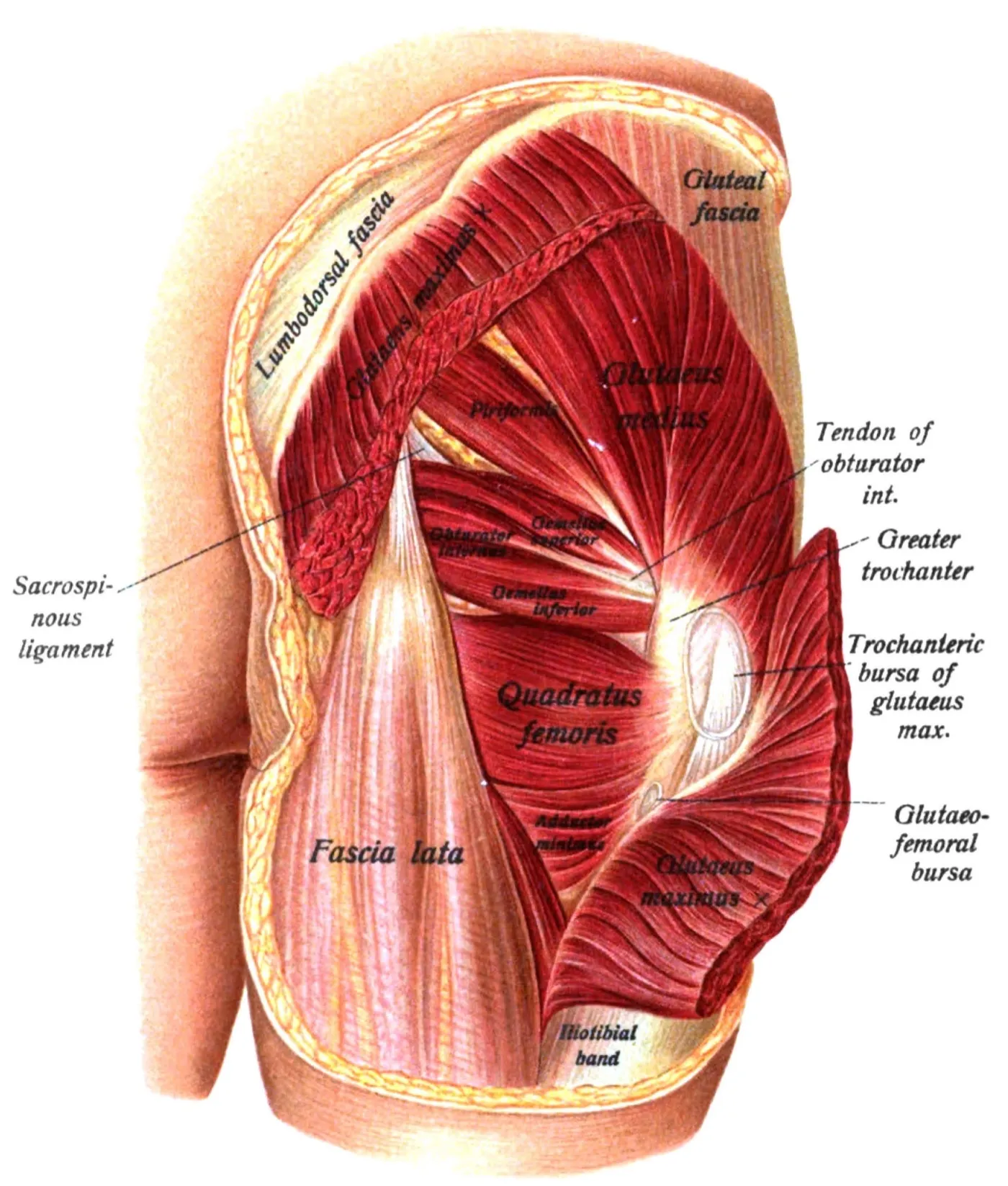
The 2010 review covered 55 studies, and noted that the literature is mainly case series and narrative reviews1. A case series reports on a group of patients without a comparison group, and a narrative review has no set search method. The features those studies recorded most often were buttock pain and tenderness over the greater sciatic notch, at the back of the hip bone1. The others were pain made worse by sitting, and pain increased by manoeuvres that raise tension in the piriformis1.
A 2018 updated systematic review concluded that a set of four symptoms and signs can define the condition10. It could not conclude, from the studies available, how accurate the physical tests and symptoms are10. The 2024 chapter states that there is no uniformly accepted case definition of piriformis syndrome2. It adds that no well-accepted test confirms the condition2.
Why the label is disputed
Reviews disagree on whether piriformis syndrome is a distinct condition, and on how often the label fits10,11. Some doubt it:
- A 2009 literature review reported no definitive proof that it exists11.
- The 2024 chapter observes that most published cases appear to give the label to a myofascial condition, not a nerve problem at one spot2. Myofascial means of muscle and the connective tissue around it.
- A 2023 review concluded that the label is applied more often than it should be3.
Others accept it, in part or in full10,11:
- The 2018 systematic review concluded it has been demonstrated that a problem in the piriformis can cause sciatica10. How common this is among people with low back pain and sciatica remains to be established10.
- The 2009 review also concluded that the muscle may be a source of pain in a subset of patients11.
- A 2021 literature review took the view that it is identified on clinical grounds alone and often goes unrecognised4.
The wider term: deep gluteal syndrome
A 2015 review states that the term deep gluteal syndrome is now preferred over piriformis syndrome7. Its reason is that the sciatic nerve can be entrapped, or caught and squeezed, at several locations7. A 2020 systematic review of 14 studies (853 patients) found that the definition of deep gluteal syndrome has three parts12. It is non-discogenic (not arising from a spinal disc), it is a sciatic nerve disorder, and the nerve is entrapped in the deep gluteal space12.
Another 2020 review describes deep gluteal syndrome as including piriformis syndrome along with three other named syndromes6.
Who it affects
Why the estimates vary so widely
The 2024 chapter states that the prevalence depends on the criteria used and the population studied2. Prevalence is the share of people in a group who have a condition. A 2021 literature review states that the prevalence is not well known4.
| Source | Estimate |
|---|---|
| 2021 literature review | 0.3% to 6% of cases of lower back and upper or posterior thigh pain4 |
| 2020 scoping review, a review that maps what research exists | Estimates ranged between 6% and 36%13 |
| 93 consecutive patients at a pain unit for chronic low back pain | 17.2% were classed as having it on a modified FAIR test14 |
| 239 consecutive patients whose sciatica had not improved after standard assessment and care | 67.8% were given a final label of piriformis syndrome after two kinds of magnetic resonance (MR) imaging15 |
In the FAIR test the hip is flexed, adducted and internally rotated: bent, moved toward the midline and turned inward16. The 2018 systematic review found three recent cross-sectional and prevalence studies10. It judged the two larger ones to be at high risk of bias10.
Who appears in published cases
A 2025 systematic review gathered 212 patients from 97 articles of published case reports17. Of these, 117 were female and 95 male, and the mean age was 43.6 years17.
In the 212 cases, 38.2% of patients had a history of pelvic trauma, or of stress on the piriformis from vigorous activity or sport17. The cause found most often was an anatomical variant, an unusual layout of the muscle or nerve, in 12.7%17. In a 2025 systematic review of 212 published cases, 47.6% of patients had no finding on imaging, testing or at surgery17.
Whether the nerve’s route matters
In a meta-analysis of 44 cadaver studies, the sciatic nerve passed undivided below the piriformis in a pooled 90%18. A meta-analysis pools the results of several earlier studies, and a cadaver is a body donated for study. The deep hip rotators page describes the other routes. Studies disagree on whether those routes go with the syndrome19,20.
- No clear link. A 2010 meta-analysis found an anomaly in 16.9% of 6,062 cadavers, against 16.2% in surgical case series of patients with piriformis syndrome19. The difference was not significant19.
- A possible link. In a retrospective study of 127 patients with findings compatible with extra-spinal sciatica, symptoms were correlated with variant anatomy20. The figures were 64% against 46% with conventional anatomy20.
What studies found
What a review of the evidence concluded
A 2023 systematic review looked at approaches for deep gluteal syndrome5. It included 13 studies with 508 patients: eight randomised trials and five surgical case series5. A randomised trial assigns people to groups by chance, then compares the groups. The review rated the overall quality of evidence as low5.
Three of the eight trials reached a minimum clinically important difference in pain, the smallest change people notice as meaningful5. Given the low quality of evidence, the review concluded that no single non-surgical approach can be put ahead of another5. It added that surgery may have a role in chronic cases5.
How it changes over time
In the 2025 review of case reports, the median (middle value) duration of symptoms before the reported intervention was 365 days17. Non-surgical approaches were recorded as effective in 41.1% of those patients, and 58.9% went on to surgery17. The authors caution that case reports are selected for publication because they are unusual17. In a study of 250 patients with piriformis muscle syndrome, the authors recorded 51.2% as resolved after medication combined with a therapy programme21.
Injections
A 2022 systematic review and meta-analysis covered 16 studies of injections into the piriformis, and pooled 1222. Pain scores fell after botulinum toxin (a drug injected to relax a muscle), local anaesthetic (a numbing drug), corticosteroid, and anaesthetic plus corticosteroid22. A corticosteroid is a drug that copies a type of hormone the body makes. Botulinum toxin was more effective than placebo, a dummy version with no active part22. The authors noted that many of the studies lacked randomisation, and many were small and of moderate quality22.
Two randomised trials each made a single comparison23,24.
| Who was studied | What was compared | What was found |
|---|---|---|
| 56 people who met an electrophysiological (electrical nerve test) definition based on the FAIR test | A botulinum toxin or placebo; both groups also had therapist-delivered sessions | Pain scores fell significantly more with the toxin from 2 to 12 weeks after injection23 |
| 47 people with piriformis syndrome | Lidocaine (a local anaesthetic) alone, or with a corticosteroid | Pain fell in both groups and did not differ between them at one week, one month or three months24 |
Stretching and exercise
In a randomised trial of 40 people aged 30 to 70 with piriformis syndrome, pain scores fell over six weeks with two stretching methods25. The methods were called ELDOA and post-facilitation stretching, and the authors concluded that the second showed more improvement25.
A trial randomly allocated 45 people with low back pain and deep gluteal syndrome to compression exercise, stretching exercise or a control group26. The stretching group lay on their backs with the affected side’s ankle placed over the other knee27. The figure-4 stretch page covers that position.
Each group also had heat and electrical nerve stimulation27. Pain fell significantly in each group, and pain scores did not differ significantly between them27. Disability scores were significantly lower with stretching than with compression exercise26.
Surgery
A 2017 systematic review of surgery for deep gluteal syndrome included 28 studies (481 patients)28. Of these, 24 were level IV evidence, a low rung on a scale that ranks study designs28. Each of the 28 reported an improvement in pain at final follow-up, a mean of 23 months28.
A 2025 review of 17 studies (386 patients) of surgery for piriformis syndrome counted complications in 12.7% of cases29. The most frequent were lack of relief (4.9%) and recurrence of symptoms (2.6%)29. The review found no reported sciatic nerve injuries29. In the 2025 case-report review, patients labelled without a finding on imaging or testing had 5.3 times the odds of an unsuccessful operation17.
Sources differ on endoscopic surgery, done through small cuts with a camera, against open surgery4,30. The 2025 surgery review found the type and frequency of complications similar with the two approaches29.
A 2026 systematic review and meta-analysis found no study directly comparing the two30. It concluded that endoscopic decompression appears to give favourable outcomes in carefully selected patients with persistent piriformis syndrome30. Decompression is surgery that takes pressure off a nerve. It also concluded that the current literature does not establish superiority over open surgery30. The 2021 literature review, by contrast, stated that current literature supports preferring the endoscopic approach4.
Connections
The piriformis is one of six muscles that lie deep to the gluteus maximus and rotate the thigh outward at the hip31. The deep hip rotators page covers the muscle itself. The sciatic nerve page covers the nerve’s course, and the other structures that can entrap it in the buttock7.
A 2007 BMJ article states that a herniated (slipped) disc compressing a nerve root in the spine causes about 90% of sciatica cases32. A nerve root is the part of a nerve where it leaves the spinal cord. The low back pain page covers the wider picture.
Related stretch page: the figure-4 stretch, whose ankle-over-knee position one trial above used27. The authors of a 2017 cadaver study wrote that research on common stretches for the short outward rotators of the hip was limited33.
Piriformis syndrome involves
Piriformis syndrome has trials of
Sources
- Hopayian K, Song F, Riera R, Sambandan S (2010). The clinical features of the piriformis syndrome: a systematic review.. European spine journal : official publication of the European Spine Society, the European Spinal Deformity Society, and the European Section of the Cervical Spine Research Society. doi:10.1007/s00586-010-1504-9 PMID 20596735
- Lo JK, Robinson LR (2024). Piriformis syndrome.. Handbook of clinical neurology. doi:10.1016/B978-0-323-90108-6.00002-8 PMID 38697742
- Sharma S, Kaur H, Verma N, Adhya B (2023). Looking beyond Piriformis Syndrome: Is It Really the Piriformis?. Hip & pelvis. doi:10.5371/hp.2023.35.1.1 PMID 36937215
- Vij N, Kiernan H, Bisht R, Singleton I, Cornett EM, Kaye AD, Imani F, Varrassi G, Pourbahri M, Viswanath O, Urits I (2021). Surgical and Non-surgical Treatment Options for Piriformis Syndrome: A Literature Review.. Anesthesiology and pain medicine. doi:10.5812/aapm.112825 PMID 34221947
- Hopayian K, Mirzaei M, Shamsi M, Arab-Zozani M (2023). A systematic review of conservative and surgical treatments for deep gluteal syndrome.. Journal of bodywork and movement therapies. doi:10.1016/j.jbmt.2022.12.003 PMID 37949567
- Park JW, Lee YK, Lee YJ, Shin S, Kang Y, Koo KH (2020). Deep gluteal syndrome as a cause of posterior hip pain and sciatica-like pain.. The bone & joint journal. doi:10.1302/0301-620X.102B5.BJJ-2019-1212.R1 PMID 32349600
- Martin HD, Reddy M, Gómez-Hoyos J (2015). Deep gluteal syndrome.. Journal of hip preservation surgery. doi:10.1093/jhps/hnv029 PMID 27011826
- Gray H; Lewis WH (editor) (1918). Anatomy of the Human Body. Lea & Febiger, Philadelphia (20th edition). Link
- Giuffre BA, Black AC, Jeanmonod R (2023). Anatomy, Sciatic Nerve. StatPearls. PMID 29494038
- Hopayian K, Danielyan A (2018). Four symptoms define the piriformis syndrome: an updated systematic review of its clinical features.. European journal of orthopaedic surgery & traumatology : orthopedie traumatologie. doi:10.1007/s00590-017-2031-8 PMID 28836092
- Halpin RJ, Ganju A (2009). Piriformis syndrome. Neurosurgery. doi:10.1227/01.NEU.0000335788.45495.0C PMID 19927068
- Kizaki K, Uchida S, Shanmugaraj A, Aquino CC, Duong A, Simunovic N, Martin HD, Ayeni OR (2020). Deep gluteal syndrome is defined as a non-discogenic sciatic nerve disorder with entrapment in the deep gluteal space: a systematic review.. Knee surgery, sports traumatology, arthroscopy : official journal of the ESSKA. doi:10.1007/s00167-020-05966-x PMID 32246173
- Siddiq MAB, Clegg D, Hasan SA, Rasker JJ (2020). Extra-spinal sciatica and sciatica mimics: a scoping review.. The Korean journal of pain. doi:10.3344/kjp.2020.33.4.305 PMID 32989195
- Kean Chen C, Nizar AJ (2013). Prevalence of piriformis syndrome in chronic low back pain patients. A clinical diagnosis with modified FAIR test.. Pain practice : the official journal of World Institute of Pain. doi:10.1111/j.1533-2500.2012.00585.x PMID 22863240
- Filler AG, Haynes J, Jordan SE, Prager J, Villablanca JP, Farahani K, McBride DQ, Tsuruda JS, Morisoli B, Batzdorf U, Johnson JP (2005). Sciatica of nondisc origin and piriformis syndrome: diagnosis by magnetic resonance neurography and interventional magnetic resonance imaging with outcome study of resulting treatment.. Journal of neurosurgery. Spine. doi:10.3171/spi.2005.2.2.0099 PMID 15739520
- Fishman LM, Dombi GW, Michaelsen C, Ringel S, Rozbruch J, Rosner B, Weber C (2002). Piriformis syndrome: diagnosis, treatment, and outcome--a 10-year study.. Archives of physical medicine and rehabilitation. doi:10.1053/apmr.2002.30622 PMID 11887107
- Monteleone G, Stevanato G, Alimandi M, Cappa E, Sorge R (2025). Piriformis syndrome: a systematic review of case reports.. BMC surgery. doi:10.1186/s12893-025-03202-2 PMID 41068685
- Poutoglidou F, Piagkou M, Totlis T, Tzika M, Natsis K (2020). Sciatic Nerve Variants and the Piriformis Muscle: A Systematic Review and Meta-Analysis. Cureus. doi:10.7759/cureus.11531 PMID 33354475
- Smoll NR (2010). Variations of the piriformis and sciatic nerve with clinical consequence: a review.. Clinical anatomy (New York, N.Y.). doi:10.1002/ca.20893 PMID 19998490
- Bharadwaj UU, Varenika V, Carson W, Villanueva-Meyer J, Ammanuel S, Bucknor M, Robbins NM, Douglas V, Chin CT (2023). Variant Sciatic Nerve Anatomy in Relation to the Piriformis Muscle on Magnetic Resonance Neurography: A Potential Etiology for Extraspinal Sciatica.. Tomography (Ann Arbor, Mich.). doi:10.3390/tomography9020039 PMID 36960998
- Michel F, Decavel P, Toussirot E, Tatu L, Aleton E, Monnier G, Garbuio P, Parratte B (2013). Piriformis muscle syndrome: diagnostic criteria and treatment of a monocentric series of 250 patients.. Annals of physical and rehabilitation medicine. doi:10.1016/j.rehab.2013.04.003 PMID 23684470
- Hilal FM, Bashawyah A, Allam AE, Lam KHS, El Oumri AA, Galluccio F, AlKharabsheh A, Kaye AD, Salti A, Varrassi G (2022). Efficacy of Botulinum Toxin, Local Anesthetics, and Corticosteroids in Patients With Piriformis Syndrome: A Systematic Review and Meta-analysis.. Pain physician. PMID 35901473
- Fishman LM, Wilkins AN, Rosner B (2017). Electrophysiologically identified piriformis syndrome is successfully treated with incobotulinum toxin a and physical therapy.. Muscle & nerve. doi:10.1002/mus.25504 PMID 27935076
- Misirlioglu TO, Akgun K, Palamar D, Erden MG, Erbilir T (2015). Piriformis syndrome: comparison of the effectiveness of local anesthetic and corticosteroid injections: a double-blinded, randomized controlled study.. Pain physician. PMID 25794202
- Shahzad M, Rafique N, Shakil-Ur-Rehman S, Ali Hussain S (2020). Effects of ELDOA and post-facilitation stretching technique on pain and functional performance in patients with piriformis syndrome: A randomized controlled trial.. Journal of back and musculoskeletal rehabilitation. doi:10.3233/BMR-181290 PMID 32894238
- Shamsi M, Akbari M, Mirzaei M, Minobes Molina E (2024). Comparing the effect of stretching and compression exercises on flexion relaxation ratio of back muscles in patients having deep gluteal syndrome: A randomized trial.. Journal of bodywork and movement therapies. doi:10.1016/j.jbmt.2024.03.073 PMID 39593660
- Shamsi M, Mirzaei M, Hopayian K (2024). A controlled clinical trial investigating the effects of stretching and compression exercises on electromyography of calf muscles in chronic LBP patients with a deep gluteal syndrome.. BMC sports science, medicine & rehabilitation. doi:10.1186/s13102-023-00802-4 PMID 38200475
- Kay J, de Sa D, Morrison L, Fejtek E, Simunovic N, Martin HD, Ayeni OR (2017). Surgical Management of Deep Gluteal Syndrome Causing Sciatic Nerve Entrapment: A Systematic Review.. Arthroscopy : the journal of arthroscopic & related surgery : official publication of the Arthroscopy Association of North America and the International Arthroscopy Association. doi:10.1016/j.arthro.2017.06.041 PMID 28866346
- Garden AR, Finerty JT, Everhart JS (2025). Evaluation of the Complications and Outcomes of Endoscopic and Open Surgical Treatment of Piriformis Syndrome: A Systematic Review.. The Journal of the American Academy of Orthopaedic Surgeons. doi:10.5435/JAAOS-D-24-01223 PMID 40526913
- Warman FI, Sedar JAMD, Mahyuddin MH, Harvey W (2026). Endoscopic vs Open Surgeries for Piriformis Syndrome: A Systematic Review and Meta-Analysis.. Advances in orthopedics. doi:10.1155/aort/5126019 PMID 42535061
- Betts JG, Young KA, Wise JA, Johnson E, Poe B, Kruse DH, Korol O, Johnson JE, Womble M, DeSaix P (2022). Anatomy and Physiology 2e. OpenStax. Link
- Koes BW, van Tulder MW, Peul WC (2007). Diagnosis and treatment of sciatica.. BMJ (Clinical research ed.). doi:10.1136/bmj.39223.428495.BE PMID 17585160
- McGovern RP, Kivlan BR, Martin RL (2017). LENGTH CHANGE OF THE SHORT EXTERNAL ROTATORS OF THE HIP IN COMMON STRETCH POSITIONS: A CADAVERIC STUDY.. International journal of sports physical therapy. doi:10.26603/ijspt20171068 PMID 29234558
Changes
- First published.