Pectoralis minor syndrome
Also called neurogenic pectoralis minor syndrome, pectoralis minor compression syndrome
How sources describe squeezing of the arm's nerve network beneath the pectoralis minor, a chest muscle, and where they disagree; who it is reported in; and what series of tendon-cutting surgery and other studies found.
- Region
- Trunk
- Muscles
- pectoralis minor
- Updated
- October 15, 2026
- Reviewed
- October 15, 2026 · how entries are checked
What it is
How sources define it
Sources describe the syndrome in different ways, and the descriptions do not fully agree1,2. Thoracic outlet syndrome is a group of disorders sharing compression at the thoracic outlet, according to 2016 reporting standards from the Society for Vascular Surgery5. Three structures can be squeezed there, the standards say: the brachial plexus and the subclavian vein and artery5. These give a neurogenic (nerve), a venous and an arterial form, which can occur together5.
| Source | How it describes pectoralis minor syndrome |
|---|---|
| A 2022 review | One of the compression problems that thoracic outlet syndrome covers as an umbrella term, with the squeeze below the collarbone related to the pectoralis minor2 |
| The same 2022 review | The dominant cause of neurogenic thoracic outlet syndrome, which was once put down to squeezing between neck muscles, or between collarbone and first rib2 |
| A 2017 review | Compression below the collarbone under the muscle, set apart from compression above it in the thoracic outlet; the two often coexist1 |
| A 2022 surgical study | A group of symptoms that can occur when the muscle is shortened and contracted6 |
| A 2024 surgical study | One of the sites where the nerves can be squeezed in neurogenic thoracic outlet syndrome; its surgical management is called unresolved3 |
| A 2026 narrative review | A distinct cause of nerve and blood vessel compression beneath the muscle, increasingly recognised7 |
Sources disagree on whether the syndrome is the main cause of the nerve form of thoracic outlet syndrome or a separate condition beside it1,2. The 2017 review says the symptoms of the two are similar, so the same history and examination are used for both1. The 2024 surgical study, of 355 operated people, found fewer than 10% had compression confined to the space beneath the muscle3. Its authors conclude that in most people the squeeze there is not a primary cause of the neurogenic form3. They see it as a likely later feature of long-standing posture changes, muscle spasm and shoulder imbalance3.
Where the squeeze happens
The pectoralis minor runs from the ribs to the coracoid process, a hooked bony point at the front of the shoulder blade2,8. A space lies behind it, bounded by the coracoid process above and the second to fourth ribs behind2. The cords of the brachial plexus, the large nerve bundles it forms before branching, take shape in this space2. The axillary artery, the main artery of the armpit, runs through it too2.
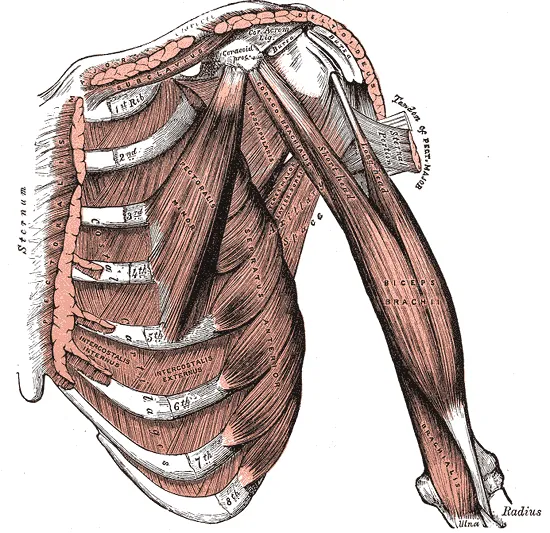
The 2022 review describes how the space may narrow2. Growing tightness, shortening and scarring of the muscle, with a forward-tilted coracoid process, are described as squeezing the cords, most strongly during overhead activity2.
Why it is hard to pin down
A 2024 narrative review states that no gold-standard test for the syndrome exists9. It says the response to a numbing muscle block is often relied on, in someone whose history fits and once commoner causes are excluded9.
A 2026 meta-analysis of 12 studies (950 patients) looked at numbing blocks for thoracic outlet syndrome10. The blocks went into the scalene muscles (muscles at the side of the neck) and the pectoralis minor10. They picked up 87% of cases but correctly cleared just 34% of people without the condition10. The authors judged them limited as stand-alone tests10.
A 2014 Cochrane review, a systematic review done to the Cochrane Collaboration’s published standards, covered thoracic outlet syndrome11. It said its work was hampered by a lack of generally accepted criteria11. A 2024 Delphi consensus of 21 hand surgeons recommends adapted Society for Vascular Surgery criteria for the neurogenic form12. Its criteria place the local findings for this syndrome at the muscle’s attachment12. For the neurogenic form, they sit at the scalene triangle, a gap between muscles at the side of the neck12.
The 2022 review reports that people with the syndrome often have long-lasting symptoms and often undergo several operations2. It attributes their variable outcomes to the condition first being mistaken for something else2.
Who it affects
Young people doing repetitive arm work
The 2017 review by surgeons describes repetitive arm and shoulder movement as the usual cause, particularly in teenagers and young adults in competitive sport1. It names swimming, baseball (especially pitching), volleyball and weightlifting1. A 2022 systematic review of thoracic outlet syndrome in sport describes an enlarged pectoralis minor as a proposed factor in athletes13.
In the 2017 review, people with the syndrome alone usually have a history of repetitive activity, particularly competitive arm sport1. People with both it and neurogenic thoracic outlet syndrome have histories of road accidents or falls1.
How often it shows up in surgical series
Counts come from surgical series and databases4,14,15:
- Since 2005, in one vascular surgery group’s experience, more than 75% of people with neurogenic thoracic outlet syndrome also had this syndrome4. The group reports that about 30% of its patients had this syndrome alone, without thoracic outlet syndrome4.
- At one French hospital, 63 of 279 people (22.5%) having surgery for thoracic outlet syndrome had operations for this syndrome14. Their mean age was about 3814.
- One database held 84 high school and college athletes operated on for thoracic outlet syndrome15. This syndrome was the main condition in 6.3% of the high school athletes and 0% of the college athletes15.
Figures for thoracic outlet syndrome as a whole
The figures below are for thoracic outlet syndrome, mostly the neurogenic form2,13,16,17.
| Who was studied | What was found |
|---|---|
| General population, in a 2022 systematic review | Incidence hard to judge, probably 3 to 80 cases per 100,000 people, perhaps more common in women13 |
| 526 people referred to one centre | Neurogenic form estimated at 2 to 3 cases per 100,000 people a year, much lower than earlier estimates16 |
| Thoracic outlet syndrome generally, as stated in the 2022 review | About 90 to 95% of cases neurogenic, a form tabulated as mostly affecting younger women2 |
| 15,609 US college athletes over seven years | Thoracic outlet syndrome found in 76 (0.48%), including 2.6% of tennis players17 |
What studies found
Care without surgery
Two reviews differ on stretching the muscle1,2. The 2022 review states that initial care with stretching and shoulder-blade and posture retraining succeeds in the majority of people with the syndrome2. The 2017 review calls the results of stretching anecdotal1. Still, it reports that some of its patients improved well after one or two months of stretching1. These had the syndrome alone, and symptoms for under a year1.
A 2026 scoping review, which maps the research on a topic, covered 29 studies of non-surgical care for neurogenic thoracic outlet syndrome19. Exercise was the most frequent approach, in 17 of 19 studies (90%)19. The scalene and chest muscles were the main stretching targets19. It judged how these programmes were reported to be generally poor19.
Botulinum toxin injections
Botulinum toxin is a drug that weakens or relaxes a muscle it is injected into. The 2014 Cochrane review names its trial of scalene injections as Finlayson 201111. That trial was in thoracic outlet syndrome of any type, not in pectoralis minor syndrome11. It randomised 38 people and analysed 3711. Toxin injected into two scalene muscles was compared with a placebo of saline (sterile salt water) in the same muscles11.
According to the Cochrane review, Allergan Inc gave the trial a grant and the study drug11. The review adds that Allergan had paid the authors honoraria for training doctors, and had no role in the trial’s design, analysis or reporting11.
The trial’s report and the Cochrane review read its tingling results differently11,20:
| Reading | What it says |
|---|---|
| The trial’s own report | No clinically or statistically significant gain in pain, tingling or function over placebo. Pain at 6 weeks differed by 5.03 mm on a visual analogue scale, a line marked for pain. The 95% confidence interval, or range of likely values, was −15.7 to 5.720 |
| The Cochrane analysis | At six months, tingling fell 7.63 mm with the toxin and rose 3.89 mm with placebo. The calculated difference, −13.63 mm (95% confidence interval −26.3 to −1.0), was significant11 |
| The Cochrane conclusion | Low risk of bias; moderate evidence that the injections brought no great gain over placebo11 |
In the same analysis, pain did not differ significantly between the groups11.
Two newer systematic reviews of the neurogenic form add to this21,22:
- A 2023 review of eight studies, which also searched for pectoralis minor syndrome, found symptoms reduced after 46 to 63% of first injections21. Its one randomised trial found no significant difference, in line with the Cochrane finding on pain and disability11,21. It called the question undecided21.
- A 2024 review of 15 publications found that injections including the pectoralis minor as well as the scalenes tended to bring greater improvement22. Most of its studies were low quality22.
In one centre’s series, 21 people with pectoralis minor syndrome who had not improved significantly after physiotherapy had botulinum toxin injections23. Oxford Shoulder Scores, a questionnaire score of shoulder pain and function, rose by a mean of 12.4 points at six weeks23. Of 17 who responded, 12 later had the tendon cut, with gains kept at about 20 months23.
Cutting the muscle’s tendon
A tenotomy is surgery that cuts a tendon; here, the pectoralis minor tendon4.
| Series | What it reported |
|---|---|
| 100 operations in 76 people, 1 to 3 years | Good to excellent after 90% for the syndrome alone, 35% when combined with neurogenic thoracic outlet syndrome; failure in 8% and 46%4 |
| 82 French operations, mostly with removal of the first rib | Symptoms resolved after 79.7%, partly after 17.7%, and recurred after 2.6%; complications in 4.9%14 |
| 10 people, keyhole release, about 19 months | Symptoms largely resolved in all but one shoulder; median pain 8.5 out of 10 before, mean 1 after; no surgical complications6 |
| 273 people with this syndrome or neurogenic thoracic outlet syndrome, keyhole release, about 9 months | Pain, shoulder function and disability scores improved; 12 complications (4.4%)18 |
Tenotomy alone or with surgery above the collarbone
Two series in neurogenic thoracic outlet syndrome compared tenotomy alone with tenotomy plus decompression (surgery to take pressure off a nerve) above the collarbone3,24. Their findings differ:
- In 200 people, tenotomy alone went to 57 whose examination findings were limited to below the coracoid process24. At 3 months, both groups improved on the DASH, a questionnaire that scores disability of the arm, shoulder and hand24. The extent of improvement did not differ significantly between the groups24.
- In the 2024 study’s 355 people, followed for about 27 months, 33 had tenotomy alone3. Poor outcomes followed 19% of tenotomies alone and 2% of combined operations3. Repeat operations above the collarbone followed 15% and 5%3. Tenotomy alone took less operating time and a shorter hospital stay3.
Return to sport
A US college athletic conference database of 15,609 athletes held 76 with thoracic outlet syndrome17. Of those managed without surgery, 80.6% returned to full competition, as did 89.9% of those operated on17. The 2022 sport review found no long-term study of athletes after surgery, and no long-term comparison of surgery with non-surgical care13.
Connections
The pectoralis minor page covers the muscle itself: where it attaches, what it does and how it tears2,8,25. Its tendon ends on the coracoid process of the scapula, the shoulder blade2,8.
The 2017 review places this squeeze below the clavicle, or collarbone, and thoracic outlet syndrome above it1. The 2022 review also states that the stretching techniques described for lengthening the muscle have had mixed results2. Related stretch page: doorway pec stretch, which reports studies of the muscle’s length over weeks of stretching26.
Pectoralis minor syndrome involves
Pectoralis minor syndrome has a review of stretching techniques for the muscle in
Pectoralis minor syndrome involves the coracoid process of
Pectoralis minor syndrome is described by where it sits relative to
Sources
- Sanders RJ, Annest SJ (2017). Pectoralis Minor Syndrome: Subclavicular Brachial Plexus Compression.. Diagnostics (Basel). doi:10.3390/diagnostics7030046 PMID 28788065
- Ahmed AS, Graf AR, Karzon AL, Graulich BL, Egger AC, Taub SM, Gottschalk MB, Bowers RL, Wagner ER (2022). Pectoralis minor syndrome - review of pathoanatomy, diagnosis, and management of the primary cause of neurogenic thoracic outlet syndrome.. JSES reviews, reports, and techniques. doi:10.1016/j.xrrt.2022.05.008 PMID 37588453
- De Silva G, Ohman JW, Henderson KM, Goestenkors DM, Meyer RD, Thompson RW (2024). Utilization and Effectiveness of Pectoralis Minor Tenotomy in the Surgical Management of Neurogenic Thoracic Outlet Syndrome.. Hand (New York). doi:10.1177/15589447241286240 PMID 39423034
- Sanders RJ, Rao NM (2010). The forgotten pectoralis minor syndrome: 100 operations for pectoralis minor syndrome alone or accompanied by neurogenic thoracic outlet syndrome.. Annals of Vascular Surgery. doi:10.1016/j.avsg.2010.02.022 PMID 20471786
- Illig KA, Donahue D, Duncan A, Freischlag J, Gelabert H, Johansen K, Jordan S, Sanders R, Thompson R (2016). Reporting standards of the Society for Vascular Surgery for thoracic outlet syndrome.. Journal of Vascular Surgery. doi:10.1016/j.jvs.2016.04.039 PMID 27565607
- Haeni D, Martinez-Catalan N, Esper RN, Wagner ER, El Hassan BT, Sanchez-Sotelo J (2022). Arthroscopic release of the pectoralis minor tendon from the coracoid for pectoralis minor syndrome.. Journal of Experimental Orthopaedics. doi:10.1186/s40634-022-00491-x PMID 35713735
- Kakamad FH, Asaad SK, Namiq HS, Ghafour AK, Hattam AS, Arif SO, Hussein OM, Mustafa LJ, Mohammed AA, Sabr NS, Sharif LA, Omer CS, Nasralla HA (2026). Current Perspectives on Pectoralis Minor Syndrome: A Narrative Review.. Annals of Vascular Surgery. doi:10.1016/j.avsg.2026.01.037 PMID 41643844
- Gray H; Lewis WH (editor) (1918). Anatomy of the Human Body. Lea & Febiger, Philadelphia (20th edition). Link
- Drossopoulos PN, Ruiz C, Mengistu J, Smith CB, Pascarella L (2024). Upper-limb neurovascular compression, pectoralis minor and quadrilateral space syndromes: A narrative review of current literature.. Seminars in Vascular Surgery. doi:10.1053/j.semvascsurg.2024.02.004 PMID 38704180
- Nagarsheth KH, Schweitzer C (2026). Diagnostic Accuracy of Scalene and Pectoralis Minor Muscle Blocks for Thoracic Outlet Syndrome: A Systematic Review and Meta-Analysis.. The American Surgeon. doi:10.1177/00031348251339530 PMID 41026580
- Povlsen B, Hansson T, Povlsen SD (2014). Treatment for thoracic outlet syndrome.. Cochrane Database of Systematic Reviews. doi:10.1002/14651858.CD007218.pub3 PMID 25427003
- Chim H, Hagan RR (2024). Consensus Recommendations for Neurogenic Thoracic Outlet Syndrome from the INTOS Workgroup.. Plastic and Reconstructive Surgery Global Open. doi:10.1097/GOX.0000000000006107 PMID 39206209
- Garraud T, Pomares G, Daley P, Menu P, Dauty M, Fouasson-Chailloux A (2022). Thoracic Outlet Syndrome in Sport: A Systematic Review.. Frontiers in Physiology. doi:10.3389/fphys.2022.838014 PMID 35755427
- Ammi M, Péret M, Henni S, Daligault M, Abraham P, Papon X, Enon B, Picquet J (2018). Frequency of the Pectoralis Minor Compression Syndrome in Patients Treated for Thoracic Outlet Syndrome.. Annals of Vascular Surgery. doi:10.1016/j.avsg.2017.09.002 PMID 28943489
- Talutis SD, Ulloa JG, Gelabert HA (2024). The impact of competitive level of high school and collegiate athletes on outcomes of thoracic outlet syndrome.. Journal of Vascular Surgery. doi:10.1016/j.jvs.2023.10.061 PMID 37931887
- Illig KA, Rodriguez-Zoppi E, Bland T, Muftah M, Jospitre E (2021). The Incidence of Thoracic Outlet Syndrome.. Annals of Vascular Surgery. doi:10.1016/j.avsg.2020.07.029 PMID 32771464
- Talutis SD, Ulloa JG, Hame SL, Gelabert HA (2025). Occurrence, management, and outcome of thoracic outlet syndrome in a National Collegiate Athletic Association Division I conference.. Journal of Vascular Surgery. doi:10.1016/j.jvs.2025.01.236 PMID 40132734
- Reihl AM, McBroom TJ, Wiley N, Vasquez D, Omurzakov A, Lohre R, Elhassan B (2026). Clinical outcomes following arthroscopic pectoralis minor release.. Journal of Shoulder and Elbow Surgery. doi:10.1016/j.jse.2026.06.025 PMID 42457073
- O'Sullivan J, Rushton C, Bateman M, Miller C, Stapleton C, Hill J (2026). Physical assessment and rehabilitation for neurogenic thoracic outlet syndrome (NTOS): A scoping review.. Hand Therapy. doi:10.1177/17589983251411877 PMID 41657761
- Finlayson HC, O'Connor RJ, Brasher PMA, Travlos A (2011). Botulinum toxin injection for management of thoracic outlet syndrome: a double-blind, randomized, controlled trial.. Pain. doi:10.1016/j.pain.2011.04.027 PMID 21628084
- Kök M, Schropp L, van der Schaaf IC, Vonken EJ, van Hattum ES, de Borst GJ, Petri BJ (2023). Systematic Review on Botulinum Toxin Injections as Diagnostic or Therapeutic Tool in Thoracic Outlet Syndrome.. Annals of Vascular Surgery. doi:10.1016/j.avsg.2023.05.009 PMID 37236533
- Woodworth TT, Le A, Miller C, Conger A, Mahan MA, Cushman DM (2024). Botulinum toxin injections for the treatment of neurogenic thoracic outlet syndrome: A systematic review.. Muscle & Nerve. doi:10.1002/mus.28080 PMID 38529885
- Howard M, Jones M, Clarkson R, Donaldson O (2020). Pectoralis minor syndrome: diagnosis with Botulinum injection and treatment with tenotomy - a prospective case series.. Shoulder & Elbow. doi:10.1177/1758573220968454 PMID 35265181
- Vemuri C, Wittenberg AM, Caputo FJ, Earley JA, Driskill MR, Rastogi R, Emery VB, Thompson RW (2013). Early effectiveness of isolated pectoralis minor tenotomy in selected patients with neurogenic thoracic outlet syndrome.. Journal of Vascular Surgery. doi:10.1016/j.jvs.2012.11.045 PMID 23375605
- Ziroglu N, Koluman AC (2026). Isolated pectoralis minor tear at the costal origin: a case-based review of the literature.. BMC musculoskeletal disorders. doi:10.1186/s12891-025-09454-6 PMID 41582129
- Rosa DP, Borstad JD, Pogetti LS, Camargo PR (2017). Effects of a stretching protocol for the pectoralis minor on muscle length, function, and scapular kinematics in individuals with and without shoulder pain.. Journal of hand therapy : official journal of the American Society of Hand Therapists. doi:10.1016/j.jht.2016.06.006 PMID 27769843
Changes
- First published.