Frozen shoulder
Also called adhesive capsulitis
A painful shoulder that stiffens over months. How guidelines define it, who it affects, the two accounts of how it changes over time, and what trials of injections, exercise, joint distension and two operations found.
- Region
- Shoulder
- Updated
- October 8, 2026
- Reviewed
- October 8, 2026 · how entries are checked
What it is
How guidelines and experts define it
The 2025 British Elbow and Shoulder Society guideline describes frozen shoulder as a painful, debilitating condition that comes on gradually1. It typically leads to stiffness and disability in the shoulder and lasts over three months1. The guideline gives adhesive capsulitis as another name for it1.
The guideline says the condition is identified from history and examination1. It commonly presents as a slow onset of pain near where the deltoid, the rounded muscle that caps the shoulder, attaches1. With the pain comes a loss of passive external rotation that is severe out of proportion1. External rotation is turning a limb outward, and passive means moved by an outside force.
Primary and secondary types
A 2025 consensus paper describes frozen shoulder as classified into two types6. Primary means no known cause6. Secondary means it is associated with a systemic (whole-body) disease such as diabetes, or with a history of surgery6. It also covers breast surgery, or a fracture of the collarbone, upper arm or shoulder blade, on the same side6.
In a survey answered by 71 shoulder specialists in Korea, 88.8% agreed the condition has primary and secondary types7. Fewer, 43.7%, agreed that frozen shoulder in people with a systemic disease should be classed as secondary7. The authors called the classification controversial7.
What changes in the joint capsule
Reviews place the changes in the joint capsule, the sleeve of tough tissue that encloses a joint8,9. A 2016 review by a committee of ISAKOS, an international society, describes fibrosis (a build-up of scar-like tissue) and inflammation of the capsule8. It says the cause is still unknown8.
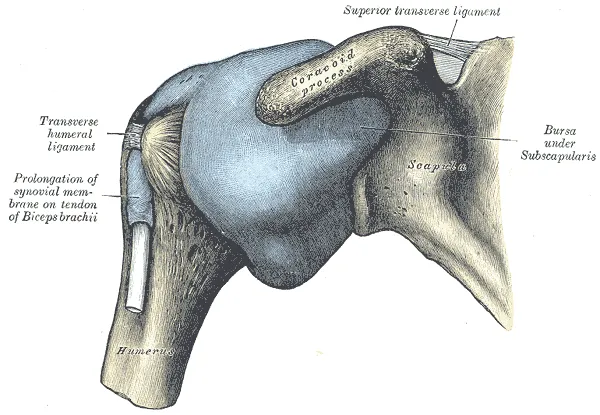
A 2020 scoping review of 48 original articles set out how the condition develops9. It concluded that inflammatory signals and mechanical stress drive fibroblasts, cells in connective tissue that make collagen, to multiply9. These turn into myofibroblasts, fibroblast-like cells that can contract9. That leaves a stiff, thickened capsule9. The shoulder joint page describes the capsule itself10.
Who it affects
How common it is
Prevalence is the share of people in a group who have a condition at a given time. A 2021 study says the prevalence of adhesive capsulitis is typically reported as 2 to 5%11. It notes estimates as low as 0.5% and as high as 10%11.
| Group studied | What was found |
|---|---|
| United States Medicare claims, 2010 to 2012, adults 65 and older | One-year prevalence of about 0.35%11 |
| 1,207 general practices in Germany in 2021, adults 65 or older | One-year prevalence of 0.4% and lifetime prevalence of 2.4%12 |
| 505 consecutive patients having elective shoulder surgery | Frozen shoulder identified in 11% within six months: 15% of women and 8% of men13 |
Age, sex and the other shoulder
The 2025 guideline says frozen shoulder typically affects women aged 45 to 60, with a peak age of 561. It says hormonal changes around the menopause are thought to contribute, although no causal link has been identified1.
The guideline says 6% to 17% of patients develop frozen shoulder in the other shoulder within five years1. In a series of 223 patients with primary frozen shoulder, 20% reported symptoms in both shoulders14. They were followed for a mean of 4.4 years from onset, and there were no recurrent cases14.
Health conditions linked with it
Three of the sources cited here report on diabetes1,15,16.
- The 2025 guideline calls diabetes the strongest association1. It cites an incidence (new cases over a set time) of 10.8% in patients with diabetes, against 2.3% in patients without1.
- A 2016 meta-analysis, a study that pools the results of several earlier studies, covered 18 studies15. It estimated that 13.4% of people with diabetes had adhesive capsulitis15. It also estimated that 30% of people with adhesive capsulitis had diabetes15.
- A UK primary care records cohort compared 43,977 people newly found to have type 2 diabetes with 43,977 without diabetes16. The hazard ratio for developing frozen shoulder was 4.38, and the authors say type 2 diabetes may be a cause16. A hazard ratio is how many times higher the rate of an event is in one group than in another.
A meta-analysis of 10 case-control studies (127,967 patients) found thyroid disease more common in people with adhesive capsulitis than in those without17. The 2025 guideline lists other associated conditions, among them Parkinson’s disease, osteoporosis, stroke and high blood lipids (fats)1.
What studies found
Two accounts of how it changes over time
One account is of stages that end in recovery2. A 1975 prospective study, one that follows people forward in time, followed 41 patients for 5 to 10 years2. It described three consecutive stages: pain, stiffness and recovery2. Together they lasted 30.1 months on average2.
A 2008 Cochrane review, a systematic review done to the Cochrane Collaboration’s standards, describes the condition as usually self-limiting (tending to settle on its own)18. It adds that the course is often prolonged, over two to three years18. The 2015 British care pathway described three overlapping phases and gave each a length19. These were 2 to 9 months for the painful phase, 4 to 12 for freezing and 12 to 42 for thawing19.
A 2025 guideline has since replaced that pathway19. It notes that three overlapping stages have been described: painful, freezing and thawing1. It adds that they overlap considerably, so the literature refers to them inconsistently and their use in guidelines is limited1.
The other account is of improvement that is not complete3. A 2017 systematic review covered seven studies of adults with frozen shoulder who received no intervention3. A systematic review searches for all the research on a question in a set, checkable way and sums it up. This one found low-quality evidence that range of motion (how far a joint moves) improved after one to four years, but not completely3. It found no evidence supporting the theory of recovery phases leading to full resolution3.
A 2025 consensus paper notes mixed opinions on whether frozen shoulder resolves on its own6. Its expert panel reached consensus that, without management, it will not resolve to the same degree6.
What long follow-up studies counted
| Who was followed | What was found |
|---|---|
| Patients in the 1975 study, followed to their greatest recovery | Slight restriction of movement remained in more than half; it was a handicap in three2 |
| 62 patients managed without surgery, reviewed an average of seven years later | 50% still had mild pain or stiffness or both; 11% reported mild functional limitation20 |
| 223 patients with primary frozen shoulder, a mean of 4.4 years from onset | 59% had normal or near-normal shoulders; 41% reported some ongoing symptoms. Of those ongoing symptoms, 94% were mild and 6% were severe14 |
| 51 patients who had observation alone, reviewed 2 to 27 years after first consultation | Range of motion had returned to the level of the other shoulder in 94%; 51% were completely free of pain21 |
In the series of 223 patients, those with the most severe symptoms at the start had the worst long-term outlook14.
Steroid injections
The 2025 guideline drew on seven randomised controlled trials of low-volume steroid injections1. Against therapist-led sessions alone, the injections improved pain and range of motion for up to three months1. After three months there was no difference, and the guideline notes that longer-term outcomes were less studied1.
The guideline also pooled three trials against a placebo (a dummy version) or saline (salt water)1. The injection improved external rotation at three months, with no difference in pain scores or patient-reported outcomes1.
Exercise and mobilisation
A 2014 Cochrane review of hands-on mobilisation and exercise included 32 trials with 1,836 participants22. It found no trial comparing the combination with a placebo or with no intervention22. The 2025 guideline found no randomised trials comparing therapist-led sessions with the natural course of the condition1. It says it is unknown whether supervised sessions of that kind give any greater benefit than the natural course1.
The Cochrane review did report one trial of 107 participants that compared the combination with a glucocorticoid (steroid) injection22. At seven weeks, pain had fallen by 32 points on a 100-point scale, against 58 points with the injection22. At six and twelve months, differences in overall pain and function were not clinically important22.
Distending the joint with fluid
Hydrodilatation is an injection of fluid that stretches the joint capsule. The 2025 guideline found evidence that it improved pain and abduction (lifting the arm out to the side) more than therapist-led sessions or supportive care1. That was in the short to medium term, and evidence on long-term outcomes was insufficient1.
A 2026 meta-analysis compared it with corticosteroid injection alone at 12 weeks23. External rotation was greater, on low certainty of evidence, while pain, disability score, abduction and forward flexion did not differ significantly23. Its authors concluded that current evidence does not support meaningful clinical improvement over injection alone23.
Two operations and a non-surgical programme: the UK FROST trial
UK FROST screened 914 patients and assigned 503 of them to one of three groups24. Participants were adults with frozen shoulder on one side and at least a 50% restriction of passive external rotation24.
- Manipulation under anaesthesia: the surgeon moved the shoulder to stretch and tear its tight capsule under general anaesthesia, with a steroid injection24.
- Arthroscopic capsular release: the surgeon divided the contracted front of the capsule, then manipulated the shoulder24. Arthroscopic means keyhole surgery inside a joint, using a small camera.
- Early structured non-surgical programme: mobilisation techniques, a graduated home exercise programme and a steroid injection24.
The trial measured the Oxford Shoulder Score, which runs from 0 to 4824.
| Group in UK FROST (participants with data) | Mean Oxford Shoulder Score at 12 months (points) |
|---|---|
| Arthroscopic capsular release (191) | 40.324 |
| Manipulation under anaesthesia (189) | 38.324 |
| Early structured non-surgical programme (93) | 37.224 |
At 12 months the score was 2.01 points higher after capsular release than after manipulation4. It was 3.06 points higher than after the early structured non-surgical programme with a steroid injection4. Manipulation did not differ significantly from that programme4. Each of those differences was smaller than the target the trial had set in advance24. The authors concluded that no approach of the three was clinically superior24.
Serious adverse events (unwanted effects seen during a trial) were rare and occurred in participants assigned to surgery4. There were eight with capsular release and two with manipulation4.
Other comparisons of the operations
A 2021 systematic review covered nine randomised controlled trials in primary frozen shoulder25. It set a mobilisation-and-exercise programme with a steroid injection beside manipulation under anaesthesia and arthroscopic capsular release25. It concluded that they were not clinically superior to one another25. The review had planned to look at return to work and recreation, but UK FROST was the one included study that reported them25.
A 2024 meta-analysis of eight comparative studies (768 patients) set capsular release against manipulation26. Beyond 12 months, release gave a statistically greater fall in pain, by less than the minimal clinically important difference26. That is the smallest change in a score that people notice as meaningful. Release also had a higher rate of severe complications26.
Connections
Frozen shoulder is a condition of the capsule of the shoulder joint, which that page describes8,10. The 2025 guideline places the pain near the attachment of the deltoid1. A review of shoulder movement reports evidence of altered motion of the scapula (shoulder blade) associated with adhesive capsulitis and stiff shoulders27.
The shoulder impingement page reports a randomised, placebo-controlled trial of 313 patients at 32 UK hospitals28. Its six study-related complications were frozen shoulders28. Two were in each of the decompression, arthroscopy-only and no-intervention groups28. A 2026 meta-analysis of eight cohort studies put the pooled prevalence of shoulder stiffness after repair of the rotator cuff at 17%29. Its authors urge caution, because the studies varied widely and defined stiffness inconsistently29.
Frozen shoulder involves
Frozen shoulder was counted as a complication in a trial reported on
Frozen shoulder is discussed on
Frozen shoulder has been studied in reviews of the movement of
Frozen shoulder is described by a guideline as causing pain near
Sources
- Rupani N, Gwilym SE, BESS Frozen Shoulder Working Group (2025). British Elbow and Shoulder Society patient care pathway: Frozen shoulder.. Shoulder & elbow. doi:10.1177/17585732251335955 PMID 40291049
- Reeves B (1975). The natural history of the frozen shoulder syndrome.. Scandinavian journal of rheumatology. doi:10.3109/03009747509165255 PMID 1198072
- Wong CK, Levine WN, Deo K, Kesting RS, Mercer EA, Schram GA, Strang BL (2017). Natural history of frozen shoulder: fact or fiction? A systematic review.. Physiotherapy. doi:10.1016/j.physio.2016.05.009 PMID 27641499
- Brealey S, Northgraves M, Kottam L, Keding A, Corbacho B, Goodchild L, Srikesavan C, Rex S, Charalambous CP, Hanchard N, Armstrong A, Brooksbank A, Carr A, Cooper C, Dias J, Donnelly I, Hewitt C, Lamb SE, McDaid C, Richardson G, Rodgers S, Sharp E, Spencer S, Torgerson D, Toye F, Rangan A (2020). Surgical treatments compared with early structured physiotherapy in secondary care for adults with primary frozen shoulder: the UK FROST three-arm RCT.. Health technology assessment (Winchester, England). doi:10.3310/hta24710 PMID 33292924
- Karasuyama M, Ishikawa H, Uchida T, Saka M, Muraki T, Minamikawa T, Nishie K, Kawachi S, Shibuya M, Yamamoto S (2026). Toward a common definition of frozen shoulder: a scoping review of randomized controlled trials.. Journal of shoulder and elbow surgery. doi:10.1016/j.jse.2026.05.040 PMID 42263929
- Salamh P, Stoner B, Ruley N, Zhu H, Bateman M, Chester R, Da Baets L, Gibson J, Hollmann L, Kelley M, Lewis J, McClure P, McCreesh K, Mertens MG, Michener L, Seitz AL, Struyf F, Zuckerman J, King W (2025). An international consensus on the etiology, risk factors, diagnosis and Management for individuals with Frozen Shoulder: a Delphi study.. The Journal of manual & manipulative therapy. doi:10.1080/10669817.2025.2470461 PMID 40042389
- Cho CH, Lee YH, Kim DH, Lim YJ, Baek CS, Kim DH (2020). Definition, Diagnosis, Treatment, and Prognosis of Frozen Shoulder: A Consensus Survey of Shoulder Specialists.. Clinics in orthopedic surgery. doi:10.4055/cios.2020.12.1.60 PMID 32117540
- Itoi E, Arce G, Bain GI, Diercks RL, Guttmann D, Imhoff AB, Mazzocca AD, Sugaya H, Yoo YS (2016). Shoulder Stiffness: Current Concepts and Concerns.. Arthroscopy : the journal of arthroscopic & related surgery : official publication of the Arthroscopy Association of North America and the International Arthroscopy Association. doi:10.1016/j.arthro.2016.03.024 PMID 27180923
- Kraal T, Lübbers J, van den Bekerom MPJ, Alessie J, van Kooyk Y, Eygendaal D, Koorevaar RCT (2020). The puzzling pathophysiology of frozen shoulders - a scoping review.. Journal of experimental orthopaedics. doi:10.1186/s40634-020-00307-w PMID 33205235
- Gray H; Lewis WH (editor) (1918). Anatomy of the Human Body. Lea & Febiger, Philadelphia (20th edition). Link
- Sarasua SM, Floyd S, Bridges WC, Pill SG (2021). The epidemiology and etiology of adhesive capsulitis in the U.S. Medicare population.. BMC musculoskeletal disorders. doi:10.1186/s12891-021-04704-9 PMID 34579697
- Jacob L, Gyasi RM, Koyanagi A, Haro JM, Smith L, Kostev K (2023). Prevalence of and Risk Factors for Adhesive Capsulitis of the Shoulder in Older Adults from Germany.. Journal of clinical medicine. doi:10.3390/jcm12020669 PMID 36675599
- Koorevaar RCT, Van't Riet E, Ipskamp M, Bulstra SK (2017). Incidence and prognostic factors for postoperative frozen shoulder after shoulder surgery: a prospective cohort study.. Archives of orthopaedic and trauma surgery. doi:10.1007/s00402-016-2589-3 PMID 28132086
- Hand C, Clipsham K, Rees JL, Carr AJ (2008). Long-term outcome of frozen shoulder.. Journal of shoulder and elbow surgery. doi:10.1016/j.jse.2007.05.009 PMID 17993282
- Zreik NH, Malik RA, Charalambous CP (2016). Adhesive capsulitis of the shoulder and diabetes: a meta-analysis of prevalence.. Muscles, ligaments and tendons journal. doi:10.11138/mltj/2016.6.1.026 PMID 27331029
- Dyer BP, Burton C, Rathod-Mistry T, Blagojevic-Bucknall M, van der Windt DA (2025). Type 2 diabetes, metabolic health, and the development of frozen shoulder: a cohort study in UK electronic health records.. BMC musculoskeletal disorders. doi:10.1186/s12891-025-08672-2 PMID 40369566
- Chuang SH, Chen YP, Huang SW, Kuo YJ (2023). Association between adhesive capsulitis and thyroid disease: a meta-analysis.. Journal of shoulder and elbow surgery. doi:10.1016/j.jse.2023.01.033 PMID 36871608
- Buchbinder R, Green S, Youd JM, Johnston RV, Cumpston M (2008). Arthrographic distension for adhesive capsulitis (frozen shoulder).. The Cochrane database of systematic reviews. doi:10.1002/14651858.CD007005 PMID 18254123
- Rangan A, Gibson J, Brownson P, Thomas M, Rees J, Kulkarni R (2015). Frozen Shoulder. Shoulder & elbow. doi:10.1177/1758573215601779 PMID 27582992
- Shaffer B, Tibone JE, Kerlan RK (1992). Frozen shoulder. A long-term follow-up.. The Journal of bone and joint surgery. American volume. PMID 1624489
- Vastamäki H, Kettunen J, Vastamäki M (2012). The natural history of idiopathic frozen shoulder: a 2- to 27-year followup study.. Clinical orthopaedics and related research. doi:10.1007/s11999-011-2176-4 PMID 22090356
- Page MJ, Green S, Kramer S, Johnston RV, McBain B, Chau M, Buchbinder R (2014). Manual therapy and exercise for adhesive capsulitis (frozen shoulder).. The Cochrane database of systematic reviews. doi:10.1002/14651858.CD011275 PMID 25157702
- Rhim HC, Shin J, Olson G, Fetterman R, Guo RC, Combs DB, Pan X, Ruiz J, Dhawan R, Robinson DM, McInnis KC (2026). Hydrodilatation for adhesive capsulitis: a systematic review exploring efficacy and optimal technique.. British journal of sports medicine. doi:10.1136/bjsports-2025-110539 PMID 42527106
- Rangan A, Brealey SD, Keding A, Corbacho B, Northgraves M, Kottam L, Goodchild L, Srikesavan C, Rex S, Charalambous CP, Hanchard N, Armstrong A, Brooksbank A, Carr A, Cooper C, Dias JJ, Donnelly I, Hewitt C, Lamb SE, McDaid C, Richardson G, Rodgers S, Sharp E, Spencer S, Torgerson D, Toye F, UK FROST Study Group (2020). Management of adults with primary frozen shoulder in secondary care (UK FROST): a multicentre, pragmatic, three-arm, superiority randomised clinical trial.. Lancet (London, England). doi:10.1016/S0140-6736(20)31965-6 PMID 33010843
- Rex SS, Kottam L, McDaid C, Brealey S, Dias J, Hewitt CE, Keding A, Lamb SE, Wright K, Rangan A (2021). Effectiveness of interventions for the management of primary frozen shoulder. Bone & joint open. doi:10.1302/2633-1462.29.BJO-2021-0060.R1 PMID 34555926
- Zhao Y, Yang T, Feng C, Li L, Pang L, Zhao S (2024). Arthroscopic Capsular Release Versus Manipulation under Anesthesia for Refractory Frozen Shoulder: A Systematic Review with Meta-Analysis.. Orthopaedic surgery. doi:10.1111/os.14077 PMID 38747000
- Ludewig PM, Reynolds JF (2009). The association of scapular kinematics and glenohumeral joint pathologies.. Journal of Orthopaedic and Sports Physical Therapy. doi:10.2519/jospt.2009.2808 PMID 19194022
- Beard DJ, Rees JL, Cook JA, Rombach I, Cooper C, Merritt N, Shirkey BA, Donovan JL, Gwilym S, Savulescu J, Moser J, Gray A, Jepson M, Tracey I, Judge A, Wartolowska K, Carr AJ (2018). Arthroscopic subacromial decompression for subacromial shoulder pain (CSAW): a multicentre, pragmatic, parallel group, placebo-controlled, three-group, randomised surgical trial.. The Lancet. doi:10.1016/S0140-6736(17)32457-1 PMID 29169668
- Tang XL, Wang YL, Zhang ZY, Cheng X, Gao SY, Ding S (2026). Prevalence and risk factors of shoulder stiffness after rotator cuff repair: a meta-analysis.. BMC musculoskeletal disorders. doi:10.1186/s12891-026-09856-0 PMID 42087148
Changes
- Revised to report sources added after their published corrections were read