Knee osteoarthritis
Also called knee OA, osteoarthritis of the knee
A long-term disease of the knee joint, in which the cartilage lining the joint wears away. How guidelines define it, who it affects, how it changes over time, and what trials of exercise, weight loss and surgery found.
- Region
- Knee
- Updated
- October 22, 2026
- Reviewed
- October 22, 2026 · how entries are checked
What it is
How guidelines and reviews define it
The 2022 NICE (UK National Institute for Health and Care Excellence) guideline describes osteoarthritis as the most common form of arthritis1. It says the condition typically shows as joint pain and stiffness, mostly in the knee, hip, hand and foot1. A 2016 review notes that thinking has shifted, from a disease limited to cartilage to one that affects the whole joint5.
A draft definition from OARSI (the Osteoarthritis Research Society International) describes a disorder of movable joints6. In it, small and large injuries trigger repair that goes wrong, with stress on cells and breakdown of the tissue around them6. Later signs are cartilage breakdown, bone remodelling, osteophytes (bone spurs at the edge of a joint), inflamed joints, and joints that stop working normally6.
What changes in the joint
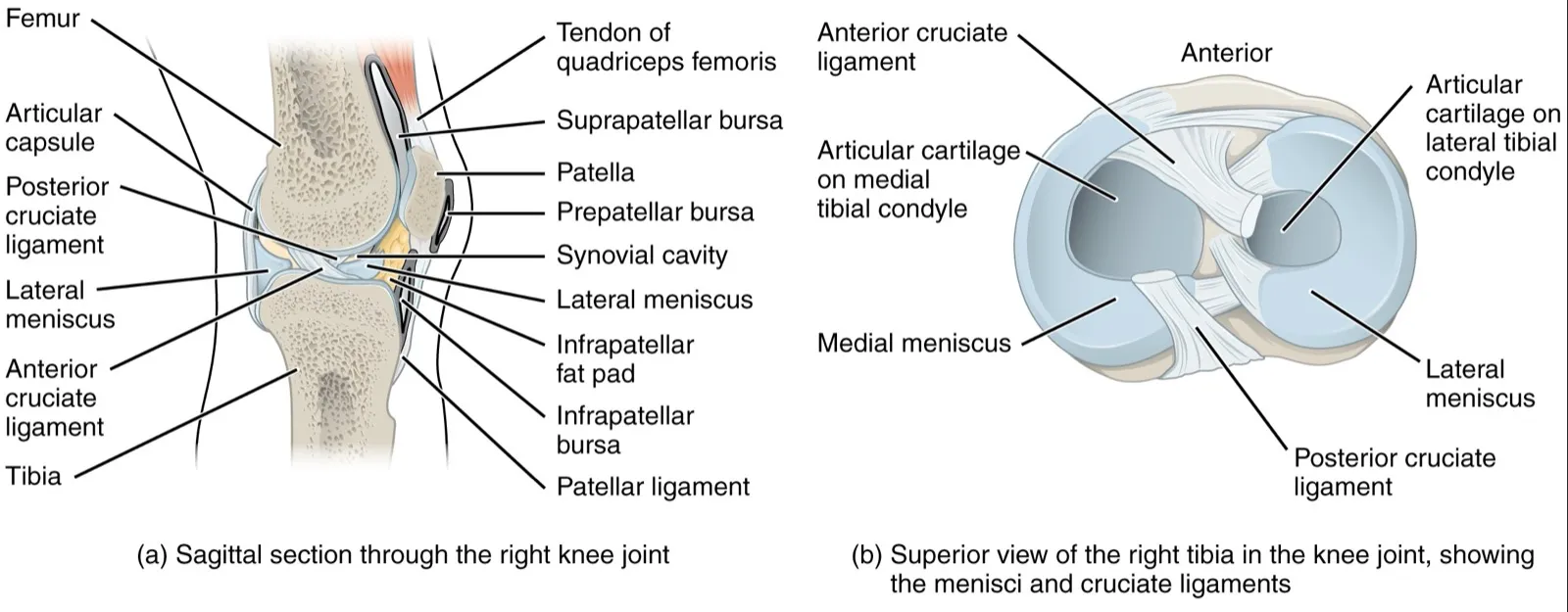
An anatomy textbook describes the articular cartilage, the layer covering the bone ends, thinning gradually in osteoarthritis7. The joint may swell with extra synovial fluid, the slippery fluid that oils its moving surfaces7. The bone beneath the damaged cartilage thickens and roughens7.
How it is identified
The NICE guideline recommends identifying osteoarthritis clinically, without imaging, in people aged 45 or over1. Its criteria are joint pain linked to activity, and either no morning stiffness or stiffness lasting 30 minutes or less1.
Osteoarthritis can also affect the joint behind the patella (kneecap)8. A 2016 consensus statement (an expert panel’s agreed report) found it there alone in 11 to 24% of older people, by population and definition8. It occurred together with osteoarthritis of the main knee joint in 4 to 40%8.
Who it affects
How common it is
The NICE guideline says osteoarthritis is more common in women, in people aged 45 and over, and in people living with obesity1. It is also more common in people in deprived areas, and its prevalence is increasing1.
| What was measured | What was found |
|---|---|
| Prevalence (share with it), worldwide | 16.0% of people aged 15 and over, 22.9% of those aged 40 and over, in 88 population studies2 |
| Incidence (new cases) in people 20 and over | 203 per 10,000 person-years (people multiplied by years followed), rising with age2 |
| Women against men | Prevalence 1.69 times and incidence 1.39 times higher in women2 |
| Age of peak | Knee osteoarthritis peaked at ages 80 to 84 in 2020 estimates9 |
Body weight
A meta-analysis pooled 12 observational studies, which watch people without assigning groups10. Risk rose with body mass index (a measure of weight for height), though not in a straight line10. Against an index of 22.5, risk was 1.59 times higher at 25, 3.55 at 30 and 7.45 at 3510.
A 2023 review of 23 trials and cohort studies (which follow people over time) linked adult weight gain with more symptoms and joint change11. Each 5 kg gained went with more knee replacement11. The hazard ratio (how many times higher the rate was) was 1.34 in women and 1.25 in men11.
Past knee injury
In a Swedish cohort of 149,288 people aged 25 to 34, a recorded knee injury went with more osteoarthritis recorded later12. The adjusted hazard ratio was 5.7 over the first 11 years and 3.4 over the next 812. Cruciate ligament injury, meniscus tears and fractures of the shinbone top or kneecap carried the largest rises in risk12.
A 2022 review of people injured at a mean age of 30 or under found moderate-certainty evidence on many injury types13. Ligament, meniscus, cartilage, dislocation, fracture and multi-part injuries each raised the odds of osteoarthritis with symptoms13. A 2019 review took 41 studies of people with an ACL tear, a tear of the front ligament crossing inside the knee14. Rates on X-ray more than 10 years later ranged from 0% to 100%14. Over half those studies were of low quality, and meniscectomy (removing meniscus tissue) was the only consistent risk factor14.
Sport and running
Reviews of athletes report a wide spread of findings15,16:
- Former athletes: a 2018 meta-analysis of 15 studies (3,100 people) estimated prevalence at 30%, on low-quality evidence15.
- Former professional footballers: a UK study compared 1,207 of them with 4,085 men from the general population17. Knee pain, X-ray signs and knee replacement were two to three times as common in the footballers17.
- By sport: a 2022 review of 32 studies, excluding osteoarthritis after injury, linked soccer, handball, ice hockey and rugby with early knee and hip osteoarthritis16. Runners and ballet dancers showed no significant increase16.
In the footballers, knee injury was the main risk factor17. Even after adjusting for it, risk of knee pain and X-ray signs stayed more than doubled17. A meta-analysis of 15 studies of running found mixed results and concluded that its role could not be determined18.
What studies found
How it changes over time
The NICE guideline says symptoms range from mild and on-and-off to more lasting or severe1. The guideline adds that the condition does not inevitably get worse, though symptoms go up and down and flares are common1. A 2020 review of seven studies (7,747 people, mainly early or moderate disease) found pain stayed steady over the mid-term in 85%19. Pain fell in 8% and worsened in 7%, while day-to-day pain was unstable in almost half19.
That review linked low education, other illnesses and depression with severe or worsening pain19. Evidence on joint factors such as X-ray severity was conflicting or absent19. A 2016 meta-analysis of 58 studies found results varied too much to describe a typical course of pain and function20. It found strong evidence that worse X-ray changes, rising pain, weaker knee straightening and slower walking predicted declining function20.
Exercise
A 2024 Cochrane review included 139 trials (12,468 people), with land-based programmes lasting 2 to 104 weeks3. Its findings varied by comparison group3:
- Against no exercise, usual care (the care people would get anyway) or limited education: pain may improve by 13.1 points out of 1003. That evidence was of low certainty3. Function likely improves by 12.5 points3.
- Against attention control or placebo: pain may improve slightly, by 8.7 points3. Function likely improves by 11.3 points3.
- Harms: against no exercise, exercise may raise adverse events (unwanted effects seen during a trial), on low-certainty evidence3. Against attention control or placebo, it may not increase them3.
The review judged these short-term gains of uncertain clinical importance, and noted most participants knew their group3. It rated most trials at unclear or high risk of bias, meaning flaws may have skewed results3. It found no differences between types of exercise, and no link with the number of sessions3.
Guidelines from NICE, OARSI, EULAR (a European rheumatology body) and the American College of Rheumatology include exercise1,21,22,23. NICE notes that joint pain may increase when exercise starts1.
Weight loss
In 142 overweight and obese older adults with the condition, each 1 kg lost went with about a 4-fold larger drop in walking knee force24. A 2007 meta-analysis of four trials (454 overweight people with the condition) found disability improved after moderate weight loss25. A further analysis in it suggested a loss of more than 5% of body weight25. NICE says any weight loss is likely to help people with osteoarthritis and overweight or obesity1. It adds that a 10% loss is likely better than a 5% loss1.
An 18-month trial took 454 overweight and obese adults aged 55 or over with the condition26. This trial, called IDEA, was funded by US National Institutes of Health grants and by General Nutrition Centers26. The diet-plus-exercise group lost 11.4% of body weight on average26. That group had less pain and better function than groups given diet or exercise alone26. In overweight or obese people with the condition, a 2019 meta-analysis found diet alone did not reduce pain, while diet with exercise reduced it moderately27.
Keyhole surgery
Studies of arthroscopy (keyhole surgery inside a joint) in worn knees found little or no lasting gain4,28,29:
- Against a placebo operation: in a trial of 180 people, patients and assessors were not told who had which operation4. Washing out or trimming gave no less pain or better function over 24 months4.
- Added to physical and medical care: in moderate-to-severe disease, one trial found washing out and trimming added no knee-score benefit at 2 years28.
- Pooled trials: these covered middle-aged and older people with degenerative (worn) knee disease29. A small pain gain at 3 and 6 months was gone by 1 to 2 years29.
NICE recommends against offering keyhole washing out or trimming for osteoarthritis1.
Knee replacement
A 2026 Cochrane review found one trial (100 adults, Denmark) comparing knee replacement with a non-surgical programme30. It gave low-certainty evidence that replacement may reduce pain by a clinically important amount at one year30. Evidence on serious adverse events, more common after surgery, was very uncertain30.
A Danish trial named MEDIC took 100 people with moderate-to-severe disease who were eligible for surgery31,32. Its funders were the Obel Family Foundation, among others31. Replacement plus a 12-week programme raised a knee score 32.5 points, against 16.0 for the programme alone31. The surgery group had 24 serious adverse events against 631. Within 12 months, 13 of those given the programme alone (26%) had a knee replacement31.
A 2018 report gave 2-year results from the same MEDIC trial, under the same registration number31,32,33. It reported them beside a parallel trial of 100 people not eligible for surgery31,33. By 2 years, 16 of the 50 eligible people given the programme (32%) had had a replacement33. So about two in three put off surgery for at least 2 years33.
Medicines
A 2016 review states that drugs for osteoarthritis mostly relieve symptoms5. At that time, no drug that also slows or stops the disease had been approved by regulators5.
Connections
Knee osteoarthritis involves the whole knee joint, its cartilage and the bone beneath5,7. The menisci are pads of cartilage in the knee. A European consensus states it is unclear whether their degenerative (worn) tears cause osteoarthritis or result from it35. In a trial of 321 people aged 45 to 70 with such meniscus tears, X-ray change progressed at comparable rates after surgery or exercise36.
A meta-analysis of 17 studies found hip and knee osteoarthritis in 3.5% of recreational runners and 13.3% of competitive ones37. In non-running controls it was 10.2%37. Its authors could not tell whether these links were causal37. In 28 people aged 50 or older with inner-knee osteoarthritis and bowed legs, the lunge raised muscle forces above walking38. Peak inner-knee contact force did not differ significantly from walking38.
Knee osteoarthritis involves
Knee osteoarthritis has higher odds after
Knee osteoarthritis has studies of runners in
Knee osteoarthritis has lab studies of joint forces during
Sources
- National Institute for Health and Care Excellence (2022). Osteoarthritis in over 16s: diagnosis and management. National Institute for Health and Care Excellence (NICE guideline NG226). Link
- Cui A, Li H, Wang D, Zhong J, Chen Y, Lu H (2020). Global, regional prevalence, incidence and risk factors of knee osteoarthritis in population-based studies.. EClinicalMedicine. doi:10.1016/j.eclinm.2020.100587 PMID 34505846
- Lawford BJ, Hall M, Hinman RS, Van der Esch M, Harmer AR, Spiers L, Kimp A, Dell'Isola A, Bennell KL (2024). Exercise for osteoarthritis of the knee.. The Cochrane database of systematic reviews. doi:10.1002/14651858.CD004376.pub4 PMID 39625083
- Moseley JB, O'Malley K, Petersen NJ, Menke TJ, Brody BA, Kuykendall DH, Hollingsworth JC, Ashton CM, Wray NP (2002). A controlled trial of arthroscopic surgery for osteoarthritis of the knee.. The New England journal of medicine. doi:10.1056/NEJMoa013259 PMID 12110735
- Martel-Pelletier J, Barr AJ, Cicuttini FM, Conaghan PG, Cooper C, Goldring MB, Goldring SR, Jones G, Teichtahl AJ, Pelletier JP (2016). Osteoarthritis.. Nature reviews. Disease primers. doi:10.1038/nrdp.2016.72 PMID 27734845
- Kraus VB, Blanco FJ, Englund M, Karsdal MA, Lohmander LS (2015). Call for standardized definitions of osteoarthritis and risk stratification for clinical trials and clinical use.. Osteoarthritis and cartilage. doi:10.1016/j.joca.2015.03.036 PMID 25865392
- Betts JG, Young KA, Wise JA, Johnson E, Poe B, Kruse DH, Korol O, Johnson JE, Womble M, DeSaix P (2022). Anatomy and Physiology 2e. OpenStax. Link
- Crossley KM, Stefanik JJ, Selfe J, Collins NJ, Davis IS, Powers CM, McConnell J, Vicenzino B, Bazett-Jones DM, Esculier JF, Morrissey D, Callaghan MJ (2016). 2016 Patellofemoral pain consensus statement from the 4th International Patellofemoral Pain Research Retreat, Manchester. Part 1: Terminology, definitions, clinical examination, natural history, patellofemoral osteoarthritis and patient-reported outcome measures.. British Journal of Sports Medicine. doi:10.1136/bjsports-2016-096384 PMID 27343241
- GBD 2021 Osteoarthritis Collaborators (2023). Global, regional, and national burden of osteoarthritis, 1990-2020 and projections to 2050: a systematic analysis for the Global Burden of Disease Study 2021.. The Lancet. Rheumatology. doi:10.1016/S2665-9913(23)00163-7 PMID 37675071
- Zhou ZY, Liu YK, Chen HL, Liu F (2014). Body mass index and knee osteoarthritis risk: a dose-response meta-analysis.. Obesity (Silver Spring, Md.). doi:10.1002/oby.20835 PMID 24990315
- Solanki P, Hussain SM, Abidi J, Cheng J, Fairley JL, Page MJ, Cicuttini FM, Wluka AE (2023). Association between weight gain and knee osteoarthritis: a systematic review.. Osteoarthritis and cartilage. doi:10.1016/j.joca.2022.10.023 PMID 36511280
- Snoeker B, Turkiewicz A, Magnusson K, Frobell R, Yu D, Peat G, Englund M (2020). Risk of knee osteoarthritis after different types of knee injuries in young adults: a population-based cohort study.. British journal of sports medicine. doi:10.1136/bjsports-2019-100959 PMID 31826861
- Whittaker JL, Losciale JM, Juhl CB, Thorlund JB, Lundberg M, Truong LK, Miciak M, van Meer BL, Culvenor AG, Crossley KM, Roos EM, Lohmander S, van Middelkoop M (2022). Risk factors for knee osteoarthritis after traumatic knee injury: a systematic review and meta-analysis of randomised controlled trials and cohort studies for the OPTIKNEE Consensus.. British journal of sports medicine. doi:10.1136/bjsports-2022-105496 PMID 36455966
- Lie MM, Risberg MA, Storheim K, Engebretsen L, Øiestad BE (2019). What's the rate of knee osteoarthritis 10 years after anterior cruciate ligament injury? An updated systematic review.. British journal of sports medicine. doi:10.1136/bjsports-2018-099751 PMID 30936063
- Madaleno FO, Santos BA, Araújo VL, Oliveira VC, Resende RA (2018). Prevalence of knee osteoarthritis in former athletes: a systematic review with meta-analysis.. Brazilian journal of physical therapy. doi:10.1016/j.bjpt.2018.03.012 PMID 29636304
- Migliorini F, Marsilio E, Torsiello E, Pintore A, Oliva F, Maffulli N (2022). Osteoarthritis in Athletes Versus Nonathletes: A Systematic Review.. Sports medicine and arthroscopy review. doi:10.1097/JSA.0000000000000339 PMID 35533058
- Fernandes GS, Parekh SM, Moses J, Fuller C, Scammell B, Batt ME, Zhang W, Doherty M (2018). Prevalence of knee pain, radiographic osteoarthritis and arthroplasty in retired professional footballers compared with men in the general population: a cross-sectional study.. British journal of sports medicine. doi:10.1136/bjsports-2017-097503 PMID 29101102
- Timmins KA, Leech RD, Batt ME, Edwards KL (2017). Running and Knee Osteoarthritis: A Systematic Review and Meta-analysis.. The American journal of sports medicine. doi:10.1177/0363546516657531 PMID 27519678
- Previtali D, Andriolo L, Di Laura Frattura G, Boffa A, Candrian C, Zaffagnini S, Filardo G (2020). Pain Trajectories in Knee Osteoarthritis-A Systematic Review and Best Evidence Synthesis on Pain Predictors.. Journal of clinical medicine. doi:10.3390/jcm9092828 PMID 32882828
- de Rooij M, van der Leeden M, Heymans MW, Holla JF, Häkkinen A, Lems WF, Roorda LD, Veenhof C, Sanchez-Ramirez DC, de Vet HC, Dekker J (2016). Prognosis of Pain and Physical Functioning in Patients With Knee Osteoarthritis: A Systematic Review and Meta-Analysis.. Arthritis care & research. doi:10.1002/acr.22693 PMID 26316234
- Bannuru RR, Osani MC, Vaysbrot EE, Arden NK, Bennell K, Bierma-Zeinstra SMA, Kraus VB, Lohmander LS, Abbott JH, Bhandari M, Blanco FJ, Espinosa R, Haugen IK, Lin J, Mandl LA, Moilanen E, Nakamura N, Snyder-Mackler L, Trojian T, Underwood M, McAlindon TE (2019). OARSI guidelines for the non-surgical management of knee, hip, and polyarticular osteoarthritis.. Osteoarthritis and cartilage. doi:10.1016/j.joca.2019.06.011 PMID 31278997
- Moseng T, Vliet Vlieland TPM, Battista S, Beckwée D, Boyadzhieva V, Conaghan PG, Costa D, Doherty M, Finney AG, Georgiev T, Gobbo M, Kennedy N, Kjeken I, Kroon FPB, Lohmander LS, Lund H, Mallen CD, Pavelka K, Pitsillidou IA, Rayman MP, Tveter AT, Vriezekolk JE, Wiek D, Zanoli G, Østerås N (2024). EULAR recommendations for the non-pharmacological core management of hip and knee osteoarthritis: 2023 update.. Annals of the rheumatic diseases. doi:10.1136/ard-2023-225041 PMID 38212040
- Kolasinski SL, Neogi T, Hochberg MC, Oatis C, Guyatt G, Block J, Callahan L, Copenhaver C, Dodge C, Felson D, Gellar K, Harvey WF, Hawker G, Herzig E, Kwoh CK, Nelson AE, Samuels J, Scanzello C, White D, Wise B, Altman RD, DiRenzo D, Fontanarosa J, Giradi G, Ishimori M, Misra D, Shah AA, Shmagel AK, Thoma LM, Turgunbaev M, Turner AS, Reston J (2020). 2019 American College of Rheumatology/Arthritis Foundation Guideline for the Management of Osteoarthritis of the Hand, Hip, and Knee.. Arthritis care & research. doi:10.1002/acr.24131 PMID 31908149
- Messier SP, Gutekunst DJ, Davis C, DeVita P (2005). Weight loss reduces knee-joint loads in overweight and obese older adults with knee osteoarthritis.. Arthritis and rheumatism. doi:10.1002/art.21139 PMID 15986358
- Christensen R, Bartels EM, Astrup A, Bliddal H (2007). Effect of weight reduction in obese patients diagnosed with knee osteoarthritis: a systematic review and meta-analysis.. Annals of the rheumatic diseases. doi:10.1136/ard.2006.065904 PMID 17204567
- Messier SP, Mihalko SL, Legault C, Miller GD, Nicklas BJ, DeVita P, Beavers DP, Hunter DJ, Lyles MF, Eckstein F, Williamson JD, Carr JJ, Guermazi A, Loeser RF (2013). Effects of intensive diet and exercise on knee joint loads, inflammation, and clinical outcomes among overweight and obese adults with knee osteoarthritis: the IDEA randomized clinical trial.. JAMA. doi:10.1001/jama.2013.277669 PMID 24065013
- Hall M, Castelein B, Wittoek R, Calders P, Van Ginckel A (2019). Diet-induced weight loss alone or combined with exercise in overweight or obese people with knee osteoarthritis: A systematic review and meta-analysis.. Seminars in arthritis and rheumatism. doi:10.1016/j.semarthrit.2018.06.005 PMID 30072112
- Kirkley A, Birmingham TB, Litchfield RB, Giffin JR, Willits KR, Wong CJ, Feagan BG, Donner A, Griffin SH, D'Ascanio LM, Pope JE, Fowler PJ (2008). A randomized trial of arthroscopic surgery for osteoarthritis of the knee.. The New England journal of medicine. doi:10.1056/NEJMoa0708333 PMID 18784099
- Thorlund JB, Juhl CB, Roos EM, Lohmander LS (2015). Arthroscopic surgery for degenerative knee: systematic review and meta-analysis of benefits and harms.. BMJ (Clinical research ed.). doi:10.1136/bmj.h2747 PMID 26080045
- Pacheco-Brousseau L, Abdelrazeq S, Kelly SE, Pardo Pardo J, Dervin G, Stacey D, Wells GA (2026). Total and partial knee arthroplasty versus non-surgical interventions of the knee for moderate to severe osteoarthritis.. The Cochrane database of systematic reviews. doi:10.1002/14651858.CD015378.pub2 PMID 41494148
- Skou ST, Roos EM, Laursen MB, Rathleff MS, Arendt-Nielsen L, Simonsen O, Rasmussen S (2015). A Randomized, Controlled Trial of Total Knee Replacement.. The New England journal of medicine. doi:10.1056/NEJMoa1505467 PMID 26488691
- Skou ST (principal investigator); Northern Orthopaedic Division, Denmark (sponsor) (2011). Structured Treatment of Osteoarthritis of the Knee With or Without Total Knee Replacement (ClinicalTrials.gov NCT01410409). ClinicalTrials.gov. Link
- Skou ST, Roos EM, Laursen MB, Rathleff MS, Arendt-Nielsen L, Rasmussen S, Simonsen O (2018). Total knee replacement and non-surgical treatment of knee osteoarthritis: 2-year outcome from two parallel randomized controlled trials.. Osteoarthritis and cartilage. doi:10.1016/j.joca.2018.04.014 PMID 29723634
- Skou ST, Roos EM (2017). Good Life with osteoArthritis in Denmark (GLA:D™): evidence-based education and supervised neuromuscular exercise delivered by certified physiotherapists nationwide.. BMC musculoskeletal disorders. doi:10.1186/s12891-017-1439-y PMID 28173795
- Beaufils P, Becker R, Kopf S, Englund M, Verdonk R, Ollivier M, Seil R (2017). Surgical management of degenerative meniscus lesions: the 2016 ESSKA meniscus consensus.. Knee surgery, sports traumatology, arthroscopy. doi:10.1007/s00167-016-4407-4 PMID 28210788
- Noorduyn JCA, van de Graaf VA, Willigenburg NW, Scholten-Peeters GGM, Kret EJ, van Dijk RA, Buchbinder R, Hawker GA, Coppieters MW, Poolman RW (2022). Effect of Physical Therapy vs Arthroscopic Partial Meniscectomy in People With Degenerative Meniscal Tears. JAMA network open. doi:10.1001/jamanetworkopen.2022.20394 PMID 35802374
- Alentorn-Geli E, Samuelsson K, Musahl V, Green CL, Bhandari M, Karlsson J (2017). The Association of Recreational and Competitive Running With Hip and Knee Osteoarthritis: A Systematic Review and Meta-analysis.. The Journal of orthopaedic and sports physical therapy. doi:10.2519/jospt.2017.7137 PMID 28504066
- Starkey SC, Diamond LE, Hinman RS, Saxby DJ, Knox G, Hall M (2022). Muscle Forces during Weight-Bearing Exercises in Medial Knee Osteoarthritis and Varus Malalignment: A Cross-Sectional Study.. Medicine and science in sports and exercise. doi:10.1249/MSS.0000000000002943 PMID 35551169
Changes
- First published.