ACL tear
Also called ACL rupture, ACL injury, anterior cruciate ligament rupture, anterior cruciate ligament tear
A tear of the anterior cruciate ligament inside the knee. How reviews and guidelines describe it, who it affects, how it changes over time, and what trials comparing surgery with an exercise programme found.
- Region
- Knee
- Updated
- September 30, 2026
- Reviewed
- September 30, 2026 · how entries are checked
What it is
How reviews and guidelines describe it
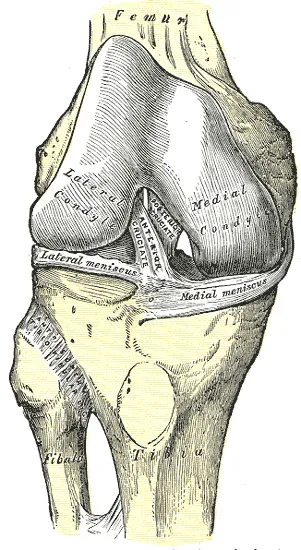
The anterior cruciate ligament, or ACL, is the front one of two ligaments that cross inside the knee, joining the thigh bone to the shinbone. Ligaments are tough bands of tissue that hold bones together at a joint. A 2016 Cochrane review describes its rupture as a common injury that mainly affects young, physically active people1. The same review says the rupture is marked by an unstable knee joint1. That instability can lead to less activity and a poorer knee-related quality of life1.
A 2023 summary of the American Academy of Orthopaedic Surgeons guideline says ACL injuries notably affect how the knee works in cutting, pivoting and landing2. A 2019 review separates two ideas5. Laxity is the passive movement of the shinbone on the thigh bone, measured by hand or with a device5. Functional instability is the person’s own sense that the knee is unstable5.
How the injury happens
A 2026 expert position statement describes an ACL rupture as caused by loading that is more than the tissue’s current strength6. That strength varies with age, sex, training and past injury6.
How often the injury happens without contact differs between sources7,8:
- A 2014 review puts it at more than 70%, typically when landing from a jump or cutting sideways in sports such as basketball and soccer7.
- A 2022 analysis of 45 studies across 13 team ball sports put it at 55%: 63% in females and 50% in males8.
A systematic review, a study that sums up the research on a question in a set, checkable way, looked at injuries checked on video9. The most common actions in noncontact cases were cutting, pressing or tackling, slowing down and landing9.
What comes with it
A 2019 review reports that ACL ruptures often come with other knee injuries5. Tears of the menisci, pads of cartilage (a firm, rubbery tissue softer than bone) in the knee, came with about 42%5. Injuries to the medial collateral ligament, on the inner side of the knee, came with about 30%5.
The same review says injuries to the lateral collateral ligament, on the outer side of the knee, are generally uncommon alongside it5. So are injuries to the posterior cruciate ligament, the back one of the two crossing ligaments5. A 2014 review links ACL injuries with damage to joint cartilage and a higher risk of early osteoarthritis7. Osteoarthritis is a long-term joint disease in which the cartilage lining the joint wears away. A meta-analysis of 53 studies found the odds of knee osteoarthritis about 4 times higher after an ACL injury than in an uninjured knee10.
Who it affects
How common it is
Incidence means how many new cases appear in a group over a set time. A 21-year population study counted new cases per 100,000 person-years, which multiply people by the years each was followed11.
| Group studied | What was found |
|---|---|
| 1,841 people with an ACL tear alone, in a 21-year population study from 1990 to 2010 | 68.6 new cases per 100,000 person-years, adjusted to the US population: 81.7 in males and 55.3 in females11 |
| The same study, by age | Highest at ages 19 to 25 in males and 14 to 18 in females11 |
| National population studies in Australia, in a systematic review | At most 0.05% of people each year12 |
| Professional basketball, soccer and other football codes, in the same review | 0.15% to 3.7% of players per year in studies of at least moderate size, with amateur sport generally in between12 |
Sex, age and sport
The population study above found a higher rate in males11. Studies of athletes found higher rates in females8,13:
- Adolescent athletes: a meta-analysis of 1,235 injuries found girls had 1.4 times the rate of boys, and about 4 times in basketball13.
- Highest-rate sports: the same analysis found the highest rates in girls’ soccer and boys’ football13. It estimated close to a 10% risk over high school for a girl playing several sports13.
- Team ball sports: a 2022 analysis of 45 studies found 0.14 noncontact injuries per 1,000 player-hours in females, against 0.05 in males8.
- Similar sports: the 2023 guideline summary reports noncontact rates two to eight times higher in females than in males2.
Factors linked with it
- A past ACL injury: a position statement names it as the most consistent risk factor within the body6. A meta-analysis put second ACL injuries after reconstruction at 15%14.
- Family: in 5,184,603 people in Korea, risk was 1.79 times higher with an injured parent, child or sibling15. It was 4.49 times higher with an injured twin15.
- Knee shape: the position statement reports strong evidence linking three features with injury6. They are a smaller ACL, a steeper backward slope of the shinbone, and a narrower notch at the end of the thigh bone6. These factors are largely not changeable6. Meta-analyses found a steeper shinbone slope and a narrower notch in people with ACL injuries than in people without16,17.
In 171 young female basketball and floorball players tested with a drop jump, the landing measures linked to injury picked out risk poorly18. A scoping review, which maps and sums up the research on a topic, looked at 11 studies19. It found the evidence for each landing predictor it reported to be limited or conflicting19. In 880 elite female handball and football players, visual ratings of the single-leg squat did not tell apart those later injured20.
What studies found
How it changes over time
A 2019 review reports that knee pain, other symptoms and limits on leisure activity are common more than five years after a rupture5. It adds that not everyone has a poor outcome5.
Some torn ligaments show signs of healing on MRI, a scan that shows soft tissue in detail21,22. A systematic review of 9 low-quality studies of complete ruptures managed without surgery found that each reported some ligaments joining up again21. In one trial of active adults, 58% (14 people) of those managed without surgery showed a continuous ligament on MRI at five years22. The same 11-year analysis suggests that continuity may be linked with worse self-reported knee scores at 11 years than early or delayed reconstruction22.
In that trial’s 11-year follow-up, osteoarthritis on X-ray in the main knee joint ranged from 14% to 23% across groups22. In the joint behind the kneecap it ranged from 11% to 41%22.
Trials comparing surgery with an exercise programme
ACL reconstruction replaces the ruptured ligament with a tendon graft23. Randomised trials have compared it with an exercise programme and optional later surgery1,24,25.
| Trial | Who was studied | What was found |
|---|---|---|
| The one trial in a 2016 Cochrane review | 141 young, active adults with a recent injury1 | No difference in self-reported knee scores at two and five years, on low-quality evidence1 |
| A trial in the Netherlands | 167 people aged 18 to 65 with a recent rupture24 | Early surgery gave a statistically better knee score at two years, 84.7 against 79.4, but not a clinically relevant one24 |
| A trial in the UK | 316 people with an older injury and a knee that stayed unstable25 | The group allocated to surgery had a higher knee score at 18 months, 73.0 against 64.625 |
In the Dutch trial, the exercise-first group had better knee scores at three months24. Scores favoured early surgery from nine months, with smaller gaps after a year24. Half of the exercise-first group, 41 of 82, had surgery within two years24. In the Cochrane trial, 39% of the non-surgical group had surgery by two years and 51% by five1. In the UK trial, 41% of the exercise-first group had surgery within 18 months25.
What reviews of the trials found
- Knee function: a 2022 review of three trials found no clinically important difference in self-reported knee function at any follow-up, at low to very low certainty3.
- Joint damage: the same review found no long-term effect of early surgery on osteoarthritis on imaging (two trials, very low certainty) or on meniscus damage (one trial, low certainty)3.
- Osteoarthritis in one trial: the Cochrane review found more on X-ray after surgery, 35% against 18%, on very low-quality evidence1.
- Return to sport: a 2025 review of 15 studies found surgery was not linked with a higher return rate, at low or very low certainty26. Ten of its studies had a high risk of confounding, other factors that could explain a link, likely to favour surgery26.
Where guidelines and reviews differ
When surgery is chosen for a recent tear of the ACL alone, the 2023 guideline summary prefers early reconstruction2. It gives this a strong rating, saying the risk of further cartilage and meniscus injury starts to rise within three months2. A 2020 panel of 66 experts recommended early reconstruction, after a period of progressive exercise, for highly active people in jumping, cutting and pivoting sports27. The panel judged an exercise programme alone acceptable for people returning to straight-line activities27.
On the other side, a 2019 review questions the belief that early surgery protects the menisci and cartilage5. It says that belief rests mostly on retrospective surgical records, which look back at past cases5. It reports that prospective studies, which follow people forward in time, do not suggest more joint injury after starting with exercise5.
Second injuries
A meta-analysis of 19 studies found a second ACL injury in 15% of people after reconstruction14. That rose to 23% in athletes under 25 who returned to sport14. In a review of 31 studies, about a quarter of athletes did not return to sport after reconstruction28. Fear of another injury was the reason given most often28.
Training programmes studied before injury
A meta-analysis of 18 studies in 27,231 female participants looked at neuromuscular training programmes4. This is exercise aimed at how nerves and muscles work together to control movement, such as landing and balance drills. The programmes lowered the risk of an ACL injury from about 1 in 54 to 1 in 1114. In female athletes, the drop was larger at middle- and high-school age than at college or professional level4.
The 2023 guideline summary gives a moderate-strength recommendation that such programmes can be used to lower the risk of a first injury in high-risk sports2. With a limited-strength recommendation, it does not prefer knee braces worn to lower the risk2.
Connections
An ACL tear involves the anterior cruciate ligament, which with the posterior cruciate ligament forms a cross inside the knee29. Together they stop the shinbone sliding too far forward or back on the thigh bone29. The injury often comes with a meniscus tear or damage to the medial collateral ligament5.
Landing studies relate to the drop landing, since the drop jump was the task most studied for predicting a first ACL injury19.
ACL tear involves
ACL tear often comes with injury to
ACL tear often comes with
ACL tear has studies of landing in
ACL tear has a screening study of
Sources
- Monk AP, Davies LJ, Hopewell S, Harris K, Beard DJ, Price AJ (2016). Surgical versus conservative interventions for treating anterior cruciate ligament injuries.. The Cochrane database of systematic reviews. doi:10.1002/14651858.CD011166.pub2 PMID 27039329
- Brophy RH, Lowry KJ (2023). American Academy of Orthopaedic Surgeons Clinical Practice Guideline Summary: Management of Anterior Cruciate Ligament Injuries.. The Journal of the American Academy of Orthopaedic Surgeons. doi:10.5435/JAAOS-D-22-01020 PMID 36727995
- Saueressig T, Braun T, Steglich N, Diemer F, Zebisch J, Herbst M, et al (2022). Primary surgery versus primary rehabilitation for treating anterior cruciate ligament injuries: a living systematic review and meta-analysis.. British journal of sports medicine. doi:10.1136/bjsports-2021-105359 PMID 36038357
- Petushek EJ, Sugimoto D, Stoolmiller M, Smith G, Myer GD (2019). Evidence-Based Best-Practice Guidelines for Preventing Anterior Cruciate Ligament Injuries in Young Female Athletes: A Systematic Review and Meta-analysis.. The American journal of sports medicine. doi:10.1177/0363546518782460 PMID 30001501
- Filbay SR, Grindem H (2019). Evidence-based recommendations for the management of anterior cruciate ligament (ACL) rupture.. Best practice & research. Clinical rheumatology. doi:10.1016/j.berh.2019.01.018 PMID 31431274
- Collings TJ, Diamond LE, Barrett RS, Saxby DJ, Lloyd DG, Whiteley R, et al (2026). An Evidence-Based and Mechanistic Approach to Reducing the Risk of Anterior Cruciate Ligament Injury: An Exercise and Sport Science Australia Position Statement.. Sports medicine (Auckland, N.Z.). doi:10.1007/s40279-026-02450-3 PMID 42133198
- Kiapour AM, Murray MM (2014). Basic science of anterior cruciate ligament injury and repair.. Bone & joint research. doi:10.1302/2046-3758.32.2000241 PMID 24497504
- Chia L, De Oliveira Silva D, Whalan M, McKay MJ, Sullivan J, Fuller CW, et al (2022). Non-contact Anterior Cruciate Ligament Injury Epidemiology in Team-Ball Sports: A Systematic Review with Meta-analysis by Sex, Age, Sport, Participation Level, and Exposure Type.. Sports medicine (Auckland, N.Z.). doi:10.1007/s40279-022-01697-w PMID 35622227
- Mai P, Willwacher S, Rahlf L, Hoenig T, Braun L, von Diecken C, et al (2026). Situations Leading to Anterior Cruciate Ligament Injury in Sports: A Systematic Review with Meta-analysis.. Sports medicine (Auckland, N.Z.). doi:10.1007/s40279-026-02436-1 PMID 42000943
- Poulsen E, Goncalves GH, Bricca A, Roos EM, Thorlund JB, Juhl CB (2019). Knee osteoarthritis risk is increased 4-6 fold after knee injury - a systematic review and meta-analysis.. British journal of sports medicine. doi:10.1136/bjsports-2018-100022 PMID 31072840
- Sanders TL, Maradit Kremers H, Bryan AJ, Larson DR, Dahm DL, Levy BA, et al (2016). Incidence of Anterior Cruciate Ligament Tears and Reconstruction. The American journal of sports medicine. doi:10.1177/0363546516629944 PMID 26920430
- Moses B, Orchard J, Orchard J (2012). Systematic review: Annual incidence of ACL injury and surgery in various populations.. Research in sports medicine (Print). doi:10.1080/15438627.2012.680633 PMID 22742074
- Bram JT, Magee LC, Mehta NN, Patel NM, Ganley TJ (2021). Anterior Cruciate Ligament Injury Incidence in Adolescent Athletes: A Systematic Review and Meta-analysis.. The American journal of sports medicine. doi:10.1177/0363546520959619 PMID 33090889
- Wiggins AJ, Grandhi RK, Schneider DK, Stanfield D, Webster KE, Myer GD (2016). Risk of Secondary Injury in Younger Athletes After Anterior Cruciate Ligament Reconstruction. The American journal of sports medicine. doi:10.1177/0363546515621554 PMID 26772611
- Ahn HS, Lee DH, Kazmi SZ, Kang T, Lee YS, Sung R, et al (2021). Familial Risk and Its Interaction With Body Mass Index and Physical Activity in Anterior Cruciate Ligament Injury Among First-Degree Relatives: A Population-Based Cohort Study.. The American journal of sports medicine. doi:10.1177/03635465211032643 PMID 34491137
- Zeng C, Borim FM, Lording T (2025). Increased posterior tibial slope is a risk factor for anterior cruciate ligament injury and graft failure after reconstruction: A systematic review.. Journal of ISAKOS : joint disorders & orthopaedic sports medicine. doi:10.1016/j.jisako.2025.100854 PMID 40164409
- Li Z, Li C, Li L, Wang P (2020). Correlation between notch width index assessed via magnetic resonance imaging and risk of anterior cruciate ligament injury: an updated meta-analysis.. Surgical and radiologic anatomy : SRA. doi:10.1007/s00276-020-02496-6 PMID 32444935
- Leppänen M, Pasanen K, Krosshaug T, Kannus P, Vasankari T, Kujala UM, et al (2017). Sagittal Plane Hip, Knee, and Ankle Biomechanics and the Risk of Anterior Cruciate Ligament Injury: A Prospective Study.. Orthopaedic journal of sports medicine. doi:10.1177/2325967117745487 PMID 29318174
- Straub RK, Powers CM (2025). Biomechanical predictors of primary ACL injury: A scoping review of prospective studies.. Gait & posture. doi:10.1016/j.gaitpost.2024.11.013 PMID 39603181
- Petushek E, Nilstad A, Bahr R, Krosshaug T (2021). Drop Jump? Single-Leg Squat? Not if You Aim to Predict Anterior Cruciate Ligament Injury From Real-Time Clinical Assessment: A Prospective Cohort Study Involving 880 Elite Female Athletes.. Journal of Orthopaedic & Sports Physical Therapy. doi:10.2519/jospt.2021.10170 PMID 34192883
- Pitsillides A, Stasinopoulos D, Giannakou K (2021). Healing potential of the anterior cruciate ligament in terms of fiber continuity after a complete rupture: A systematic review.. Journal of bodywork and movement therapies. doi:10.1016/j.jbmt.2021.06.003 PMID 34776148
- Filbay SR, Roemer F, Roos EM, Turkiewicz A, Frobell R, Lohmander LS, et al (2025). Association Between ACL Continuity on Magnetic Resonance Imaging at 5 Years After an Acute ACL Rupture and 11-Year Outcomes: A Secondary Analysis From the KANON Trial.. The American journal of sports medicine. doi:10.1177/03635465251339061 PMID 40387842
- Claes S, Verdonk P, Forsyth R, Bellemans J (2011). The “Ligamentization” Process in Anterior Cruciate Ligament Reconstruction. The American journal of sports medicine. doi:10.1177/0363546511402662 PMID 21515806
- Reijman M, Eggerding V, van Es E, van Arkel E, van den Brand I, van Linge J, et al (2021). Early surgical reconstruction versus rehabilitation with elective delayed reconstruction for patients with anterior cruciate ligament rupture: COMPARE randomised controlled trial.. BMJ (Clinical research ed.). doi:10.1136/bmj.n375 PMID 33687926
- Beard DJ, Davies L, Cook JA, Stokes J, Leal J, Fletcher H, et al (2022). Rehabilitation versus surgical reconstruction for non-acute anterior cruciate ligament injury (ACL SNNAP): a pragmatic randomised controlled trial.. Lancet (London, England). doi:10.1016/S0140-6736(22)01424-6 PMID 35988569
- Filbay SR, Bullock G, Russell S, Brown F, Hui W, Egerton T (2025). No Difference in Return-to-Sport Rate or Activity Level in People with Anterior Cruciate Ligament (ACL) Injury Managed with ACL Reconstruction or Rehabilitation Alone: A Systematic Review and Meta-Analysis.. Sports medicine (Auckland, N.Z.). doi:10.1007/s40279-025-02268-5 PMID 40603829
- Diermeier T, Rothrauff BB, Engebretsen L, Lynch AD, Ayeni OR, Paterno MV, et al (2020). Treatment After Anterior Cruciate Ligament Injury: Panther Symposium ACL Treatment Consensus Group.. Orthopaedic journal of sports medicine. doi:10.1177/2325967120931097 PMID 32637434
- Yensen K, Mayfield CK, Bolia IK, Palmer RA, Brown M, Kim DR, et al (2025). Subjective Causes for Failure to Return to Sport After Anterior Cruciate Ligament Reconstruction: A Systematic Review and Meta-analysis.. Sports health. doi:10.1177/19417381241231631 PMID 38532528
- Evans J, Mabrouk A, Nielson JL (2023). Anterior Cruciate Ligament Knee Injury.. StatPearls. PMID 29763023
Changes
- A supporting claim was narrowed to match its source; the page text is unchanged.