Meniscus tear
Also called meniscal tear, torn meniscus, meniscal injury, meniscus lesion, meniscal lesion, degenerative meniscus lesion, degenerative meniscal tear
A tear or degenerative split in one of the two cartilage pads inside the knee. How consensus reports define it, who it affects, and what trials comparing surgery with exercise found.
- Region
- Knee
- Updated
- September 30, 2026
- Reviewed
- September 30, 2026 · how entries are checked
What it is
How consensus reports and guidelines define it
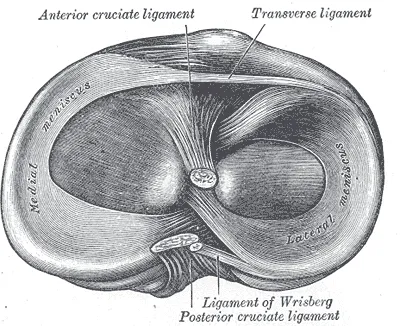
The menisci are pads of cartilage in the knee. A 2019 European (ESSKA) consensus statement separates injuries to them by cause1. It calls a “meniscus tear” traumatic when it comes with a sufficient knee injury and sudden knee pain1. These are mainly vertical tears1.
A 2016 ESSKA consensus describes a degenerative “meniscus lesion” as one that develops slowly2. It is typically a horizontal split in the meniscus of a middle-aged or older person2. It is often found by chance on MRI (magnetic resonance imaging, a scan that shows soft tissue in detail)2.
The 2019 consensus counts horizontal lesions as degenerative even in younger people1. It links them to repeated small injuries and tissue breakdown, with or without osteoarthritis1.
The 2019 consensus calls a tear unstable when its torn inner part can shift into the middle of the joint1. That causes locking and sudden pain1. It notes that a complete radial tear can mean an almost complete loss of its function1. The 2016 consensus notes that “mechanical symptoms” have no clear definition2. The term may cover many symptoms of differing severity and frequency2.
A 2017 BMJ clinical practice guideline uses a wider term, degenerative knee disease6. It means knee pain, particularly in people over 356. This can be with or without meniscus tears, osteoarthritis on imaging, mechanical symptoms other than a knee that stays locked, or a recent or fairly recent onset6. It excludes recent symptoms after major knee injury with sudden joint swelling6.
Whether a tear causes pain
The 2019 consensus states that traumatic tears can cause pain, by acting on nerve endings and raising inflammatory signals in the joint1. The 2017 BMJ guideline panel, writing on degenerative knee disease, called meniscus tears common, usually incidental findings, unlikely to cause knee pain, aching or stiffness6. One population sample took in 991 adults aged 50 to 907. Of those with a tear on MRI, 61% had no such symptoms in the previous month7.
Who it affects
How common it is
The 2019 consensus reports 0.5 to 0.7 acute meniscus injuries per 1,000 people a year in the general population1. The rate was 0.7 per 1,000 in men and 0.3 in women1. The 2016 consensus gives these shares for the general population2:
| Age group | Share of knees with a meniscus lesion |
|---|---|
| 50 to 59 | About 25%2 |
| 60 to 69 | About 35%2 |
| 70 to 79 | About 45%2 |
With knee osteoarthritis, it gives 75% to 95%2.
In sport and daily life
- Athletes: about 15% of athletes with an acute knee injury and bleeding into the joint have an isolated meniscus tear, 76% of them medial (inner)1.
- Adults aged 18 to 60: in 392 people with tears seen at arthroscopy, about a third of tears came from sport8. Half of the daily-life tears happened while squatting or rising from a squat8.
Risk factors studies have linked
The 2018 Danish paper found low-quality evidence for overweight (for degenerative tears), male sex, contact and pivoting sports, and much kneeling or squatting at work5. A meta-analysis is a study that pools the results of several earlier studies. One, of 11 studies in people over 16, found strong evidence that soccer and rugby were risk factors for acute tears9. For degenerative tears, it found strong evidence for age over 60, male sex, kneeling and squatting at work, and climbing over 30 flights of stairs9.
A 2019 review reports that an ACL tear, a tear of the anterior cruciate ligament (ACL), often comes with other knee injuries10. Meniscal tears came with about 42%10. With a fresh ACL tear, lateral (outer) tears are more common than medial ones, apart from one type called ramp tears, the 2019 consensus reports1. It reports meniscus tears in up to 96% of knees with a long-standing ACL tear1.
The meta-analysis of 11 studies linked waiting over 12 months for ACL reconstruction with medial, but not lateral, tears9.
What studies found
How it changes over time
The 2017 BMJ guideline describes degenerative knee disease as long-term, with symptoms that come and go6. It says pain, on average, tends to ease with time after a visit to a physician6. Its panel judged that most people with it improve importantly in pain and function without arthroscopy6. The 2019 consensus found no results on whether isolated tears heal on their own1.
A meta-analysis of 53 studies found the odds of knee osteoarthritis about six times higher after a meniscal injury than in an uninjured knee11. The review reported large inconsistency between studies11. The 2016 consensus states it is still unclear whether degenerative lesions cause osteoarthritis or result from it2.
Trials in degenerative tears
Several randomised trials compared surgery on the torn meniscus with other approaches12,13,14:
- Against sham surgery: the trial took 146 people aged 35 to 65 with a degenerative medial tear and no osteoarthritis12. Results were no better after surgery than after sham (dummy) surgery12.
- Same trial, later: at five years, surgery went with a slightly higher risk of osteoarthritis on X-ray, and no benefit in what patients reported15.
- Against 16 exercise sessions: the trial took 321 people aged 45 to 70 whose tears did not lock the knee13. Exercise was noninferior (not meaningfully worse) for knee function over 24 months13. It remained so at five years16.
- With mild-to-moderate osteoarthritis: in 351 people aged 45 or older, function improved similarly at 6 months after surgery or a standardised non-surgical programme14.
In the 321-person trial, 29% of the exercise group had surgery by 24 months13. Adverse events (unwanted effects seen during a trial) occurred in 18 people after surgery and 12 in the exercise group13. Osteoarthritis on X-ray progressed at comparable rates in both groups at five years16.
What reviews and guidelines concluded
The 2022 Cochrane review found 16 trials with 2,105 people with degenerative knee disease3. They compared arthroscopy with placebo surgery or non-surgical care such as exercise3. On low-certainty evidence, it found:
| Outcome | After arthroscopy | In control groups |
|---|---|---|
| Self-reported success, up to five years, against placebo | 82 in 1003 | 74 in 1003 |
| Serious adverse events | 8 in 1003 | 6 in 1003 |
| Later knee replacement or osteotomy (surgery that cuts and reshapes a bone), up to five years | 4 in 1003 | 2 in 1003 |
The review judged surgery may make little or no difference to success3. Whether it leads to slightly more later knee surgery was left unresolved3.
An individual participant data meta-analysis, which pools each person’s own data from several trials, combined 605 patients from four trials18. Partial meniscectomy (surgery removing part of a torn meniscus) gave a small 24-month pain gain over non-surgical or sham care, about 2.5 points out of 10018. Function did not differ18. Testing factors such as age, sex and mechanical symptoms, it detected no relevant subgroup that benefited from surgery18. The 2018 Danish paper found high-quality evidence that adding surgery to exercise had no clinically relevant effect on pain or function5.
The 2017 BMJ guideline made a strong recommendation against arthroscopy in nearly all people with degenerative knee disease6. It reports a small or very small gain at three months in under 15% of participants, not sustained at one year6.
The 2016 ESSKA consensus reports that most trials since 2002 found no added benefit from partial meniscectomy over non-operative care or sham surgery at short- and mid-term follow-up2. One trial found better results with surgery2. It states that while mid-term results may be similar, results under 12 months might be better with surgery2.
Trials in young adults and traumatic tears
The 2018 Danish paper found no randomised trials of surgery against non-surgical care in people under 40 or with traumatic tears5. The 2017 BMJ guideline did not consider young people with sports injuries6. The 2019 consensus rated studies of how traumatic tears are treated as rather low in quality1.
One randomised trial studied 121 adults aged 18 to 40 with meniscal tears4. The authors conclude their results suggest that, in young, active adults, early surgery is not superior to 12 weeks of supervised exercise and education with later surgery possible4. By 12 months, both groups had improved in pain, function and quality of life4. At two years, knee scores had improved by 16.4 points after early surgery and 21.5 after exercise19. Among the 82 followed to two years, structural worsening on MRI was similar in both groups19.
Repair compared with removal
The 2019 consensus holds that saving the meniscus should come first for traumatic tears where possible, as long-term results are worse after removal1. A meta-analysis of 20 studies found, in the six reporting each outcome, less advanced osteoarthritis and fewer knee replacements after repair, at about four years20. The same meta-analysis found a higher score on one knee scale after removal, and no difference in failures20.
The 2019 consensus reports more repeat arthroscopy after repair than after meniscectomy: 20.7% against 3.9% long term1. People generally return to daily activities 2 to 4 weeks after meniscectomy and take much longer after repair1. After repair, though, they are more likely to return to the same activity level1.
A review of 421 elite athletes (98.6% of them men, mean age 23) compared return to competitive sport after each operation21:
| Operation | Returned to competitive sport | Returned to pre-injury level | Later surgery |
|---|---|---|---|
| Partial meniscectomy | 84.7%21 | 78.3%21 | 3.7%21 |
| Repair | 85.1%21 | 75.5%21 | 17.0%21 |
Connections
The tear involves one of the two menisci of the knee joint22. The 2019 consensus reports lateral tears as more common than medial ones with a fresh anterior cruciate ligament (ACL) tear1. The tibial collateral ligament is another name for the medial collateral ligament23. The ACL tear page covers that ligament’s injury, which often comes with other knee injuries10.
In one review of athletes with articular cartilage defects, meniscal tears were the most common other injury, at 47%24. A review of deadlift injuries found few studies; knee meniscus injuries were among those reported25.
Meniscus tear involves
Meniscus tear can be injured with
Meniscus tear often comes with
Meniscus tear has studies of cartilage damage in
Meniscus tear has injury reports in
Sources
- Kopf S, Beaufils P, Hirschmann MT, Rotigliano N, Ollivier M, Pereira H, Verdonk R, Darabos N, Ntagiopoulos P, Dejour D, Seil R, Becker R (2020). Management of traumatic meniscus tears: the 2019 ESSKA meniscus consensus.. Knee surgery, sports traumatology, arthroscopy. doi:10.1007/s00167-020-05847-3 PMID 32052121
- Beaufils P, Becker R, Kopf S, Englund M, Verdonk R, Ollivier M, Seil R (2017). Surgical management of degenerative meniscus lesions: the 2016 ESSKA meniscus consensus.. Knee surgery, sports traumatology, arthroscopy. doi:10.1007/s00167-016-4407-4 PMID 28210788
- O'Connor D, Johnston RV, Brignardello-Petersen R, Poolman RW, Cyril S, Vandvik PO, Buchbinder R (2022). Arthroscopic surgery for degenerative knee disease (osteoarthritis including degenerative meniscal tears).. The Cochrane database of systematic reviews. doi:10.1002/14651858.CD014328 PMID 35238404
- Skou ST, Hölmich P, Lind M, Jensen HP, Jensen C, Garval M, Thorlund JB (2022). Early Surgery or Exercise and Education for Meniscal Tears in Young Adults.. NEJM evidence. doi:10.1056/EVIDoa2100038 PMID 38319181
- Thorlund JB, Juhl CB, Ingelsrud LH, Skou ST (2018). Risk factors, diagnosis and non-surgical treatment for meniscal tears: evidence and recommendations: a statement paper commissioned by the Danish Society of Sports Physical Therapy (DSSF).. British journal of sports medicine. doi:10.1136/bjsports-2017-098429 PMID 29420236
- Siemieniuk RAC, Harris IA, Agoritsas T, Poolman RW, Brignardello-Petersen R, Van de Velde S, et al (2017). Arthroscopic surgery for degenerative knee arthritis and meniscal tears: a clinical practice guideline.. BMJ (Clinical research ed.). doi:10.1136/bmj.j1982 PMID 28490431
- Englund M, Guermazi A, Gale D, Hunter DJ, Aliabadi P, Clancy M, et al (2008). Incidental meniscal findings on knee MRI in middle-aged and elderly persons.. The New England journal of medicine. doi:10.1056/NEJMoa0800777 PMID 18784100
- Drosos GI, Pozo JL (2004). The causes and mechanisms of meniscal injuries in the sporting and non-sporting environment in an unselected population.. The Knee. doi:10.1016/S0968-0160(03)00105-4 PMID 15066629
- Snoeker BA, Bakker EW, Kegel CA, Lucas C (2013). Risk factors for meniscal tears: a systematic review including meta-analysis.. The Journal of orthopaedic and sports physical therapy. doi:10.2519/jospt.2013.4295 PMID 23628788
- Filbay SR, Grindem H (2019). Evidence-based recommendations for the management of anterior cruciate ligament (ACL) rupture.. Best practice & research. Clinical rheumatology. doi:10.1016/j.berh.2019.01.018 PMID 31431274
- Poulsen E, Goncalves GH, Bricca A, Roos EM, Thorlund JB, Juhl CB (2019). Knee osteoarthritis risk is increased 4-6 fold after knee injury - a systematic review and meta-analysis.. British journal of sports medicine. doi:10.1136/bjsports-2018-100022 PMID 31072840
- Sihvonen R, Paavola M, Malmivaara A, Itälä A, Joukainen A, Nurmi H, Kalske J, Järvinen TL (2013). Arthroscopic partial meniscectomy versus sham surgery for a degenerative meniscal tear.. The New England journal of medicine. doi:10.1056/NEJMoa1305189 PMID 24369076
- van de Graaf VA, Noorduyn JCA, Willigenburg NW, Butter IK, de Gast A, Mol BW, Saris DBF, Twisk JWR, Poolman RW (2018). Effect of Early Surgery vs Physical Therapy on Knee Function Among Patients With Nonobstructive Meniscal Tears. JAMA. doi:10.1001/jama.2018.13308 PMID 30285177
- Katz JN, Brophy RH, Chaisson CE, de Chaves L, Cole BJ, Dahm DL, et al (2013). Surgery versus physical therapy for a meniscal tear and osteoarthritis.. The New England journal of medicine. doi:10.1056/NEJMoa1301408 PMID 23506518
- Sihvonen R, Paavola M, Malmivaara A, Itälä A, Joukainen A, Kalske J, et al (2020). Arthroscopic partial meniscectomy for a degenerative meniscus tear: a 5 year follow-up of the placebo-surgery controlled FIDELITY (Finnish Degenerative Meniscus Lesion Study) trial.. British journal of sports medicine. doi:10.1136/bjsports-2020-102813 PMID 32855201
- Noorduyn JCA, van de Graaf VA, Willigenburg NW, Scholten-Peeters GGM, Kret EJ, van Dijk RA, Buchbinder R, Hawker GA, Coppieters MW, Poolman RW (2022). Effect of Physical Therapy vs Arthroscopic Partial Meniscectomy in People With Degenerative Meniscal Tears. JAMA network open. doi:10.1001/jamanetworkopen.2022.20394 PMID 35802374
- Sihvonen R, Englund M, Turkiewicz A, Järvinen TL (2016). Mechanical Symptoms and Arthroscopic Partial Meniscectomy in Patients With Degenerative Meniscus Tear. Annals of internal medicine. doi:10.7326/M15-0899 PMID 26856620
- Wijn SRW, Hannink G, Østerås H, Risberg MA, Roos EM, Hare KB, et al (2023). Arthroscopic partial meniscectomy vs non-surgical or sham treatment in patients with MRI-confirmed degenerative meniscus tears: a systematic review and meta-analysis with individual participant data from 605 randomised patients.. Osteoarthritis and cartilage. doi:10.1016/j.joca.2023.01.002 PMID 36646304
- Clausen SH, Skou ST, Boesen MP, Radev DI, Kurt EY, Damsted C, et al (2023). Two-year MRI-defined structural damage and patient-reported outcomes following surgery or exercise for meniscal tears in young adults.. British journal of sports medicine. doi:10.1136/bjsports-2023-107352 PMID 37879858
- Migliorini F, Schäfer L, Bell A, Weber CD, Vecchio G, Maffulli N (2023). Meniscectomy is associated with a higher rate of osteoarthritis compared to meniscal repair following acute tears: a meta-analysis.. Knee surgery, sports traumatology, arthroscopy. doi:10.1007/s00167-023-07600-y PMID 37812251
- D'Ambrosi R, Meena A, Raj A, Ursino N, Mangiavini L, Herbort M, Fink C (2023). In elite athletes with meniscal injuries, always repair the lateral, think about the medial! A systematic review.. Knee surgery, sports traumatology, arthroscopy. doi:10.1007/s00167-022-07208-8 PMID 36319751
- Betts JG, Young KA, Wise JA, Johnson E, Poe B, Kruse DH, Korol O, Johnson JE, Womble M, DeSaix P (2022). Anatomy and Physiology 2e. OpenStax. Link
- Mabrouk A, Hubbard JB (2025). Anatomy, Bony Pelvis and Lower Limb, Knee Medial Collateral Ligament. StatPearls. PMID 29939557
- Flanigan DC, Harris JD, Trinh TQ, Siston RA, Brophy RH (2010). Prevalence of chondral defects in athletes' knees. Medicine and science in sports and exercise. doi:10.1249/MSS.0b013e3181d9eea0 PMID 20216470
- Bengtsson V, Berglund L, Aasa U (2018). Narrative review of injuries in powerlifting with special reference to their association to the squat, bench press and deadlift.. BMJ Open Sport & Exercise Medicine. doi:10.1136/bmjsem-2018-000382 PMID 30057777
Changes
- A supporting claim was narrowed to match its source; the page text is unchanged.