Femoral nerve
The main nerve of the front of the thigh. Where it runs, what it supplies, how it moves with the hip and knee, how it gets injured in sport and after surgery, and what studies report about recovery.
- Region
- Thigh
- Updated
- October 8, 2026
- Reviewed
- October 8, 2026 · how entries are checked
Function
What it supplies
The femoral nerve is the biggest nerve to come off the lumbar plexus, a network of nerves in the lower back1. It forms from the L2 to L4 nerve roots of the lower back1. It is a mixed nerve: it supplies the muscles of the front of the thigh, skin, and the hip and knee joints3.
The nerve controls the major hip flexors and the muscles that straighten the knee1. Sources name these muscles in its supply:
- the quadriceps, the group of four muscles on the front of the thigh that straighten the knee7;
- the iliacus, a muscle lining the inside of the pelvis and one of the hip flexors8,9;
- the sartorius, a long, thin muscle that runs across the front of the thigh10;
- the pectineus, a muscle at the top of the inner thigh, in each of 100 thighs dissected from 52 cadavers (donated bodies)11.
The iliacus joins the psoas major, a deep muscle that bends the hip, to form the iliopsoas. Sources disagree on what supplies the psoas major3,8,9. One classic account and a current reference say branches of the upper lumbar nerves supply it8,9. Another source says the femoral nerve itself gives branches to the psoas major3.
For feeling, the nerve carries sensation from the front and inner thigh, and from the inner side of the leg down to the big toe1. It also sends sensory branches to the hip and knee joints10.
Its path from the lower back to the thigh
The nerve begins within the psoas major in the abdomen, then runs down through the pelvis10. It emerges from the outer border of the psoas major and runs between the psoas and the iliacus12. It enters the thigh under the middle of the inguinal ligament, a band of tough tissue running across the groin10. There it lies on the outer side of the femoral artery12.
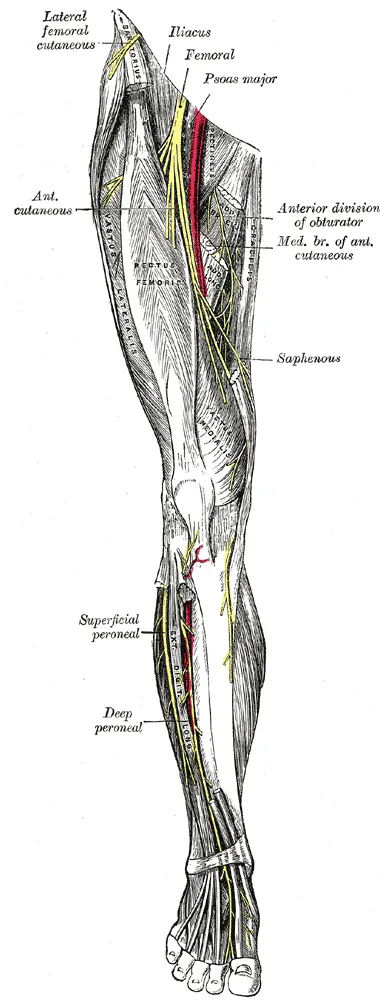
Below the ligament, the nerve runs close to the front wall of the hip socket10. There the iliopsoas is the one structure between the nerve and the front of the hip’s joint capsule10. A joint capsule is the sleeve of tough tissue that encloses a joint.
The femoral triangle lies at the junction of the hip and thigh13. After entering its outer side, the nerve divides into motor branches, which carry signals to muscles10.
The nerve’s end branch is the saphenous nerve, which supplies the skin on the inner front of the knee, leg and foot10. The saphenous nerve is purely sensory: it carries feeling and has no motor function14. It runs through the adductor canal, under the sartorius, alongside the femoral vessels12.
What a numbed nerve shows
A nerve block is an injection that numbs a nerve for a short time. One randomised, placebo-controlled crossover study of blocks analysed 11 healthy young men2. In a crossover study, each person tries every option in turn. A femoral nerve block cut quadriceps strength by a mean 49% from baseline2. A block in the adductor canal, further down the thigh, cut it by 8%2.
In a randomised, blinded study of 16 volunteers, quadriceps strength and balance scores fell significantly after a femoral nerve block17. Hip adductor (inner thigh muscle) strength did not change17.
How it moves with the hip and knee
In 30 people without symptoms, ultrasound (a scan made with sound waves) showed the nerve sliding lengthways at the top of the thigh18. The nerve slid a mean 3.6 mm when the knee was bent lying on the back, and 1.1 mm when semi-seated18. It slid even though it ends above the knee18.
Two cadaver studies looked at the hip19,20. In one, on 6 femoral nerves, a spring was fixed across the cut nerve19. It lengthened a mean 8.83 mm with hip extension, which means moving the thigh backward at the hip19. It lengthened 3.73 mm when the leg was pulled into traction, so tension was greatest with hip extension19.
The other study placed 5 cadavers on their side and measured strain, meaning stretch as a share of resting length20. Strain in the nerve near the L4-L5 disc of the lower back fell as the hip was bent further, from 0 to 60 degrees20.
Breakdown
What an injury takes away
Damage to the nerve weakens or paralyses the quadriceps, which severely limits or abolishes straightening of the knee3. A person with the injury has great difficulty with stairs or a slight slope3. They can walk with the knee straight but fall when it bends even a little3. Hip bending is typically weaker too, which is put down to paralysis of the iliacus and sartorius3. Nerve damage is also associated with reduced, lost or altered feeling over the front of the thigh and the inner knee, leg and foot3.
A retrospective review, which looks back at past records, covered 159 patients with isolated femoral neuropathy6. They were seen at Mayo Clinic Rochester between 1999 and 20196. Their presenting symptoms were weakness in 96%, loss of feeling in 73% and pain in 53%6. On examination, knee straightening was moderately weak in 34% and could not be activated in 25%6.
Where it gets squeezed
A clinical commentary names three places where the nerve can be entrapped, meaning trapped and squeezed16:
- where it enters the femoral triangle at the inguinal ligament16;
- in the iliacus compartment16;
- in the adductor canal, where the saphenous branch is involved16.
The main feature of entrapment is quadriceps weakness16.
In sport and dance
Pelvic trauma in contact sports can lead to swelling and reduced blood flow inside the iliacus compartment, which entraps the nerve16. The nerve passes through a closed compartment with fibrous walls21. The iliac fascia, a sheet of tough tissue, and the ilium (the wide upper part of the hip bone) form it21. A haematoma is a pocket of blood that collects in tissue outside the blood vessels. As one expands inside the compartment, the nerve is compressed21.
Palsy is loss of power in a muscle from a nerve problem. A 2010 case report and literature review covered femoral nerve palsy from an injury-related iliacus haematoma in people without a clotting disorder21. It found only 16 reported cases in 40 years21. All were aged 12 to 24, and the vast majority followed a sports injury21.
In reported cases, the most common mechanism is falling on the back or buttocks21. A direct blow to the pelvis may tear the muscle and lead to the haematoma21. So may hyperextension of the hip, which is straightening it past its normal limit21. People first report groin pain, and nerve symptoms may begin as late as 10 days after the injury21.
One case report describes sudden-onset femoral nerve neurapraxia in a modern dancer4. In neurapraxia, signals are blocked but the nerve fibres stay whole. Repeated mild stretching of the nerve during a set dance routine, over several months, was implicated as the cause4.
After medical procedures
A scoping review, which maps the research on a topic, reports that up to 60% of femoral nerve injuries follow a medical or surgical procedure3. Procedure-related damage is mostly of the two milder grades of nerve injury, and complete division of the nerve is infrequent3.
The retrospective review of 159 patients at Mayo Clinic Rochester counted causes in people seen within 6 months of their first symptoms6. The most common were compression (40%), stretch around the time of surgery (35%) and inflammation (6%)6.
| Procedure | What was counted | How often palsy or injury of the nerve followed |
|---|---|---|
| Hip replacement through the front of the hip | 16,258 operations in 9 studies, in a systematic review | 0.36%22 |
| Hip arthroscopy (keyhole surgery inside a joint) | Not stated | 0.1 to 0.2%3 |
| Single-injection femoral nerve block | 10,309 procedures, the largest study | 0.03%3 |
In hip arthroscopy, the most likely cause is the prolonged pulling apart of the joint that the procedure needs3. In hip replacement through the front of the hip, excessive hip extension during the operation is among the reported contributors22.
Recovery
Why the grade of injury matters
Seddon’s classification sorts nerve injuries into three grades: neurapraxia, axonotmesis and neurotmesis23. In axonotmesis the fibres are damaged but their wrappings stay whole. In neurotmesis the fibres and their wrappings are torn or cut apart. A review describes neurapraxia as a temporary block that clears fully within 12 weeks, after myelin is restored24. Myelin is the fatty, insulating wrap around many nerve fibres.
The same review describes axonotmesis as followed by slow regrowth at about 1 mm a day, often with incomplete recovery24.
What studies of this nerve report
In a study of 32 patients with femoral neuropathy, function improved in 2 out of 3 within 2 years, whatever the cause5. The estimated share of nerve fibres lost was the only significant predictor of outcome5. Everyone with an estimated loss of 50% or less improved within 1 year5. With a greater loss, fewer than half should be expected to improve5.
In the retrospective review of 159 patients with isolated femoral neuropathy, 154 had follow-up data, and 83% of them reported clinical improvement6. The mean time to the first improvement was 3.3 months6. The mean time to recovery at final follow-up was 14.8 months6. In that review, 48% had complete or nearly complete recovery6. Its authors conclude that motor recovery is common, but that improvement is often prolonged and incomplete6.
| Group studied | What was reported |
|---|---|
| One modern dancer with neurapraxia, in a case report | The thigh muscles weakened quickly but regained strength within 3 months, and recovery was complete4 |
| One 19-year-old woman with palsy from an iliacus haematoma that was left to resolve, in a case report | Her symptoms had gone completely 6 weeks after the injury, and she had returned to full sport21 |
| 174 reported cases of palsy from a haematoma in the iliopsoas, in a systematic review | Almost half (49%) had lasting muscle weakness at final follow-up25 |
| Palsy after hip replacement through the front, in the 6 studies of a systematic review that gave times | 79% regained full muscle function within 3 to 15 months22 |
A systematic review of procedure-related injuries concluded that the outlook is good in most cases26. Some people need the nerve repaired or grafted, and some keep permanent deficits26.
Connections
Muscles and joints
The femoral nerve supplies the quadriceps and the iliacus, one of the hip flexors7,8,9. It supplied the pectineus, covered with the hip adductors, in each of 100 dissected thighs11.
Branches of the femoral nerve supply the sartorius and the rectus femoris, the quadriceps muscle at the front of the thigh27. The tensor fasciae latae, a small muscle beside them at the upper outer thigh, is supplied by the superior gluteal nerve instead27.
Stretches that load it
A clinical commentary says the symptoms of entrapment are typically reproduced by extending the hip while the knee is bent16.
The prone knee bend is a test in which the knee is bent while the person lies face down with the pelvis held28. It is used to assess how sensitive the femoral nerve is to movement28. It also stresses the quadriceps and the front-of-thigh structures, so it can provoke pain from either28. In a study of 100 people with patellofemoral pain in one knee, the test showed a sensitive femoral nerve in 36%28. Patellofemoral pain is pain around or behind the kneecap.
Related stretch pages: quadriceps stretch, hip flexor stretch19,28.
Femoral nerve supplies
Femoral nerve supplies the iliacus, one of the
Femoral nerve supplies the pectineus, covered with the
Femoral nerve runs close to the front of
Femoral nerve sends sensory branches to
Femoral nerve is loaded by
Sources
- Refai NA, Black AC, Tadi P (2023). Anatomy, Bony Pelvis and Lower Limb: Thigh Femoral Nerve. StatPearls. PMID 32310525
- Jaeger P, Nielsen ZJ, Henningsen MH, Hilsted KL, Mathiesen O, Dahl JB (2013). Adductor Canal Block versus Femoral Nerve Block and Quadriceps Strength. Anesthesiology. doi:10.1097/ALN.0b013e318279fa0b PMID 23241723
- Gibelli F, Ricci G, Sirignano A, Bailo P, De Leo D (2021). Iatrogenic femoral nerve injuries: Analysis of medico-legal issues through a scoping review approach.. Annals of medicine and surgery (2012). doi:10.1016/j.amsu.2021.103055 PMID 34815865
- Sammarco GJ, Stephens MM (1991). Neurapraxia of the femoral nerve in a modern dancer.. The American journal of sports medicine. doi:10.1177/036354659101900417 PMID 1897660
- Kuntzer T, van Melle G, Regli F (1997). Clinical and prognostic features in unilateral femoral neuropathies.. Muscle & nerve. doi:10.1002/(sici)1097-4598(199702)20:2<205::aid-mus11>3.0.co;2-1 PMID 9040660
- Santilli AR, Martinez-Thompson JM, Speelziek SJA, Staff NP, Laughlin RS (2024). Femoral neuropathy: A clinical and electrodiagnostic review.. Muscle & nerve. doi:10.1002/mus.27994 PMID 37941415
- Kowalska B, Sudoł-Szopińska I (2012). Ultrasound assessment of selected peripheral nerves pathologies. Part II: Entrapment neuropathies of the lower limb.. Journal of Ultrasonography. doi:10.15557/jou.2012.0033 PMID 26673938
- Gray H; Lewis WH (editor) (1918). Anatomy of the Human Body. Lea & Febiger, Philadelphia (20th edition). Link
- Bordoni B, Varacallo MA (2026). Anatomy, Bony Pelvis and Lower Limb: Iliopsoas Muscle.. StatPearls. PMID 30285403
- Patton RS, Runner RP, Lazarus D, Bradbury TL (2018). Femoral neuropathy following direct anterior total hip arthroplasty: an anatomic review and case series†.. Journal of surgical case reports. doi:10.1093/jscr/rjy171 PMID 30206472
- Kim H, Kim WK, Kim YS, Nam YS (2021). Morphologic classification and innervation patterns of the pectineus muscle.. Anatomical science international. doi:10.1007/s12565-021-00619-6 PMID 34156649
- Valera-Calero JA (2026). A Didactic Ultrasound Manual for identifying lumbar Plexus Peripheral Nerves in the lower limb: Lower Abdominal Wall, Groin and Thigh.. Ultrasound international open. doi:10.1055/a-2920-0129 PMID 42591916
- Betts JG, Young KA, Wise JA, Johnson E, Poe B, Kruse DH, Korol O, Johnson JE, Womble M, DeSaix P (2022). Anatomy and Physiology 2e. OpenStax. Link
- Mathew K, Varacallo MA (2023). Anatomy, Bony Pelvis and Lower Limb: Saphenous Nerve, Artery, and Vein. StatPearls. PMID 31082089
- Tomaszewski KA, Popieluszko P, Henry BM, Roy J, Sanna B, Kijek MR, Walocha JA (2016). The surgical anatomy of the lateral femoral cutaneous nerve in the inguinal region: a meta-analysis.. Hernia : the journal of hernias and abdominal wall surgery. doi:10.1007/s10029-016-1493-7 PMID 27115766
- Martin R, Martin HD, Kivlan BR (2017). NERVE ENTRAPMENT IN THE HIP REGION: CURRENT CONCEPTS REVIEW.. International journal of sports physical therapy. doi:10.26603/ijspt20171163 PMID 29234567
- Kwofie MK, Shastri UD, Gadsden JC, Sinha SK, Abrams JH, Xu D, Salviz EA (2013). The Effects of Ultrasound-Guided Adductor Canal Block Versus Femoral Nerve Block on Quadriceps Strength and Fall Risk. Regional anesthesia and pain medicine. doi:10.1097/AAP.0b013e318295df80 PMID 23788068
- Sierra-Silvestre E, Bosello F, Fernández-Carnero J, Hoozemans MJM, Coppieters MW (2018). Femoral nerve excursion with knee and neck movements in supine, sitting and side-lying slump: An in vivo study using ultrasound imaging.. Musculoskeletal science & practice. doi:10.1016/j.msksp.2018.06.007 PMID 29986192
- Livingstone JP, Tamate TM, Richardson AK, Harpstrite JK (2022). A Cadaveric Study Measuring Femoral Nerve Tension During Anterior Total Hip Arthroplasty Approach.. Hawai'i journal of health & social welfare. PMID 35340935
- OʼBrien J, Haines C, Dooley ZA, Turner AW, Jackson D (2014). Femoral nerve strain at L4-L5 is minimized by hip flexion and increased by table break when performing lateral interbody fusion.. Spine. doi:10.1097/BRS.0000000000000039 PMID 24108277
- Murray IR, Perks FJ, Beggs I, Moran M (2010). Femoral nerve palsy secondary to traumatic iliacus haematoma--a young athlete's injury.. BMJ case reports. doi:10.1136/bcr.05.2010.3045 PMID 22791579
- Zeiman M, Makrides A, Lee J, Yoon RS (2025). Femoral Nerve Palsy After Anterior Total Hip Arthroplasty: A Systematic Review.. Arthroplasty today. doi:10.1016/j.artd.2025.101889 PMID 41245377
- Menorca RM, Fussell TS, Elfar JC (2013). Nerve physiology. Hand Clinics. doi:10.1016/j.hcl.2013.04.002 PMID 23895713
- Grinsell D, Keating CP (2014). Peripheral nerve reconstruction after injury: a review of clinical and experimental therapies.. BioMed Research International. doi:10.1155/2014/698256 PMID 25276813
- Guild TT, Crawford AM, Striano BM, Mortensen S, Wixted JJ (2023). The epidemiology and management of iliopsoas hematoma with femoral nerve palsy: A descriptive systematic review of 174 cases.. Injury. doi:10.1016/j.injury.2022.11.057 PMID 36586813
- Moore AE, Stringer MD (2011). Iatrogenic femoral nerve injury: a systematic review.. Surgical and radiologic anatomy : SRA. doi:10.1007/s00276-011-0791-0 PMID 21328076
- Putzer D, Haselbacher M, Hörmann R, Thaler M, Nogler M (2018). The distance of the gluteal nerve in relation to anatomical landmarks: an anatomic study.. Archives of Orthopaedic and Trauma Surgery. doi:10.1007/s00402-017-2847-z PMID 29177540
- Zamani S, Abbaszadeh-Amirdehi M, Talebi G, Tavassoli M, Esmaeilnejadganji SM, Gholinia H (2025). Prevalence of femoral nerve neurodynamic disorder in patients with patellofemoral pain syndrome: a cross-sectional study.. BMC musculoskeletal disorders. doi:10.1186/s12891-025-08951-y PMID 40707930
Changes
- Revised to report sources added after their published corrections were read
- First published.