Patellofemoral pain
Also called runner's knee, patellofemoral pain syndrome, chondromalacia patella
Pain around or behind the kneecap, also called runner's knee. How consensus statements define it, who it affects, how it changes over time, and what trials of exercise, foot orthoses, taping and surgery found.
- Region
- Knee
- Muscles
- quadriceps, gluteus medius, gluteus maximus
- Updated
- September 30, 2026
- Reviewed
- September 30, 2026 · how entries are checked
What it is
How consensus statements and reviews define it
The 2016 consensus statement names “patellofemoral pain” as the preferred term1. It lists patellofemoral pain syndrome, chondromalacia patella, anterior knee pain and runner’s knee as other names for it1. Its core definition is pain around or behind the patella (kneecap)1. The pain worsens with one or more activities that load a bent knee under body weight, such as squatting, stairs, running or jumping1.
A 2015 Cochrane review calls it a common knee problem, mainly in adolescents and young adults4. It says the pain comes mostly when the muscles that straighten the knee are loaded, as on stairs or in squats4.
An earlier Cochrane review, from 2012, links the pain to changes in the patellofemoral joint, the joint between the kneecap and the thigh bone5. It says the pain usually comes on gradually, without signs of other knee diseases or of an injury5. The 2016 consensus statement says there is no definitive clinical test for it1.
The joint and tissues involved
At the patellofemoral joint, the kneecap slides up and down in a groove on the lower end of the femur (thigh bone)6.
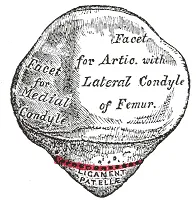
Patellofemoral force is the force pressing the kneecap against the thigh bone. A meta-analysis found it higher in activities with more knee bend, such as squatting, than in those with less, such as walking7. The same review pooled studies’ estimates of peak force in everyday activities, in multiples of body weight7:
| Activity | Healthy people | People with patellofemoral pain |
|---|---|---|
| Walking | 0.97 | 0.87 |
| Stair ascent | 3.27 | 2.57 |
| Stair descent | 2.87 | 2.67 |
| Running | 5.27 | 4.17 |
It found no clear differences in everyday activities between healthy people and those with this pain or osteoarthritis (wearing away of joint cartilage)7. Among 25,124 knee arthroscopies (keyhole operations inside a joint), articular cartilage damage was most often behind the kneecap (36%)8.
Who it affects
How common it is
A 2018 international consensus statement says it affects a large share of people, from adolescents to older adults9. Incidence counts new cases over a set time, and person-years multiply people by the years each was followed.
| Group studied | What was found |
|---|---|
| General population and adolescents, in a meta-analysis of 23 studies | Yearly prevalence reported as 22.7% and 28.9%2 |
| Adolescents, in a meta-analysis | Prevalence at one point in time of 7.2%, and 22.7% in female-only groups of adolescent athletes2 |
| 1,525 US Naval Academy participants, followed up to 2.5 years | 22 new cases per 1,000 person-years10; women were 2.23 times as likely as men to develop it10 |
| Military recruits and amateur runners, in an epidemiology review | 9.7 to 571.4 per 1,000 person-years in recruits, and 1,080.5 in amateur runners2 |
| Ultra-marathon runners, in a review of running injuries (8 studies, 3,500 runners in all) | Prevalence of 7.4% to 15.6%, one of the two most common running injuries11 |
Factors studied
Reviews of studies that follow people forward in time have tested which traits come before the pain12:
- Body size and age: a meta-analysis of 18 such studies found strong to moderate evidence that age, height and weight were not risk factors12.
- Hip strength: a meta-analysis of 18 studies with 4,818 people found moderate evidence against weak hips being a risk factor12. In adolescents, it found moderate evidence that greater hip abduction strength (moving the thigh out to the side) was one12.
- Thigh strength: a meta-analysis found moderate evidence linking quadriceps weakness with later pain in military groups12. The quadriceps are the four muscles on the front of the thigh that straighten the knee.
- Landing: a meta-analysis found peak inward knee angle on landing did not predict the pain, while lower knee-straightening strength did13.
- Sport: in the 2016 consensus statement, specialising in one sport went with about 1.5 times the risk of new pain, against playing several1.
One meta-analysis found lower hip strength in adults with the pain in cross-sectional studies, which measure people at one time14. Forward-looking studies found no link, which suggests the weakness may follow the pain rather than cause it14.
What studies found
How it changes over time
A 2016 study noted it was long seen as self-limiting, settling on its own15. It added that recent studies find many still report knee pain long term15.
- 310 people from two trials: 55% had an unfavourable recovery at 3 months and 40% at 12 months3. The authors said this held whatever the intervention3. Pain lasting over 2 months at the start went with an unfavourable recovery at 12 months, and was the most consistent predictor3.
- People from two trials, 5 to 8 years on: 34 of 60 who replied (57%) reported an unfavourable recovery15.
- General practice, 172 people aged 12 to 35 with non-injury knee symptoms: in those with this condition, 40% still had symptoms after 6 years16.
- 2,200 Danish adolescents aged 15 to 19: this pain was set against other knee pain17. Knee pain 2 years on was 1.26 times as likely after it17. They were also more likely to cut back or stop sport17.
A 2010 review found little high-quality evidence on whether front-of-knee pain in younger adults leads to later kneecap osteoarthritis18. It found one case-control study linking such pain with later kneecap osteoarthritis, at 4.4 times the odds18. Six small uncontrolled studies gave rough yearly risks of 0% to 3.4%18. In the 5-to-8-year follow-up, 48 of the 50 people X-rayed showed no signs of osteoarthritis15.
What reviews and panels concluded
A 2018 consensus statement, voted on by 41 experts, supported exercise, combined approaches and foot orthoses (shoe inserts) for pain or function9. It did not support mobilisations (moving a joint by hand) alone or electrophysical agents (devices that apply heat, sound, light or electricity to the body)9. It was unsure about taping, bracing and gait retraining (changing how a person walks or runs)9. It was also unsure about acupuncture (needles into set points on the skin) and dry needling (needles into tight spots in muscle)9. The same went for blood flow restriction training (exercise with a limb cuff that partly limits blood flow)9.
A 2022 meta-analysis of 65 randomised trials found six approaches with positive effects at 3 months19. None had been adequately tested beyond that point19. Within 3 months, four beat sham or placebo (dummy versions) or wait-and-see: knee-focused exercise, combined approaches, foot orthoses and lower-quadrant manual therapy (hands-on methods)19. Hip-and-knee exercise, and knee exercise plus a dextrose (a simple sugar) injection near the nerves, did better than knee exercise alone19.
A 2024 guide combined 65 high-quality trials with interviews of people with the pain and of clinical experts20. It concluded that exercise and education should come first, with others fitted to the person20.
Exercise and education
- 2015 Cochrane review: in two pooled studies (166 people), exercise gave about 88 more recoveries per 1,000 at 12 months than control’s 2504. The confidence interval (a range showing how precise the result is) ran from 2 fewer to 210 more4. It could not tell which form of exercise is best4.
- Hip and knee strengthening: in a meta-analysis of 14 trials (673 people), this cut pain more than knee strengthening alone21. Yet strength did not change significantly in any programme21.
- 131 people, one trial: supervised exercise gave less pain at 3 and 12 months than rest and avoiding painful activity22. Function was better at 3 months but not at 1222. Recovery at 12 months was 62.1% against 50.8%, not a statistically significant difference22.
- 121 adolescents, one trial: some had education plus 3 months of supervised exercise at school, others education alone23. The exercise group had higher odds of recovery at 12 months (odds ratio 1.73)23.
A 2020 review of nine trials found low-credibility evidence that health education material alone did worse than exercise24. Education from a health professional gave outcomes similar to exercise plus education, on low to very low-credibility evidence24.
Foot orthoses, taping and add-ons
A 2011 Cochrane review of two trials (210 people) found foot orthoses had no clear edge over plain insoles25. It said orthoses may ease knee pain in the short term, though the gain may be marginal25. Wearers more often reported mild problems such as rubbing and blisters25. In one trial of 179 people aged 18 to 40, off-the-shelf orthoses gave more short-term gain than flat inserts, notably at 6 weeks26. All four groups in it made clinically meaningful gains over 52 weeks26.
A 2012 Cochrane review of five small trials found no significant difference in pain between kneecap taping and no taping5. It judged the evidence low quality and too thin for conclusions5.
A 2024 review of 45 trials looked at add-ons to exercise27. Adding taping, whole-body vibration or a knee brace gave no different pain or function than exercise alone27. Adding electrical stimulation (small currents that make a muscle contract) or diathermy (heating deep tissue with electromagnetic energy) brought short-term pain gains27. Both findings rest on very low-certainty evidence27.
Surgery
In a randomised trial of 56 people with long-standing pain, arthroscopy was added to 8 weeks of home exercise28. At 9 months it gave no better knee questionnaire score than exercise alone, and both groups improved markedly28. At 5 years, outcomes were equally good in both groups, and some people in each still had symptoms29. Direct health costs were an estimated 901 euros per person higher with arthroscopy28.
Connections
The pain centres on the patella and where it meets the knee1,6. The kneecap sits inside the tendon of the quadriceps6.
The gluteus medius is the main hip abductor30, and the gluteus maximus extends the hip31. In a review of five studies, females with the pain had weaker hip abduction, external rotation and extension on the painful side than healthy controls32. A 2026 review of adult endurance runners looked across this pain, iliotibial band syndrome and patellar tendinopathy together33. Across them, the leading risk factors were previous injury, more training load and structural malalignment (bones or joints sitting out of their usual line)33.
In a study of 20 females with the pain and 20 without, the pain group’s knee moved further inward during the single-leg squat34. Among 35 activities tested in 20 healthy people, the single-leg decline squat had the highest kneecap loading score, combining peak and total load35.
For the drop landing, one review noted that a single study found the knee’s inward turning force at first contact predictive13. In 44 people with the pain and tight quadriceps, static and dynamic quadriceps stretch did not differ significantly in pain or function36. In a study of 30 people with the pain and 30 without, the pain group had less flexible calves, which relates to the calf stretch37.
Patellofemoral pain involves
Patellofemoral pain has studies of strength in
Patellofemoral pain has studies of hip strength in
Patellofemoral pain shares risk factors with
Patellofemoral pain has studies of the movement of
Patellofemoral pain has lab studies of kneecap load during
Patellofemoral pain has studies of landing in
Patellofemoral pain has trials of
Patellofemoral pain has studies of calf flexibility in
Sources
- Crossley KM, Stefanik JJ, Selfe J, Collins NJ, Davis IS, Powers CM, McConnell J, Vicenzino B, Bazett-Jones DM, Esculier JF, Morrissey D, Callaghan MJ (2016). 2016 Patellofemoral pain consensus statement from the 4th International Patellofemoral Pain Research Retreat, Manchester. Part 1: Terminology, definitions, clinical examination, natural history, patellofemoral osteoarthritis and patient-reported outcome measures.. British Journal of Sports Medicine. doi:10.1136/bjsports-2016-096384 PMID 27343241
- Smith BE, Selfe J, Thacker D, Hendrick P, Bateman M, Moffatt F, et al (2018). Incidence and prevalence of patellofemoral pain: A systematic review and meta-analysis.. PloS one. doi:10.1371/journal.pone.0190892 PMID 29324820
- Collins NJ, Bierma-Zeinstra SM, Crossley KM, van Linschoten RL, Vicenzino B, van Middelkoop M (2013). Prognostic factors for patellofemoral pain: a multicentre observational analysis.. British Journal of Sports Medicine. doi:10.1136/bjsports-2012-091696 PMID 23242955
- van der Heijden RA, Lankhorst NE, van Linschoten R, Bierma-Zeinstra SM, van Middelkoop M (2015). Exercise for treating patellofemoral pain syndrome.. Cochrane Database of Systematic Reviews. doi:10.1002/14651858.CD010387.pub2 PMID 25603546
- Callaghan MJ, Selfe J (2012). Patellar taping for patellofemoral pain syndrome in adults.. Cochrane Database of Systematic Reviews. doi:10.1002/14651858.CD006717.pub2 PMID 22513943
- Betts JG, Young KA, Wise JA, Johnson E, Poe B, Kruse DH, Korol O, Johnson JE, Womble M, DeSaix P (2022). Anatomy and Physiology 2e. OpenStax. Link
- Hart HF, Patterson BE, Crossley KM, Culvenor AG, Khan MCM, King MG, Sritharan P (2022). May the force be with you: understanding how patellofemoral joint reaction force compares across different activities and physical interventions-a systematic review and meta-analysis.. British Journal of Sports Medicine. doi:10.1136/bjsports-2021-104686 PMID 35115309
- Widuchowski W, Widuchowski J, Trzaska T (2007). Articular cartilage defects: study of 25,124 knee arthroscopies.. The Knee. doi:10.1016/j.knee.2007.02.001 PMID 17428666
- Collins NJ, Barton CJ, van Middelkoop M, Callaghan MJ, Rathleff MS, Vicenzino BT, Davis IS, Powers CM, Macri EM, Hart HF, de Oliveira Silva D, Crossley KM (2018). 2018 Consensus statement on exercise therapy and physical interventions (orthoses, taping and manual therapy) to treat patellofemoral pain: recommendations from the 5th International Patellofemoral Pain Research Retreat, Gold Coast, Australia, 2017.. British Journal of Sports Medicine. doi:10.1136/bjsports-2018-099397 PMID 29925502
- Boling M, Padua D, Marshall S, Guskiewicz K, Pyne S, Beutler A (2010). Gender differences in the incidence and prevalence of patellofemoral pain syndrome.. Scandinavian Journal of Medicine & Science in Sports. doi:10.1111/j.1600-0838.2009.00996.x PMID 19765240
- Lopes AD, Hespanhol Júnior LC, Yeung SS, Costa LO (2012). What are the Main Running-Related Musculoskeletal Injuries?. Sports Medicine. doi:10.1007/BF03262301 PMID 22827721
- Neal BS, Lack SD, Lankhorst NE, Raye A, Morrissey D, van Middelkoop M (2019). Risk factors for patellofemoral pain: a systematic review and meta-analysis.. British Journal of Sports Medicine. doi:10.1136/bjsports-2017-098890 PMID 30242107
- Pappas E, Wong-Tom WM (2012). Prospective Predictors of Patellofemoral Pain Syndrome. Sports health. doi:10.1177/1941738111432097 PMID 23016077
- Rathleff MS, Rathleff CR, Crossley KM, Barton CJ (2014). Is hip strength a risk factor for patellofemoral pain? A systematic review and meta-analysis.. British Journal of Sports Medicine. doi:10.1136/bjsports-2013-093305 PMID 24687010
- Lankhorst NE, van Middelkoop M, Crossley KM, Bierma-Zeinstra SM, Oei EH, Vicenzino B, Collins NJ (2016). Factors that predict a poor outcome 5-8 years after the diagnosis of patellofemoral pain: a multicentre observational analysis.. British Journal of Sports Medicine. doi:10.1136/bjsports-2015-094664 PMID 26463119
- Kastelein M, Luijsterburg PA, Heintjes EM, van Middelkoop M, Verhaar JA, Koes BW, Bierma-Zeinstra SM (2015). The 6-year trajectory of non-traumatic knee symptoms (including patellofemoral pain) in adolescents and young adults in general practice: a study of clinical predictors.. British Journal of Sports Medicine. doi:10.1136/bjsports-2014-093557 PMID 25431450
- Rathleff MS, Rathleff CR, Olesen JL, Rasmussen S, Roos EM (2016). Is Knee Pain During Adolescence a Self-limiting Condition?. American Journal of Sports Medicine. doi:10.1177/0363546515622456 PMID 26792702
- Thomas MJ, Wood L, Selfe J, Peat G (2010). Anterior knee pain in younger adults as a precursor to subsequent patellofemoral osteoarthritis: a systematic review.. BMC Musculoskeletal Disorders. doi:10.1186/1471-2474-11-201 PMID 20828401
- Neal BS, Bartholomew C, Barton CJ, Morrissey D, Lack SD (2022). Six Treatments Have Positive Effects at 3 Months for People With Patellofemoral Pain: A Systematic Review With Meta-analysis.. Journal of Orthopaedic and Sports Physical Therapy. doi:10.2519/jospt.2022.11359 PMID 36070427
- Neal BS, Lack SD, Bartholomew C, Morrissey D (2024). Best practice guide for patellofemoral pain based on synthesis of a systematic review, the patient voice and expert clinical reasoning.. British Journal of Sports Medicine. doi:10.1136/bjsports-2024-108110 PMID 39401870
- Nascimento LR, Teixeira-Salmela LF, Souza RB, Resende RA (2018). Hip and Knee Strengthening Is More Effective Than Knee Strengthening Alone for Reducing Pain and Improving Activity in Individuals With Patellofemoral Pain: A Systematic Review With Meta-analysis.. Journal of Orthopaedic and Sports Physical Therapy. doi:10.2519/jospt.2018.7365 PMID 29034800
- van Linschoten R, van Middelkoop M, Berger MY, Heintjes EM, Verhaar JA, Willemsen SP, Koes BW, Bierma-Zeinstra SM (2009). Supervised exercise therapy versus usual care for patellofemoral pain syndrome: an open label randomised controlled trial.. BMJ. doi:10.1136/bmj.b4074 PMID 19843565
- Rathleff MS, Roos EM, Olesen JL, Rasmussen S (2015). Exercise during school hours when added to patient education improves outcome for 2 years in adolescent patellofemoral pain: a cluster randomised trial.. British Journal of Sports Medicine. doi:10.1136/bjsports-2014-093929 PMID 25388552
- de Oliveira Silva D, Pazzinatto MF, Rathleff MS, Holden S, Bell E, Azevedo F, Barton C (2020). Patient Education for Patellofemoral Pain: A Systematic Review.. Journal of Orthopaedic and Sports Physical Therapy. doi:10.2519/jospt.2020.9400 PMID 32349640
- Hossain M, Alexander P, Burls A, Jobanputra P (2011). Foot orthoses for patellofemoral pain in adults.. Cochrane Database of Systematic Reviews. doi:10.1002/14651858.CD008402.pub2 PMID 21249707
- Collins N, Crossley K, Beller E, Darnell R, McPoil T, Vicenzino B (2008). Foot orthoses and physiotherapy in the treatment of patellofemoral pain syndrome: randomised clinical trial.. BMJ. doi:10.1136/bmj.a1735 PMID 18952682
- Souto LR, De Oliveira Silva D, Pazzinatto MF, Siqueira MS, Moreira RFC, Serrão FV (2024). Are adjunct treatments effective in improving pain and function when added to exercise therapy in people with patellofemoral pain? A systematic review with meta-analysis and appraisal of the quality of interventions.. British Journal of Sports Medicine. doi:10.1136/bjsports-2024-108145 PMID 38889956
- Kettunen JA, Harilainen A, Sandelin J, Schlenzka D, Hietaniemi K, Seitsalo S, Malmivaara A, Kujala UM (2007). Knee arthroscopy and exercise versus exercise only for chronic patellofemoral pain syndrome: a randomized controlled trial.. BMC Medicine. doi:10.1186/1741-7015-5-38 PMID 18078506
- Kettunen JA, Harilainen A, Sandelin J, Schlenzka D, Hietaniemi K, Seitsalo S, Malmivaara A, Kujala UM (2012). Knee arthroscopy and exercise versus exercise only for chronic patellofemoral pain syndrome: 5-year follow-up.. British Journal of Sports Medicine. doi:10.1136/bjsm.2010.079020 PMID 21357578
- Pinheiro RP, Macaya DAM, Itezerote AM, Saleh SO, Hojaij F, Andrade M, et al. (2026). Anatomical Investigation of the Gluteus Medius Muscle Innervation and Its Topographical Correspondence With Myofascial Trigger Points.. BioMed Research International. doi:10.1155/bmri/7544057 PMID 41561444
- Pourahmadi M, Asadi M, Dommerholt J, Yeganeh A (2020). Changes in the macroscopic morphology of hip muscles in low back pain.. Journal of Anatomy. doi:10.1111/joa.13086 PMID 31475359
- Prins MR, van der Wurff P (2009). Females with patellofemoral pain syndrome have weak hip muscles: a systematic review.. Australian Journal of Physiotherapy. doi:10.1016/s0004-9514(09)70055-8 PMID 19226237
- Senthil K, Whitaker S, Nazarov M, Cassidy B, Edge C, Cyrus J, O'Neill C, Goodloe J (2026). Common Risk Factors for Knee Injuries in Runners: A Systematic Review.. Orthopaedic journal of sports medicine. doi:10.1177/23259671261444314 PMID 42221209
- Willson JD, Davis IS (2008). Utility of the frontal plane projection angle in females with patellofemoral pain.. Journal of Orthopaedic & Sports Physical Therapy. doi:10.2519/jospt.2008.2706 PMID 18827327
- Song K, Scattone Silva R, Hullfish TJ, Silbernagel KG, Baxter JR (2023). Patellofemoral Joint Loading Progression Across 35 Weightbearing Rehabilitation Exercises and Activities of Daily Living.. The American journal of sports medicine. doi:10.1177/03635465231175160 PMID 37272685
- Lee JH, Jang KM, Kim E, Rhim HC, Kim HD (2021). Static and Dynamic Quadriceps Stretching Exercises in Patients With Patellofemoral Pain: A Randomized Controlled Trial.. Sports health. doi:10.1177/1941738121993777 PMID 33615901
- Piva SR, Goodnite EA, Childs JD (2005). Strength around the hip and flexibility of soft tissues in individuals with and without patellofemoral pain syndrome.. The Journal of orthopaedic and sports physical therapy. doi:10.2519/jospt.2005.35.12.793 PMID 16848100
Changes
- A supporting claim was narrowed to match its source; the page text is unchanged.